Manitoba Non Disclosure Agreement Template (NDA) [Free PDF]
People often think the confidential part is the meeting itself. It usually isn’t. It’s the email sent afterward with pricing, customer lists, product ideas, or a draft proposal attached. That’s the point where things start to matter. I remember helping a small software consultant in Winnipeg who had spent months sharing technical specifications with a potential business partner before anyone signed an agreement. The relationship ended, and suddenly everyone disagreed about what information was supposed to stay private.
A Manitoba Non Disclosure Agreement is commonly used by business owners, contractors, consultants, startups, and employees across the province before confidential information changes hands. In Manitoba, contractual disputes are governed through the Court of King’s Bench Act, which sets out the structure and authority of the province’s superior court where many contract enforcement matters are heard, making clear written terms far more valuable than assumptions that were never recorded. It’s not dramatic until it is.
A confidentiality clause that is too broad, too vague, or missing altogether can leave you trying to enforce promises that the court simply won’t recognize. That’s expensive. If you’re about to hire someone, discuss a new business idea, or share financial or technical information, you need the expectations written down before the conversation moves any further. I once worked with a manufacturing client who lost a long-standing customer after confidential pricing was passed to a competitor, and there was no signed agreement defining what information had to remain confidential.
The legal fees came anyway, but there wasn’t much left to enforce. Fill in the template with the names of the parties, define exactly what information is confidential, set the confidentiality period, and have everyone sign before anything is shared.
Free Manitoba Non Disclosure Agreement Template
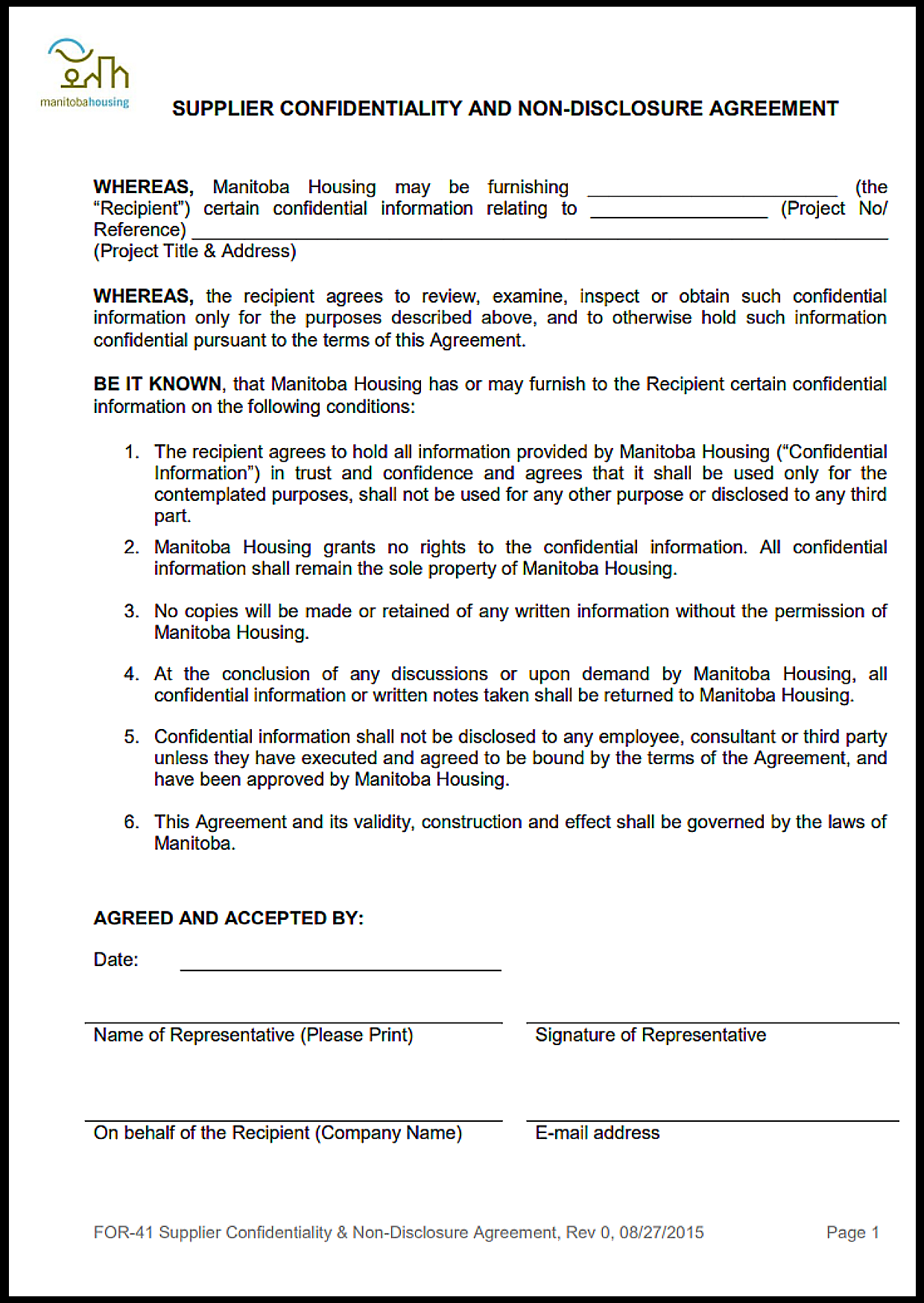
Below is a simple Manitoba NDA template structure businesses commonly use for commercial agreements.
Manitoba Non Disclosure Agreement Laws, Enforceability Rules & Legal Restrictions
| Topic / Issue | Manitoba Legal Rule | Governing Statute |
|---|---|---|
| General NDA enforceability | Manitoba NDAs are primarily governed by common law contract and breach-of-confidence principles rather than a standalone NDA statute. | Manitoba common law contract principles |
| Human rights limitations | NDAs connected to workplace policies, employment contracts, or human rights settlements are restricted by Manitoba human rights protections. | The Human Rights Code, C.C.S.M. c. H175 |
| Legal signing authority | NDAs may be signed by adults or authorized corporate representatives with legal capacity. | The Age of Majority Act, C.C.S.M. c. A7, s. 1 |
| Witness requirements | Witnesses are generally not legally required for Manitoba NDA agreements. | No statutory requirement — governed by common law principles |
| Notarization requirements | Manitoba law generally does not require NDAs to be notarized. | No statutory requirement — governed by common law principles |
| Protected whistleblower disclosures | NDAs cannot legally block crime reporting, regulatory disclosures, or protected whistleblower communications. | The Public Interest Disclosure (Whistleblower Protection) Act, C.C.S.M. c. P230; Criminal Code, R.S.C. 1985, c. C-46 |
| Limitation period for NDA lawsuits | Claims for a breach of confidentiality must be filed within a 2-year window starting from the day the breach was discovered. | The Limitations Act, S.M. 2021, c. 44, s. 6 |
| Required disclosure carve-outs | Manitoba NDAs should contain clauses allowing legally required disclosures, subpoenas, police reporting, and regulatory cooperation. | The Public Interest Disclosure (Whistleblower Protection) Act, C.C.S.M. c. P230 |
| Public filing requirements | Commercial and employment NDAs are private contracts and are not filed with Manitoba government registries. | Manitoba common law contract principles |
| Court filing exception | NDA terms may become public during litigation unless the court grants a sealing order. | Manitoba Court of King’s Bench procedures |
| Overly broad confidentiality restrictions | Manitoba courts may strike down NDAs that define confidential information too broadly or impose excessive timelines. | Canadian common law restraint of trade principles |
| Crime suppression prohibitions | NDAs attempting to conceal criminal conduct or obstruct justice may be void and unenforceable. | Criminal Code, R.S.C. 1985, c. C-46 |
| Unconscionability concerns | Courts may invalidate NDAs created through severe bargaining imbalance or unfair pressure. | Manitoba equitable unconscionability principles |
| Manitoba legislative approach | Manitoba relies primarily on common law and human rights principles instead of standalone anti-NDA legislation. | The Human Rights Code, C.C.S.M. c. H175 |
| Strict lawsuit deadline | Manitoba applies a strict 2-year discovery-based limitation period to NDA breach lawsuits. | The Limitation of Actions Act, C.C.S.M. c. L150 |
One of the most important Manitoba NDA rules is that confidentiality agreements cannot legally silence someone from reporting crimes, cooperating with police, or making protected whistleblower disclosures. Many businesses mistakenly believe an NDA creates unlimited secrecy, but Manitoba law places clear public-interest limits on confidentiality clauses. This becomes especially important in workplace harassment, fraud, discrimination, or misconduct situations where courts and human rights authorities may closely review the agreement itself.
The overbreadth rules also matter in real business situations because Manitoba courts may completely strike down an NDA that tries to restrict too much information for too long. A confidentiality clause covering “all information forever” may become unenforceable instead of partially protected. Manitoba’s strict two-year limitation period is another major issue because businesses that wait too long to sue after discovering a breach may permanently lose enforcement rights. Poorly drafted NDAs can create failed lawsuits, reputational damage, and expensive commercial disputes over confidential information. Download the free Manitoba Non Disclosure Agreement template below to help structure your confidentiality agreement properly.
When Businesses Use a Manitoba NDA
Employee Confidentiality Agreements
Many Manitoba employers ask employees to sign NDAs before gaining access to sensitive company information. This may include:
- Client databases
- Marketing plans
- Internal pricing
- Financial records
- Product development information
Under Manitoba law, employment NDAs must be reasonable. Courts may refuse to enforce overly broad restrictions that unfairly limit a worker’s future employment opportunities.
Perpetual confidentiality obligations are especially risky in employment contracts unless the employer is protecting true trade secrets.
Startup and Investor Discussions
Startups often share confidential ideas with investors, developers, and business partners before launching a product or service.
Mutual NDAs are common in these situations because both sides may exchange sensitive information during negotiations.
A properly drafted NDA helps reduce the risk of business ideas, software concepts, or funding plans being shared publicly
Freelancer and Contractor Projects
Freelancers and contractors frequently access confidential business information while completing projects.
Examples include:
- Website development
- Marketing campaigns
- Graphic design
- Accounting services
- Software programming
Businesses commonly use NDAs to protect customer lists, product designs, and internal systems from unauthorized disclosure.
Business Sale or Merger Negotiations
When businesses are sold or merged, buyers often review sensitive financial and operational records during due diligence.
Without an NDA, leaked information could damage:
- Customer relationships
- Employee trust
- Supplier negotiations
- Company value
Commercial NDAs help control how business records are shared during negotiations.
Vendor and Supplier Relationships
Manufacturing, technology, and wholesale businesses often share confidential pricing structures or operational data with suppliers.
Vendor NDAs help prevent:
- Pricing leaks
- Unauthorized data sharing
- Competitor access to customer information
These agreements are especially important when suppliers handle proprietary manufacturing processes or software systems.
Are Non Disclosure Agreements Legal in Manitoba?
Manitoba NDAs Are Generally Enforceable
Under Manitoba law, NDAs are usually enforceable if they meet standard contract requirements.
These basic legal elements include:
- Offer
- Acceptance
- Consideration
- Legal capacity
Manitoba courts rely heavily on common law contract principles when deciding whether an NDA is valid.
Businesses are legally expected to draft confidentiality clauses clearly and reasonably. Courts may reject agreements that are unfair, vague, or excessively restrictive.
Special Rules for Harassment and Discrimination Settlements
Manitoba does not have a standalone statute limiting NDAs in harassment or discrimination settlements. Bill 225 (The Non-Disclosure Agreements Act) was officially defeated in the legislature following a Manitoba Law Reform Commission report advising against it. Workplace settlement clauses remain bound strictly by The Human Rights Code and general contract law.
- The confidentiality clause reflects the complainant’s expressed wish
- The complainant had an opportunity to receive independent legal advice
- The agreement does not negatively affect public safety or the public interest
These rules are designed to prevent employers from improperly silencing workplace misconduct complaints.
NDAs Cannot Block Crime Reporting
A Manitoba NDA cannot legally stop someone from:
- Reporting criminal activity
- Cooperating with police investigations
- Complying with court orders
- Participating in protected whistleblowing disclosures
Federal Criminal Code rules prevent businesses from using confidentiality agreements to obstruct justice.
Even carefully drafted NDAs must allow legally protected disclosures.
Key Clauses in a Manitoba Non Disclosure Agreement
Definition of Confidential Information
One of the most important NDA clauses defines what information is actually protected.
Vague wording creates enforcement problems. Courts may refuse to enforce confidentiality terms that are unclear or overly broad.
Businesses should specifically identify the categories of protected information, such as:
- Trade secrets
- Internal pricing
- Customer lists
- Software code
- Marketing strategies
- Financial records
Purpose of Information Sharing
An NDA should clearly explain why confidential information is being shared.
For example:
- Evaluating a business partnership
- Completing a contractor project
- Reviewing investment opportunities
- Performing consulting services
This clause is also important for privacy law compliance when personal information is involved.
Under Manitoba privacy rules, businesses are generally expected to explain the purpose of collecting or sharing personal information.
Confidentiality Time Limits
Reasonable time limits improve enforceability.
In most Manitoba business situations:
- 2–5 years is common
- Longer terms may apply to trade secrets
- Permanent restrictions are more difficult to enforce
Employment NDAs with indefinite restrictions may face increased court scrutiny.
Non-Use and Non-Disclosure Obligations
This clause restricts the receiving party from:
- Sharing confidential information
- Using information for unauthorized purposes
- Allowing unauthorized access
Strong NDAs also require businesses to use reasonable security measures to protect sensitive data.
Return or Destruction Clause
Businesses should explain what happens to confidential information after the relationship ends.
The agreement may require:
- Returning physical documents
- Permanently deleting digital files
- Destroying backup copies
- Confirming deletion in writing
Secure handling procedures help reduce future disputes.
Remedies for Breach
A Manitoba NDA often includes remedies available after a breach.
Possible remedies include:
- Court injunctions
- Financial damages
- Emergency court orders
However, Manitoba courts may reject excessive financial penalties that function as punishment instead of a reasonable estimate of damages.
Electronic Signatures and Witness Rules
Are Electronic Signatures Valid in Manitoba?
Yes. Under Manitoba law, electronic signatures generally carry the same legal effect as traditional handwritten signatures.
Businesses commonly use online signing platforms for:
- Employment agreements
- Contractor agreements
- Commercial NDAs
- Vendor contracts
Electronic records should still be stored securely for future proof of consent.
Does an NDA Need a Witness?
Manitoba law does not normally require witnesses for standard commercial NDAs.
However, witnesses are still highly recommended because they can help prove:
- Identity of the signer
- Authenticity of the signature
- Date of execution
Witnesses may become important if the agreement is challenged later in court.
Can a Minor Sign an NDA?
In Manitoba, the age of majority is 18.
Contracts signed by minors may be voidable at the minor’s option. This means businesses face additional legal risk when using NDAs with individuals under 18 years old.
Companies should verify age before relying on confidentiality agreements.
Common Manitoba NDA Mistakes Businesses Make
Using Overly Broad Confidentiality Language
Some businesses attempt to classify nearly everything as confidential.
Courts may reject NDAs that use unreasonable or vague restrictions, especially in employment situations.
Clear and specific wording improves enforceability.
Making NDAs Last Forever
Perpetual confidentiality clauses create problems when ordinary business information loses value over time.
There is an important difference between:
- Long-term trade secrets
- Regular operational information
True trade secrets may justify longer protection periods, but ordinary business data often does not.
Ignoring Privacy Law Requirements
Businesses sometimes forget that NDAs involving personal information may trigger privacy law obligations.
The agreement should clearly explain:
- Why information is collected
- How information will be used
- Who may access the data
Poor privacy practices can create legal and reputational risks.
Adding Unenforceable Financial Penalties
Large automatic penalties are common in poorly drafted templates copied from the internet.
Under Manitoba law, courts may refuse to enforce penalty clauses that are excessive or punitive.
Reasonable damages clauses are more likely to survive legal review.
Copying U.S. NDA Templates
American NDA forms often contain legal language that does not match Manitoba law.
Common problems include:
- Incorrect legal terminology
- Invalid employment restrictions
- Different privacy standards
- Conflicting lawsuit rules
Businesses should use Manitoba-focused agreements whenever possible.
How to Fill Out a Manitoba NDA Properly
Identify the Correct Parties
Always use full legal names.
For businesses, include:
- Registered company name
- Corporation type if applicable
- Business address
Clearly identify whether the agreement involves individuals, corporations, or contractors.
Clearly Describe Protected Information
Avoid generic phrases like “all company information.”
Instead, identify specific categories of confidential information relevant to the relationship.
Clear drafting reduces disputes later.
Choose a Reasonable Confidentiality Period
The confidentiality period should match the business purpose.
|
Business Situation
|
Common NDA Duration
|
| Employee confidentiality | 2–5 years |
| Contractor projects |
Project term + limited period
|
| Startup discussions | 2–5 years |
| Trade secrets |
Longer periods may apply
|
| Vendor agreements |
Based on business relationship
|
Include Manitoba Governing Law Language
A governing law clause helps avoid jurisdiction disputes.
Without this clause, businesses may face arguments about which province’s laws apply to the agreement.
Keep Signed Copies Secure
Businesses should securely store:
- Signed agreements
- Email communications
- Access logs
- Shared files
- Amendment records
Both digital and physical copies should remain accessible if a dispute occurs.
NDA vs Non-Compete Agreement in Manitoba
Important Legal Differences
An NDA protects confidential information.
A non-compete agreement restricts a person from working for competitors or starting competing businesses.
These are separate legal tools with different legal risks.
Why Manitoba Courts Scrutinize Employment Restrictions
Manitoba courts carefully review employment restrictions that may unfairly limit someone’s ability to work.
Overly broad restrictions may become unenforceable if they go beyond protecting legitimate business interests.
This is especially true when employers attempt to use NDAs as hidden non-compete agreements.
When Businesses Should Use Both Agreements
Some businesses may use both agreements in limited situations involving:
- Real trade secrets
- Senior executives
- Specialized technical information
- High-level business strategy
Even then, restrictions should remain narrow and reasonable.
What Happens If Someone Breaks an NDA in Manitoba?
Possible Legal Remedies
If someone breaches a Manitoba NDA, businesses may seek legal remedies such as:
- Injunctions
- Financial damages
- Court orders preventing further disclosure
The available remedy depends on the seriousness of the breach and the evidence available.
Manitoba Limitation Period for Lawsuits
Under Manitoba’s limitation rules, breach of contract claims generally must begin within 2 years from the date the claim was discovered.
Waiting too long may prevent legal recovery.
Businesses should act quickly after discovering unauthorized disclosure.
Evidence Businesses Should Keep
Strong evidence improves the chance of enforcing an NDA.
Businesses should keep:
- Signed contracts
- Emails
- Access logs
- Shared documents
- Security records
- Meeting notes
Good recordkeeping often becomes critical during litigation.
Types of NDAs Used in Manitoba
Businesses use different NDA structures depending on the relationship and the type of confidential information involved.
Unilateral NDA
A unilateral NDA is the most common type of confidentiality agreement in Manitoba. One party shares confidential information while the other party agrees to keep it private.
This type is often used by:
- Employers hiring staff
- Marketing agencies
- Consultants
- Freelancers
- Service providers
For example, a Manitoba software company may require a freelance developer to sign an NDA before receiving access to internal systems or client databases.
Mutual NDA
A mutual NDA protects both parties because each side shares confidential information.
These agreements are common during:
- Business negotiations
- Partnership discussions
- Joint ventures
- Product collaborations
- Mergers and acquisitions
A mutual NDA is useful when both businesses need protection before discussing pricing models, operational plans, or technical systems. When those discussions lead to a formal arrangement, the parties often follow up with a written agreement setting out each partner’s rights.
Employee NDA
Employee NDAs help employers protect confidential information during and after employment.
These agreements often cover:
- Customer lists
- Sales strategies
- Internal procedures
- Financial information
- Proprietary systems
Under Manitoba law, confidentiality clauses cannot be written so broadly that they effectively prevent a person from working in their industry. Courts may strike down unreasonable restrictions under restraint of trade principles.
Independent Contractor NDA
Independent contractor NDAs are commonly used with freelancers, consultants, designers, marketers, and remote workers.
These agreements help businesses protect:
- Client information
- Internal systems
- Product plans
- Marketing strategies
- Confidential business operations
Contractor NDAs are especially common in IT, software development, digital marketing, and creative services. These confidentiality terms are frequently paired with a contract defining the project scope and payment terms.
Business Sale NDA
Business sale NDAs are used before sharing sensitive information with potential buyers.
A seller may disclose:
- Financial statements
- Supplier agreements
- Customer data
- Tax information
- Operational records
Without an NDA, a potential buyer could misuse confidential business information even if the sale never happens.
Startup & Investor NDA
Startups sometimes use NDAs when discussing business ideas, software concepts, or technical innovations with investors or strategic partners.
These agreements may protect:
- Product roadmaps
- Technical systems
- Revenue models
- Proprietary software concepts
However, many investors refuse to sign NDAs because they regularly review multiple business ideas and want to avoid future legal disputes.
Software Development NDA
Software companies in Manitoba frequently use NDAs during app development or SaaS projects.
These agreements help protect:
- Source code
- APIs
- Development plans
- Product testing data
- Security architecture
Software NDAs are commonly paired with development agreements or service contracts.
Settlement NDA
Settlement NDAs are used during legal disputes or employment settlements.
Manitoba law now places significant workplace NDA restrictions involving harassment or discrimination claims. Under The Non-Disclosure Agreements Act, the confidentiality clause must reflect the complainant’s wishes and cannot be forced on them.
The agreement must also:
- Allow legal disclosures
- Permit communication with lawyers or police
- Include a limited duration
- Avoid harming public interest or public safety
Vendor and Supplier NDA
Vendor NDAs are common when outside companies access confidential operational information.
Examples include:
- Manufacturing vendors
- Shipping providers
- Procurement consultants
- Technology suppliers
These agreements help businesses control sensitive pricing, production, and logistics data.These NDAs often accompany a broader supply contract with the vendor that governs the overall relationship.
Frequently Asked Questions
Are verbal NDAs enforceable in Manitoba?
Verbal confidentiality agreements may sometimes be enforceable, but they are much harder to prove. Written NDAs provide stronger legal protection.
Can an NDA last forever in Manitoba?
Permanent NDAs may face legal scrutiny, especially in employment settings. Longer terms are more acceptable when protecting genuine trade secrets.
Do Manitoba NDAs need notarization?
No. Manitoba law does not normally require notarization for standard commercial NDAs.
Can employees refuse to sign an NDA?
Yes. Employees can refuse to sign, but employers may decide confidentiality agreements are required for certain positions involving sensitive information.
Are mutual NDAs better for partnerships?
Mutual NDAs are often useful when both parties exchange confidential information during negotiations or joint business projects.
Can an NDA protect customer lists?
Yes. Customer lists are commonly protected if they provide business value and are not publicly available.
Is an electronic signature legally valid?
Yes. Manitoba law recognizes electronic signatures for most commercial agreements, including NDAs.