Free Manitoba Independent Contractor Agreement Template
Manitoba Independent Contractor Agreement is one of the most important business contracts a company or freelancer can use because it does far more than simply describe services. In real business situations, this agreement helps define whether a worker is genuinely operating as an independent contractor or may legally be treated as an employee under Manitoba and federal law.
This distinction matters far more than many businesses realize. Simply calling someone a contractor does not automatically make them one. Under Manitoba law and federal tax principles, worker classification depends on how the relationship actually works in practice. If a business misclassifies a worker, it can face CRA worker classification reassessments, CPP and EI obligations, Employment Standards claims, and significant financial penalties.
For contractors, this agreement can clarify important rights and responsibilities, including payment terms, tax obligations, project scope, and business independence. For clients, it can reduce payroll risk, strengthen legal protection, and create a clearer professional relationship from the start.
This issue commonly comes up when hiring freelance consultants, IT specialists, construction subcontractors, marketing agencies, or incorporated solo professionals. In each of these situations, the structure of the working relationship matters just as much as the contract itself.
In most business contract situations, legal clarity matters more than labels. A poorly drafted agreement can create expensive disputes, tax problems, and compliance risks long after the work begins.
Last Updated: September 2026
Free Manitoba Independent Contractor Agreement Template
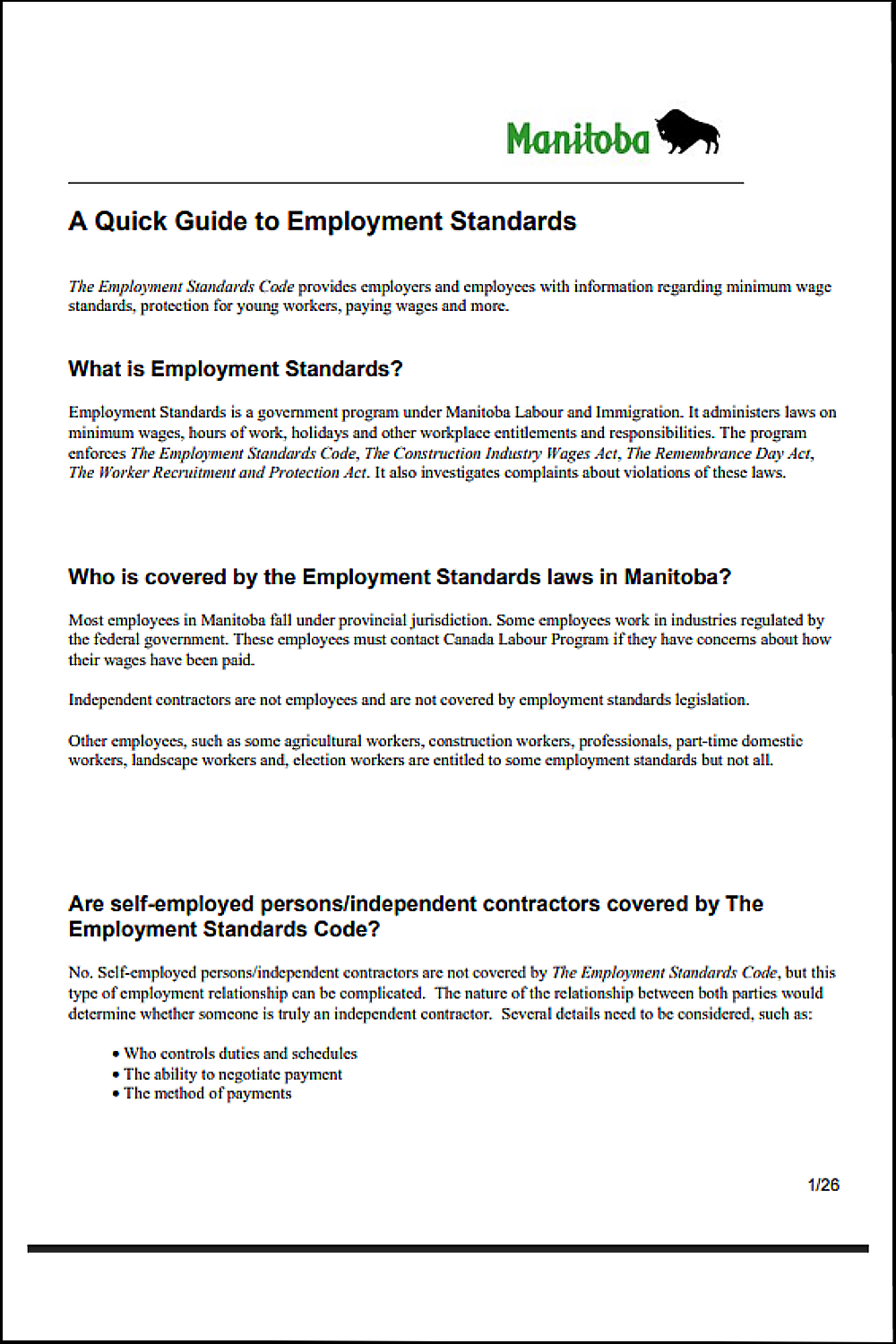
This template is designed for Manitoba contractor relationships and includes practical clauses that help support independent contractor classification.
Manitoba Independent Contractor Laws, Worker Classification Rules & CRA Risks
| Topic / Issue | Manitoba Legal Rule | Governing Statute |
|---|---|---|
| Governing legal framework | Manitoba does not have a standalone Independent Contractor Act. Independent-contractor status is considered under employment standards legislation and applicable common-law principles. | The Employment Standards Code, C.C.S.M. c. E110 |
| Federal tax framework | CRA determines whether a worker is an employee or self-employed based on the actual facts and working relationship. | Income Tax Act, R.S.C., 1985, c. 1 (5th Supp.) |
| Legal signing authority | An individual can sign personally, while a corporation should have the agreement signed by someone authorized to bind the corporation. | Applicable contract and corporate law |
| Witness requirements | Witnesses are generally not required for an ordinary independent contractor agreement. | Applicable contract law |
| Notarization requirements | Independent contractor agreements are generally not required to be notarized. | Applicable contract law |
| Age requirement | Manitoba’s general age of majority is 18. Contractual capacity can depend on the circumstances and applicable law. | The Age of Majority Act, C.C.S.M. c. A7 |
| Mental capacity requirement | The parties should have the legal capacity required to enter into the agreement and understand the contractual obligations being accepted. | Applicable contract law |
| Lawsuit limitation period | Manitoba’s current limitation legislation provides a basic 2-year limitation period from discovery for proceedings subject to the Limitations Act, with exceptions and transition rules. | The Limitations Act, S.M. 2021, c. 44 |
| Mandatory wording requirements | Manitoba law does not prescribe a government form or mandatory boilerplate wording for an ordinary independent contractor agreement. | General contract law |
| Worker classification review | Manitoba Employment Standards states that classification depends on the specific circumstances of the relationship and identifies factors used to distinguish employees from independent contractors. | The Employment Standards Code / Manitoba Employment Standards |
| Independent contractor status factors | Relevant factors can include control, who owns tools, business risk, opportunity for profit or loss, and whether the worker operates an independent business. | Manitoba common law / Employment Standards guidance / CRA guidance |
| Government filing requirements | Ordinary independent contractor agreements are private contracts and are not generally filed with Manitoba government agencies. | Private contractual practice |
| Misclassification risk | A person described as an independent contractor may still be considered an employee if the actual relationship has the characteristics of employment. | The Employment Standards Code |
| Non-compete clause restrictions | Restrictive covenants can raise enforceability issues where they are unreasonable in scope, duration, or geographic reach. | Manitoba common law |
| Consideration for contract changes | Whether fresh consideration is required depends on the circumstances and applicable contract-law rules. | Manitoba common law |
| Manitoba age difference | Manitoba’s general age of majority is 18. | The Age of Majority Act |
| WCB classification | WCB Manitoba has its own rules for deciding whether a service provider is an independent business or a worker for workers-compensation purposes. | The Workers Compensation Act / WCB Manitoba policy |
| WCB contractor coverage | Businesses that hire contract labour may have responsibilities for workers-compensation coverage, depending on the industry and contractor’s status. | The Workers Compensation Act / WCB Manitoba |
Calling someone an “independent contractor” does not automatically determine the person’s legal status. Manitoba Employment Standards states that each situation is unique and must be assessed based on the specific circumstances of the relationship. The CRA similarly says that employment status is determined by the actual facts and terms of the relationship, not simply by what the parties call it. (gov.mb.ca) (canada.ca)
The limitation rules also require more careful wording than a simple statement that every contract claim has a two-year deadline. Manitoba’s current Limitations Act establishes a basic two-year period from discovery for claims subject to the Act, while other provisions address ultimate limitation periods and exceptions. (web2.gov.mb.ca)
WCB Manitoba uses a separate framework for workers-compensation purposes. In industries where contract labour is common, a business may have responsibilities for contractor coverage even when the contractor is described as independent in the agreement. WCB Manitoba also uses an independent-business test in applicable circumstances. (wcb.mb.ca)
An independent contractor agreement helps businesses define project terms, payment conditions, and work expectations for self-employed professionals. To better understand how these commercial documents are structured, you can review the main business contracts guide in Canada together with the legal enforceability guide for Manitoba contracts.
Why Contractor vs Employee Classification Matters So Much
Many businesses believe a signed contract alone decides worker status. It does not.
Manitoba Employment Standards states that independent-contractor status depends on the circumstances of the relationship. The CRA also examines the actual working relationship when deciding whether someone is an employee or self-employed. (gov.mb.ca) (canada.ca)
Key Factors Often Reviewed:
- Who controls how the work is done
- Who owns or supplies the tools
- Who bears business risk
- Who has an opportunity for profit
- Whether the worker operates an independent business
Common Misclassification Red Flags
If a contractor:
- Works fixed employee-style hours
- Is directly supervised on an ongoing basis
- Has little financial risk
- Depends heavily on one business
- Performs work as an integral part of the payer’s business
Then the facts may support further review of the worker’s classification.
Why This Matters
A misclassification can have consequences such as:
- Employment Standards claims
- Payroll and withholding issues
- CPP obligations
- EI obligations where applicable
- Vacation or overtime claims if the person is legally an employee
The CRA provides a ruling process where a payer or worker is unsure about CPP/EI employment status. (canada.ca)
Companies hiring outside professionals often use related agreements depending on the services being provided. Advisory projects may involve a consulting agreement, while creative professionals frequently work under a freelance contract template.
Key Clauses That Protect Independent Contractor Status
A well-written contract should accurately describe the intended independent relationship.
Independent Status Clause
This clause can state that the parties intend to create a business relationship rather than an employment relationship.
However, the clause does not determine status by itself. The actual working relationship remains relevant.
Control Clause
Businesses should describe the contractor’s responsibility for deciding how the services will be performed, while still setting reasonable specifications, deliverables, deadlines, and quality requirements.
Tax Indemnification Clause
An agreement can state that the contractor is responsible for their own applicable tax obligations.
Independent contractors may be responsible for:
- Income tax
- CPP contributions
- EI premiums where applicable
- GST/HST where registration and collection requirements apply
The CRA states that self-employed workers generally pay both the employer and employee portions of CPP and do not normally pay EI premiums unless they opt into the special-benefits program. (canada.ca)
Scope of Work
A vague scope often creates disputes. Businesses should clearly define:
- Deliverables
- Deadlines
- Performance expectations
- Client responsibilities
Payment Terms
Both parties should always clarify:
- Rate
- Invoice dates
- Payment deadlines
- Late payment rules
If confidential company information is shared during the project, businesses may also include a non-disclosure agreement to help protect internal business data.
Payment Structure, Invoicing, and Tax Rules
Payment structure affects both legal clarity and tax administration.
Common Models:
- Hourly
- Flat project fee
- Retainer
- Milestone-based
GST/HST Threshold
A contractor who makes taxable supplies may have to register for GST/HST once the applicable small-supplier threshold is exceeded. For most businesses, the federal threshold is $30,000 in a single calendar quarter or over the relevant preceding four consecutive calendar quarters. (canada.ca)
Contractor Tax Planning Risks
Poor planning can create:
- CRA review or reassessment
- Personal Services Business concerns for qualifying corporations
- Tax-deduction limitations
- Unexpected CPP or other tax obligations
Practical Tip
Contractors should keep:
- Invoices
- Business expense records
- GST/HST records where applicable
- Insurance documents
- Written contracts and amendments
Manitoba Registration and Compliance Requirements
Some contractors need more than a contract.
Key Compliance Areas:
- Business name registration where required
- CRA Business Number
- Manitoba tax obligations where applicable
- WCB requirements where applicable
- Industry-specific safety compliance
Important Note
WCB status is not determined solely by the wording of the contract. WCB Manitoba can determine whether a service provider is an independent business or a worker for compensation purposes. In industries where contract labour is common, businesses may have to provide coverage for contractors who do not have their own applicable coverage. (wcb.mb.ca)
Non-Compete, Confidentiality, and IP Ownership
These clauses should be drafted separately and carefully because they address different legal interests.
Non-Compete Clauses
In Manitoba, restrictive covenants can face enforceability problems when they are broader than reasonably necessary to protect a legitimate interest.
Confidentiality Clauses
These can help protect:
- Client lists
- Trade secrets
- Marketing plans
- Financial data
- Proprietary business information
Intellectual Property Ownership
Without clear language, disputes can arise over:
- Website code
- Marketing content
- Designs
- Training materials
- Other project deliverables
Practical Rule
Businesses should clearly define who owns the final deliverables, what licence rights are granted, and what materials remain the contractor’s property.
Common Legal Mistakes Businesses Make
Many businesses create problems by treating the contract label as more important than the actual relationship.
Common Errors:
- Treating contractor like staff
- Missing tax clauses
- No termination terms
- Vague scope
- Overly restrictive exclusivity
- No IP ownership clause
Common Legal Mistakes Contractors Make
Contractors also create avoidable risks.
Common Errors:
- Not registering for GST/HST when required
- Not registering a business name when required
- Poor invoicing systems
- Accepting extensive employee-like control without understanding the implications
- No insurance where the business requires it
- Weak payment protections
Termination Clauses and Breach Risks
Termination language often determines how the parties can end the relationship.
Ending for Convenience
Allows a party to end the agreement by giving the notice required by the contract.
Ending for Cause
May involve:
- Non-payment
- Misconduct
- Confidentiality breach
- Failure to deliver
- Material breach of the agreement
Important Protection
Both parties should always define:
- Notice periods
- Final invoice timing
- Return of materials
- IP transfer
- Treatment of unfinished work
Clause Comparison Table
| Clause Type | Main Purpose |
Common Risk if Missing
|
| Scope of Work | Defines services | Project disputes |
| Tax Clause | Allocates tax-related responsibilities |
Tax liability uncertainty
|
| Payment Terms | Defines money flow |
Late or unpaid invoices
|
| Termination Clause | Defines exit rights | Legal conflict |
| IP Clause | Defines ownership |
Content ownership disputes
|
Real-Life Manitoba Contractor Disputes
Common examples include:
- CRA worker-classification reviews
- Web designer unpaid invoice disputes
- Construction contract and WCB issues
- Consultant ownership conflicts
- Contractors treated like employees
The issues usually become more difficult when the written agreement does not match how the relationship operates in practice.
Step-by-Step: How to Fill Out a Manitoba Independent Contractor Agreement Properly
Practical Process:
- Identify both parties clearly
- Define services precisely
- Clarify the intended independent business relationship
- Set payment structure
- Add tax responsibility language
- Review termination rights
- Address confidentiality and IP ownership
- Sign and store records
Small details can make a substantial difference when the parties later need to establish what they agreed.
FAQ
Is an independent contractor the same as self-employed?
Often, an independent contractor is self-employed for tax purposes, but the terms are not interchangeable in every legal context. Worker status depends on the actual relationship and the applicable law.
Can Manitoba contractors be reclassified as employees?
Yes. Manitoba Employment Standards states that some employees are incorrectly classified as independent contractors. Classification depends on the specific circumstances of the relationship, not simply the contract label. (gov.mb.ca)
Do contractors need GST/HST registration?
Possibly. A contractor making taxable supplies generally has GST/HST registration obligations once the federal small-supplier threshold and other applicable requirements are met. (canada.ca)
Is WCB mandatory?
Not automatically in every contractor situation. WCB Manitoba determines coverage according to the industry, the contractor’s circumstances, and its applicable rules. Businesses hiring contract labour may have responsibilities to ensure contractors have appropriate coverage. (wcb.mb.ca)
Are non-compete clauses enforceable?
They are not automatically enforceable. The enforceability of a non-compete provision depends on the wording, scope, duration, legitimate interests being protected, and the applicable Manitoba common-law rules.