Agreement Of Purchase And Sale Ontario: Free Template & PDF
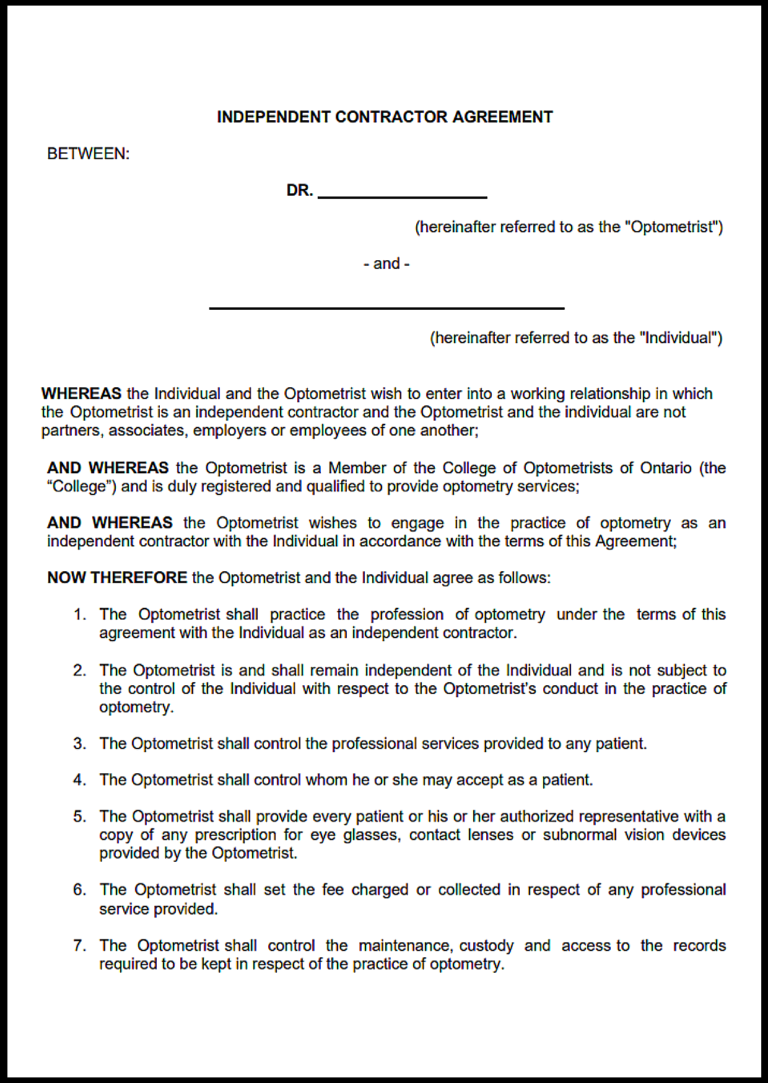
Agreement Of Purchase And Sale Ontario is usually searched by buyers and sellers who want to document a property transaction properly before committing to one of the largest financial decisions they’ll make. Ontario real estate agreements must satisfy the province’s requirements for written land sale contracts, and relying on a generic purchase agreement often leaves important details such as conditions, included fixtures, deposits, or closing obligations open to dispute.
I’ve seen private transactions reach the Ontario Superior Court of Justice because an agreement was incomplete or key terms were drafted so vaguely that the parties disagreed about what had actually been sold. Whether you’re buying, selling, or completing a private real estate transaction without a brokerage, using an Ontario-specific agreement can help avoid unnecessary problems before closing. On this page you’ll find an Ontario-focused Agreement of Purchase and Sale template, guidance on completing each section, and practical information about using the document correctly.
Table of Contents
ToggleAgreement Of Purchase And Sale Ontario (Free PDF)
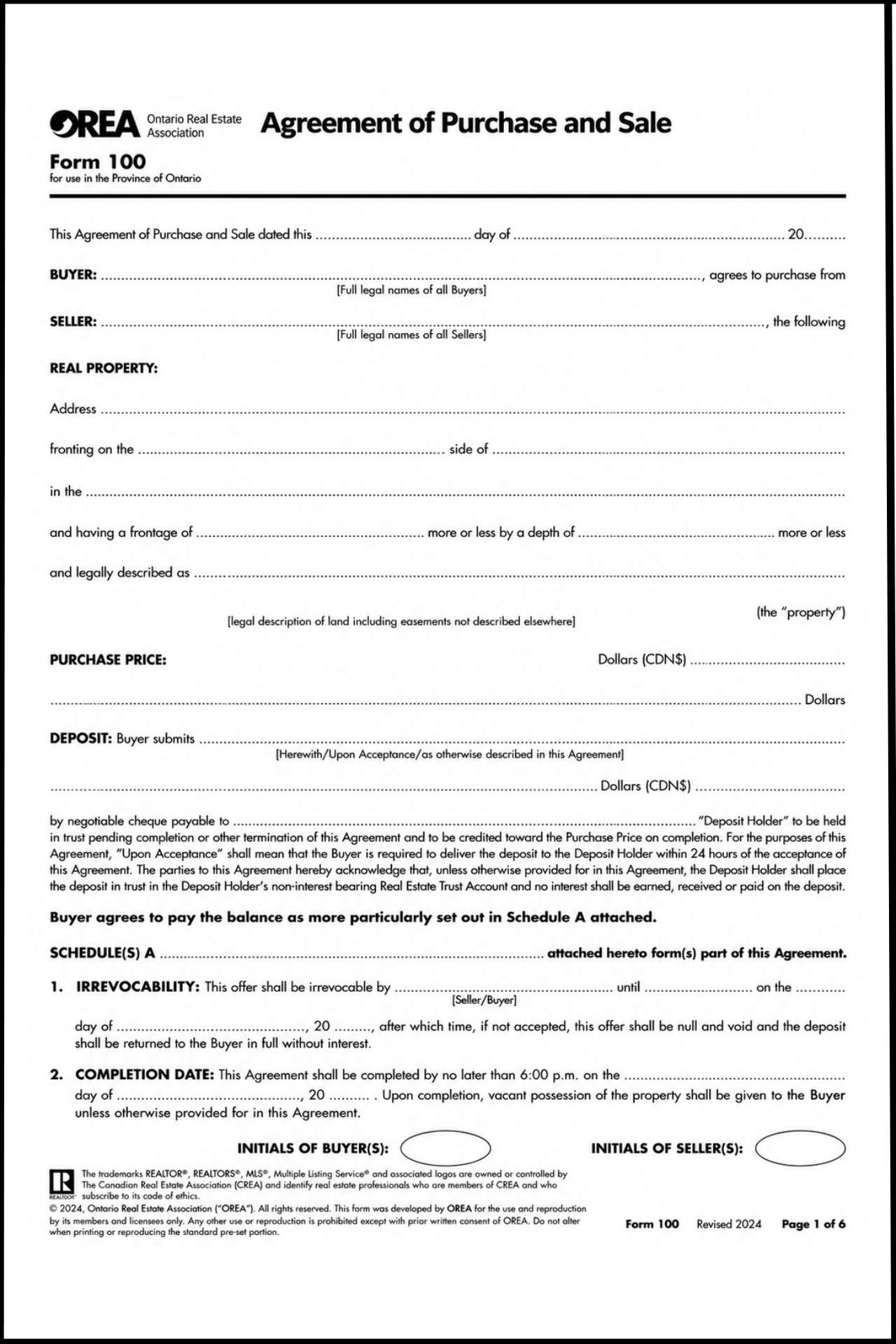
Key Clauses Of An Ontario Agreement Of Purchase And Sale
Every Agreement of Purchase and Sale contains numerous provisions, but several clauses have a direct impact on whether the transaction can proceed smoothly. Buyers often focus on the purchase price, while sellers pay attention to the closing date. Those terms matter, but they are only part of the agreement. Ontario law also requires certain legal protections that help determine whether the contract can be enforced if a dispute arises.
The Writing And Signature Clause
The writing requirement is the legal foundation of every Ontario real estate transaction.Statute of Frauds, R.S.O. 1990. Without those signatures, Ontario law generally does not recognize the agreement as an enforceable contract for the sale of land.
This rule surprises many first-time buyers. They may spend days negotiating by phone, email, or text message and assume they already have a binding deal. In reality, those discussions usually form part of the negotiations rather than the final contract.
Consider a buyer in Ottawa who verbally agrees to purchase a detached home after several rounds of negotiations. Both sides agree on the purchase price and expected closing date, and the buyer even begins arranging mortgage financing. Before anyone signs a written agreement, the seller accepts another offer. Because the parties never completed a signed written contract, the buyer may have little legal protection.
The writing requirement applies regardless of the property’s value. Whether the purchase involves a small condominium, a family home, or a rural property, the agreement must satisfy the Statute of Frauds before it becomes legally enforceable.
The Spousal Consent Clause
Ontario gives special legal protection to a property that qualifies as a matrimonial home. Family Law Act (Ontario)
Many homeowners assume that only the registered owner’s signature matters because only one name appears on title. Ontario law says otherwise when the property is a matrimonial home.
Imagine a homeowner in London who purchased a house several years before getting married. After the marriage, the couple lives in that home together. Although only one spouse owns the property on paper, the seller generally cannot complete the sale without the other spouse’s written consent if the property qualifies as a matrimonial home.
This rule does not automatically apply to every property owned by a married person. It specifically protects qualifying matrimonial homes. Understanding that distinction before listing the property can prevent delays during closing.
The Planning Act Compliance Clause
Some real estate transactions involve more than transferring an existing legal lot. A seller may want to divide land, sell part of a larger property, or complete another transaction that requires municipal approval.
When those circumstances exist, the Agreement of Purchase and Sale should include a saving clause stating that the agreement becomes effective only if the requirements of section 50 of the Planning Act, R.S.O. 1990, c. P.13, are satisfied.
For example, a property owner near Kingston agrees to sell the rear portion of a large lot to a neighbouring landowner. The parties negotiate the price, sign the agreement, and expect to close several months later. If the transaction requires a land severance but the agreement ignores the Planning Act requirements, Ontario law may prevent the agreement from transferring any legal interest in the land.
Most ordinary residential sales involving existing legal lots do not raise subdivision issues. However, buyers and sellers should identify these situations early because they often require additional legal review before closing.
The Title Requisitions Clause
Before the transaction closes, the buyer’s lawyer normally investigates the property’s legal title. This review helps identify issues such as easements, restrictive covenants, registrations, or other matters that could affect ownership after closing.
Most Agreements of Purchase and Sale specify a deadline for submitting title objections or requisitions. Clear deadlines help both parties understand when concerns must be raised.
If the agreement does not contain that deadline, Ontario law supplies one automatically. Under section 4(b) of the Vendors and Purchasers Act, R.S.O. 1990, c. V.2, the buyer has 30 days from the date of the contract to search title and submit written objections or requisitions when the agreement is silent.
Consider a buyer in Mississauga whose lawyer discovers an unexpected easement affecting future renovation plans. If the agreement never established a deadline for title objections, the buyer may rely on the statutory 30-day period instead.
Although Ontario provides this default rule, buyers and sellers should not depend on it. A clearly drafted Agreement of Purchase and Sale creates fewer misunderstandings because everyone knows the applicable timelines before the transaction moves toward closing.
What Makes An Ontario Agreement Of Purchase And Sale Legally Enforceable
Signing an Agreement of Purchase and Sale is only one step in the process. Ontario law also requires certain legal conditions before the contract becomes legally valid. If the agreement fails to meet those requirements, one or both parties may struggle to enforce it later.
Legal Capacity To Sign
The first requirement is legal capacity. Under the Age of Majority and Accountability Act, R.S.O. 1990, c. A.7, s. 1, anyone signing the agreement must be at least 18 years old and have the mental capacity to enter into a contract. A legally registered corporation may also buy or sell real estate through an authorized representative.
For example, if a corporation purchases an office building in Toronto, the person signing the Agreement of Purchase and Sale must have authority to act for the corporation. Likewise, an individual cannot sign on another adult’s behalf unless they have legal authority to do so.
Witnesses And Notarization
Many buyers assume they must have the Agreement of Purchase and Sale witnessed or notarized before it becomes valid. Ontario law does not impose either requirement.
The Verified Legal Facts confirm that there is no statutory witness or notarization requirement. While many real estate professionals include witness signatures because they strengthen the evidence that the parties signed the document, Ontario law focuses on the written agreement and the required signatures rather than witnessing formalities.
That distinction often surprises first-time buyers. They may delay signing while searching for witnesses when the law does not actually require them.
Foreign Buyer Eligibility
Before signing an Agreement of Purchase and Sale, buyers should also confirm that they are legally eligible to purchase residential property.
The Prohibition on the Purchase of Residential Property by Non-Canadians Act, S.C. 2022, c. 10, s. 235 remains in force until January 1, 2027, unless an exemption applies.
For instance, a buyer relocating to Ontario from another country may assume they can complete the purchase once financing is approved. However, federal eligibility rules may affect whether they can legally complete the transaction. Checking eligibility before signing helps avoid expensive delays later in the process.
Meeting these legal requirements does not replace the conditions written into the agreement. Financing conditions, inspection clauses, deposits, and negotiated closing dates continue to govern the transaction alongside Ontario’s statutory rules.
Rights And Obligations Of Each Party To The Agreement
Once both parties sign a legally enforceable Agreement of Purchase and Sale, they accept important legal responsibilities. Understanding those responsibilities before signing often prevents disputes before closing.
Buyer’s Rights Before Closing
Ontario law gives buyers several important protections during the period between signing the agreement and closing the transaction.
One of those protections is the ability to register a Notice of an Agreement against the property’s title. Under section 71 of the Land Titles Act, R.S.O. 1990, c. L.5, a purchaser may register this notice to protect their equitable interest before closing.
Consider a buyer purchasing a newly built home in Vaughan with a closing date several months away. Registering a Notice of an Agreement may help protect the buyer’s interest during that waiting period by preventing the seller from transferring the property to another purchaser.
Not every transaction requires this additional protection, but it can be valuable where the circumstances justify it.
Seller’s Responsibilities
The seller also assumes significant legal responsibilities after signing the agreement.
Most importantly, the seller must transfer clear title according to the terms of the Agreement of Purchase and Sale on the agreed closing date, subject to any negotiated conditions.
If the agreement states that certain appliances remain with the property, the seller must leave those items behind. Likewise, if the parties agree that specific repairs will be completed before closing, the seller should complete those obligations before ownership transfers.
A seller who ignores these contractual responsibilities may create unnecessary disputes shortly before closing, when both parties expect the transaction to proceed.
Representation Under TRESA
Ontario’s real estate rules changed significantly after the implementation of the Trust in Real Estate Services Act, 2002 (TRESA).
Before these changes, buyers and sellers could sometimes deal with a realtor as a “customer.” The Verified Legal Facts explain that TRESA abolished that legal category. Today, every participant is either:
- A Client, who receives full fiduciary duties from their real estate professional.
- A Self-Represented Party (SRP), who does not receive advice or guidance from the other party’s realtor.
This distinction affects many first-time buyers.
Imagine someone attending an open house without hiring their own real estate representative. They may believe the listing realtor can explain which offer terms are best or advise them during negotiations. Under TRESA, the listing realtor cannot provide that type of advice if the individual chooses to proceed as a Self-Represented Party.
Understanding this distinction before negotiations begin helps buyers and sellers decide whether they want professional representation throughout the transaction.
What Happens If One Party Breaches The Agreement
A breach occurs when either the buyer or the seller fails to meet a legal obligation contained in the Agreement of Purchase and Sale. The outcome depends on the nature of the problem and whether the agreement satisfies Ontario’s legal requirements.
For example, a seller may sign an agreement to sell a matrimonial home without obtaining the required written consent from the non-owner spouse. Under section 21(1) of the Family Law Act, that spouse may apply to have the sale set aside.
Another example involves subdivision control. If a seller agrees to transfer only part of a property without complying with section 50(21) of the Planning Act, the agreement may create or convey no legal interest in the land.
Some disputes arise before the parties even have an enforceable contract. If they never sign a written agreement that satisfies the Statute of Frauds, Ontario law generally does not recognize an enforceable contract for the sale of land.
The result depends on the specific facts, but acting quickly after discovering a potential breach often gives both parties more options for resolving the issue.
When You Don’t Need A Lawyer Vs When You Do
Not every real estate transaction requires extensive legal advice from the beginning.
A straightforward residential purchase involving an existing legal lot, no matrimonial home concerns, no land severance, and no questions about buyer eligibility may proceed smoothly using standard brokerage documentation before the lawyer completes the closing work.
However, buyers and sellers should consider speaking with a real estate lawyer if the transaction involves:
- Land severance or subdivision issues under the Planning Act
- A matrimonial home requiring spousal consent
- Questions about the federal foreign buyer restrictions
- Title objections or complicated ownership issues
- Disputes about contractual obligations before closing
Seeking legal advice early often helps parties resolve problems before they delay the transaction.
Summary of Applicable Laws
| Topic | Rule | Governing Statute |
|---|---|---|
| Who can sign | Must be 18 or older with mental capacity, or a registered corporation | Age of Majority and Accountability Act, R.S.O. 1990, c. A.7, s. 1 |
| Writing requirement | Agreement must be in writing and signed by the party being charged | Statute of Frauds, R.S.O. 1990, c. S.19, s. 4 |
| Spousal consent | Required for the sale of a matrimonial home | Family Law Act, R.S.O. 1990, c. F.3, s. 21(1) |
| Subdivision control | Non-compliant agreements convey no interest in land | Planning Act, R.S.O. 1990, c. P.13, s. 50(21) |
| Default title deadline | Buyer has 30 days if the agreement is silent | Vendors and Purchasers Act, R.S.O. 1990, c. V.2, s. 4(a) |
The Matrimonial Home Veto: Why Ontario’s Rule Is Unique
Ontario’s matrimonial home rules differ from those in many other provinces. Under section 21(1) of the Family Law Act, the non-owner spouse has statutory rights that affect the sale of a matrimonial home. Even if only one spouse appears on title, the seller generally must obtain the other spouse’s written consent before completing the sale.
For example, a husband purchased a home before marriage and remained the sole registered owner. After the marriage, the couple used that property as their family residence. He cannot simply sign an Agreement of Purchase and Sale and ignore his spouse’s rights if the property qualifies as a matrimonial home.
The Verified Legal Facts also explain that British Columbia follows a different approach. Rather than providing an automatic possessory veto within the purchase agreement process, British Columbia relies on the Land (Spouse Protection) Act, where a spouse must register a restrictive charge on title to block a sale.
Myth-Busting: Common Confusion About Ontario Purchase Agreements
Myth: A verbal agreement is enough if both parties agree.
Reality: Ontario law requires a written agreement signed by the party being charged under the Statute of Frauds.
Myth: Only the registered owner’s signature matters.
Reality: If the property is a matrimonial home, the non-owner spouse’s written consent is also required under the Family Law Act.
Myth: Every realtor can advise every buyer.
Reality: Under TRESA, only a Client receives full fiduciary duties. Realtors cannot provide advice to a Self-Represented Party in the same manner.
Frequently Asked Questions
Is a verbal agreement to buy a house legally binding in Ontario?
No. Ontario law requires the agreement to be in writing and signed under the Statute of Frauds, R.S.O. 1990, c. S.19, s. 4.
Does my spouse need to sign the Agreement of Purchase and Sale?
Yes, if the property qualifies as a matrimonial home. The Family Law Act requires the non-owner spouse’s written consent before the sale can proceed.
What happens if the agreement does not include a title review deadline?
The Vendors and Purchasers Act gives the buyer 30 days from the contract date to submit title requisitions or objections if the agreement is silent.
Can I sell only part of my property?
Possibly. Transactions involving land severance must comply with section 50 of the Planning Act. Otherwise, the agreement may not transfer any legal interest in the land.