Free Ontario Trailer Bill of Sale Form | PDF Template
Ontario Trailer Bill of Sale documents are essential when buying or selling a trailer in Ontario. A simple handshake isn’t enough—without proper paperwork, you can face registration issues, tax problems, or even ownership disputes.
I’ve seen buyers in Ontario get stuck with trailers they couldn’t register because the bill of sale was missing key details like the VIN, sale price, or seller information. When people are already stressed about the transfer process, even a small paperwork mistake can create delays, tax issues, or disputes over ownership later.
Whether you’re selling a small utility trailer or buying a used travel trailer, this article gives you:
- A free Ontario-specific template
- Clear legal explanations under Ontario law
- Step-by-step instructions to avoid costly mistakes
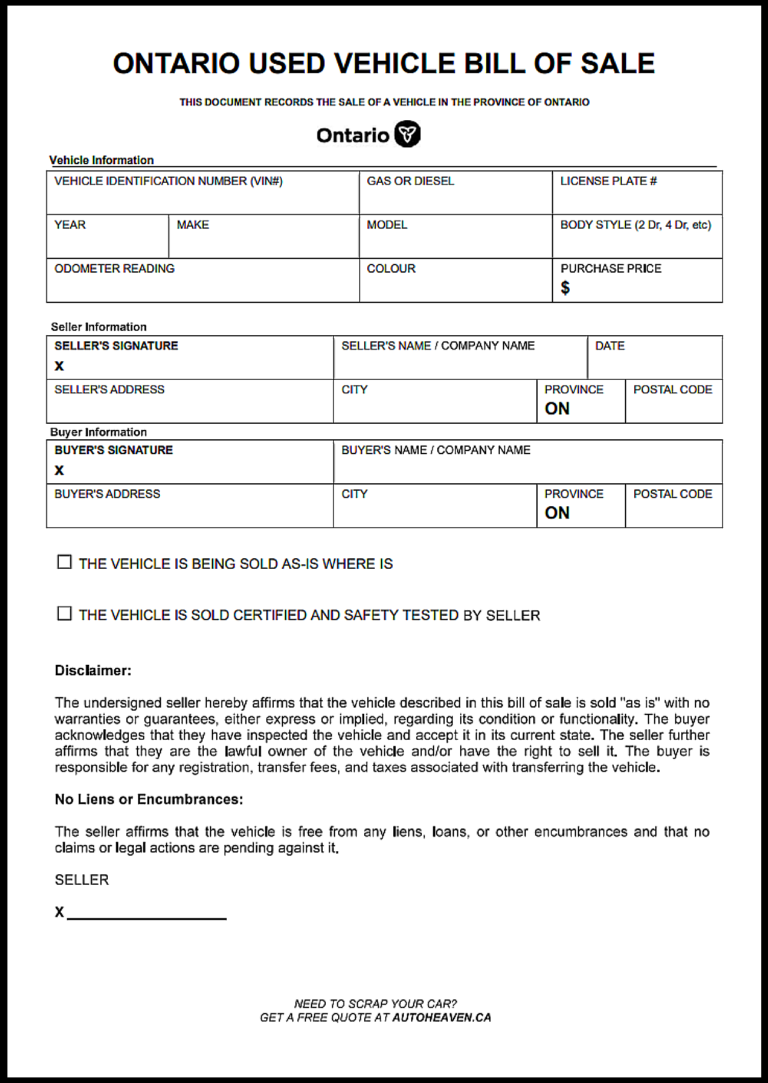
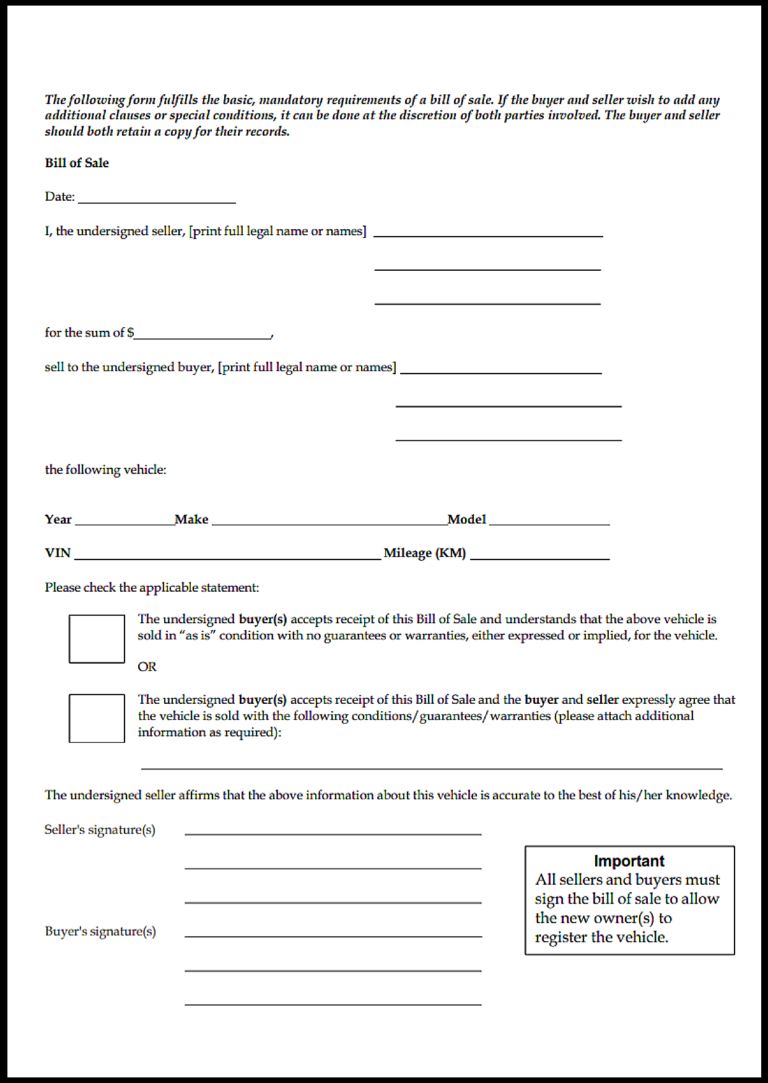
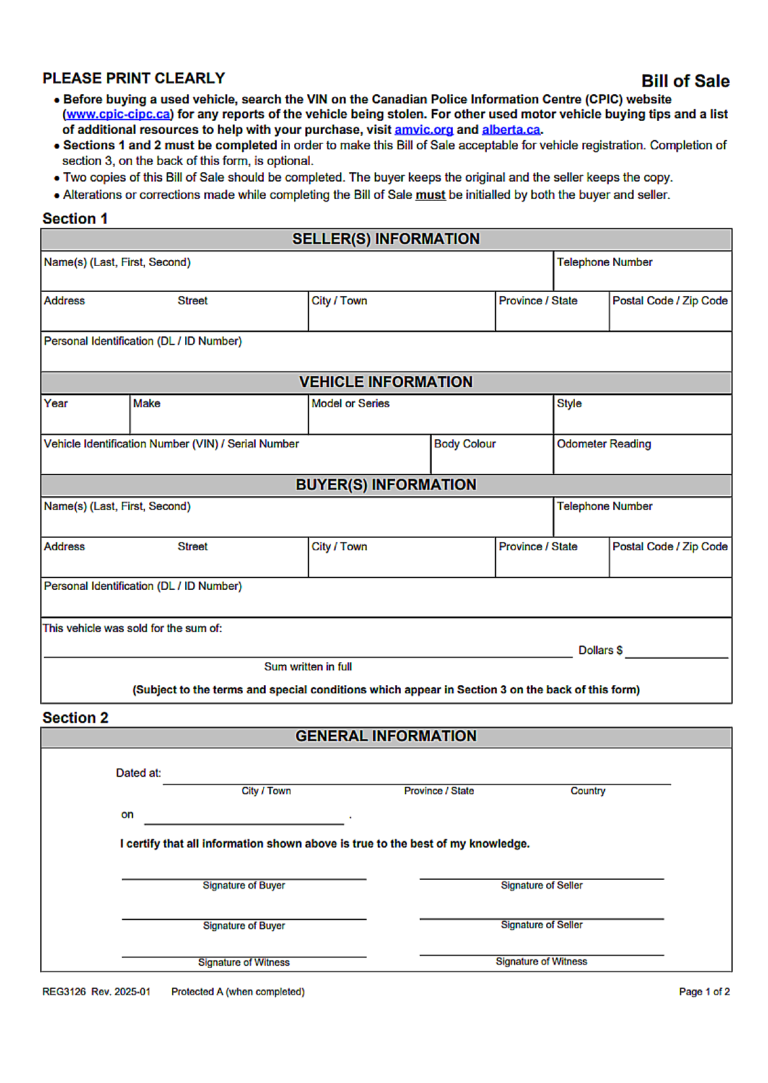
Free Ontario Trailer Bill of Sale Template
Use this template for private trailer sales in Ontario. You can copy it into a document or download it as a PDF for printing.
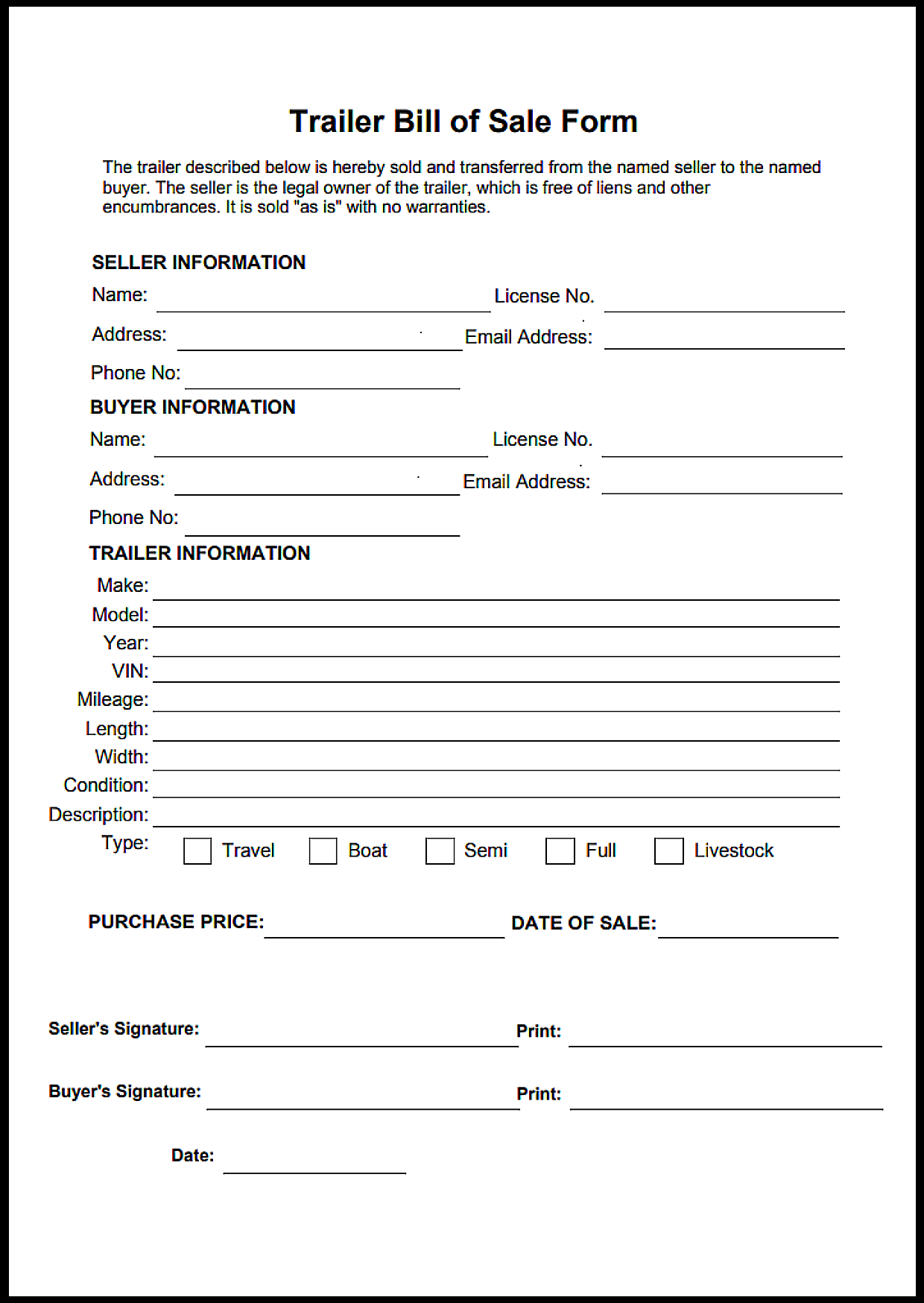
Keep this document simple, clear, and complete. Avoid leaving any blank fields.
Ontario Trailer Bill of Sale Laws and Registration Rules in Ontario
| Topic / Issue | Ontario Legal Rule | Governing Statute |
|---|---|---|
| Governing legislation | Trailer registration and transfer procedures in Ontario are governed primarily by the Highway Traffic Act and the Ministry of Transportation’s registration requirements. | Highway Traffic Act, R.S.O. 1990, c. H.8 |
| Federal legislation | Federal requirements may apply to the manufacture or importation of a trailer, while registration and ownership-transfer procedures in Ontario are governed by Ontario law. | Motor Vehicle Safety Act, S.C. 1993, c. 16 |
| Who can sign | The holder of the vehicle permit must complete and sign the transfer application on the vehicle portion of the permit when transferring the trailer to the new owner. | Highway Traffic Act, s. 11(1) |
| Witness requirements | Ontario’s trailer-registration requirements do not require a witness for a private trailer bill of sale. | N/A |
| Notarization | Ontario’s trailer-registration requirements do not require a private trailer bill of sale to be notarized. | N/A |
| Age and mental capacity | Ontario’s age of majority is 18. Contractual capacity can also depend on the circumstances and the applicable law, so age 18 should not be treated as a complete statement of contractual capacity in every trailer sale. | Age of Majority and Accountability Act, R.S.O. 1990, c. A.7 |
| Registration deadline | For a trailer for which a permit has been issued, the new owner must apply for a new permit within six days after becoming the owner. | Highway Traffic Act, s. 11(2) |
| Required trailer information | A practical Ontario trailer bill of sale should identify the trailer clearly and state the sale price, sale date, and the buyer and seller’s names and signatures. Including the VIN or other identifying information is strongly recommended. | Ontario registration requirements |
| Ownership transfer wording | No special statutory wording for a private trailer bill of sale was confirmed in the Ontario registration guidance reviewed, but the document should clearly identify the parties, trailer and transaction. | Sale of Goods Act; Ontario registration requirements |
| Filing requirement | A bill of sale is among the documents Ontario requires for several trailer-registration situations, together with the applicable vehicle permit and other required documents. | Ontario trailer-registration requirements |
| Taxes on registration | For specified vehicles such as trailers, Ontario’s Retail Sales Tax guidance states that RST is calculated at 13% of the purchase price for applicable private purchases from a non-GST/HST registrant, subject to applicable exemptions. | Retail Sales Tax Act and Ontario RST guidance |
| Missing VIN consequences | A missing or incorrect VIN can create registration problems because the trailer may be harder to identify and the registration information may need to be verified or corrected. | Highway Traffic Act and Ontario registration requirements |
| Missing seller signature | For registration, the transfer application on the vehicle permit must be completed and signed by the permit holder. Ontario’s Sale of Goods Act also permits contracts of sale to be made in writing, orally, partly in writing and partly orally, or implied from conduct, subject to the Act and other applicable law. | Highway Traffic Act, s. 11(1); Sale of Goods Act, s. 4 |
| UVIP inconsistencies | The effect of inconsistencies between documents depends on the circumstances. Buyers should make sure the bill of sale, vehicle permit and registration information are accurate and consistent. | Ontario registration requirements |
| Ontario-specific UVIP rule | A UVIP is not required for the trailer-registration situations described on Ontario’s current trailer-registration guidance. Ontario’s UVIP rules apply to specified used motor vehicles rather than trailers. | Highway Traffic Act, s. 11.1; Ontario registration guidance |
| Safety certificate rule | Trailers are exempt from the Safety Standards Certificate requirement for registration and transfer. | Ontario Safety Standards Certificate guidance |
| Short transfer timeline | Ontario requires the new owner of a permitted trailer to apply for a new permit within six days after becoming the owner. | Highway Traffic Act, s. 11(2) |
The six-day rule is easy to overlook. Under the Highway Traffic Act, the new owner of a permitted trailer must apply for a new permit within six days after becoming the owner. The paperwork should also identify the trailer accurately. If the VIN or other identifying information is wrong, ServiceOntario may need additional documentation before the registration record can be corrected.
A common mistake is assuming that a trailer requires the same Used Vehicle Information Package (UVIP) used for certain used motor vehicles. Ontario’s current trailer-registration guidance does not list a UVIP among the documents required for trailer registration. Instead, buyers should make sure the bill of sale, vehicle permit and transfer information are accurate and consistent.
Many people also wrongly assume notarization is required, but Ontario’s trailer-registration requirements do not require a private trailer bill of sale to be notarized. What matters is accurate information, appropriate signatures, and completing the registration paperwork required for the particular trailer.
Do You Need a Bill of Sale for a Trailer in Ontario?
Ontario’s trailer-registration guidance requires a bill of sale for several common registration situations, including used trailers previously registered in Ontario. The exact documents depend on whether the trailer is new, previously registered in Ontario, previously registered outside Ontario, or homemade.
You will need it when:
- Registering a trailer at Service Ontario
- Proving ownership in a private sale
- Resolving disputes about payment or condition
For common private trailer registrations, Ontario requires proof of purchase, and its trailer-registration guidance specifically lists a bill of sale.
Without it, registration can become difficult or delayed.
This document is used to record the sale and transaction involving a trailer in Ontario. To understand how it fits within standard documentation practices, refer to the complete bill of sale resource and related forms like the vehicle transfer document.
Ontario Trailer Registration Rules
To legally use a trailer in Ontario, it must be registered through ServiceOntario. Ontario states that trailers must be registered before they are taken onto public roads.
Key Requirements
When registering, you typically need:
- A Bill of Sale
- Proof of identity
- The applicable vehicle permit or other registration documents
- Payment of applicable taxes and fees
The exact documents depend on the trailer’s registration history. For example, Ontario has different requirements for new trailers, used trailers previously registered in Ontario, used trailers previously registered elsewhere, and homemade trailers.
Registration Process
- Bring your documents to Service Ontario
- Pay applicable taxes and registration fees
- Receive:
- Trailer plate
- Vehicle permit
Ontario says a trailer is registered once and receives a licence plate and vehicle permit.
Different Situations
| Trailer Type | What You Need |
| Used registered trailer |
Bill of sale + vehicle portion of the existing permit
|
| Homemade trailer |
Registration documents required by ServiceOntario, with additional documentation for trailers over 900 kg
|
| Unregistered trailer |
Additional documentation may be required depending on the trailer’s history and type
|
Homemade trailers have their own registration requirements. For a homemade trailer weighing more than 900 kg empty, Ontario requires a weight slip and a signed ownership letter containing specified information.
What Must Be Included in a Valid Trailer Bill of Sale?
A strong bill of sale protects both buyer and seller. Clear details can make the transaction easier to document and can help if questions arise later.
Buyer and Seller Details
- Full legal names
- Complete addresses
- Contact information
This helps identify both parties if questions or disputes arise.
Trailer Identification
- VIN or other identifying number, where applicable
- Make, model, and year
A correct identifying number is important because registration records must accurately identify the trailer. If the information is missing or incorrect, registration may require additional verification.
Sale Information
- Exact sale price
- Date of transaction
For applicable private purchases of trailers, Ontario’s RST rules generally use the purchase price for calculating RST.
Condition Disclosure
- “As-is” clause, where appropriate
- Notes about damage or repairs
Accurately describing the trailer and disclosing material information can help reduce the risk of disputes, but the legal effect of an omission or misrepresentation depends on the circumstances of the sale.
How to Fill Out the Trailer Bill of Sale (Step-by-Step)
For an Ontario trailer sale, the form should match the information you will use at registration. Check the trailer description, sale price and identifying information before either party signs.
Step-by-Step Guide
- Start with accurate personal details
- Double-check the VIN and trailer information
- Clearly write the sale price
- Add condition notes (damage, repairs, missing parts)
- Both parties should sign and date the document
- Each person should keep a copy
Tip: Avoid messy handwriting or unclear wording. If something is hard to read, it can cause delays when the documents are reviewed.
It is often used alongside other asset-specific templates such as the motorcycle bill of sale. You can also review whether this document is legally required in your situation.
Taxes and Fees When Buying a Trailer in Ontario
Ontario’s current Retail Sales Tax guidance treats trailers as specified vehicles. For applicable private purchases from a person who is not a GST/HST registrant, 13% RST applies unless an exemption applies.
How Tax Is Calculated
- RST for trailers and other specified vehicles covered by the rule is generally calculated at 13% of the purchase price. Unlike automobiles, vans and trucks in the specified category that are subject to the Red Book rule, trailers are listed among the specified vehicles for which purchase price is used.
When You Pay It
- Paid at ServiceOntario during registration
Important Tip:
Providing an inaccurate sale price may result in reassessment and, depending on the circumstances, penalties under Ontario’s Retail Sales Tax Act.
Common Mistakes That Can Cause Problems
Even small errors can create registration or documentation problems.
Avoid These Mistakes
- Missing or incorrect VIN or identifying information
- Not signing the document
- Leaving the price blank
- Using unclear handwritten forms
- Not keeping a copy
Real-Life Scenario
A buyer purchases a used trailer but receives an incomplete bill of sale.
At ServiceOntario, the buyer may need additional documentation or clarification if the trailer or transaction cannot be properly identified.
Result:
- Delays
- Extra paperwork
- Possible dispute with the seller
A complete bill of sale helps create a clearer record of the transaction and can make the registration process easier.
Special Case: Homemade or Unregistered Trailers
These cases require extra care because Ontario has different registration requirements depending on the trailer’s type and history.
Additional Requirements
- Follow the registration requirements applicable to the trailer
- Provide additional documentation where required
- For a homemade trailer weighing more than 900 kg empty, obtain the required weight slip and signed ownership letter
Ontario states that a homemade trailer must still be registered. For a homemade trailer over 900 kg empty, the registration process requires a weight slip and a signed ownership letter containing details such as the body type, declaration that the trailer is homemade, and year built.
Why the Bill of Sale Matters More
For homemade trailers:
- There may be no prior ownership record
- The bill of sale can provide important evidence of the transaction and ownership history
Include detailed descriptions such as materials, build type, dimensions, weight, and other identifying information where available.
Bill of Sale vs Ownership Transfer
Many people confuse these two.
| Bill of Sale |
Proof of Transaction
|
| Registration (permit) |
Registered ownership information
|
You should keep the bill of sale and complete the registration process.
A bill of sale documents the transaction, while Ontario registration is also required to put the trailer into the new owner’s registered name and obtain the applicable permit. Under the Highway Traffic Act, the permit holder must complete the transfer application and the new owner must apply for a new permit within six days after becoming the owner.
When Things Go Wrong: Disputes in Trailer Sales
Disputes can arise when the parties disagree about the condition, price, payment, or terms of a trailer sale.
Common Issues
- Buyer claims hidden damage
- Seller accused of misrepresentation
- Payment disagreements
How a Bill of Sale Helps
A properly written bill of sale:
- Shows agreed price
- Records the agreed condition of the trailer
- Provides proof of transaction date
In disputes, this document can provide useful evidence of what the parties recorded and agreed to at the time of the transaction.
Frequently Asked Questions
Can I write a trailer bill of sale by hand?
Yes, a trailer bill of sale can be handwritten. Ontario’s Sale of Goods Act permits contracts of sale to be made in writing, orally, partly in writing and partly orally, or implied from the conduct of the parties. For registration purposes, however, it is important to provide the documents and information required by ServiceOntario.
Do I need notarization in Ontario?
No, Ontario’s trailer-registration requirements do not require a private trailer bill of sale to be notarized. Having both the buyer and seller sign and date the document is strongly recommended because it creates clearer evidence of the transaction, although the Sale of Goods Act does not impose a universal signature requirement for every contract of sale.
Can I register a trailer without a bill of sale?
Ontario’s trailer-registration guidance lists a bill of sale among the documents required for several common trailer-registration situations. If you do not have one, contact ServiceOntario to determine what alternative documentation, if any, may be accepted.
What if the trailer has no VIN?
If a trailer does not have an identifying number required for registration, contact ServiceOntario before completing the registration process because the required steps depend on the trailer’s type and history. Ontario also has specific registration requirements for homemade trailers, including additional documentation in some circumstances.