Manitoba Service Agreement (Free PDF & WORD Template)
A Manitoba Service Agreement is a legal contract between a service provider and a client. It explains the services being provided, payment terms, deadlines, and each party’s responsibilities. These agreements are commonly used by businesses, freelancers, contractors, consultants, and service providers across Manitoba.
B2B service pacts allow broad freedom, but consumer agreements trigger protective caps under The Consumer Protection Act and The Business Practices Act. Crucially, following the June 2026 enactment of Bill 49 (The Business Practices Amendment Act), consumer service providers are strictly prohibited from using automated algorithms or personal browsing histories to inflate dynamic pricing.
A written agreement helps reduce misunderstandings, avoid payment disputes, and clearly explain what happens if work is delayed, cancelled, or not completed properly.
Free Manitoba Service Agreement Template
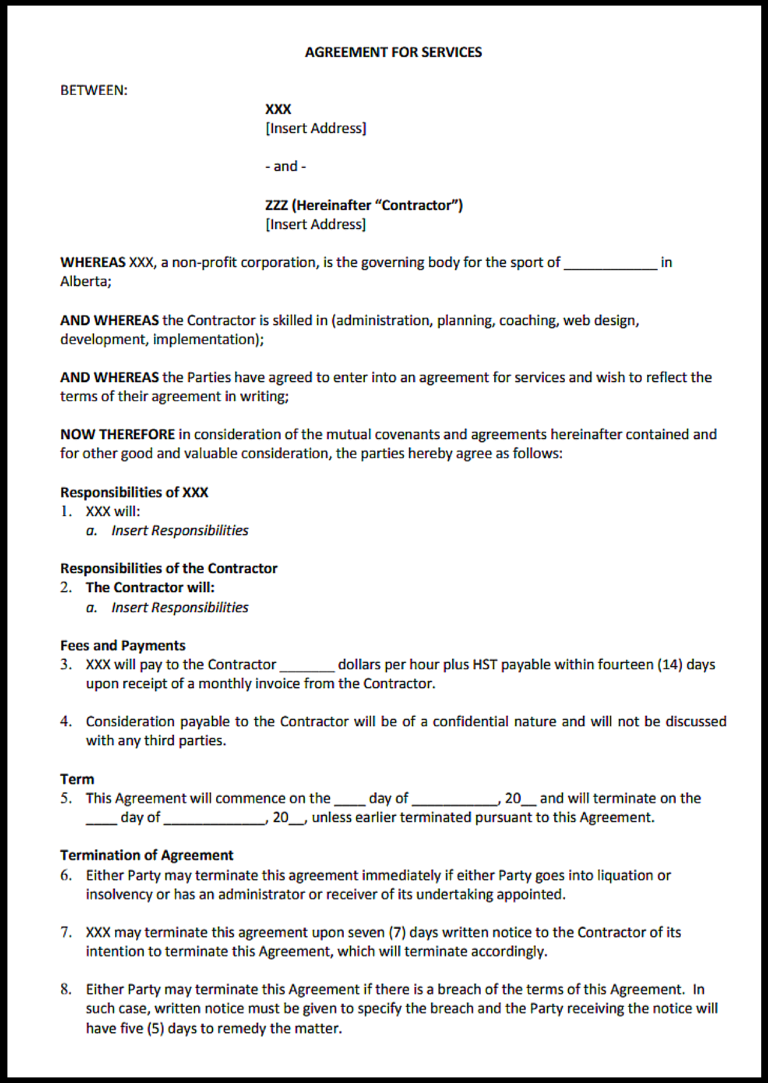
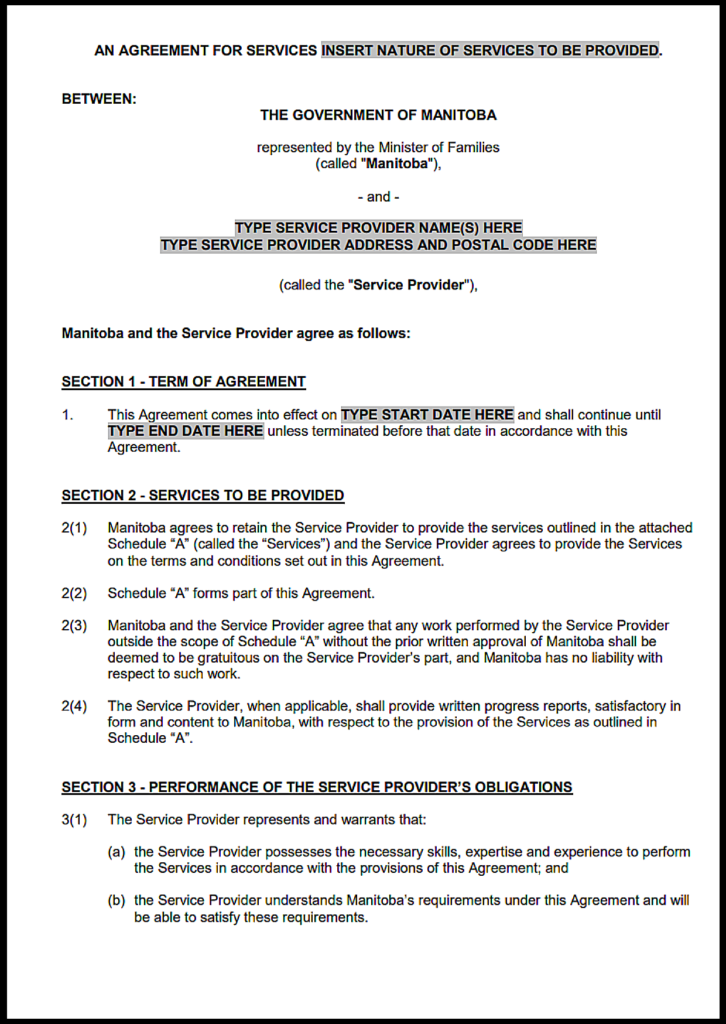
Below is a basic Manitoba Service Agreement sample that can be customized for many industries and service relationships.
Manitoba Service Agreement Laws, Consumer Contract Rules & Enforcement Deadlines
| Topic / Issue | Manitoba Legal Rule | Governing Statute |
|---|---|---|
| General contract framework | Manitoba service agreements are primarily governed by common law contract principles. | Manitoba common law contract principles |
| Consumer-facing service contracts | Consumer service agreements are regulated under Manitoba consumer protection laws. | The Consumer Protection Act, C.C.S.M. c. C200 |
| Real estate service agreements | Licensed brokerages and property managers are statutorily required to execute written contracts prior to rendering trades under Section 25 of The Real Estate Services Act, C.C.S.M. c. R21. These agreements must clearly designate precise definitions of service and definitive end dates. | The Real Estate Services Act, C.C.S.M. c. R21 |
| Limitation period for lawsuits | Breach of contract or unpaid invoice claims are locked into a strict 2-year statutory discovery window under The Limitations Act, S.M. 2021, c. 44, s. 6. The clock starts ticking the moment a party uncovers or reasonably ought to have uncovered the performance default. | The Limitations Act, C.C.S.M. c. L150, s. 6 |
| Legal signing authority | Service agreements may be signed by adults or authorized business representatives with legal authority. | The Age of Majority Act, C.C.S.M. c. A7, s. 1; Common Law Corporate Attribution |
| Witness requirements | Manitoba generally does not require witnesses for ordinary service agreements. | No statutory requirement — governed by common law principles |
| Notarization requirements | Manitoba law generally does not require service agreements to be notarized. | No statutory requirement — governed by common law principles |
| Mental capacity requirements | Contracts involving minors for non-necessary services may be voidable at the minor’s option. | The Age of Majority Act, C.C.S.M. c. A7, s. 1 |
| Mandatory cancellation disclosure | Certain direct seller and internet service contracts must contain a clear statutory cancellation clause. | The Consumer Protection Act, C.C.S.M. c. C200 |
| 10-day cooling-off period | Certain direct consumer service contracts allow cancellation within 10 days after receiving the executed agreement. | The Consumer Protection Act, C.C.S.M. c. C200 |
| Extended cancellation rights | Consumers may cancel within one year if services are not delivered within 30 days of the promised commencement date. | The Consumer Protection Act, C.C.S.M. c. C200 |
| Government filing requirements | Standard Manitoba service agreements are private contracts and are not filed with provincial registries. | Manitoba common law contract principles |
| Business registration requirement | Businesses operating under trade names or corporate structures must maintain proper registration status. | The Corporations Act; The Business Names Registration Act |
| Builders’ lien rights | Service agreements involving property improvements may support lien registration if payment disputes arise. | The Builders’ Liens Act, C.C.S.M. c. B91 |
| Prohibited shortened lawsuit periods | Manitoba law allows parties to extend limitation periods but prohibits shortening the statutory 2-year deadline. | The Limitations Act, C.C.S.M. c. L150, s. 24 |
| Uncertain pricing or scope terms | Contracts may become unenforceable if the services or payment terms are too vague or uncertain. | Manitoba common law certainty of terms principles |
| Invalid consumer warranty waivers | Consumer service providers cannot fully exclude statutory warranties or liability protections. | The Consumer Protection Act, C.C.S.M. c. C200, s. 58(1) |
| Manitoba anti-shortening rule | Manitoba does not allow service agreements to reduce the statutory limitation period below 2 years. | The Limitations Act, C.C.S.M. c. L150, s. 24 |
| Door-to-door service protections | Direct sales service contracts may trigger extended cancellation rights if disclosure rules are violated. | The Consumer Protection Act, C.C.S.M. c. C200 |
One of the most important Manitoba service agreement rules is the province’s strict two-year limitation framework. Many businesses incorrectly copy service contract templates from other provinces that shorten lawsuit deadlines to six months or one year. Manitoba law specifically blocks these shortened limitation clauses, meaning those provisions can become legally invalid. Consumer cancellation rights are another major issue because some direct sales contracts allow buyers to cancel within 10 days or even up to one year if mandatory disclosure rules are missed.
These rules matter in real life because vague scopes of work, unclear pricing, or missing cancellation language can seriously weaken a company’s ability to enforce payment or defend disputes later. Businesses performing renovation work or property improvements may also need proper written agreements to support future builders’ lien rights if invoices remain unpaid. Incorrect consumer clauses, invalid warranty waivers, or poorly drafted limitation provisions can lead to unenforceable contracts, payment losses, and expensive litigation. Download the free Manitoba Service Agreement template below to help structure your contract correctly.
What Is a Manitoba Service Agreement?
A service agreement is a contract where one party agrees to perform services for another party in exchange for payment.
Under Manitoba law, a properly written service agreement creates legally enforceable responsibilities. If one party fails to follow the contract, the other party may be able to seek compensation through negotiation or court action.
Common industries using service agreements in Manitoba include:
- Marketing agencies
- Consultants
- Cleaning companies
- IT providers
- Contractors
- Freelancers
- Real estate professionals
Many business owners confuse service agreements with other contract types. However, they serve different purposes.
|
Agreement Type
|
Main Purpose |
| Service Agreement | Defines services being provided |
| Independent Contractor Agreement | Clarifies contractor relationship and non-employment status |
| Employment Contract | Governs employee duties and workplace terms |
| Statement of Work (SOW) | Describes specific project tasks and deliverables |
A Statement of Work is often attached to a larger service agreement for detailed projects.
When Businesses in Manitoba Commonly Use Service Agreements
Ongoing Business Services
Many Manitoba businesses use recurring service contracts for long-term working relationships.
Examples include:
- Monthly bookkeeping
- Digital marketing retainers
- IT maintenance plans
- Snow removal services
- Commercial cleaning
These agreements usually include recurring payment schedules and ongoing service obligations.
One-Time Projects
Some service agreements are used only for a single project.
Common examples include:
- Website development
- Renovation work
- Graphic design
- Business consulting
- Equipment installation
For project-based work, the agreement should clearly define deliverables, deadlines, and approval procedures.
Consumer Service Contracts
Consumer-facing service agreements are more regulated under Manitoba law.
Examples include:
- Gym memberships
- Appliance servicing
- Home cleaning contracts
- Landscaping services
- Repair services
In many consumer contracts involving future performance, Manitoba law requires additional disclosures such as pricing details and completion dates.
High-Risk Service Relationships
Some contracts involve greater legal risk and should contain stronger protection clauses.
Examples include:
- Access to confidential business information
- Long-term payment arrangements
- High-value commercial projects
- Data handling services
- Projects involving liability exposure
In these situations, businesses often add confidentiality clauses, insurance requirements, and dispute resolution terms.
Important Clauses in a Manitoba Service Agreement
Scope of Work
The scope of work explains exactly what services are included.
Vague descriptions often cause disputes later. A contract should clearly define:
- Services being provided
- Project deliverables
- Deadlines
- Client responsibilities
- Revision limits
Instead of writing “marketing services,” it is better to list exact tasks such as:
- Social media management
- SEO optimization
- Monthly reporting
- Advertising management
Detailed descriptions reduce confusion and improve payment enforcement.
Payment Terms and Late Fees
Payment clauses should explain:
- Total project price
- Deposit requirements
- Milestone payments
- Final payment deadlines
- Accepted payment methods
If interest charges apply to unpaid invoices, federal law may also affect disclosure requirements. Under the Interest Act, unclear interest terms can create legal problems.
Businesses should also clarify whether GST/HST applies to the quoted pricing.
Service Deadlines and Completion Dates
Completion dates are especially important in Manitoba consumer contracts.
Under The Consumer Protection Act, many future performance agreements must include:
- Service completion timelines
- Payment details
- Description of services
Missing deadlines or vague completion terms can increase dispute risk.
Businesses should avoid unrealistic promises that may later become difficult to fulfill.
Cancellation and Termination Rights
Business contracts and consumer contracts follow different rules.
In many B2B agreements, cancellation rights are negotiated freely between the parties.
However, some Manitoba consumer contracts include statutory cancellation rights. Door-to-door sales contracts often require a 10-day cooling-off period.
Businesses are legally expected to disclose these rights clearly in the agreement.
Confidentiality and Data Protection
Many service providers collect sensitive customer or business information.
Examples include:
- Client records
- Financial information
- Login credentials
- Marketing data
- Customer databases
Federal privacy law under PIPEDA may apply when businesses collect personal information during commercial activities.
A common privacy consent clause states:
“By providing personal information to the company, the customer consents to the collection, use, and disclosure of information for the purpose of fulfilling the service agreement.”
Businesses should also explain how records are stored and protected.
Limitation of Liability Clauses
Liability clauses attempt to limit financial exposure if something goes wrong.
For example, a contract may limit damages to the amount paid under the agreement.
However, Manitoba consumer protection principles place limits on these clauses. Businesses generally cannot fully avoid responsibility for negligent services or statutory obligations.
A clause stating “the company has no liability whatsoever” may not hold up in court, especially in consumer situations.
Dispute Resolution Terms
Dispute clauses explain how disagreements will be handled.
Many Manitoba service agreements include:
- Negotiation requirements
- Mediation clauses
- Arbitration options
- Manitoba court jurisdiction terms
Clear dispute procedures can reduce legal costs and improve settlement chances.
When confidential information is shared during the project, parties may also choose to include a Manitoba NDA template to help protect sensitive business details.
Manitoba Laws That Affect Service Agreements
Summary of Applicable Laws
| Topic | Rule | Governing Statute |
| Consumer contracts | Regulates many consumer-facing service agreements | The Consumer Protection Act (Manitoba) |
| Unfair practices | Prohibits unconscionable business practices | The Business Practices Act (Manitoba) |
| Electronic signatures | E-signatures are generally valid | The Electronic Commerce and Information Act |
| Privacy obligations | Governs personal information handling | PIPEDA |
| Interest disclosure | Limits unclear interest claims |
Interest Act (Canada)
|
Electronic Signatures in Manitoba
Electronic signatures are generally legally valid in Manitoba.
Businesses commonly use:
- PDF signing platforms
- Online contract systems
- Email acceptance processes
The Electronic Commerce and Information Act supports electronic contracts and digital business transactions.
This helps businesses manage remote projects and online service arrangements more efficiently.
Age Requirements for Contracts
Under Manitoba law, the age of majority is 18.
Contracts signed by minors may be unenforceable or voidable in some situations. Because of this, businesses should confirm the legal age of clients before entering important agreements.
Consumer Protection Rules
Manitoba consumer law requires many agreements to use clear and understandable language.
The Business Practices Act also prohibits unconscionable conduct, including charging prices that grossly exceed similar services without justification.
Businesses should avoid:
- Hidden fees
- Misleading advertising
- Confusing contract wording
- Aggressive sales tactics
Clear communication reduces legal risk and improves customer trust.
Consumer Service Agreements vs Business Contracts
Consumer Agreements Have Stricter Rules
Consumer-facing agreements usually require stronger legal compliance.
These contracts may involve:
- Mandatory disclosures
- Cancellation rights
- Clear wording requirements
- Consumer protection rules
Door-to-door contracts are especially regulated.
B2B Agreements Allow More Flexibility
Commercial agreements between businesses generally allow more negotiation freedom.
Parties can often customize:
- Payment structures
- Liability terms
- Service standards
- Confidentiality obligations
- Industry-specific clauses
However, basic contract principles still apply.
Why This Difference Matters
Consider the difference between:
- A homeowner hiring a cleaning company
- A corporation hiring a commercial janitorial provider
The homeowner agreement may trigger consumer protection rules and cancellation rights. The commercial agreement usually allows broader negotiation flexibility.
This distinction can significantly affect contract enforceability.
Common Legal Mistakes in Manitoba Service Agreements
Using Vague Service Descriptions
Unclear service terms are one of the most common contract problems.
This can lead to disputes about:
- What work was included
- Whether the project was completed
- Additional charges
- Revision requests
Detailed scopes of work reduce confusion.
Missing Completion Dates
Consumer agreements often require clear timing details.
Missing completion dates can create:
- Compliance issues
- Cancellation disputes
- Delayed payment conflicts
Businesses should always define expected timelines.
Overly Broad Non-Compete Clauses
Under Manitoba common law, non-compete clauses are often difficult to enforce.
Courts frequently reject restrictions that are:
- Too broad geographically
- Too long in duration
- Unreasonable for the industry
Narrow and reasonable restrictions have a better chance of enforcement.
Invalid Liability Waivers
Some businesses attempt to remove all legal responsibility through aggressive liability clauses.
In many consumer situations, courts may reject terms claiming:
“No liability whatsoever for negligence.”
Businesses are still expected to provide services with reasonable skill and care.
Forgetting Privacy Consent Language
Privacy compliance is commonly overlooked.
Businesses collecting customer information online should include clear consent language explaining:
- What data is collected
- Why it is collected
- How it is used
This is especially important for online booking systems and digital service platforms.
Door-to-Door Sales and Restricted Service Contracts in Manitoba
10-Day Consumer Cancellation Right
Certain direct sales contracts in Manitoba include a statutory cooling-off period.
Consumers may cancel some agreements within 10 days after receiving a copy of the contract.
Businesses should clearly disclose these rights in writing.
Household Systems Door-to-Door Ban
Manitoba restricts door-to-door sales involving certain household systems, including:
- Furnaces
- Water heaters
- Air conditioners
- Windows
Service agreements created through prohibited solicitation practices may become void.
Why Some Service Agreements Can Be Void
A contract may become unenforceable if it involves:
- Illegal solicitation practices
- Missing mandatory disclosures
- Consumer law violations
- Misleading conduct
Businesses should carefully review consumer compliance requirements before using standardized templates.
How to Create a Legally Strong Manitoba Service Agreement
Clearly Identify Both Parties
Always include:
- Full legal names
- Business names
- Addresses
- Contact information
Accurate identification helps avoid enforcement problems later.
Define the Exact Services
List all services clearly and avoid vague descriptions.
Detailed scopes reduce payment disputes and confusion.
Include Payment and Tax Details
Specify:
- Pricing
- Payment schedule
- Deposits
- Late fees
- GST/HST treatment
Clear payment terms improve collection efforts.
Add Termination Procedures
Explain how either party can end the agreement.
Include:
- Notice requirements
- Refund rules
- Final payment obligations
- Return of confidential information
Review Consumer Law Compliance
Businesses working with consumers should confirm that contracts include:
- Required disclosures
- Completion dates
- Cancellation rights
- Clear wording
This is especially important for future performance contracts and direct sales arrangements.
Keep Signed Copies and Digital Records
Businesses should securely store:
- Signed contracts
- Amendments
- Invoices
- Email approvals
- Electronic signatures
Proper records help support legal claims if disputes arise later.
Manitoba Service Agreement FAQs
Is a verbal service agreement legally valid in Manitoba?
Yes. Verbal agreements can sometimes be legally valid under Manitoba law. However, proving the exact terms becomes much harder without written documentation.
Can I use electronic signatures on a Manitoba service contract?
Yes. Manitoba generally recognizes electronic signatures under The Electronic Commerce and Information Act.
Does Manitoba require witnesses for service agreements?
No. Standard Manitoba service agreements usually do not require witnesses to be legally valid.
Can a client cancel a service agreement after signing?
It depends on the contract type. Certain consumer direct sales agreements include a statutory 10-day cancellation right.
Are non-compete clauses enforceable in Manitoba?
Sometimes. Manitoba courts often reject non-compete clauses that are overly broad or unreasonable in scope or duration.
What happens if a customer refuses to pay for services?
The service provider may attempt collection efforts, negotiation, mediation, or court action depending on the contract terms and amount owed.