Free British Columbia Eviction Notice Template
British Columbia Eviction Notice is a legal document used by landlords to tell a tenant they must leave a rental property. Under British Columbia law, this step is mandatory before removing any tenant.
In simple words, it is a formal notice that starts the eviction process. It is commonly used by landlords and property managers when there is a valid reason like unpaid rent or rule violation. If the notice is done wrong, it can be rejected.
I have seen British Columbia eviction notices thrown out because the landlord used the wrong notice period or missed required service rules, which only delayed the process and increased conflict. When tenants or landlords come to me for the first time, they are usually already stressed, and small paperwork mistakes often turn into expensive Residential Tenancy Branch disputes.
In this guide, you will learn how to use a free template, understand legal rules, avoid common mistakes, and know your rights clearly.
Last Updated: August 2026
Table of Contents
ToggleFree British Columbia Eviction Notice Template
Below is a simple template you can copy and fill. It follows basic structure used in British Columbia.
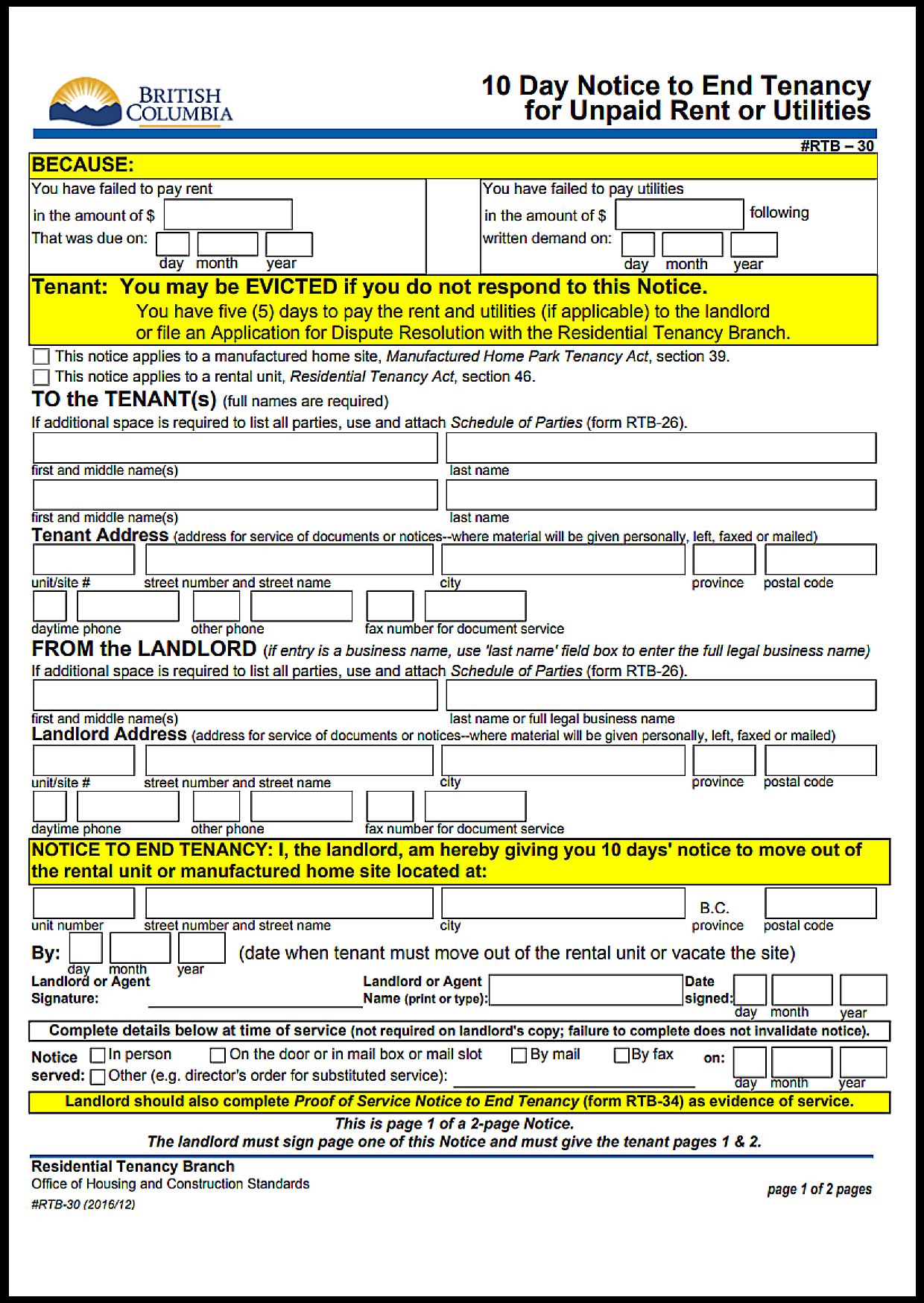
British Columbia Eviction Notice Laws and RTB Requirements
| Topic / Issue | British Columbia Legal Rule | Governing Statute |
|---|---|---|
| Governing legislation | Residential eviction notices in BC are governed by the Residential Tenancy Act. | Residential Tenancy Act, SBC 2002, c. 78 |
| Federal law | Residential tenancy rules in British Columbia are primarily governed by provincial legislation. | Residential Tenancy Act |
| 2024 amendments | The Tenancy Statutes Amendment Act, 2024, S.B.C. 2024, c. 19 changed rules for ending certain tenancies, including landlord or purchaser use, and introduced the statutory framework for generated notices. | Tenancy Statutes Amendment Act, 2024, S.B.C. 2024, c. 19 |
| Who can sign | A landlord’s notice to end tenancy must be signed and dated by the landlord or the person giving the notice on the landlord’s behalf, as applicable. | Residential Tenancy Act, s. 52(a) |
| Witness requirement | A witness signature is not required by section 52 for a landlord’s notice to end tenancy. The landlord should nevertheless keep evidence showing that the notice was properly served. | Residential Tenancy Act, s. 52 |
| Notarization | The Residential Tenancy Act does not require a landlord’s notice to end tenancy to be notarized. | Residential Tenancy Act, s. 52 |
| Age and capacity | The Residential Tenancy Act does not impose the stated age-19 requirement on landlords. | Residential Tenancy Act |
| Notice deadlines | The required notice period and process depend on the statutory ground being used. | Residential Tenancy Act, ss. 46–49 |
| 10-day notice | Used when rent is unpaid, subject to the requirements of section 46. | Residential Tenancy Act, s. 46 |
| 1-month notice | Used for specified causes under section 47, such as repeated late rent, significant disturbance, certain illegal activity, extraordinary damage, or an uncorrected material-term breach. | Residential Tenancy Act, s. 47 |
| 3-month notice | Used for specified landlord or purchaser use under section 49. | Residential Tenancy Act, s. 49 |
| 4-month notice | Used for certain landlord-use purposes under section 49, including specified demolition or conversion circumstances. | Residential Tenancy Act, s. 49 |
| Required notice contents | A notice to end tenancy must be in writing and, as applicable, be signed and dated, identify the rental-unit address, state the effective date, state the grounds for ending the tenancy, and use the approved form when given by a landlord. | Residential Tenancy Act, s. 52 |
| Tenant dispute warning | A tenant may have a right to dispute a notice, and the applicable dispute deadline depends on the type of notice. | Residential Tenancy Act |
| RTB portal requirement | Certain notices under section 49 must be generated through the Residential Tenancy Branch process, including notices under the provisions prescribed by section 42.1 of the Residential Tenancy Regulation. | Residential Tenancy Regulation, s. 42.1 |
| Filing requirement | A notice to end tenancy is served on the tenant. If the tenant does not leave or disputes the notice, the landlord may need to apply to the RTB for an Order of Possession. | Residential Tenancy Act, ss. 55–56 |
| Order of Possession | If a tenant does not leave, the landlord may need to apply to the RTB for an Order of Possession, depending on the circumstances and the type of tenancy-ending process used. | Residential Tenancy Act, s. 55 |
| Writ of Possession | If a tenant does not comply with an Order of Possession, the landlord must use the B.C. Supreme Court enforcement process and an authorized court bailiff. | Residential Tenancy Act and BC court enforcement process |
| Wrong effective date | An incorrect effective date does not always invalidate a notice; section 53 can automatically change certain non-compliant effective dates to the earliest date permitted by the Act. | Residential Tenancy Act, s. 53 |
| Approved form requirement | A landlord’s notice to end tenancy must be in the approved form required by section 52, and certain prescribed notices must also be generated under section 53.1. | Residential Tenancy Act, ss. 52–53.1 |
| Specific grounds requirement | A landlord’s notice to end tenancy must state the grounds for ending the tenancy, except where the Act provides otherwise. | Residential Tenancy Act, s. 52(d) |
| Automatic correction rule | BC has a specific rule for incorrect effective dates. Under section 53, certain dates are deemed changed to the earliest date permitted by the applicable requirements. | Residential Tenancy Act, s. 53 |
| No self-help evictions | Landlords cannot physically remove tenants or take direct enforcement action; an Order of Possession must be enforced through the B.C. Supreme Court and an authorized court bailiff. | Residential Tenancy Act enforcement rules |
For certain section 49 notices, BC requires a generated notice under section 53.1. The prescribed provisions are set out in section 42.1 of the Residential Tenancy Regulation.
A landlord cannot simply lock out a tenant when the notice period ends. If the tenant remains, an Order of Possession may be required, and enforcement of that order must proceed through the B.C. Supreme Court and an authorized court bailiff.
BC has a specific rule for incorrect effective dates. Under section 53, certain dates are deemed changed to the earliest date permitted by the applicable requirements.
Missing grounds, incorrect notice periods or failure to use the required approved form can create problems with a notice. Use the template as a starting point, but make sure the completed notice complies with the current Residential Tenancy Act and applicable RTB requirements.
This notice is generally used when a landlord needs to formally address serious tenancy issues such as unpaid rent, repeated lease violations, or illegal property use. Before taking legal action, many property owners review the British Columbia tenant rights resource to better understand notice periods and legal obligations under provincial housing rules.
What Is an Eviction Notice in British Columbia?
An eviction notice is a written notice used to end a tenancy under a specific provision of BC’s Residential Tenancy Act. Receiving one does not by itself authorize the landlord to physically remove the tenant.
Under British Columbia law:
- A landlord must follow the applicable written notice and tenancy-ending process
- A tenant may have a right to respond or dispute
- A landlord cannot physically force a tenant out without following the lawful enforcement process
This notice can be an important step in ending a tenancy. If the tenant does not leave, the landlord may need to obtain an Order of Possession and follow the required enforcement process.
Eviction disputes often begin with problems connected to a residential tenancy contract or ongoing payment issues documented through a rent payment tracking record. In some situations, landlords may first attempt to resolve issues through updated rental terms or written warnings before ending the tenancy completely.
When Can a Landlord Issue an Eviction Notice?
Non-Payment of Rent
If rent is unpaid after it is due, section 46 allows the landlord to give a 10-day notice. The tenant has 5 days after receiving the notice to pay the overdue rent or dispute the notice.
Breach of Tenancy Agreement
If a tenant breaks a material term of the agreement or engages in conduct covered by section 47, the landlord may be able to end the tenancy. Depending on the circumstances, this can include repeated late payment, significant disturbance, certain illegal activity, extraordinary damage, or failure to correct a material-term breach.
Landlord or Family Use
An individual landlord may use section 49 when the landlord or a qualifying close family member intends in good faith to occupy the rental unit. The applicable prescribed notice period for the section 49(3) ground is currently 3 months.
End of Fixed-Term Lease
A fixed-term tenancy does not automatically end merely because the fixed term expires. Where the agreement does not require the tenant to vacate in circumstances permitted by the Act and regulations, the tenancy generally continues as a periodic tenancy.
For better understanding, see related pages like /british-columbia-lease-agreement/ and /british-columbia-rental-agreement/.
Types of Eviction Notices in British Columbia
Different situations require different notices. Using the wrong type can make the notice invalid.
- 10-Day Notice is used for unpaid rent
- 1-Month Notice is used for specified causes
- 3-Month Notice is used for specified landlord or purchaser use
- 4-month notice periods apply to certain section 49 purposes, while qualifying renovations or repairs proceed through the section 49.2 RTB order process
Each notice or RTB process has its own statutory ground, notice period and dispute procedure, so the landlord must use the process that matches the circumstances.
If the tenant remains in the property after the original fixed term expires, the arrangement may continue under a month-to-month occupancy agreement. Landlords handling changes to pricing during this period may also need a formal rent adjustment notice that follows provincial requirements.
Legal Notice Periods
|
Reason for Eviction
|
Notice Type |
Minimum Notice Period
|
| Non-payment of rent | 10-Day | 10 days |
| Breach of agreement | 1-Month | 1 month |
| Landlord use | 3-Month | 3 months |
| Demolition or certain conversion purposes | 4-Month | 4 months |
How to Fill Out the Eviction Notice (Step-by-Step)
The notice should be completed carefully because the Residential Tenancy Act sets specific requirements for its form, content and effective date.
- Enter correct tenant names and rental address
- Clearly mention the legal reason
- Add correct notice period and dates
- Sign the notice properly
It is important to keep everything clear and accurate so that the notice complies with the applicable legal requirements.
How to Serve an Eviction Notice Legally
The notice must be served using a method permitted by BC tenancy law. The method used can also affect the date on which the notice is considered received.
- Personal service is one permitted method
- A copy may be attached to the door or another conspicuous place where permitted
- Mail is a permitted service method
- Email service is permitted in the circumstances authorized by the Regulation
Keep proof of delivery like photos or records. This helps if the case goes to the Residential Tenancy Branch.
What Makes an Eviction Notice Invalid?
Many eviction notices fail because of simple mistakes. Under British Columbia law, a notice may be ineffective or subject to dispute if it does not follow the applicable requirements.
- Wrong notice period is given
- Important details are missing
- Reason is not legally valid
- Landlord acts in bad faith
- RTB rules are not followed
For example, a landlord using section 49 must follow through with the stated purpose in good faith. Failing to do so can expose the landlord or purchaser to compensation consequences under the Act.
Tenant Rights After Receiving an Eviction Notice
Receiving a notice does not remove the tenant’s rights under the Residential Tenancy Act. Depending on the type of notice, the tenant may have a specific period to apply for dispute resolution.
- They can dispute the notice through RTB
- They may remain in the rental unit while the tenancy continues according to the Act and applicable dispute process
- They may get compensation in some cases
- They are protected from illegal eviction
To learn more, see /tenant-rights-british-columbia/.
What Happens After the Notice Period Ends?
After the effective date of the notice, the next step depends on whether the tenant has vacated and whether the landlord needs an Order of Possession.
| Situation | Result |
| Tenant leaves voluntarily | Process ends |
| Tenant refuses to leave |
Landlord may need to apply for an Order of Possession
|
If a tenant does not leave, the landlord may need to apply to the RTB for an Order of Possession, depending on the circumstances and the type of notice.
Landlords are not allowed to change locks, remove belongings, or force the tenant out. If an Order of Possession has been issued and the tenant does not comply, the landlord must use the court enforcement process and an authorized court bailiff.
Common Mistakes Landlords Should Avoid
Many landlords delay their own process by making avoidable mistakes. It is important to follow rules carefully.
- Using the wrong notice type
- Not keeping proof of service
- Giving incorrect dates
- Trying to evict without legal order
- Not understanding notice rules
Avoiding these mistakes can help reduce unnecessary delays and disputes.
Real-Life Example
A landlord may serve a 10-day notice under section 46 when rent is unpaid. The tenant has 5 days after receiving the notice to pay the overdue rent or dispute the notice. If the notice remains effective and the tenant does not leave, the landlord can use the applicable RTB process to seek an Order of Possession.
If the tenant disputes, the Residential Tenancy Branch reviews the case. The outcome depends on the evidence, the applicable statutory requirements, and the circumstances of the tenancy.
Eviction Notice vs Eviction Order
An eviction notice is a written notice used to end a tenancy under the applicable statutory process.
An Order of Possession is an RTB order giving the successful landlord the right to recover possession. If the tenant does not comply, the order must be enforced through the B.C. Supreme Court and an authorized court bailiff.
The two documents serve different purposes, and landlords should not treat a notice as permission to physically remove a tenant.
Frequently Asked Questions
Can a landlord evict a tenant immediately in BC?
Usually no. A landlord must follow the applicable notice and enforcement process, although the Residential Tenancy Act allows the RTB to end a tenancy early in certain serious circumstances.
How much notice is required for eviction?
It depends on the legal ground. For example, section 46 uses a 10-day notice for unpaid rent, section 47 generally uses one month for cause, prescribed section 49 landlord or purchaser-use grounds generally use 3 months, and certain section 49 purposes use the default 4-month period.
Can a tenant stop an eviction notice?
Yes. A tenant may be able to dispute the notice through the Residential Tenancy Branch, but the deadline depends on the type of notice.
Do eviction notices need to be in writing?
A notice to end tenancy under the Residential Tenancy Act must meet the statutory written-form requirements. A verbal demand to leave is not a substitute for the required notice.
What happens if a landlord breaks the rules?
The notice or enforcement process may be affected, and depending on the circumstances, a landlord may face an RTB order, compensation claim, or other consequences under the Residential Tenancy Act.