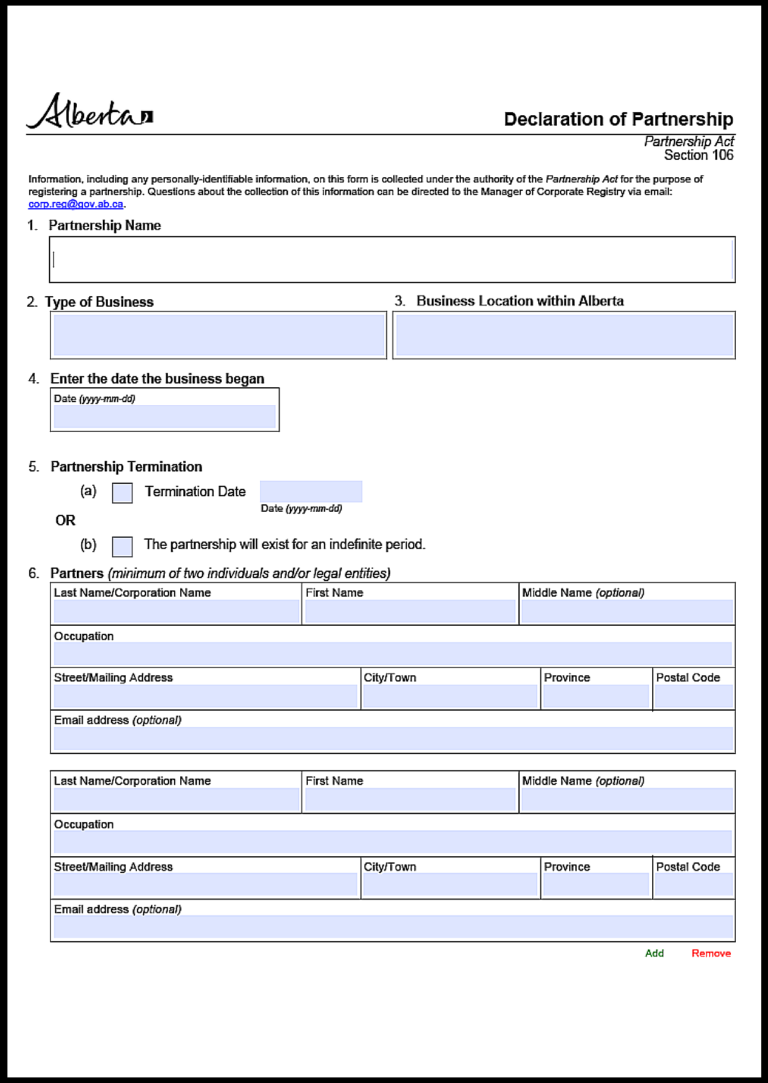
Ontario Partnership Agreement (Free Legal Template Canada)
An Ontario Partnership Agreement is often prepared after business partners realise that a verbal understanding may not reflect how they actually want their venture to operate. Under Ontario’s Partnerships Act, partners who don’t set out their own rules can find themselves subject to default provisions on profit sharing, management authority, and dissolution that may not match their expectations.
I’ve seen disputes reach the Ontario Superior Court of Justice where partners contributed different amounts of money and effort but never documented those arrangements, leaving the court to rely on statutory defaults instead of the parties’ intentions. That’s a costly lesson for any business relationship, especially when disagreements arise over ownership interests or a partner wants to leave the business.
This page explains how an Ontario Partnership Agreement works, what terms are commonly included, and how to create a document that reflects the way your partnership is actually meant to operate.
Last Updated: September 2026
Free Ontario Partnership Agreement Template
Below is a simple and practical template you can use. You can customize it based on your business needs.
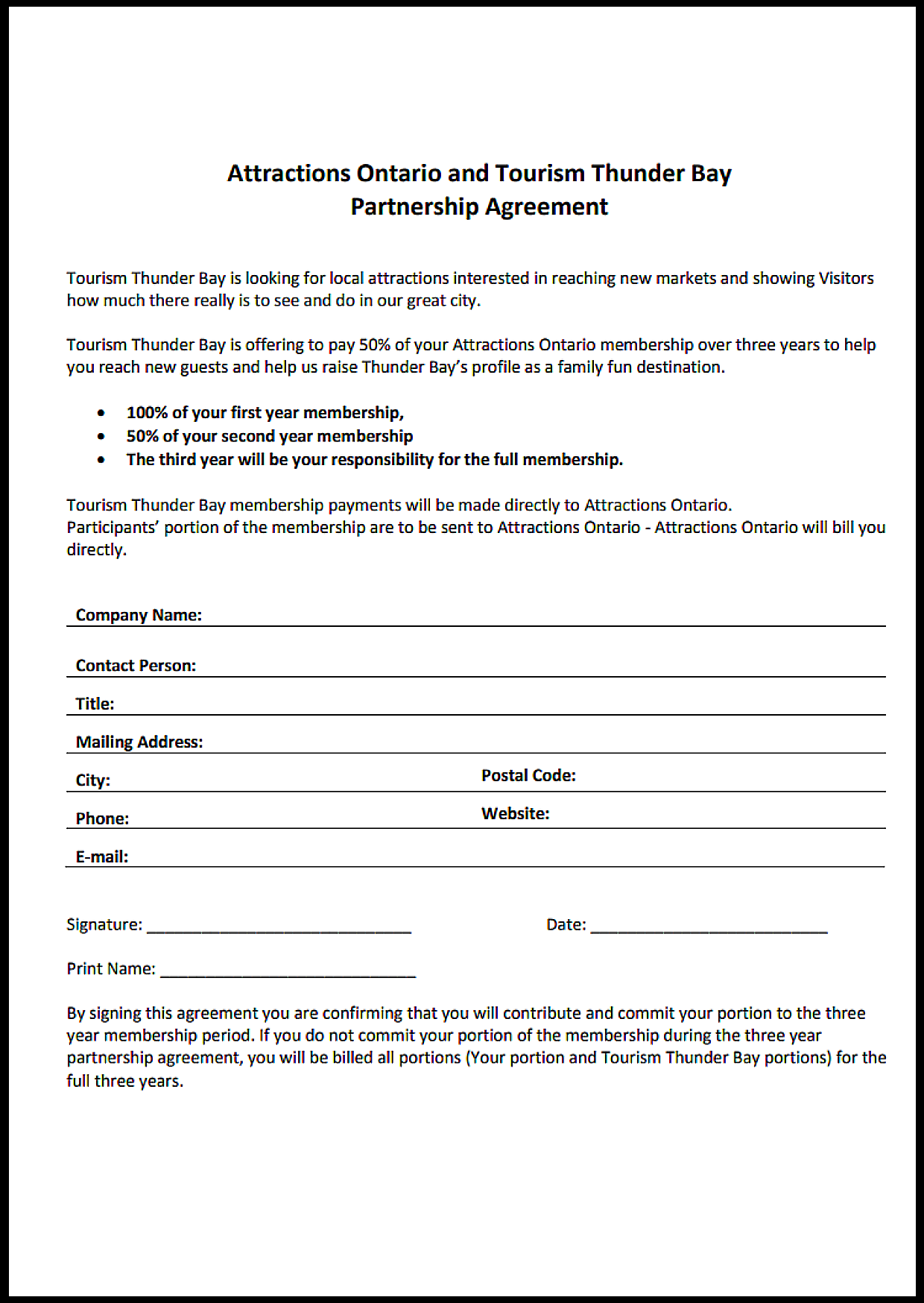
Ontario Partnership Laws, Registration Rules & Legal Requirements
| Topic / Issue | Ontario Legal Rule | Governing Statute |
|---|---|---|
| Governing legislation | Ontario general partnerships are governed mainly by the Partnerships Act, while limited partnerships are governed by the Limited Partnerships Act. Business-name registration requirements are addressed separately under the Business Names Act. | Partnerships Act, R.S.O. 1990, c. P.5; Business Names Act, R.S.O. 1990, c. B.17; Limited Partnerships Act, R.S.O. 1990, c. L.16 |
| Jurisdiction | Ontario partnership agreements are governed primarily by provincial contract and partnership law, although federal laws can also apply to matters such as taxation. | Partnerships Act, R.S.O. 1990, c. P.5 |
| Recent modernization | Ontario modernized business-name and partnership-related filings through the Ontario Business Registry system. | Cutting Unnecessary Red Tape Act, 2017; Ontario Business Registry |
| Who can sign | A partnership under Ontario’s Partnerships Act is a relationship between persons carrying on a business in common with a view to profit. Depending on the structure, a partner may be an individual or another legally capable entity. | Partnerships Act, s. 2 |
| Witness requirement | Ontario’s Partnerships Act does not impose a general witness requirement for an ordinary partnership agreement, although witnessing signatures may provide useful evidence if execution is later disputed. | Partnerships Act |
| Notarization | Ontario’s Partnerships Act does not generally require an ordinary partnership agreement to be notarized. | Partnerships Act |
| Age requirement | Ontario’s age of majority is 18, and a person aged 18 or older is presumed capable of entering into a contract under the Substitute Decisions Act, 1992. | Age of Majority and Accountability Act, s. 1; Substitute Decisions Act, 1992 |
| Mental capacity | A person aged 18 or older is presumed capable of entering into a contract unless there are reasonable grounds to believe otherwise. | Substitute Decisions Act, 1992 |
| Business name registration deadline | A partnership generally must register its firm name before carrying on business or identifying itself to the public under that name. The Business Names Act contains an exception where the name is composed of the partners’ names. | Business Names Act, R.S.O. 1990, c. B.17, s. 2 |
| LLP naming requirement | An Ontario limited liability partnership’s firm name must contain “limited liability partnership” or an authorized abbreviation such as “LLP” or “L.L.P.” as its final words or letters. | Partnerships Act, s. 44.3 |
| Filing requirement | The partnership agreement itself is generally a private contract and is not filed as the partnership’s business-name registration with the Ontario Business Registry. | Business Names Act |
| Firm name registration | Ontario partnerships generally register their firm name through the Ontario Business Registry, subject to the Business Names Act exception for a name composed of the partners’ names. | Business Names Act, R.S.O. 1990, c. B.17 |
| Master Business Licence | Ontario business registration provides a 9-digit Business Identification Number (BIN). This is different from the federal Business Number issued by the Canada Revenue Agency. | Business Names Act; Ontario business-registration rules |
| Illegal purpose | Section 34 of Ontario’s Partnerships Act provides that a partnership is dissolved if an event makes it unlawful for the firm’s business to be carried on or for its members to carry it on in partnership. | Partnerships Act, s. 34 |
| Profit requirement | Under section 2 of Ontario’s Partnerships Act, a partnership involves persons carrying on a business in common with a view to profit. | Partnerships Act, s. 2 |
| Incapacity or duress | Agreements may be challenged where a partner lacked contractual capacity or entered the agreement because of legally recognized duress or other vitiating circumstances. | Ontario contract law |
| Limited partner control risk | Under section 13 of Ontario’s Limited Partnerships Act, a limited partner may become liable as a general partner if, in addition to exercising the rights and powers of a limited partner, they take part in control of the business. | Limited Partnerships Act, s. 13 |
| Dissolution on death or insolvency | Subject to any agreement between the partners, section 33(1) of Ontario’s Partnerships Act provides that a partnership is dissolved by the death or insolvency of a partner. | Partnerships Act, s. 33 |
| Registration renewal requirement | An Ontario Business Name Registration is effective for five years. Ontario currently allows it to be renewed from six months before expiry until 60 days after the expiry date. | Business Names Act; Ontario Business Registry rules |
One of the most important Ontario partnership rules is that, subject to the partners’ agreement, a partnership can be dissolved when a partner dies or becomes insolvent. Section 33 of the Partnerships Act deals with these events. A carefully drafted agreement can address what the partners want to happen instead.
Another practical issue is registration maintenance. An Ontario Business Name Registration is generally effective for five years. Ontario currently allows it to be renewed from six months before expiry until 60 days after the expiry date. If the registration has been expired for 60 days or less, it can still be renewed through the Ontario Business Registry. After more than 60 days, Ontario requires a new business-name registration instead, and a new Business Identification Number is issued.
Ontario also treats limited partnerships differently from general partnerships. Under section 13 of the Limited Partnerships Act, a limited partner may become liable as a general partner if, beyond exercising the rights and powers of a limited partner, they take part in control of the business. That is an important distinction for anyone considering a limited partnership structure.
Getting these rules wrong can lead to disputes, unexpected liability, partnership dissolution, or registration problems later. The agreement should therefore reflect the actual arrangement between the partners and the Ontario statutory rules that apply to the chosen partnership structure.
Understanding Partnership Agreements in Ontario
What Is an Ontario Partnership Agreement?
A partnership under Ontario law involves persons carrying on a business in common with a view to profit.
An Ontario partnership agreement is a written contract that explains:
- Who owns what
- Who does what
- How profits and losses are shared
There are two common types:
- General Partnership – Partners generally share responsibility for managing the business and may have personal liability for partnership obligations.
- Limited Partnership – A limited partnership has general and limited partners, with different rights and liability rules under the Limited Partnerships Act.
In simple terms:
A written agreement lets partners decide important business rules instead of leaving every issue to statutory defaults.
When Do You Need a Partnership Agreement?
A written agreement becomes particularly important when two or more people are carrying on a business together and want clear rules about money, responsibilities, management, or what happens when the relationship changes.
Common situations:
- Starting a small business
Example: Two friends open a café together - Family-run businesses
Example: Siblings running a retail shop - Freelancers collaborating
Example: A designer and developer working on client projects - Real estate partnerships
Example: Two investors buying property together
A written agreement is especially useful where partners contribute different amounts of capital, expect unequal profit shares, divide management authority differently, or want the business to continue after a partner’s death.
Key Clauses You Must Include
Ownership & Capital Contribution
Clearly define:
- Who owns what percentage
- Who invested money, assets, or skills
- Whether additional contributions may be required
- How partner advances or loans to the business will be treated
This helps prevent future arguments about capital and the partners’ financial interests.
Profit and Loss Distribution
Decide:
- Equal sharing (50/50)
- Or based on an agreed allocation
Under section 24 of Ontario’s Partnerships Act, statutory default rules can apply where the partners have not agreed otherwise. Among other things, the Act provides for equal sharing of capital and profits and equal contribution toward losses, subject to the Act’s rules.
For Canadian income-tax purposes, partnership income or loss generally flows through to the partners, who report their respective shares on the applicable individual, corporate, or other tax return. Certain partnerships must also file a T5013 Partnership Information Return. So the agreement’s allocation provisions should be clear and consistent with the partnership’s accounting and tax records.
Roles and Responsibilities
Define daily duties:
- Who manages operations
- Who handles finances
- Who deals with clients
- Which decisions require approval from another partner
This prevents overlap and makes it easier to hold each partner accountable for agreed responsibilities.
Decision-Making Process
Not every decision needs to be discussed, but major ones should follow a clear rule.
You can choose:
- Majority voting for decisions where the agreement permits majority approval
- Unanimous approval for major decisions, such as changing the nature of the business, where the partners want that protection
Ontario’s Partnerships Act contains default management and decision-making rules. For example, every partner has a right to take part in management, while differences arising in the ordinary course of the business may generally be decided by a majority of the partners.
It is also smart to think ahead. What happens if both partners disagree? This is called a “deadlock,” and without a solution, the business can get stuck.
Exit Strategy & Buyout Clause
Important but often ignored.
Include:
- Notice period to leave
- How the business will be valued
- How a departing partner’s interest will be bought out
- What happens if a partner dies or becomes insolvent
- Whether the remaining partners can continue the business
Without clear exit provisions, a partner’s departure can create uncertainty about valuation, assets, debts, and the future of the business.
Dispute Resolution Clause
No one starts a business expecting conflict. But disagreements can happen, especially when partners have different views about money or management.
Instead of going directly to court, an agreement may include:
- Mediation (a neutral person helps both sides)
- Arbitration (a private decision-maker resolves the issue)
These procedures can provide an alternative to litigation, but the cost, timing, and suitability depend on the dispute and the wording of the agreement.
Legal Validity & Common Mistakes
Is a Partnership Agreement Legally Valid in Ontario?
Yes, a partnership agreement can be a binding contract when the parties have reached an enforceable agreement and the terms are sufficiently clear.
Common contract considerations include:
- Offer – One party proposes terms
- Acceptance – The other agrees
- Consideration – Something of value is exchanged
The parties should also have contractual capacity, and the agreement must not be affected by circumstances that make it legally unenforceable.
Under Ontario law, a written agreement can provide clear evidence of what the partners actually agreed to.
Written agreements are generally easier to prove and administer than arrangements based only on oral discussions.
Common Mistakes That Cause Problems
Many partnership disputes arise because the partners never clearly record what they intended.
- A very common mistake is leaving profit sharing “flexible.” At the beginning, partners may say, “We’ll decide later.” But when money starts coming in, both may have different expectations.
- Another issue is mixing personal and business finances. For example, using the same bank account for both can create confusion and make accounting more difficult.
- Some partnerships also forget to update their agreement. Businesses grow and change, but the agreement stays the same. Over time, this can create gaps between the actual business arrangement and the written terms.
- And one major mistake is ignoring exit planning. Many people focus only on starting the business, not on what happens if a partner leaves, dies, becomes insolvent, or the partners can no longer work together.
Example:
Two partners agree to “work out” their profit shares later. When the business becomes profitable, they discover that they had completely different expectations about how the profits should be divided.
Real-Life Scenario: What Can Go Wrong
Suppose one Ontario partner contributes most of the startup capital while the other contributes substantially more labour.
If they never agree on a different allocation, section 24 of the Partnerships Act becomes important. Its default rule is equal sharing of capital and profits and equal contribution toward losses, subject to the Act’s rules.
Recording a different profit or capital arrangement in the agreement can prevent the partners from discovering too late that the statutory default does not match what they intended.
Partnership vs Corporation in Ontario
Here’s a quick comparison to help you decide:
| Feature | Partnership | Corporation |
| Ownership | Shared between partners |
Separate legal entity owned by shareholders
|
| Liability | General partners may have personal liability for partnership obligations |
Shareholders generally benefit from limited liability, subject to exceptions
|
| Taxation | Partnership income generally flows through to partners |
Corporation generally files its own corporate tax return
|
| Setup | Generally simpler than incorporating |
More formal and complex
|
Tip: Partnerships can be simpler to establish, but a corporation creates a separate legal entity and may provide limited liability for shareholders, subject to applicable exceptions.
How to Create a Partnership Agreement (Step-by-Step)
Start by identifying each partner’s capital contribution, profit-and-loss share, management authority, and responsibilities.
Step 1: Discuss expectations openly
Talk about money, roles, management, and long-term goals.
Step 2: Decide roles and profit split
Be specific about each partner’s contribution and the agreed allocation of profits and losses.
Step 3: Use a template
Start with the template above and adapt it to the actual partnership.
Step 4: Review together
Make sure both partners understand and agree with the final terms.
Step 5: Sign and store safely
Keep copies of the signed agreement and any later amendments for future reference.
It is also worth checking which Ontario statutory defaults you want the agreement to change. Section 24 of the Partnerships Act deals with matters such as profit sharing, losses, management rights, and ordinary business decisions, while sections 32 and 33 address important dissolution events.
Tax & Financial Considerations
For Canadian income-tax purposes, a partnership generally does not pay income tax at the partnership level. Instead, its income or loss flows through to the partners, who report their respective shares on the applicable individual, corporate, or other tax return.
CRA also requires certain partnerships to file a T5013 Partnership Information Return. The exact filing obligations depend on the partnership and its circumstances.
For example, if the business earns profit, each partner generally reports the partner’s allocated share rather than the partnership being taxed like a corporation.
This is why proper record-keeping is very important. Keep track of income, expenses, capital contributions, partner drawings, and distributions clearly. Good records make it easier to prepare tax filings and resolve questions about what each partner has contributed or received.
Can You Change or End a Partnership Agreement?
Yes.
You can:
- Amend the agreement – With the partners’ agreement, subject to the existing agreement and applicable law
- End the partnership – Based on the agreement, the Partnerships Act, or other applicable legal grounds
Dissolution should include:
- Asset division
- Debt settlement
- Final payouts
- Treatment of outstanding contracts and obligations
- Any required business-name or tax filings
Ontario’s Partnerships Act contains statutory dissolution rules, including rules concerning the death or insolvency of a partner. The agreement should therefore explain whether and how the business will continue after these events.
Always document changes in writing.
Frequently Asked Questions
Is a partnership agreement required in Ontario?
No, a partnership agreement is not generally required by the Partnerships Act for an ordinary partnership. However, it is highly recommended because it allows partners to set clear rules and address matters that would otherwise be governed by statutory defaults.
Can a verbal partnership agreement be valid?
Yes, a verbal partnership agreement can potentially be valid. However, proving the exact terms of an oral arrangement can be difficult if a dispute reaches court, so a written agreement is generally much safer.
Do I need a lawyer to create one?
No, it is not mandatory to hire a lawyer to create an ordinary partnership agreement. However, legal advice can be particularly useful for complex partnerships, significant investments, limited partnerships, real estate ventures, or agreements containing detailed buyout and dispute provisions.
How many partners can be in a partnership?
A partnership involves two or more persons carrying on a business in common with a view to profit. The Partnerships Act does not state a simple universal maximum number of partners for an ordinary partnership.
What happens if a partner dies or leaves?
This depends on the partnership agreement and the applicable Ontario law. Subject to an agreement between the partners, section 33 of the Partnerships Act provides that a partnership is dissolved by the death or insolvency of a partner. A well-drafted agreement can establish what happens to the departing partner’s interest and whether the remaining partners can continue the business.