Free Ontario Independent Contractor Agreement Template
Ontario Independent Contractor Agreement is one of the most important documents you can use when hiring freelancers, consultants, or remote workers.
Imagine you hire a freelance designer for your business. Work starts smoothly, but later there is confusion about payment or who owns the final design. Without a written agreement, things can quickly turn into disputes.
In Ontario, clearly defining the relationship between a business and a contractor is not just helpful—it’s critical. If you don’t, you risk:
I’ve seen Ontario businesses get pulled into CRA audits and wrongful dismissal claims because they used a simple verbal arrangement instead of a proper contractor agreement. When people come to me after a dispute has already started, the biggest issue is usually that nobody clearly set out payment terms, deadlines, or ownership of the work in writing.
This article gives you a free template & simple legal explanation so you can use it confidently.
Last Updated: September 2026
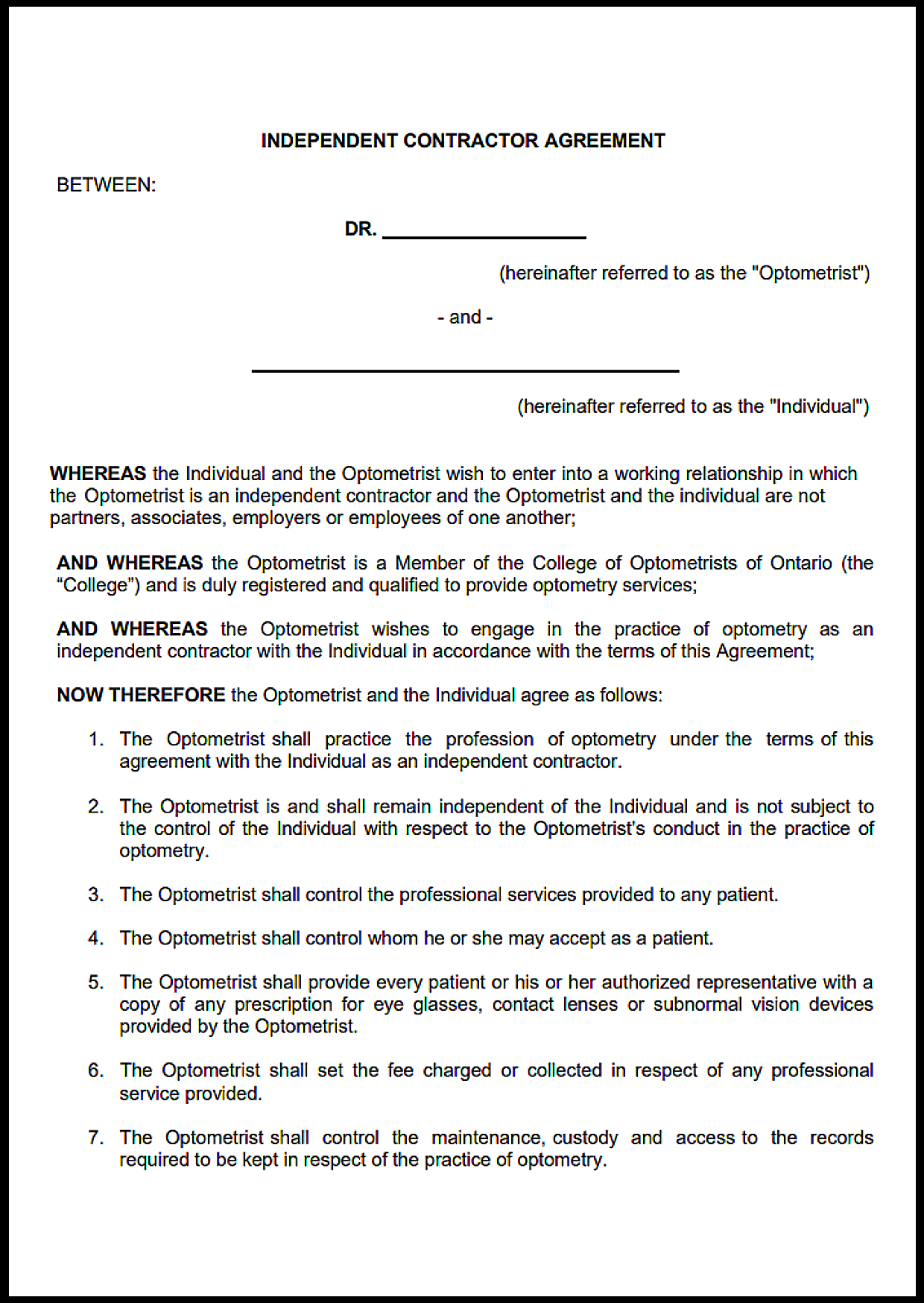
Free Ontario Independent Contractor Agreement Template
Below is a clean and practical template you can copy, edit, and use right away.
Ontario Contractor Classification Laws, WSIB Rules & Legal Requirements
| Topic / Issue | Ontario Legal Rule | Governing Statute |
|---|---|---|
| Governing legislation | Ontario independent contractor agreements are generally governed by contract law, while employment standards and workplace-insurance rules may apply depending on the worker’s actual status and the nature of the work. Federal tax rules also apply to CPP, EI, and income-tax obligations. | Common Law of Contract; Employment Standards Act, 2000; Workplace Safety and Insurance Act, 1997 |
| Federal tax treatment | Federal law governs contractor tax treatment, CPP, and EI obligations. The tax treatment depends on whether the worker is genuinely self-employed or is legally an employee. | Income Tax Act (R.S.C., 1985, c. 1); Canada Revenue Agency rules |
| Recent legislative changes | The Employment Standards Act, 2000 prohibits an employer from treating a person who is an employee as though they were not an employee. Under s. 5.1, where an employer or alleged employer claims that a person is not an employee in an employment-standards proceeding or investigation, the employer or alleged employer generally bears the burden of proving that the person is not an employee. | Employment Standards Act, 2000, s. 5.1 |
| Who can legally sign | A person who is 18 or older is generally presumed capable of entering into a contract. A corporation should have the agreement signed by a person who has authority to bind the corporation. | Age of Majority and Accountability Act; Substitute Decisions Act, 1992 |
| Witness requirement | An ordinary independent contractor agreement does not generally require a witness merely to be a valid contract, although having clear signatures and records can help prove what the parties agreed to. | General contract law |
| Notarization | An ordinary independent contractor agreement generally does not need to be notarized merely to be enforceable, although particular transactions or documents may have additional formal requirements. | General contract law |
| Age and legal capacity | In Ontario, a person who is 18 or older is presumed to be capable of entering into a contract. Contractual capacity can still become an issue where there are reasonable grounds to question a person’s capacity. | Substitute Decisions Act, 1992, s. 2 |
| Time limit to sue | The basic limitation period in Ontario is generally two years from the date a claim is discovered, subject to the exceptions and other rules in the Limitations Act, 2002. | Limitations Act, 2002, ss. 4–5 |
| WSIB clause requirement | For construction work, the agreement should address the parties’ WSIB responsibilities because Ontario’s WSIA contains special compulsory-insurance rules for specified independent operators, sole proprietors, partnerships and corporate officers in construction. | Workplace Safety and Insurance Act, 1997 |
| HST clause requirement | If the contractor is required to register for GST/HST, the agreement can require the contractor to provide its GST/HST registration details and charge HST where applicable. For most businesses, the CRA’s small-supplier threshold is $30,000 over four consecutive calendar quarters, with specific rules applying when the threshold is exceeded in a single quarter. | Excise Tax Act, R.S.C., 1985, c. E-15, s. 148 |
| Filing requirement | An ordinary independent contractor agreement is a private contract and does not generally have to be filed with the Ontario government. | General contract law |
| Business name registration | An individual carrying on business in Ontario under a name other than their own name generally must register that business name under the Business Names Act. | Business Names Act, R.S.O. 1990, c. B.17 |
| WSIB registration | Construction businesses and workers can be subject to Ontario’s compulsory WSIB rules, while independent operators outside the construction industry are not automatically required to register simply because they are independent operators. | Workplace Safety and Insurance Act, 1997 |
| Misclassification risk | Calling a worker an “independent contractor” does not determine their legal status. Ontario employment standards and federal tax authorities can consider the actual working relationship, including factors such as control, tools, financial risk and opportunity for profit. | Employment Standards Act, 2000; federal tax rules |
| Illegal purpose | A contractor agreement should not be drafted to evade mandatory tax, employment or WSIB obligations. A contractual label does not override applicable legislation or the parties’ actual working relationship. | Applicable Ontario and federal legislation; common law |
| Unconscionability | Courts may refuse to enforce an unconscionable contractual term where the applicable legal test is met. Whether consumer-protection legislation applies depends on the parties, transaction and legislation involved. | Canadian common law; Uber Technologies Inc. v. Heller, 2020 SCC 16 |
| Construction industry difference | Ontario’s WSIA contains compulsory-insurance rules for specified independent operators, sole proprietors, partnerships and executive officers carrying on business in construction, subject to statutory exceptions. | Workplace Safety and Insurance Act, 1997, s. 12.2 |
| Dependent contractor category | Ontario common law recognizes a dependent-contractor category between employee and independent contractor status. Where a contractor is economically dependent, including through complete or near-complete exclusivity, reasonable notice may be required on termination. | Ontario common law; McKee v. Reid’s Heritage Homes Ltd., 2009 ONCA 916 |
One of the biggest legal risks in Ontario contractor agreements is worker misclassification. Many businesses believe simply calling someone an “independent contractor” in a contract is enough, but Ontario law looks at the real working relationship instead. If the business controls the contractor’s schedule, tools, or work process too closely, the contractor may legally be treated as an employee.
This matters because businesses can face CRA tax issues, WSIB problems, and employment-related claims if the classification is wrong. Ontario has special WSIB rules for specified construction workers and businesses. Another important Ontario rule is the “dependent contractor” category. A contractor who is economically dependent on one company may, in appropriate circumstances, have a right to reasonable notice on termination under the common law.
These rules matter because poorly drafted agreements can create expensive disputes, back-pay claims, and tax problems later. The free Ontario Independent Contractor Agreement template below can help you document the main terms of the relationship, but the agreement should be adapted to the actual work arrangement and applicable Ontario requirements.
Understanding the Agreement, Usage & Key Clauses
What Is an Independent Contractor Agreement in Ontario?
An independent contractor agreement is a legal contract between a business and a worker who is engaged to provide services rather than employed under a contract of service.
Unlike employees, a genuinely independent contractor may:
- Work independently
- Have greater control over how the work is performed
- Handle their own tax obligations, depending on their actual legal and tax status
Under Ontario law, a contract generally requires agreement between the parties and consideration, along with other requirements of enforceability. The specific circumstances determine whether a binding contract was formed.
- One party makes an offer
- The other accepts it
- Both exchange something of value (called “consideration”)
A written agreement is not generally required simply because the parties intend to create an independent-contractor relationship, but written terms can make the parties’ obligations and evidence of the agreement much clearer.
This is especially important for classification. If the actual relationship resembles employment, the contract’s label alone will not prevent an employee finding or other legal consequences.
When Should You Use This Agreement?
You should use this agreement when you engage someone to provide services as an independent contractor rather than as an employee.
Common situations include:
- Freelancers (writers, designers, developers)
- Business consultants or advisors
- Project-based work
- Remote or short-term roles
Real-life example:
A startup hires a freelance web developer for a 2-month project. Without an agreement, there could be confusion about payment, deadlines, or ownership of the website.
Independent contractors frequently sign confidentiality clauses, so reviewing the [main NDA guide] can help ensure proper protection of business information.
Key Clauses That Protect You (Must-Have Sections)
Clear Scope of Work
Spell out the contractor’s deliverables rather than relying on a broad job description. For a design, consulting or development project, identify the expected work product, deadlines, revision limits and any approval process. Clear scope terms also make later payment and ownership disputes easier to resolve.
Payment & Invoicing Terms
This clause should clearly state how much will be paid, whether the rate is fixed or hourly, when invoices should be submitted, and when payment is due. If the parties agree to interest or other charges for late payment, those terms should also be stated clearly and comply with applicable law.
Independent Status Clause
This clause records the parties’ intention to create an independent-contractor relationship. It does not, however, decide the worker’s legal status. Ontario employment standards and federal tax authorities can look at the actual working relationship.
The agreement can also state that the contractor is responsible for their own business expenses and tax obligations where legally appropriate. However, the wording should not be used to remove statutory rights that apply if the worker is legally an employee.
Confidentiality Clause
If the contractor will receive client information, pricing data, source files or other confidential business information, the agreement should identify what must remain confidential and what the contractor may do with that information during and after the engagement.
Intellectual Property Ownership
Copyright ownership should be addressed expressly in the agreement. Where the contractor is the first owner of copyright, a written assignment can transfer copyright rights to the client. Moral rights are separate: they cannot be assigned, but the Copyright Act permits them to be waived in whole or in part. If the client needs the ability to modify or use the work without restrictions arising from moral rights, the agreement should address an appropriate moral-rights waiver.
Copyright Act, R.S.C., 1985, c. C-42, ss. 13, 14.1
Termination Conditions
Because Ontario common law recognizes reasonable notice as a possible remedy for dependent contractors, a termination clause should clearly state the parties’ intended notice or termination terms. Whether the clause is enforceable will depend on the wording and the legal status of the worker and relationship.
The agreement can set out notice periods, payment-in-lieu provisions and circumstances allowing termination for cause. However, the parties should not assume that a contractual label alone eliminates legal rights that may arise from the actual relationship.
Ontario Common Law; McKee v. Reid’s Heritage Homes Ltd., 2009 ONCA 916
Legal Validity, Contractor vs Employee & Taxes
Is This Agreement Legally Valid in Ontario?
An Ontario contractor agreement is generally enforceable when the parties have formed a binding contract and the terms are sufficiently clear and lawful.
A contract may involve:
- Offer
- Acceptance
- Consideration
It should also:
- Clearly identify the parties and their obligations
- Set out sufficiently clear terms
- Comply with applicable law
Written agreements are easier to use as evidence of what the parties agreed.
Ontario’s Electronic Commerce Act generally recognizes electronic signatures and electronic contracts, subject to the Act’s exclusions and any other applicable legal requirements.
Independent Contractor vs Employee
This is where many businesses make mistakes.
| Factor | Contractor | Employee |
| Control | May have greater independence over how work is performed |
Employer generally exercises greater control over the work
|
| Taxes | A genuinely self-employed contractor generally handles their own tax obligations |
Employer may have payroll deduction and remittance obligations
|
| Benefits | Not automatically entitled to employee benefits |
May receive statutory and contractual employment benefits
|
| Legal risk | Classification still depends on the actual relationship |
Misclassification can create employment-law and tax consequences
|
Under CRA guidelines, classification depends on the facts of the relationship, including:
- Who controls the work
- Who provides tools
- Whether the worker can subcontract or hire assistance
- Financial risk
- Investment and management of the business
- Chance of profit
If you misclassify:
- You may owe amounts that should have been deducted or remitted
- You may face penalties or other legal consequences
Tax Responsibilities in Ontario (Very Important)
A genuinely self-employed contractor generally handles their own income-tax and CPP obligations. But the contract label is not decisive. If the actual relationship is one of employment, the business may have payroll obligations.
This may include:
- Income tax
- CPP contributions
- HST (if applicable)
A contractor’s GST/HST responsibilities depend on whether they are required to register and the nature of their taxable supplies.
They do NOT automatically receive:
- Ordinary employee Employment Insurance (EI) coverage
- Employee benefits
Simple explanation:
If the worker is genuinely self-employed, they generally handle their own business tax obligations and the business normally pays the contractor according to the agreed invoice or payment terms. If the worker is actually an employee, the business may have payroll obligations instead.
A business generally does not make employee payroll deductions for a worker who is genuinely self-employed, but it may have payroll obligations if the worker is legally an employee.
This document is often used alongside a [consulting agreement] or a [freelance contract template], depending on the nature of the work arrangement.
Mistakes, Risks & How to Use This Template
Common Mistakes to Avoid
For an Ontario contractor arrangement, check the classification before relying on the agreement’s label. Then document the scope, payment schedule, ownership of work and termination terms. If the work is in construction, separately check whether WSIB compulsory-coverage rules apply.
- Treating a worker as a contractor when the actual relationship resembles employment
- Not clearly defining the work scope
- Ignoring ownership of work
- Not setting payment terms
- Failing to consider applicable WSIB obligations
These problems can make disputes harder to resolve.
Legal Risks Without This Agreement
A missing written agreement can make an Ontario contractor dispute harder to resolve because important terms may be left to emails, invoices and other evidence. Classification can also become an issue if the actual relationship resembles employment, while construction businesses may have separate WSIB obligations.
How to Fill and Use This Template (Step-by-Step)
Follow these simple steps:
Step 1: Add names and contact details
Make sure both parties are clearly identified
Step 2: Define the work clearly
Be specific about tasks and deliverables
Step 3: Set payment terms
Include amount, method, and schedule
Step 4: Review all clauses
Check confidentiality, ownership, and termination
Step 5: Sign and share copies
Each party should keep a signed version
Real-Life Example
A small Ontario business hires a freelance graphic designer for a fixed project.
The agreement should identify the deliverables, payment schedule, revision limits, copyright ownership, confidentiality obligations and termination terms. The business should also make sure the actual working relationship is consistent with independent-contractor status.
This gives both sides a clearer record of their rights and responsibilities and can reduce avoidable disputes.
FAQs
Do I need a lawyer for this agreement?
Not always. A straightforward freelance arrangement may be documented using a template. For complex arrangements, significant intellectual-property rights, restrictive covenants, construction work, or uncertainty about worker classification, legal advice can be worthwhile.
Can a contractor become an employee?
Yes. Calling someone a contractor does not determine their legal status. If the actual working relationship has characteristics of employment, Ontario employment standards and federal tax authorities may treat the worker differently.
Is a verbal agreement valid in Ontario?
Yes, a verbal contractor agreement can be legally binding in appropriate circumstances. The difficulty is proving the exact scope, payment terms and other conditions if the parties later disagree, which is why written terms are usually preferable.
Who owns the work created?
It depends on the agreement and applicable copyright law. If the contractor is the first owner of copyright, a written assignment can transfer copyright rights to the client. The agreement should also address moral rights where appropriate.
Do contractors get benefits in Ontario?
Independent contractors are not automatically entitled to employee benefits under Ontario employment standards. The parties can, however, agree to additional contractual compensation or benefits.