Ontario Bill of Sale vs Ownership | Key Differences Explained
Bill of Sale vs Ownership Ontario is one of the most misunderstood topics in private vehicle sales. Many buyers believe a Bill of Sale proves ownership—but under Ontario law, that is not fully true.
I have seen many Ontario buyers walk into ServiceOntario thinking the Bill of Sale alone proves legal ownership, only to find out the vehicle permit and transfer process were never properly completed. In disputes over unpaid tickets, taxes, or vehicle history problems, this misunderstanding creates serious headaches that could have been avoided from the start.
In most private sale situations, both documents serve different purposes. If you mix them up, you can face registration problems, tax issues, or even legal disputes.
This article will help you:
- Understand the difference clearly
- Avoid costly mistakes
- Learn exactly what you need to transfer ownership in Ontario
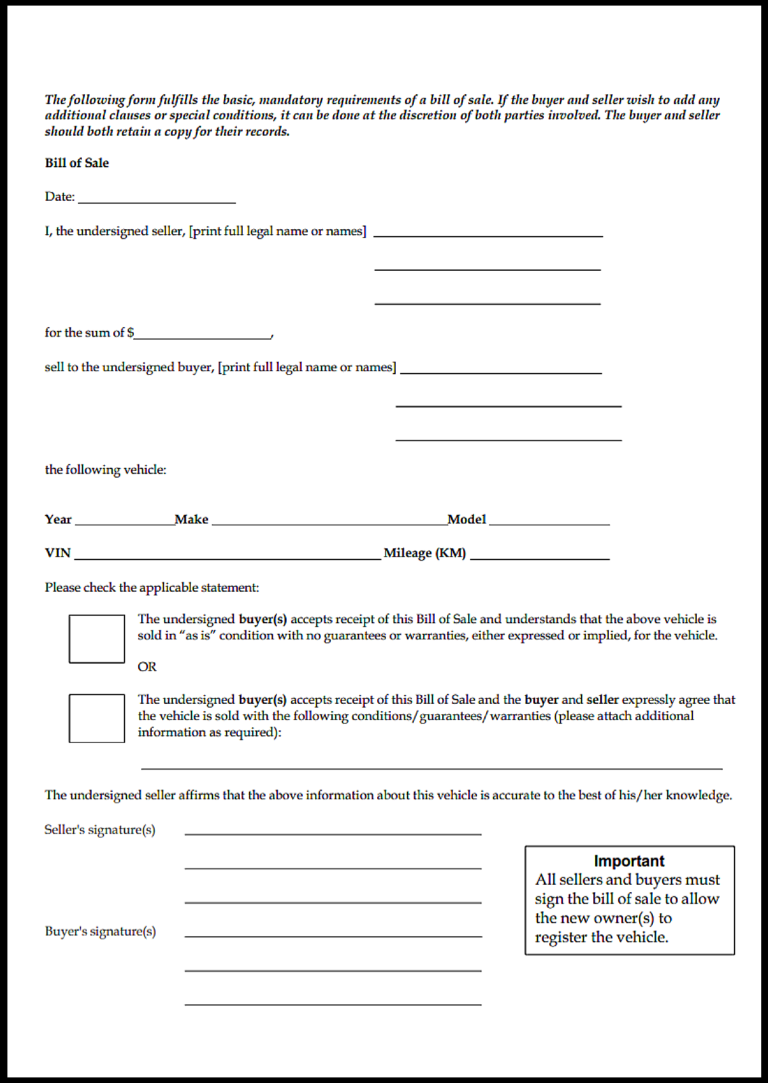
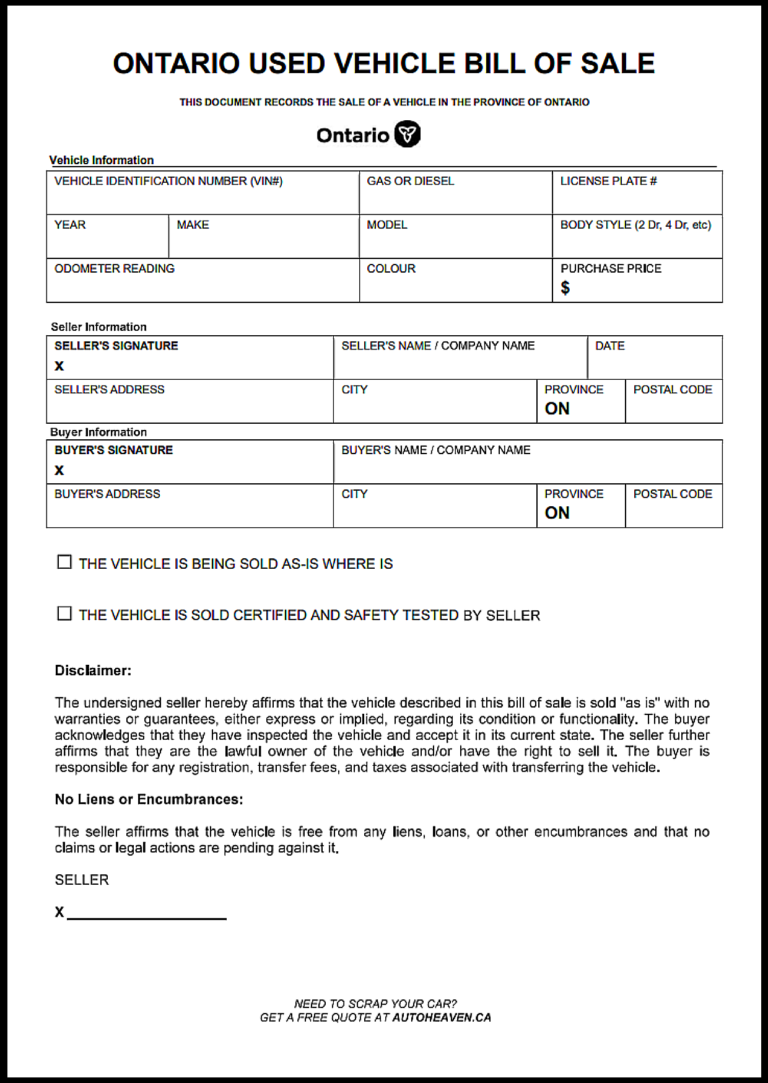
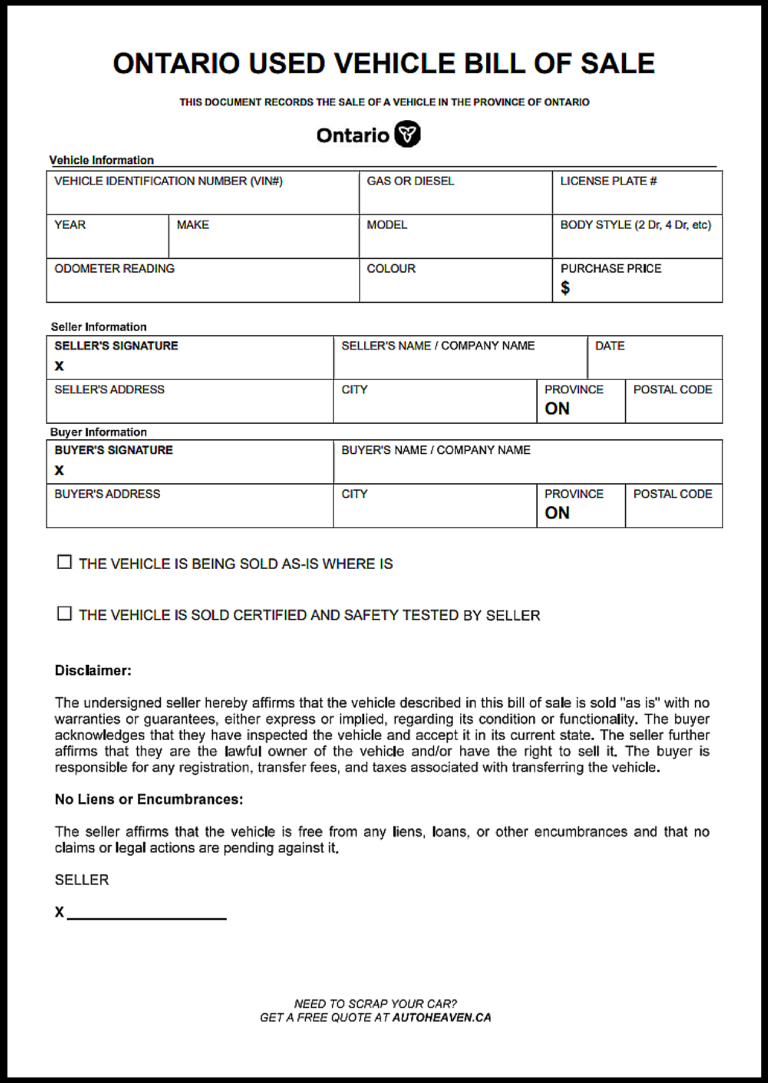
Free Ontario Bill of Sale Template for Private Sales
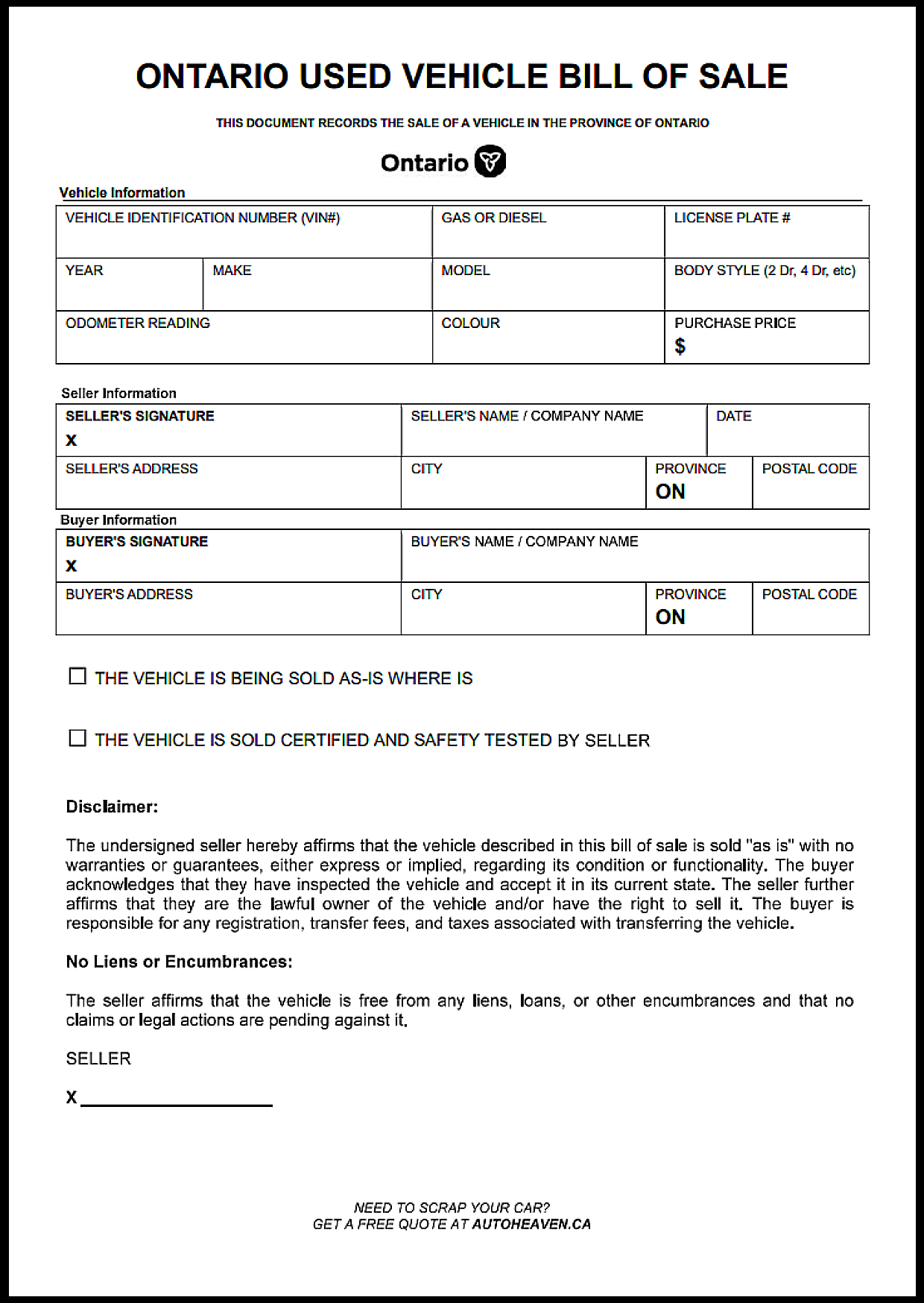
Use this simple, Ontario-ready template for private sales. You can copy and use it directly:
Ontario Legal Rules That Separate a Bill of Sale From Ownership
| Topic / Issue | Ontario Legal Rule | Governing Statute |
|---|---|---|
| Vehicle registration and transfer law | Vehicle ownership transfers and registration are governed by provincial transportation law. | Highway Traffic Act, R.S.O. 1990, c. H.8 |
| Contractual transfer of personal property | Bills of Sale for personal property are governed by contract sale law. | Sale of Goods Act, R.S.O. 1990, c. S.1 |
| Tax collection on private transfers | Retail Sales Tax applies during private vehicle ownership transfers. | Retail Sales Tax Act, R.S.O. 1990, c. R.31 |
| Federal involvement | Vehicle title and private vehicle sales are purely provincial matters in Ontario. | No federal act applies |
| Who can sign | The registered owner whose name is printed on the vehicle permit must execute the transfer application on the reverse side of the vehicle portion. | HTA, R.S.O. 1990, c. H.8, s. 11(1) |
| Witness requirement | Witnesses are not legally required. | N/A |
| Notarization requirement | Notarization is not required for standard sales, except family gift transfers. | N/A |
| Minimum age and capacity | An individual must be at least 16 years of age to hold a vehicle permit (R.R.O. 1990, Reg. 628, s. 2). However, contractual capacity to execute a Bill of Sale is governed by common law and the Sale of Goods Act, meaning transactions with individuals under 18 for non-necessaries are voidable. | Sale of Goods Act, R.S.O. 1990, c. S.1, s. 3; R.R.O. 1990, Reg. 628, s. 2 |
| Registration deadline | The transferee must submit the executed vehicle portion of the permit to ServiceOntario to register the change of ownership within 6 days of the transaction. | HTA, R.S.O. 1990, c. H.8, s. 11(2) |
| Mandatory Bill of Sale details | The document must contain VIN, make, model, body type, purchase price, sale date, and full buyer/seller details. | HTA, s. 11 |
| Implied seller warranties | Ontario law assumes the seller has the legal right to sell the vehicle unless stated otherwise. | Sale of Goods Act, s. 13 |
| “As-Is” clause use | “As-Is” clauses are commonly used to limit implied warranties under contract law. | Sale of Goods Act principles |
| Registration filing process | The Bill of Sale, UVIP, and signed ownership permit must be submitted to ServiceOntario. | Highway Traffic Act / ServiceOntario process |
| Two-part ownership transfer rule | The seller must sign the transfer application section on the back of the Vehicle Portion only and deliver it to the buyer. The seller must retain the Plate Portion of the permit to prevent ongoing vicarious liability for the vehicle. | HTA, R.S.O. 1990, c. H.8, s. 11(1) & s. 11(2) |
| Inconsistent VIN | A VIN mismatch between documents and the vehicle can void the transfer. | HTA, s. 11 |
| Missing UVIP | Sellers must provide a valid Used Vehicle Information Package dated within 30 days. | HTA, s. 11.1(1) |
| Undisclosed liens | Buyers may not receive clear title if the vehicle has an active lien. | Personal Property Security Act (PPSA) |
| Ontario-specific UVIP rule | Ontario requires sellers to provide a government-issued UVIP during private sales. | HTA, s. 11.1 |
| Ontario’s 6-day registration rule | “Ontario strictly enforces a 6-day statutory window from the date of transfer for the buyer to register the updated vehicle permit. | HTA, R.S.O. 1990, c. H.8, s. 11(2) |
| Ontario wholesale value tax rule | Retail Sales Tax is charged on the greater of the sale price or wholesale value listed in the UVIP. | Retail Sales Tax Act / UVIP process |
One of the most misunderstood rules in Ontario is that a Bill of Sale alone does not make you the legal owner of a vehicle. Many buyers think the signed sale document is enough, but Ontario law also requires the signed ownership permit and the UVIP before ServiceOntario will complete the transfer. This is why the “two-part” ownership rule is so important in real life.
The VIN matching rule is another major issue buyers often overlook. If the VIN on the Bill of Sale does not exactly match the ownership permit or the vehicle itself, the transfer can be rejected immediately. Ontario’s strict 6-day registration deadline also catches many people by surprise, especially compared to provinces that allow more time.
The lien rules matter just as much because a buyer can still lose the vehicle if there is an unpaid secured debt attached to it. Missing these requirements can lead to registration refusal, tax problems, financial loss, or legal disputes. Download the free Ontario Bill of Sale template below to make sure your paperwork is completed correctly from the start.
Understanding Bill of Sale vs Ownership in Ontario
What Is a Bill of Sale in Ontario?
A Bill of Sale is a written record of a transaction between a buyer and seller.
Under Ontario law, it is commonly used in private sales such as:
- Cars and trucks
- Motorcycles
- Furniture or electronics
It acts as:
- Proof of payment
- Agreement between both parties
However, it is important to understand:
A Bill of Sale does NOT prove legal ownership on its own.
What Is Vehicle Ownership (Ownership Permit)?
The vehicle ownership document (also called the ownership permit) is the official proof of ownership in Ontario.
It is issued by the government through ServiceOntario and includes:
- Vehicle portion (Permit Category: Vehicle Portion — must be signed on the reverse by the seller and surrendered to the buyer to complete the transfer) \n Plate portion (Permit Category: Plate Portion — must be detached and retained permanently by the seller along with the physical platesThis is the document that legally shows who owns the vehicle.
Key Difference: Bill of Sale vs Ownership
Here is a simple comparison to remove confusion:
| Feature | Bill of Sale |
Ownership Permit
|
| Legal Status | Proof of sale |
Legal proof of ownership
|
| Issued By | Buyer & Seller |
Government (ServiceOntario)
|
| Required for Registration | Yes (supporting) | Mandatory |
| Can You Drive Without It? | Yes (The Bill of Sale is not a highway operations document) | No (The validated vehicle permit and corresponding plates must be inside the vehicle under HTA s. 7) |
In simple terms:
- Bill of Sale = proof you bought it
- Ownership = proof you own it legally
Many people confuse a bill of sale with ownership documents, but they serve different legal purposes. To understand this distinction clearly, refer to the complete bill of sale guide and examples like the vehicle transfer document.
Why Both Documents Are Needed in Ontario
In most private vehicle sales, you need both documents together.
Real-life example
You buy a used car from a private seller.
You will need:
- Bill of Sale → proves purchase price (used to calculate tax)
- Ownership permit → required to transfer the vehicle into your name
Without both:
- You cannot complete registration
- You may face delays or rejection
Ontario uses the sale price (or market value) to calculate Retail Sales Tax, so the Bill of Sale is important.
How Ownership Transfer Works in Ontario
Here is the correct step-by-step process:
- Get a signed Bill of Sale from the seller
- Receive the signed ownership permit
- Obtain the Used Vehicle Information Package (UVIP)
- Visit ServiceOntario
- Pay taxes and registration fees
- Register the vehicle in your name
Common Mistakes Buyers Make
Many buyers make simple mistakes that lead to serious problems.
Thinking Bill of Sale = Ownership
This is the most common mistake. Without ownership transfer, you are not the legal owner.
Not verifying VIN
If the VIN does not match:
- You may be buying a stolen vehicle
- Registration can be denied
Missing seller signature
An unsigned document may be considered invalid.
Buying without UVIP
Sellers are required to provide a UVIP in private vehicle sales in Ontario.
Not checking liens
If there is an unpaid loan on the vehicle:
- You could lose the car
- Or be forced to pay the debt
Legal Risks If You Only Have a Bill of Sale
If you only have a Bill of Sale, you are exposed to serious risks.
- You are not the legal owner
- You cannot register the vehicle
- Insurance may not be valid
- Risk of fraud or stolen vehicle
Real-life scenario
A buyer purchases a used car and receives only a Bill of Sale. The seller disappears without signing the ownership permit.
Result:
- The buyer cannot register the vehicle
- Cannot legally drive it
- Money is lost
This situation happens more often than people expect in private sales.
When a Bill of Sale Is Enough (Non-Vehicle Cases)
For non-registered items, a Bill of Sale is usually sufficient.
Examples:
- Furniture
- Electronics
- Small personal items
In these cases:
- Ownership transfer is informal
- No government registration is required
So, the Bill of Sale acts as both:
- Proof of purchase
- Proof of ownership (practically)
You can also review when a bill of sale is required and how it fits into compliance rules outlined in the Ontario requirements guide.
Key Details Required in Both Documents
Bill of Sale Must Include:
- Buyer and seller information
- Date of sale
- Vehicle or item details
- Sale price
- Signatures
Ownership Must Include:
- Registered owner’s name
- Vehicle Identification Number (VIN)
- Plate information
FAQs
Is a Bill of Sale proof of ownership in Ontario?
No. It is only proof of the transaction, not legal ownership.
Can I transfer ownership without a Bill of Sale?
In most cases, no. It is required to support registration and tax calculation.
Do I need both documents to register a car?
Yes. Both are required for a proper transfer.
What happens if ownership is missing?
You cannot register or legally drive the vehicle.
Can I drive with just a Bill of Sale?
No. You need registered ownership to drive legally.
Conclusion
The difference between Bill of Sale vs Ownership Ontario is simple but very important.
- A Bill of Sale shows you bought the vehicle
- Ownership shows you legally own it
In Ontario vehicle transactions, you need both documents together.
To stay safe:
- Always verify documents
- Never skip ownership transfer
- Check VIN and liens carefully
Taking these steps can protect you from legal trouble and financial loss.