Ontario Vendor Agreement Template – Free Legal Form for Ontario
An Ontario Vendor Agreement is often prepared when a business is ready to purchase goods, hire a supplier, or formalise an ongoing commercial relationship, but many people don’t realise how quickly a deal can become complicated when key terms are left to emails or verbal discussions. In Ontario, vendor arrangements involving the sale of goods may also engage the Sale of Goods Act, making it important to clearly identify what is being supplied, when payment is due, and who bears responsibility if something goes wrong.
I’ve seen situations where businesses started work based on a short email chain, only to find themselves arguing over pricing and deliverables when a dispute later reached the Ontario Small Claims Court (for claims up to $35,000) or the Ontario Superior Court of Justice (for claims exceeding $35,000, where severe cost penalties apply under the Rules of Civil Procedure if an action is brought in the wrong forum).A well-drafted agreement helps reduce that uncertainty by setting expectations from the start and creating a clear record of the arrangement.
Last Updated: September 2026
Below, you’ll find an Ontario Vendor Agreement template along with practical information about key clauses, execution requirements, and common issues that arise in commercial transactions.
Table of Contents
ToggleFree Ontario Vendor Agreement Template
You can copy and use this template for most business situations. Just edit the details based on your needs.
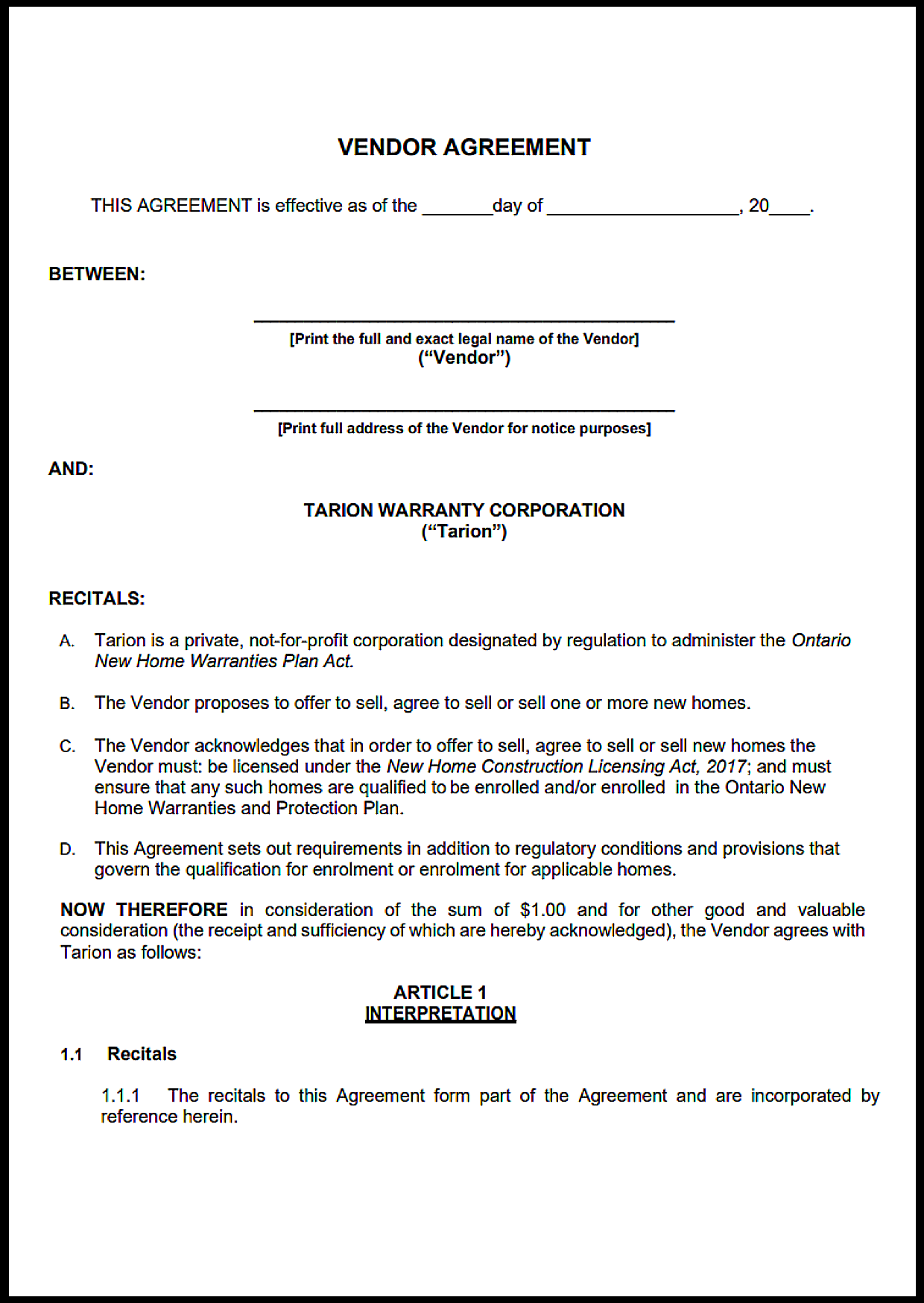
Quick tip: Keep a signed copy (digital or printed). In most business disputes, the written agreement is your strongest proof.
Ontario Vendor Agreement Laws, Consumer Rules & Contract Requirements
| Topic / Issue | Ontario Legal Rule | Governing Statute |
|---|---|---|
| Governing legislation | Vendor agreements in Ontario are governed by provincial common law contract principles, specific commercial sale rules, and consumer frameworks where applicable. | Sale of Goods Act, R.S.O. 1990, c. S.1; Consumer Protection Act, 2002, S.O. 2002, c. 30, Sched. A; Electronic Commerce Act, 2000, S.O. 2000, c. 17 |
| Federal oversight | Vendor pricing, advertising, and marketing practices may fall under federal competition law. | Competition Act, R.S.C., 1985, c. C-34 |
| Recent amendments | Ontario continues to operate under the Consumer Protection Act, 2002 framework. The Consumer Protection Act, 2023 has received Royal Assent but remains not yet in force because its commencement depends on proclamation. | Consumer Protection Act, 2002, S.O. 2002, c. 30, Sched. A; Consumer Protection Act, 2023 |
| Legal signatory | An individual who has authority to enter into the agreement may sign on behalf of the individual or business. For a corporation, the person signing should have appropriate actual or apparent authority to bind the corporation. | Applicable contract and corporate law |
| Witness requirement | An ordinary vendor agreement generally does not require a witness merely to make the contract enforceable, although particular transactions or documents may have additional formal requirements. | N/A |
| Notarization | An ordinary vendor agreement generally does not need to be notarized merely to be enforceable, unless another applicable legal requirement calls for notarization. | N/A |
| Age requirement | Ontario’s age of majority is 18, but contractual capacity can depend on the circumstances and applicable rules. The Sale of Goods Act also contains a specific rule concerning necessaries supplied to a minor. | Age of Majority and Accountability Act, R.S.O. 1990, c. A.7, s. 1; Sale of Goods Act, s. 3 |
| Mental capacity | Contractual capacity can depend on whether a party has the legal capacity to enter into the agreement, and capacity issues may require a fact-specific legal assessment. | Common law principles |
| Time limit to sue | The basic limitation period in Ontario is generally two years from when the claim is discovered, subject to exceptions and other applicable limitation rules. | Limitations Act, 2002, S.O. 2002, c. 24, Sched. B, ss. 4–5 |
| Cooling-off notice requirement | For qualifying direct agreements covered by the Consumer Protection Act, 2002, a consumer may generally cancel from the date of entering into the agreement until 10 days after receiving the written copy, with additional cancellation rights in certain circumstances. | Consumer Protection Act, 2002, s. 43 |
| Itemized disclosure requirement | Certain consumer agreements, including qualifying internet, remote, direct and future-performance agreements, have specific disclosure, copy-delivery and cancellation requirements. The requirements vary by the type of agreement. | Consumer Protection Act, 2002 |
| B2B contract language | Business-to-business vendor agreements generally allow substantial freedom of contract, subject to applicable legislation, mandatory legal rules and common-law doctrines. | Governed by common law principles |
| Filing requirement | An ordinary vendor agreement generally does not need to be filed with the government, although a separate registration may be required if the transaction creates a registrable security interest. | N/A |
| Security interest registration | Where a transaction creates a purchase-money security interest in inventory, the Personal Property Security Act sets specific perfection and notice requirements for obtaining PMSI priority, including perfection when the debtor obtains possession and advance written notice to certain existing secured parties. | Personal Property Security Act, R.S.O. 1990, c. P.10, s. 33 |
| Failure to disclose required information | The Consumer Protection Act, 2002 provides one-year cancellation or rescission rights in certain specified circumstances, such as particular failures involving consumer agreements or unfair practices; the right does not apply to every vendor agreement. | Consumer Protection Act, 2002 |
| False or misleading representations | Where a consumer agreement is entered into after or while a person has engaged in an unfair practice, the Consumer Protection Act, 2002 may allow the consumer to rescind the agreement and seek other remedies, subject to the Act’s requirements, including its notice period. | Consumer Protection Act, 2002, ss. 14, 15, 17, 18 |
| Illegal consideration | Agreements involving illegal acts or statutory violations may be affected by common-law doctrines of illegality and other applicable legal rules. | Common law doctrine of statutory illegality |
| Ontario limitation period difference | Ontario generally has a two-year basic limitation period for claims, calculated from discovery, but exceptions and other limitation rules can apply. | Limitations Act, 2002 |
| Writing requirement difference | Ontario’s Sale of Goods Act expressly permits a contract of sale to be made in writing, orally, partly in writing and partly orally, or by the conduct of the parties. Section 5 of the Act has been repealed. | Sale of Goods Act, s. 4 |
| Implied quality condition | Section 15 of the Sale of Goods Act contains specified implied conditions concerning quality and fitness, including merchantable quality in qualifying sales by description. Section 53 permits certain implied rights, duties and liabilities under a sale of goods contract to be varied by express agreement, subject to other applicable law. | Sale of Goods Act, R.S.O. 1990, c. S.1, ss. 15 and 53 |
One of the most important Ontario vendor agreement rules involves consumer disclosure requirements. Certain types of consumer agreements have specific disclosure, copy-delivery and cancellation rules. If a vendor does not meet those requirements, the consumer may have statutory cancellation or other remedies depending on the type of agreement and the circumstances.
Another important point is Ontario’s basic 2-year limitation period. Businesses that wait too long to act after discovering a claim may lose the ability to bring an action, subject to exceptions and other applicable limitation rules. Section 15 of the Sale of Goods Act also contains specified implied conditions concerning quality and fitness in qualifying sales. In some commercial transactions, section 53 may allow certain implied terms to be varied or excluded by express agreement, but a disclaimer does not automatically eliminate every potential quality, warranty, misrepresentation or other contractual claim. Consumer transactions may also be subject to mandatory protections under the Consumer Protection Act, 2002.
Ontario’s Sale of Goods Act permits contracts of sale to be made orally or partly orally, but relying on verbal terms can make it harder to prove what the parties actually agreed to. A written vendor agreement provides a clearer record of the commercial arrangement.
Understanding Ontario Vendor Agreements
What Is an Ontario Vendor Agreement?
In simple terms, it’s a legal contract between a business and a vendor that:
- Covers goods or services being provided
- Sets payment rules
- Defines delivery timelines
- Explains expectations clearly
A vendor agreement generally requires the elements of a valid contract, which can include offer, acceptance, consideration, an intention to create legal relations and sufficiently certain terms, subject to the circumstances and applicable law.
These are important elements of contract formation, but enforceability also depends on the wording of the agreement, the parties’ authority and capacity, applicable legislation, and any other circumstances affecting the contract.
When Should You Use a Vendor Agreement?
A written vendor agreement is particularly useful when a transaction involves recurring purchases, significant payments, detailed delivery obligations, or services that need clear performance standards.
Common situations include:
- Hiring vendors for events (catering, décor, rentals)
- Buying products for resale (retail or eCommerce)
- Outsourcing services (cleaning, IT, maintenance)
- Working with repeat suppliers
- Any ongoing business relationship
Real-world insight: Many vendor disputes start with a simpler problem: the parties remember the deal differently. Writing down price, delivery, quality and payment terms gives both sides a clearer record.
Vendors often exchange sensitive information, so it’s useful to review the [Ontario NDA resource] when drafting a legally secure agreement.
Key Clauses That Protect You
Scope of Goods or Services
Start with the deliverables. Identify the goods or services, quantities, specifications and any required standards so there is less room for disagreement about what the vendor actually promised to provide. If the transaction involves products, include enough detail to identify the products clearly. For services, describe the expected work and deliverables.
Payment Terms & Late Fees
State the invoice date, payment deadline, accepted payment method and any agreed interest or late-payment charge. That gives both sides a clear reference point if an invoice later becomes disputed. If taxes such as HST apply, the agreement should also make clear whether the stated price includes or excludes applicable taxes.
Delivery Timeline & Conditions
This clause should clearly state when the goods or services will be delivered, where they will be delivered, and who is responsible for transportation. If timing is important, especially for an event or time-sensitive business order, the agreement can also specify the consequences of a material delay.
Quality & Performance Standards
Where quality matters, identify an objective standard, specification, sample, inspection process or acceptance requirement. The more measurable the standard, the easier it is to determine whether the agreed deliverable was supplied. For goods, consider identifying applicable product specifications and agreed inspection or rejection procedures.
Liability & Indemnity Clause
This clause sets out who bears responsibility if something goes wrong. The agreement can address liability for negligence, breach of contract, third-party claims and other identified risks. Any limitation or exclusion of liability should be drafted carefully and reviewed against applicable law.
Termination Rights
Not every agreement goes smoothly, so it’s important to include an exit option. This section should state the agreed notice period and identify circumstances that permit termination without notice, subject to the terms of the agreement and any mandatory legal requirements. Clear termination rights help both parties understand what happens when the relationship needs to end.
Is a Vendor Agreement Legally Valid in Ontario?
Yes, a vendor agreement can be enforceable in Ontario when the requirements for contract formation are satisfied and its terms are enforceable under applicable law.
Here’s a quick breakdown:
| Requirement | What It Means |
| Offer |
One party proposes terms
|
| Acceptance |
Other party agrees
|
| Consideration |
Payment or another legally recognized exchange of value
|
| Clear Terms |
The parties’ obligations are sufficiently certain
|
A contract can be:
- Written
- Digital
- Even email-based, depending on the circumstances
Ontario law recognizes qualifying electronic documents, electronic signatures and electronic contracts. A consolidated written agreement can make the agreed terms easier to prove.
This agreement is typically used alongside a [service contract] or a [partnership agreement] depending on the business arrangement.
Ontario Laws That May Affect Vendor Agreements
While vendor agreements are flexible, some laws may apply depending on your situation.
Key areas to consider:
- Consumer protection laws
If you deal with individuals, extra rules may apply. - Tax obligations (HST)
Vendors may need to charge and report HST depending on their circumstances. - Industry-specific rules
Food, construction, health services and other regulated activities may be subject to additional requirements.
Important: Under Ontario law, contracts cannot override mandatory legal rules.
How to Fill Out the Template (Step-by-Step)
Follow this simple process:
- Use full legal names (not nicknames)
- Clearly describe goods/services
- Add exact payment details
- Set realistic delivery timelines
- Review everything before signing
Pro tip: If something feels unclear, rewrite it. Clarity prevents disputes.
Common Mistakes to Avoid
Before signing, compare the draft against the actual transaction. Check that the goods or services, price, delivery obligations, payment dates and remedies reflect what the parties actually agreed.
- Vague service descriptions
- Missing delivery deadlines
- No payment schedule
- No termination clause
- Relying on verbal agreements
Even a simple written contract can provide a clearer record of the parties’ agreement than relying entirely on informal conversations.
Real-Life Example
A small business hires a catering vendor for an event and the agreement specifies the delivery time, payment schedule, acceptable performance standards and the remedy for a material delay.
If a dispute arises, those written terms give the parties a clearer record of what they agreed to than a series of informal conversations alone.
Vendor Agreement vs Service Agreement
| Feature | Vendor Agreement |
Service Agreement
|
| Focus | Goods, services, or both |
Primarily services
|
| Delivery terms | Can address delivery of goods or services |
Can address service delivery
|
| Product supply | Can be included |
May or may not be included depending on the agreement
|
If your arrangement includes both products and services, use an agreement that clearly covers both components rather than choosing solely by the document’s title.
Frequently Asked Questions
Do I need a lawyer to create a vendor agreement?
Not always. For a straightforward transaction, a well-customized template may be a useful starting point. For complex, high-value, unusual or heavily negotiated contracts, legal advice can help identify risks before signing.
Can I use the same template for every vendor?
You can use the same basic template as a starting point, but each agreement should be customized to the transaction. In particular, review:
- Services or goods
- Payment
- Timeline
- Delivery obligations
- Quality requirements
- Termination rights
Is an email agreement legally binding in Ontario?
Yes, an agreement may be formed through electronic communications, including email, depending on the parties’ communications and the requirements for contract formation. A consolidated written agreement can make the agreed terms easier to prove.
What happens if a vendor does not deliver?
Depending on the contract and circumstances, you may have remedies such as pursuing damages, enforcing contractual rights, rejecting non-conforming goods where permitted, or relying on other remedies available under the Sale of Goods Act.
Final Thoughts
A vendor agreement is most useful when it records the terms that are easiest to misunderstand later: what is being supplied, the price, payment timing, delivery obligations, quality standards, and what happens if either side fails to perform.
They:
- Protect your money
- Set clear expectations
- Reduce business stress
Even small businesses can benefit from putting important commercial terms in writing.
Taking time to record those terms can reduce uncertainty if a dispute arises.
For professional legal assistance and verified lawyer resources, you can refer to the [Law Society of Ontario], which regulates legal professionals in Ontario.