Ontario Employment Contract Guide: What Employers Need to Include
Ontario Employment Contract is one of the most important documents when you hire someone or start a new job in Ontario. It clearly explains what both sides agree to—and helps avoid confusion later.
Imagine you hire your first employee, or you finally land a new job. Everything feels exciting—until a disagreement happens about salary, work hours, or notice period. That’s where a written employment contract saves you.
Under Ontario law, a clear employment agreement protects both employer and employee. It sets expectations, reduces disputes, and gives legal clarity if things go wrong.
I’ve seen Ontario employers rely on verbal promises or outdated templates, only to face costly disputes later over termination pay, overtime, or probation clauses that didn’t actually comply with Ontario law. When someone comes to me after a problem has already started, it’s usually because the contract was unclear, incomplete, or never signed properly in the first place.
Without it, even small misunderstandings can turn into serious legal issues.
Last Updated: September 2026
Free Ontario Employment Contract Template
Below is a simple, ready-to-use template. You can copy, edit, and use it based on your situation.
Ontario Employment Contract Laws, ESA Rules & Legal Requirements
| Topic / Issue | Ontario Legal Rule | Governing Statute |
|---|---|---|
| Governing legislation | Most Ontario employment contracts are governed by provincial employment law. | Employment Standards Act, 2000, S.O. 2000, c. 41 |
| Federal jurisdiction exception | The Canada Labour Code applies to employees in federally regulated workplaces and industries, including banking and telecommunications, rather than to Ontario workplaces generally. | Canada Labour Code |
| Recent legal amendments | As of January 1, 2026, Ontario employers with 25 or more employees are subject to new rules for publicly advertised job postings, including compensation information, disclosure of certain AI use, a prohibition on Canadian-experience requirements, vacancy-status information, and post-interview information about whether a hiring decision has been made. | Working for Workers Four Act, 2024; Working for Workers Five Act, 2024; O. Reg. 476/24 |
| Disconnecting from work policy | An employer that has 25 or more employees on January 1 of a year must have a written policy on disconnecting from work in place before March 1 of that year and must provide the policy to employees within the time required by the ESA. | Employment Standards Act, 2000, Part VII.0.1, s. 21.1.2 |
| Electronic monitoring policy | An employer that has 25 or more employees on January 1 of a year must have a written electronic-monitoring policy in place before March 1, explaining whether the employer electronically monitors employees and, if so, how, when and for what purposes the information may be used. | Employment Standards Act, 2000, Part XI.1, s. 41.1.1 |
| Who can legally sign | An employment contract can generally be signed by the employee and the employer or an authorized representative of the employer. | General contract law |
| Witness requirement | An ordinary employment contract does not generally require a witness, although keeping clear records of the signed agreement can help establish what the parties agreed to. | General contract law |
| Notarization | An ordinary Ontario employment contract does not generally need to be notarized to be enforceable. | General contract law |
| Minimum working age | Ontario has minimum-age rules that vary by workplace and industry. For example, the minimum age is generally 14 for certain workplaces, 15 for factories other than logging operations, and 16 for construction and certain other workplaces, subject to applicable exceptions. | Ontario employment and occupational health and safety legislation |
| Mental capacity | Contractual capacity can become an issue where a person’s ability to understand the nature and consequences of the agreement is in question. | Ontario common law |
| Time limit for claims | For an ESA complaint, the Employment Standards Act generally limits an employment standards officer’s recovery of wages to wages that became due within the two years before the complaint was filed, subject to the Act’s rules and exceptions. | Employment Standards Act, 2000, s. 111 |
| Employment information requirement | As of July 1, 2025, employers with 25 or more employees on a new employee’s first day must provide specified information in writing before the employee’s first day, or as soon as reasonably possible if that is not practicable. | Employment Standards Act, 2000 |
| Temporary help agency disclosure | Temporary help agencies and recruiters have specific licensing, record-keeping and information obligations under the ESA, including requirements concerning assignment employees and their client assignments. | Employment Standards Act, 2000, Part XVIII.1 |
| Filing requirement | Ordinary employment contracts are private agreements and generally do not have to be filed with the Ontario government. | N/A |
| Record retention requirement | Ontario employers must retain required employment records for the periods specified by the ESA. Depending on the record, the retention period can run from three years after employment ends, three years after the information was given, or another specified date. | Employment Standards Act, 2000, s. 15 |
| Contracting out prohibition | An employment contract cannot waive or contract out of an ESA employment standard, and a provision that does so is generally void. A contractual provision that provides a greater benefit to the employee can apply instead. | Employment Standards Act, 2000, s. 5 |
| Lack of consideration | A significant change to an existing employment agreement after employment has begun can raise a consideration issue under Ontario common law. Whether fresh consideration is required depends on the circumstances and the nature of the modification. | Ontario Common Law — Techform Products Ltd. v. Wolda, 2001 CanLII 8604 (ON CA) |
| Non-compete restrictions | Ontario generally prohibits employers from entering into non-compete agreements with employees, subject to statutory exceptions, including certain agreements connected with the sale of a business and agreements involving defined executives. | Employment Standards Act, 2000, s. 67.2 |
| Ontario termination standard difference | Under Ontario’s termination rules, an employee may be excluded from statutory termination notice or pay in certain circumstances involving wilful misconduct, disobedience or wilful neglect of duty that is not trivial and has not been condoned by the employer. | O. Reg. 288/01, s. 2 |
| Right to disconnect difference | Ontario requires qualifying employers to maintain a written policy on disconnecting from work under the Employment Standards Act. | Employment Standards Act, 2000 |
One of the biggest employment contract mistakes in Ontario is using termination language that does not fully comply with the Employment Standards Act. Even a small drafting mistake can make a termination provision unenforceable, which may result in the employee receiving more compensation than the employer expected.
Ontario’s non-compete rules also surprise many employers. Ontario generally prohibits employers from entering into employment non-compete agreements, subject to limited statutory exceptions such as certain business-sale transactions and agreements involving defined executives. Another major Ontario-specific rule is the mandatory “Right to Disconnect” policy for qualifying employers. Businesses with 25 or more employees on January 1 must maintain the required written policy by March 1, subject to the ESA’s specific requirements.
These rules matter in real life because poorly written contracts can create wrongful dismissal claims, ESA violations, and expensive legal disputes. Employers can also face compliance issues if they fail to provide required ESA information or maintain required workplace policies.
The free Ontario Employment Contract template below can help you document the employment relationship, but it should be reviewed and adapted to the employee’s circumstances and applicable Ontario law.
What Is an Ontario Employment Contract (And Why You Need One)
An Ontario employment contract records the terms of the employment relationship, including compensation, duties, hours, vacation, termination and other agreed conditions. Some terms are contractual, while others are governed by minimum standards under the Employment Standards Act, 2000.
Written vs Verbal Agreements
- Written contracts → Clearer record of the agreed terms and easier to prove
- Verbal agreements → Can be legally binding, but important terms may be harder to prove
In Ontario, an employment agreement does not necessarily have to be entirely in writing. However, written terms are strongly recommended because they reduce uncertainty about salary, duties, hours, vacation, termination and other conditions.
Why Employers Should Always Use One
An employment contract generally requires agreement between the parties and consideration, together with sufficiently certain and lawful terms. Employment relationships are also subject to mandatory Ontario employment standards that cannot generally be waived.
A written contract also gives the parties a clearer record of salary, duties, hours, vacation, termination terms and other agreed conditions, which can be especially important when an ESA minimum or common-law right is later disputed.
Real-Life Example
A small Ontario employer hires an employee without documenting the bonus arrangement or vacation terms. Months later, the parties disagree about what was promised. A written employment agreement could provide clearer evidence of the agreed compensation and vacation terms.
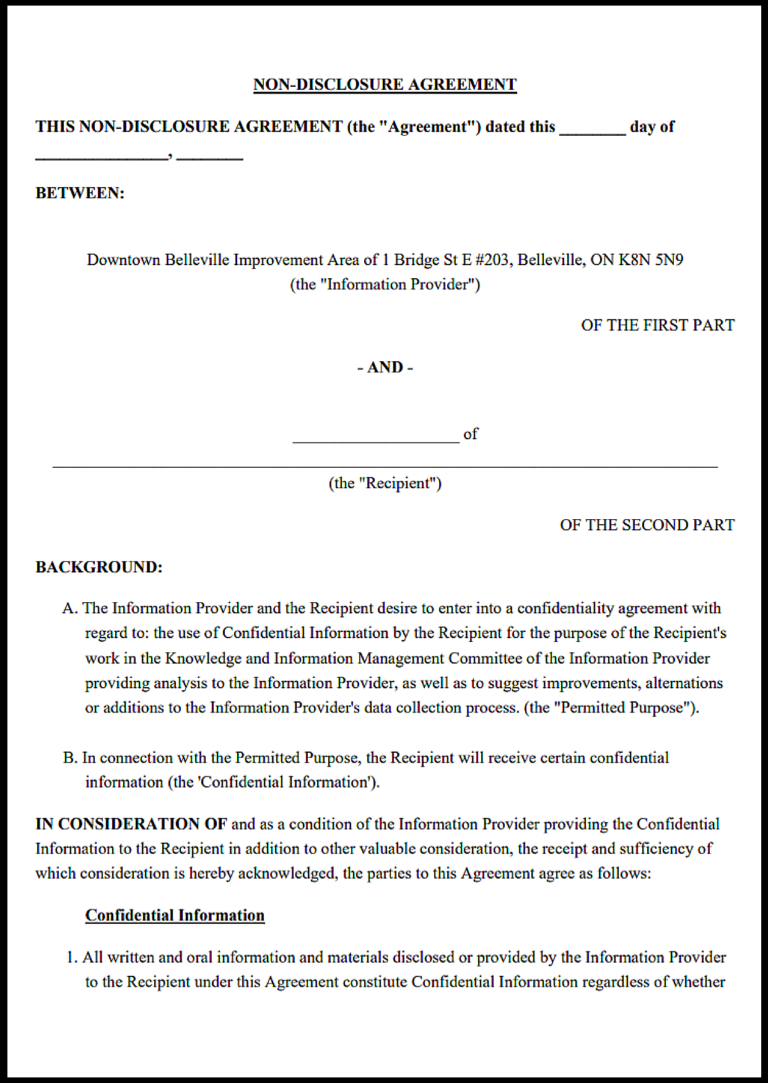
Employment agreements often include confidentiality clauses, which are explained in detail within the [NDA template guide] for Ontario businesses.
Is an Employment Contract Legally Required in Ontario?
No, Ontario law does not require a written employment contract in every case.
But it is strongly recommended.
When Contracts Are Essential
You should use a written contract when:
- Hiring full-time employees
- Offering remote or hybrid work
- Hiring executives or managers
- Providing bonuses or special benefits
Legal Backing
Employment relationships in Ontario are governed by the [Employment Standards Act (ESA)], which sets minimum legal standards for wages, hours, vacation, termination and other employment matters. A contract cannot waive or contract out of ESA minimum standards.
That means:
- You can offer more benefits than ESA
- But you cannot contract out of applicable ESA minimum standards
Enforceability Basics
An employment contract generally requires:
- Agreement between the parties
- Sufficiently clear terms
- Lawful terms
- Compliance with applicable employment legislation
Key Elements Every Ontario Employment Contract Must Include
Job Role and Responsibilities
Clearly define:
- Job title
- Daily duties
- Reporting structure
Use specific duties and reporting responsibilities, particularly where the employee’s role affects compensation, overtime eligibility, confidentiality or performance expectations.
Salary, Overtime, and Payment Terms
Include:
- Base salary or hourly rate
- Pay schedule (weekly/bi-weekly)
- Overtime rules
For most employees covered by Ontario’s overtime rules, overtime pay begins after 44 hours in a work week at at least 1.5 times the regular rate, subject to exemptions and special rules.
Work Hours and Location
Specify:
- Work hours
- Office, remote, or hybrid setup
For remote or hybrid employees, the agreement should identify the expected work location and any applicable attendance or scheduling requirements.
Termination and Notice Period
This is the most critical clause.
It must follow ESA rules for:
- Notice period
- Termination pay
Under Waksdale v. Swegon North America Inc., 2020 ONCA 391, the termination provisions in the agreement were read together, and the Court of Appeal held that the termination provisions were unenforceable because the for-cause provision contravened the ESA. The decision shows why Ontario termination clauses must be drafted carefully and must comply with ESA minimum standards.
Probation Clause
There is no universal Ontario statutory probation period of 3 to 6 months.
Employers may include a probationary period in the contract, but ESA rules still apply. In general, statutory termination notice or termination pay is not required for an employee who has been employed for less than three months, subject to the ESA’s exceptions.
Confidentiality and Non-Disclosure
Protects:
- Company data
- Trade secrets
- Client information
You can also use a separate Ontario Non-Disclosure Agreement for stronger protection.
Non-Compete / Non-Solicitation
Ontario has strict rules:
- Non-compete agreements with employees are generally prohibited under the ESA, subject to statutory exceptions
- Non-solicitation clauses are not automatically prohibited by the ESA, but their enforceability depends on the wording, circumstances and applicable common-law rules
Always use these carefully.
This document may also relate to an [contractor agreement] or a [consulting contract], depending on the type of working relationship.
Ontario-Specific Employment Law Rules You Must Follow
Here’s a quick overview of key ESA rules:
| Rule | Requirement |
| Minimum Wage |
Must meet Ontario minimum wage
|
| Overtime |
1.5x pay after 44 hours/week for most covered employees, subject to exemptions
|
| Vacation |
At least 2 weeks after each vacation entitlement year for employees with less than 5 years of employment, increasing to at least 3 weeks after 5 years, subject to ESA rules
|
| Public Holidays |
Eligible employees generally receive public-holiday entitlements under the ESA, subject to the Act’s eligibility, substitution and special rules
|
| Termination Notice |
Based on length of service and applicable ESA rules
|
Important: The ESA establishes minimum employment standards, and s.5 generally prevents employers and employees from contracting out of or waiving those standards.
How to Write or Fill an Ontario Employment Contract (Step-by-Step)
Step 1: Identify Employer and Employee
Use full legal names and correct addresses.
Step 2: Define Clear Job Terms
Be specific about:
- Duties
- Expectations
- Reporting
Step 3: Add Compliant Pay Structure
Ensure:
- Wage meets minimum standards
- Overtime is included where applicable
Step 4: Include ESA-Compliant Clauses
Especially:
- Termination clause
- Vacation entitlement
Step 5: Review Before Signing
Check for:
- Clarity
- Legal compliance
- Missing terms
Tip: Even experienced business owners often get termination clauses wrong—review carefully.
Common Mistakes That Can Make Your Contract Invalid
Avoid these common errors:
- Ignoring the Employment Standards Act
- Copying generic templates from the internet
- Missing termination clause
- Adding prohibited non-compete clauses
- Using vague job descriptions
Some drafting errors can make a particular contractual provision unenforceable, while others may affect the enforceability of a broader termination framework. The effect depends on the wording and the applicable law.
Permanent vs Fixed-Term Employment Contracts (Ontario)
Key Differences
| Type | Description |
| Permanent |
Ongoing employment with no end date
|
| Fixed-Term |
Ends on a specific date
|
When to Use Each
- Permanent → Long-term employees
- Fixed-term → Temporary projects
Risks of Fixed-Term Contracts
If not drafted with extreme caution:
- The Payout Trap without Mitigation: Under Howard v. Benson Group Inc., 2016 ONCA 256, where a fixed-term employment contract lacks an enforceable early-termination provision, an employee may be entitled to compensation for the unexpired portion of the term, and the Court of Appeal held that the damages in that case were not subject to a duty to mitigate.
- Automatic Conversion Risk: If an employee continues working after a fixed-term contract expires, the legal effect depends on the wording of the agreement and the parties’ subsequent conduct. Employers should not assume that a single day of continued work automatically creates a permanent employment relationship.
Real-Life Example: Why a Proper Contract Matters
An Ontario employer may face substantially greater termination-related liability when an employment contract does not contain an enforceable termination provision. The actual amount depends on the ESA minimums, contractual terms and, where applicable, common-law reasonable notice.
When they tried to terminate the employee, the termination provision did not meet ESA requirements.
Result:
- The termination provision may be unenforceable
- The employee may be entitled to greater compensation than the employer expected
A properly drafted agreement can reduce uncertainty by clearly setting out the parties’ intended terms and ensuring that contractual provisions comply with applicable Ontario law.
When Should You Update an Employment Contract?
Update your contract when:
- Employee gets promoted
- Salary changes
- Job role changes
- Moving to remote or hybrid work
- Ontario laws change
Keeping contracts updated can help ensure that the written terms continue to reflect the employment relationship and applicable legal requirements.
FAQs About Ontario Employment Contracts
Can I write my own employment contract in Ontario?
Yes, you can write your own employment contract in Ontario. Many small business owners do, but the terms should comply with the Employment Standards Act and other applicable law.
Are verbal agreements valid?
Yes, verbal employment agreements can be legally binding in appropriate circumstances. However, important terms may be more difficult to prove later, so written terms are generally preferable.
Can an employer change a contract after signing?
An employer generally cannot simply impose a new contractual term on an employee and assume it is binding. A proposed material change may require the employee’s agreement and can raise additional employment-law issues depending on the circumstances.
Is a non-compete clause enforceable in Ontario?
Generally, Ontario prohibits employers from entering into employment non-compete agreements, subject to statutory exceptions such as certain business-sale agreements and agreements involving defined executives.
Do part-time employees need contracts?
Part-time employees are generally covered by the ESA unless an exemption applies. Ontario does not generally require a separate written employment contract simply because an employee works part-time, but written terms can make the arrangement easier to understand and prove.
Final Thoughts
A well-drafted Ontario employment contract should clearly set out the employment terms while respecting the ESA’s minimum standards. Pay, duties, vacation, termination and restrictive covenants deserve particular attention because Ontario law places specific limits on what an employment agreement can require.
If you’re hiring—or starting a new job—don’t rely on assumptions. Put the important terms in writing.