Free Ontario Non Disclosure Agreement (Template & Guide)
Ontario Non Disclosure Agreement is one of the easiest ways to protect your business ideas, client data, and sensitive information. Imagine sharing your startup idea with a freelancer or pitching to a potential partner—without any protection, your idea could be used without your permission.
In Ontario, protecting confidential information is not just smart—it’s essential. An NDA (Non-Disclosure Agreement) is a simple legal tool that helps you do exactly that.
I’ve seen Ontario business owners assume a handshake or simple email was enough, only to end up in expensive disputes when confidential information was shared without clear written terms. When an NDA is drafted properly from the start, it gives you much stronger footing if someone later misuses your business information or client data.
Last Updated: September 2026
In this article, you’ll get:
- A free Ontario NDA template
- Simple legal explanation
- Practical tips to use it correctly
Table of Contents
ToggleFree Ontario Non Disclosure Agreement Template
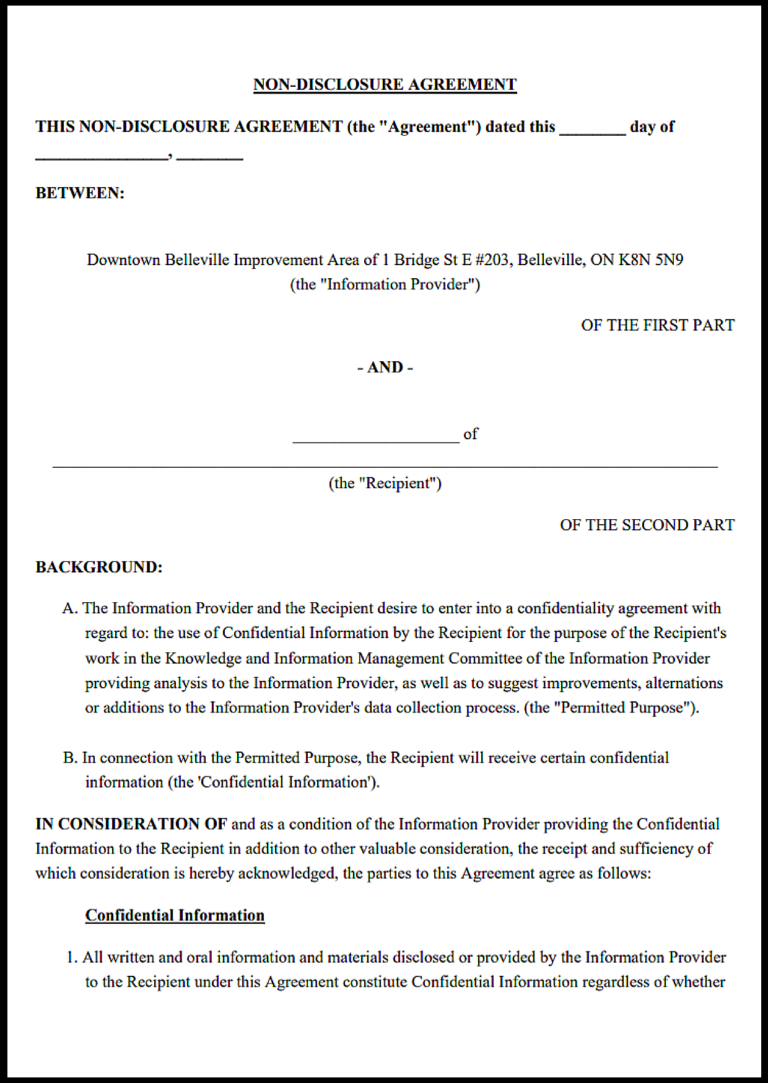
Below is a clean, ready-to-use template. You can copy, edit, and use it for your business.
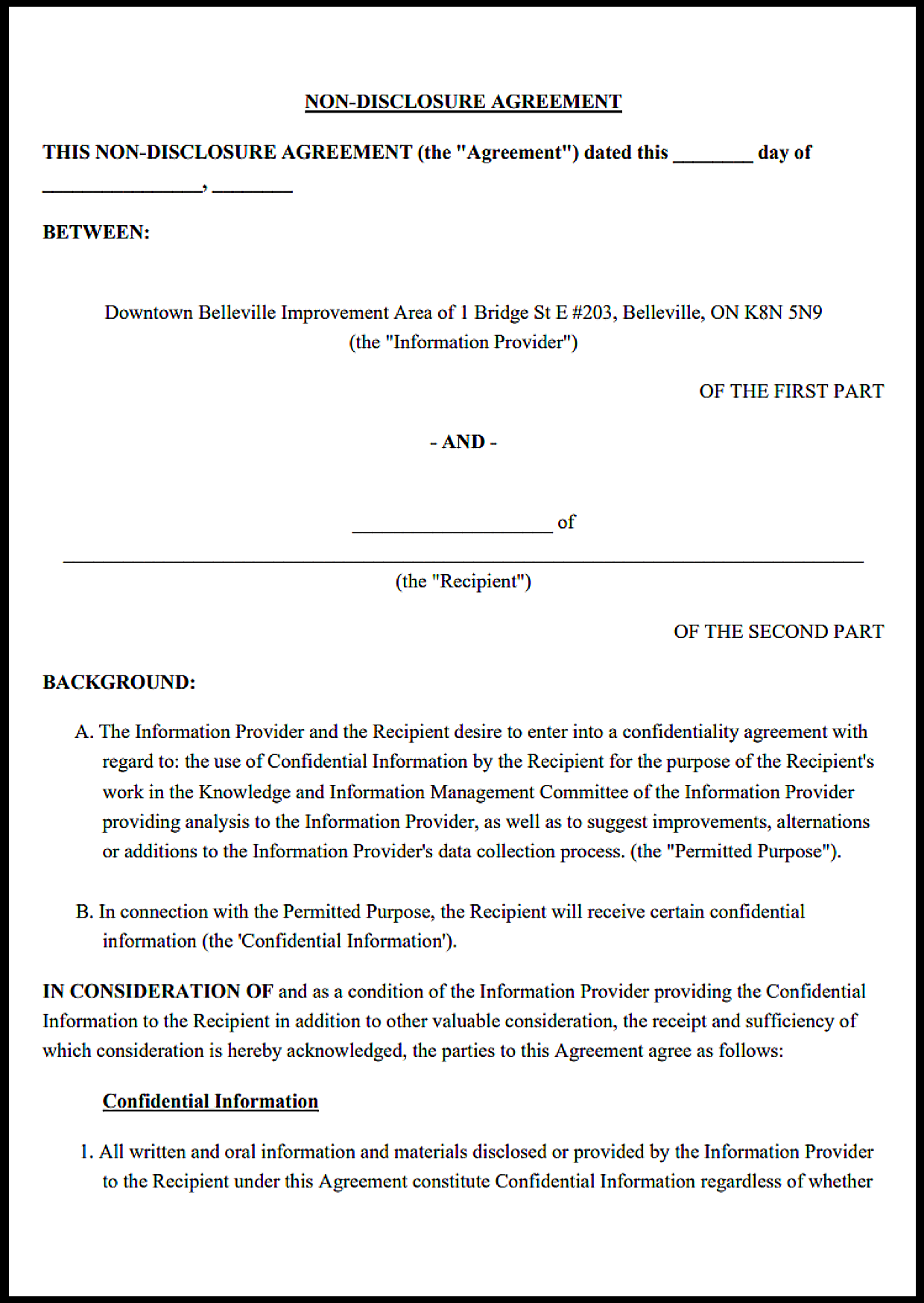
Tip: Always customize this template. A generic NDA may not fully protect your situation.
Ontario NDA Laws That Can Affect Enforceability
| Topic / Issue | Ontario Legal Rule | Governing Statute |
|---|---|---|
| Main legal framework for NDAs | Ordinary NDAs in Ontario are generally governed by contract law and applicable common-law and equitable principles, including the law of confidence. | Common law principles |
| Employment-related NDA rules | Employment-related NDAs must comply with Ontario employment law. The ESA prohibits most employment non-compete agreements under s. 67.2, but that prohibition does not itself prohibit ordinary non-disclosure or non-solicitation agreements. | Employment Standards Act, 2000, S.O. 2000, c. 41, s. 67.2 |
| Restrictions on NDAs in post-secondary sexual misconduct cases | Ontario law restricts certain confidentiality terms involving allegations or complaints of sexual misconduct between covered post-secondary institutions and students, including rules under s. 16.1 of the Ministry of Training, Colleges and Universities Act. | Ministry of Training, Colleges and Universities Act, R.S.O. 1990, c. M.19, s. 16.1; Private Career Colleges Act, 2005, S.O. 2005, c. 28, s. 44.1 |
| Federal privacy obligations | Federal privacy law, including PIPEDA where its statutory application requirements are met, may apply when an NDA involves personal information. | Personal Information Protection and Electronic Documents Act (PIPEDA) |
| Jurisdiction status | For an NDA governed by Ontario law, enforceability is generally assessed under Ontario contract law and applicable common-law and equitable principles. | Ontario contract and common law |
| Who can sign | An NDA should be signed by each party or by a person who has proper authority to bind the party on whose behalf they sign. | Contract law and applicable corporate/agency principles |
| Witness requirement | Ordinary NDAs do not generally require witnessing merely because they are NDAs, although particular circumstances or related documents may have different requirements. | Contract law and applicable circumstances |
| Notarization requirement | Ordinary NDAs do not generally require notarization merely because they are NDAs, although particular transactions or documents may have separate requirements. | Contract law and applicable circumstances |
| Minimum age requirement | Ontario’s age-of-majority rules generally treat 18 as the age of majority, but contractual capacity can depend on the nature and circumstances of the agreement. | Age of Majority and Accountability Act, R.S.O. 1990, c. A.7 |
| Mental capacity requirement | A person’s contractual capacity can depend on whether they were capable of understanding the nature and consequences of the agreement when it was made. | Ontario common-law principles of contractual capacity |
| Time limit for breach claims | Contract claims in Ontario are generally subject to a two-year basic limitation period from the date the claim was discovered, subject to the discoverability rules and other exceptions in the Limitations Act, 2002. | Limitations Act, 2002, S.O. 2002, c. 24, Sched. B, ss. 4, 5 and 15 |
| Mandatory wording in post-secondary settlements | For covered post-secondary sexual-misconduct matters, a confidentiality term that would otherwise be prohibited may be permitted when the student requests it and the statutory safeguards in s. 16.1 are satisfied. | Ministry of Training, Colleges and Universities Act, R.S.O. 1990, c. M.19, s. 16.1 |
| Disclosure carve-out requirement | An Ontario NDA should address disclosures required or permitted by law, such as disclosures required by a court order or applicable legislation. | Contract law and applicable legislation |
| Filing requirement | Ordinary private NDAs are generally not filed in a public Ontario registry. | No general NDA filing requirement |
| Restriction on reporting crimes | An NDA should not be drafted to prevent disclosures that a person is legally entitled or required to make, including disclosures required by applicable law. | Applicable legislation and public-policy principles |
| Disguised non-compete restrictions | In an employment setting, a confidentiality clause should not be drafted as a disguised restriction on competing. Ontario’s ESA prohibits most employment non-compete agreements, while genuine non-disclosure and non-solicitation provisions are treated separately. | Employment Standards Act, 2000, s. 67.2 |
| Unreasonable duration limits | The appropriate duration depends on the information being protected and the wording of the agreement; indefinite protection may be more defensible for genuine trade secrets than for ordinary business information. | Common-law contract and restraint-of-trade principles |
| Ontario’s non-compete ban difference | Ontario generally prohibits employers from entering into employee non-compete agreements under s. 67.2 of the Employment Standards Act, 2000, subject to statutory exceptions. | Employment Standards Act, 2000, s. 67.2 |
| Ontario’s post-secondary NDA restrictions | Ontario’s statutory NDA restrictions include specific rules concerning sexual misconduct matters involving covered post-secondary institutions and students. | Ministry of Training, Colleges and Universities Act, s. 16.1 |
Under Ontario’s regulatory landscape, an overreaching NDA can create serious enforceability problems. Under s. 67.2 of the Employment Standards Act, 2000 (ESA), employers generally cannot enter into employment non-compete agreements with employees. The prohibition took effect on October 25, 2021, and the legislation contains specific exceptions, including certain business-sale situations. If an NDA contains restrictions that go beyond protecting confidential information and instead function as a restriction on competing, the wording should be reviewed carefully.
Another important rule involves confidentiality clauses connected to sexual misconduct complaints in post-secondary institutions. Ontario law restricts certain confidentiality agreements involving sexual misconduct between covered institutions and students. Section 16.1 of the Ministry of Training, Colleges and Universities Act sets out specific rules and safeguards for these situations.
An NDA should also not be drafted to prevent disclosures that a person is legally entitled or required to make. This can include disclosures required by applicable legislation, court orders, or regulatory processes. Businesses should therefore make sure their confidentiality clauses contain appropriate legal-disclosure exceptions. Download the free Ontario Non Disclosure Agreement template below to create a clearer agreement.
Understanding Ontario NDAs (What, When & Legal Rules)
What Is an Ontario Non Disclosure Agreement?
An NDA is a legal contract where one party agrees to keep specified confidential information from being disclosed or misused.
In simple terms:
“I’ll share confidential information with you, and you agree to handle it according to the confidentiality terms we have agreed on.”
There are two main types:
- Unilateral NDA → One party shares information (common in hiring)
- Mutual NDA → Both parties share information (common in partnerships)
Real-life examples:
- Hiring a freelancer for your website
- Discussing a startup idea with a developer
- Sharing client data with a consultant
When Should You Use an NDA in Ontario?
An NDA is most useful when you are about to give another person or business access to information that is not public and that you want them to use only for a defined purpose.
Common situations:
- Hiring employees or contractors
- Business partnerships or joint ventures
- Selling or buying a business
- Sharing trade secrets or strategies
Risk of not using an NDA:
- The parties may later disagree about what information was confidential
- Client or business information may be misused
- It may be harder to prove what confidentiality obligations were actually agreed to
Are NDAs Legally Enforceable in Ontario?
An NDA may be enforceable in Ontario when it forms a valid contract and its terms are legally enforceable. Offer, acceptance, consideration, capacity, certainty, legality, and the wording and circumstances of the agreement can all matter.
A contract may involve:
- Offer → One party proposes terms
- Acceptance → Other party agrees
- Consideration → Something of value exchanged
Important: Courts also consider the wording and circumstances of the agreement.
They may scrutinize agreements that are:
- Too broad
- Unclear
- Unreasonable in their restrictions
Clear and specific wording is critical.
If you are drafting a confidentiality agreement, it’s helpful to start with the main NDA template resource, which explains the overall structure and legal intent of these agreements in Ontario.
Key Clauses Every Ontario NDA Must Include
Definition of Confidential Information
Be specific. Avoid vague terms like “all information.”
Better: “client lists, pricing strategy, financial records”
Purpose of Disclosure
Clearly state why the information is shared.
Example: “for evaluating a business partnership”
Confidentiality Obligations
The receiving party must:
- Not share information except as permitted by the agreement
- Not copy or misuse it
- Protect it using appropriate safeguards
Time Duration
Choose the confidentiality period based on the information being protected.
- Fixed term → Use a defined period that fits the nature of the information
- Indefinite → May be appropriate for some information, particularly genuine trade secrets that remain confidential
Exclusions Clause
Not all information is protected.
Exclude:
- Public information
- Already known data
- Information independently developed or lawfully obtained, where appropriate
Remedies for Breach
Explain what may happen if the NDA is breached.
This may include:
- Financial damages
- Court orders, including injunctions where legally available
Governing Law Clause
Must clearly state:
Ontario, Canada
This helps identify the law the parties intend to govern the agreement, subject to applicable legal rules.
How to Fill Out the NDA (Step-by-Step)
Here’s a simple way to complete your agreement:
- Add full names and addresses of both parties
- Clearly define confidential information
- Write the purpose of sharing information
- Set a reasonable confidentiality period
- Review everything before signing
Important tip:
Do not blindly copy templates from the internet—especially US-based ones. Ontario laws are different.
Common Mistakes That Make NDAs Invalid
Avoid these common errors:
- Too broad or unclear definitions
- An unclear disclosure purpose
- An inappropriate confidentiality period
- Assuming consideration issues can be ignored
- Using US templates in Canada
- Failing to obtain signatures from the parties who are agreeing to the obligations
These issues do not automatically make every NDA invalid, but they can create uncertainty or make particular provisions harder to enforce.
This document is often used together with a consulting contract or a freelance agreement format, especially when sensitive business information is shared during short-term projects.
Legal Risks & Limitations of NDAs in Ontario
NDAs are useful—but not unlimited.
They cannot:
- Be relied on to authorize illegal activities
- Prevent disclosures that a person is legally entitled or required to make
Courts may scrutinize NDAs that are:
- Unreasonable
- Too restrictive
- Excessive in scope or duration
Important:
An NDA gives contractual protection when its terms are enforceable—but it’s not a guarantee. You still need proper business practices and appropriate safeguards for confidential information.
NDA vs Non-Compete vs Non-Solicitation
Here’s a quick comparison:
|
Agreement Type
|
What It Does | When to Use |
| NDA | Protects confidential information |
Sharing ideas or data
|
| Non-Compete | Restricts working with competitors |
Employment or certain business-sale situations, subject to applicable law
|
| Non-Solicitation | May restrict solicitation of specified clients, customers, employees or other relationships |
Where the restriction is appropriate and legally enforceable
|
In Ontario employment relationships, a non-compete is subject to the prohibition in s. 67.2 of the Employment Standards Act, 2000, subject to statutory exceptions. A genuine NDA is different because its primary purpose is to protect confidential information rather than prevent a person from competing.
Real-Life Example
Let’s say you’re a startup founder.
You hire a developer to build your app and share confidential information about the project.
With NDA:
- The agreement can identify the information that must remain confidential
- If the information is misused or disclosed in breach of the agreement, the business may have legal remedies
Without NDA:
- The parties may disagree about what information was confidential
- It may be harder to prove what restrictions were actually agreed to
For a small Ontario business, the practical value of an NDA is clarity: both sides know what information is confidential and what the receiving party agreed to do with it.
FAQs
Do NDAs need to be notarized in Ontario?
Ordinary NDAs do not generally require notarization merely because they are NDAs. A signed agreement can be sufficient where the parties have otherwise formed an enforceable contract, but particular transactions or related documents may have different requirements.
How long does an NDA last?
There is no Ontario statutory rule requiring every NDA to last 1–5 years. The confidentiality period should match the nature of the information being protected. Some obligations may continue after a fixed period, particularly where the agreement protects information that remains confidential.
Can an NDA be broken?
Yes. A party can breach an NDA by doing something prohibited by the agreement, such as improperly disclosing or using confidential information. Depending on the agreement and circumstances, legal remedies may include damages or a court order such as an injunction.
Is a verbal NDA valid?
An oral confidentiality agreement may create legal obligations depending on the circumstances, but proving what the parties actually agreed to can be much more difficult than with a written NDA. A written agreement is generally preferable because it provides clearer evidence of the parties’ terms.
Can small businesses use NDAs?
Yes. Small businesses can use NDAs to establish clear confidentiality obligations when sharing business information, client information, pricing, strategies, trade secrets, or other non-public information.