Quit Claim Deed Ontario | Free Fillable PDF Template

Quit Claim Deed Ontario is a phrase many homeowners search when they want to transfer property to a spouse, family member, or former partner, but Ontario doesn’t use the same quitclaim deed system found in many U.S. states. Instead, property transfers are completed under Ontario’s Land Registration Reform Act using the prescribed Transfer/Deed of Land (Form 1) for registration, which is why generic Canadian or American templates often create problems.

I’ve seen situations where someone relied on a U.S. quitclaim deed they found online, only for the issue to surface months later when a real estate lawyer discovered the transfer couldn’t be registered before a sale or refinance could close. That mistake usually means preparing the correct Ontario land transfer documents before the transaction can move forward. Below you’ll find an explanation of why people search for a Quit Claim Deed in Ontario, the document that’s actually

Free Quit Claim Deed Ontario Template
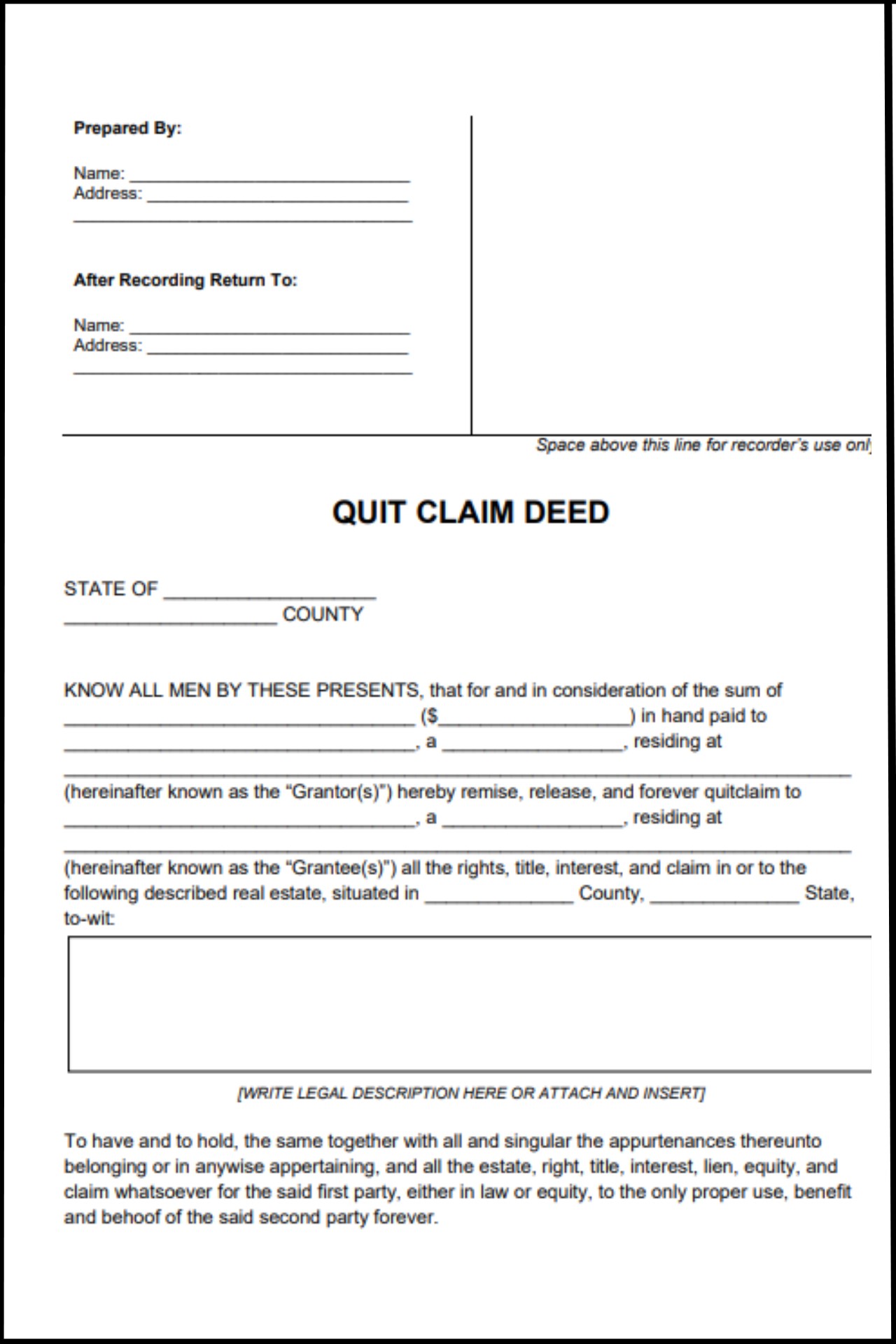
Quit Claim Deed Ontario

Get PDF | WORD

Key Clauses Of An Ontario Quit Claim Transfer

Although Ontario does not use a separate Quit Claim Deed form, every Transfer intended to have the same legal effect relies on several mandatory statements required by provincial legislation. Missing one of these can prevent registration or change the legal effect of the transfer.

The Statement Of Consideration Clause

Every Ontario Transfer must state the consideration exchanged between the parties. Consideration simply means what is being given in return for the transfer. In many family transactions, this may be a nominal amount such as $2.00 together with wording like “natural love and affection.”

The requirement comes from O. Reg. 19/99, section 5(1)(a) under the Land Registration Reform Act. Without this statement, the electronic registration cannot be completed correctly.

For example, a father in Mississauga transferring his ownership interest to his daughter without selling the property on the open market must still include the required consideration statement. The amount recorded does not have to reflect the property’s market value, but the Transfer must contain the information required for registration.

The Spousal Status Declaration Clause

Ontario also requires the Transfer to include a statement about the transferor’s spousal status under the Family Law Act. This declaration helps ensure that unregistered spousal rights are not overlooked during the transfer process.

This requirement appears in O. Reg. 19/99, section 5(1)(e) made under the Land Registration Reform Act.

Consider a homeowner in Hamilton who is the only registered owner but lives in the property with their spouse as the family home. Before transferring that interest, the required spousal declaration must be completed because matrimonial home rights may apply. This requirement does not automatically apply in every property transfer, but it becomes essential when the property is a matrimonial home.

The Exclusion Of Statutory Covenants Clause

This clause is what makes an Ontario Transfer function like a traditional quit claim.

By default, section 5(1) of the Land Registration Reform Act implies statutory covenants of title in a registered Transfer. Those implied covenants provide certain guarantees from the transferor to the transferee.

To remove those guarantees, the Transfer must expressly exclude the statutory covenants. Once excluded, the transferor simply releases whatever interest they actually own without promising that the title is valid, complete, or free from defects.

A common example involves siblings who inherited property together. If one sibling transfers their ownership interest to the other, they may only want to transfer whatever rights they currently hold rather than guarantee the quality of the title. Without the exclusion clause, the Transfer would not operate in the way people usually expect from a quit claim transaction.

The Age Declaration Clause

Ontario’s electronic registration rules also require confirmation that the transferor has reached the age of majority.

Under O. Reg. 19/99, section 5(1)(d) together with the Age of Majority and Accountability Act, R.S.O. 1990, c. A.7, s. 1, the transferor must be at least 18 years of age, and this must be expressly stated in the electronic registration.

For instance, if a lawyer prepares a Transfer involving family property in London, Ontario, the electronic registration includes confirmation that the transferor satisfies the statutory age requirement before the document can proceed. The Verified Legal Facts do not establish additional statutory requirements regarding mental capacity, so no further legal rule should be assumed.

What Makes An Ontario Quit Claim Transfer Legally Enforceable

Preparing the correct wording is only one part of the process. Registration requirements determine whether the transfer can legally update the parcel register.

To be legally enforceable:

  • The Transfer must be signed by the transferor (who has reached the age of majority) or their lawfully appointed attorney acting under a valid Power of Attorney pursuant to the Powers of Attorney Act / Substitute Decisions Act, 1992 and electronic land registration authorization protocols.

  • Ontario legislation does not impose a statutory witness requirement.
  • Ontario legislation does not impose a statutory notarization requirement.
  • Ontario Land Registry Offices
  • Electronic registration requires a licensed Ontario real estate lawyer with a personalized encrypted security token.

A common example involves former spouses transferring ownership after dividing family property. Even if both parties agree to the transfer, the property’s registered title is not updated until the Transfer is electronically registered through Teraview by a licensed Ontario lawyer.

Unlike some provinces that still accept paper deeds, Ontario’s Land Titles system generally does not provide a practical do-it-yourself registration process for this type of property transfer.

Rights And Obligations Of Each Party To The Transfer

An Ontario Transfer intended to function like a quit claim changes ownership differently from a standard property transfer. Instead of guaranteeing clear title, the transferor simply releases whatever legal interest they currently have. That distinction affects both parties and should be understood before the document is registered.

The transferor gives up their ownership interest without providing statutory warranties about the property’s title. Because the statutory covenants are expressly excluded under section 5(1) of the Land Registration Reform Act, the transferor is not promising that they own the entire property or that no defects exist in the title.

The transferee receives only the interest the transferor actually possessed. If the transferor owned only a partial interest, that is all the transferee receives. For example, if two brothers jointly own a cottage near Kingston and one transfers his share to the other, the receiving brother acquires only the transferring brother’s ownership interest rather than any additional rights that never existed.

Both parties are also responsible for ensuring that the required Land Transfer Tax affidavit accompanies the registration, together with any applicable tax payment or valid statutory exemption. Without those documents, the registration cannot proceed.

The Mortgaged Property Tax Trap (Land Transfer Tax Act)

A common financial surprise in Ontario family transfers occurs when property is transferred for nominal consideration (e.g., $2.00 or “natural love and affection”). Many owners assume that paying no purchase money means zero Land Transfer Tax (LTT) is owed. However, under Section 1(1) of the Land Transfer Tax Act, the “value of consideration” includes the amount of any liabilities or encumbrances assumed by the transferee.

If a parent transfers a property with an active $400,000 mortgage to an adult child via a quitclaim-style Transfer, Ontario taxes the $400,000 assumed mortgage liability as valuable consideration, triggering full provincial LTT (and Toronto Municipal LTT, if applicable). While transfers between spouses incident to a formal breakdown of marriage or written separation agreement are exempt under O. Reg. 696/93, transfers between non-spousal family members involving assumed mortgages remain fully taxable.

A quit claim-style Transfer should never be viewed as a substitute for investigating ownership. Anyone accepting property through this type of transfer should understand that no statutory guarantees of title accompany the registration.

What Happens If The Transfer Fails To Register

A Transfer does not achieve its intended legal effect simply because both parties agree to it. Registration is what updates the land records and protects the transferee’s interest against third parties.

One of the most significant reasons a Transfer may later be challenged involves a matrimonial home. Under section 21(1) of the Family Law Act, a married transferor cannot transfer an interest in a matrimonial home without the required spousal consent. If that consent is missing, the court may set the transfer aside.

Another issue arises when someone attempts to transfer only part of a parcel without obtaining the required municipal approval. Under section 50(21) of the Planning Act, a Transfer that violates subdivision control rules is legally void and conveys no interest.

Registration will also fail if the required Land Transfer Tax affidavit is missing. Under section 5(1) of the Land Transfer Tax Act, the Land Registrar will reject the registration until the affidavit and required payment, or a valid statutory exemption, are provided.

Consider a family transferring recreational property between generations. Even if everyone signs the paperwork, failing to satisfy one of these statutory requirements can delay or prevent registration altogether.

When You Don’t Need A Lawyer Vs When You Do

People often ask whether they can prepare and register a quit claim document themselves. In Ontario, there is effectively no practical DIY registration process for Land Titles properties.

Electronic registration must be completed through the Teraview system by a licensed Ontario real estate lawyer using a personalized encrypted security token. While you can gather the property information and discuss the intended transfer beforehand, the registration itself cannot generally be completed without legal assistance.

A lawyer becomes especially important when the property is a matrimonial home, where questions about spousal consent arise, or when the transfer involves only part of a parcel that may trigger subdivision control rules under the Planning Act.

For example, a parent transferring a cottage to an adult child may believe the transaction is straightforward. Once questions about title, land transfer tax, or family law rights arise, professional legal assistance becomes essential to ensure the Transfer is properly registered.

Summary Of Applicable Laws

Topic Rule Governing Statute
Who can sign Transferor or their lawfully appointed attorney, age 18 or older Conveyancing and Law of Property Act, R.S.O. 1990, c. C.34, s. 9
Exclusion of covenants Transfer must expressly exclude implied statutory covenants of title Land Registration Reform Act, R.S.O. 1990, c. L.4, s. 5(1)
Spousal consent Required for the transfer of a matrimonial home Family Law Act, R.S.O. 1990, c. F.3, s. 21(1)
Subdivision control Transfer is void if it breaches severance rules Planning Act, R.S.O. 1990, c. P.13, s. 50(21)
Land Transfer Tax filing Registration is rejected without the required affidavit and payment or exemption Land Transfer Tax Act, R.S.O. 1990, c. L.6, s. 5(1)

Why Ontario Has No Dedicated Quit Claim Deed Form

Register or Transfer Property in Ontario Instead, the province uses its standard electronic Transfer document to accomplish the same legal result.

The critical difference lies in the wording. By expressly excluding the statutory covenants of title implied under the Land Registration Reform Act, the Transfer releases the transferor’s interest without providing title warranties.

Someone searching online for a printable Ontario Quit Claim Deed may therefore find U.S. forms or outdated paper documents. Those documents generally cannot be registered within Ontario’s modern electronic land registration system.

Ontario’s Mandatory Electronic Registration Vs Other Provinces

Ontario’s land registration system differs significantly from that used in many other jurisdictions.

Rather than allowing signed paper deeds to be filed directly at a registry office, Ontario requires most Land Titles documents to be registered electronically through Teraview. This system is operated using licensed lawyers who possess secure electronic registration credentials.

In practical terms, this means that even a simple family property transfer follows the same electronic registration process as many other real estate transactions. While other provinces may still accept certain paper filings, that approach is generally obsolete for Ontario Land Titles properties.

Frequently Asked Questions

Does Ontario have a Quit Claim Deed form?

No. Ontario does not have a separate Quit Claim Deed form. Instead, parties register a standard electronic Transfer while expressly excluding the statutory covenants of title so the Transfer has the same legal effect.

Can I file a paper Quit Claim Deed in Ontario?

Generally, no. Most Land Titles properties must be registered electronically through the Teraview system by a licensed Ontario lawyer, making paper quit claim deeds largely obsolete.

Does my spouse need to consent to a Quit Claim Transfer in Ontario?

Yes, if the property is a matrimonial home. Under section 21(1) of the Family Law Act, the required spousal consent must be obtained or the transfer may later be set aside.

What makes a Transfer function as a Quit Claim in Ontario?

The Transfer must expressly exclude the statutory covenants of title that would otherwise be implied under section 5(1) of the Land Registration Reform Act.

Do I need a lawyer to complete a Quit Claim Transfer in Ontario?

Yes. Electronic registration through Teraview requires a licensed Ontario real estate lawyer with the appropriate security credentials.

What happens if the Land Transfer Tax affidavit is not filed?

The Land Registrar will reject the registration until the required affidavit and any applicable payment or statutory exemption have been provided.

used, and a practical template that reflects Ontario practice rather than U.S. terminology.

Similar Posts

Leave a Reply

Your email address will not be published. Required fields are marked *