Free Alberta Living Will Template & Guide
Alberta Living Will is one of the most important documents you can create if you want control over your medical care when you cannot speak for yourself. In Alberta, this document is legally known as a Personal Directive, and it plays a key role in healthcare and estate planning.
I have seen Alberta families struggle during medical emergencies because no Personal Directive was in place, leaving loved ones arguing over treatment decisions while doctors waited for legal direction. Many people also do not realize that outdated or unclear wording in these documents can create serious problems when urgent healthcare choices need to be made quickly.
Last Updated: August 2026
What Is an Alberta Living Will?
A living will is a written document that explains your healthcare wishes if you become mentally incapable of making decisions. Under Alberta law, this is called a Personal Directive.
In simple terms, it tells doctors and your family what kind of treatment you want—or don’t want—if you cannot communicate. This can include decisions about life support, surgery, or end-of-life care.
Most people think this document is only for elderly individuals, but that’s not true. Any adult (18+) in Alberta can benefit from having one in place.
On this article, you’ll find:
- A free Alberta living will template
- Different types of personal directives explained
- Legal basics you must follow in Alberta
- Simple guidance to help you choose the right option
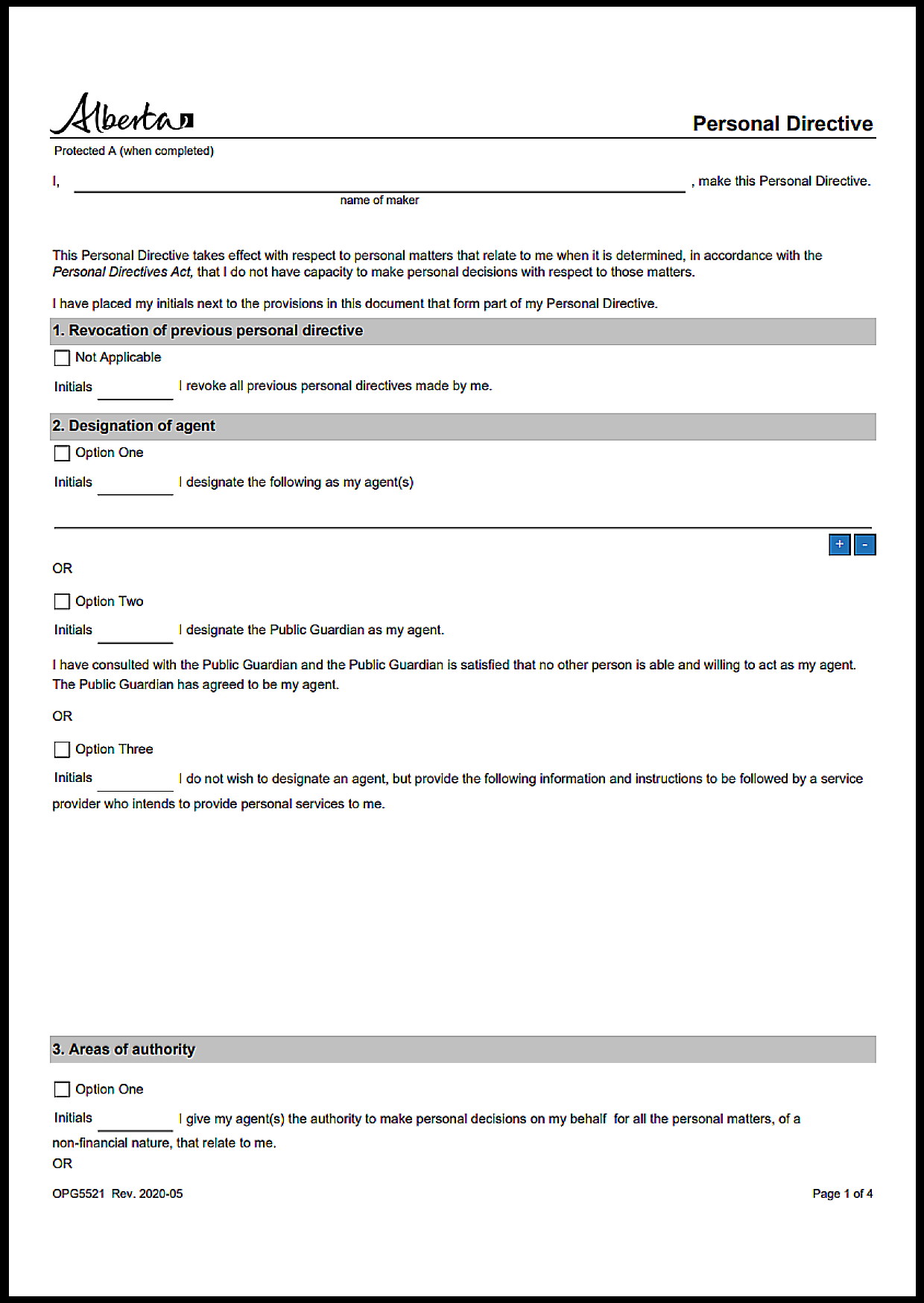
Free Alberta Living Will Template
Below is a simple, general-purpose template based on common Alberta requirements. It is designed for healthcare decisions only—not financial matters.
Alberta Living Will Legal Requirements and Personal Directive Rules
| Topic / Issue | Alberta Legal Rule | Governing Statute |
|---|---|---|
| Governing Legislation | Alberta Living Wills are generally referred to in law as Personal Directives and are governed by Alberta’s Personal Directives Act. | Personal Directives Act, RSA 2000, c P-6 |
| Jurisdiction | Personal Directives in Alberta are governed by Alberta provincial law. | Personal Directives Act |
| Legislative Status | The Personal Directives Act is Alberta legislation governing Personal Directives and related decision-making when a person lacks capacity. | Personal Directives Act |
| Who Can Sign | The Maker or a person signing at the Maker’s direction may sign the directive in accordance with Alberta’s statutory requirements. | Personal Directives Act, s. 5 |
| Witness Requirements | A Personal Directive must be witnessed in accordance with the requirements of the Personal Directives Act. | Personal Directives Act, s. 5 |
| Witness Disqualifications | Certain people are disqualified from witnessing a Personal Directive, including the named Agent, certain spouses or partners, and the person signing on behalf of the Maker. | Personal Directives Act, s. 5 |
| Notarization | Alberta law does not generally require notarization simply to create a Personal Directive, although a particular situation or institution may have additional requirements. | Personal Directives Act |
| Age Requirement | The Maker must be an adult when making a Personal Directive. | Personal Directives Act |
| Mental Capacity | The Maker must have the capacity required by Alberta law when making the Personal Directive. | Personal Directives Act |
| Expiry Rules | A Personal Directive does not have a fixed expiry date simply because time passes. It can be revoked or otherwise cease to operate in circumstances provided by Alberta law. | Personal Directives Act |
| Mandatory Language | Alberta law does not require one particular set of boilerplate words for every Personal Directive. The document should clearly express the Maker’s instructions and/or appointment of an Agent. | Personal Directives Act |
| Writing and Signature Requirements | The directive must satisfy Alberta’s statutory requirements concerning writing, signing and witnessing. | Personal Directives Act, s. 5 |
| Agent or Instructions Requirement | A Personal Directive can contain instructions for personal decisions and may appoint an Agent to make decisions on the Maker’s behalf when the directive is in effect. | Personal Directives Act |
| Registry Availability | Alberta has a voluntary Personal Directives Registry that can help healthcare providers locate information about a registered directive. | Office of the Public Guardian and Trustee (OPGT) |
| Registry Effect | Registration does not replace the legal requirements for making a Personal Directive and is not what makes the document valid. | Personal Directives Act |
| Invalid Due to Improper Witness | Using a person who is disqualified from witnessing can affect whether the Personal Directive satisfies Alberta’s statutory execution requirements. | Personal Directives Act |
| Invalid Due to Lack of Capacity | The Maker must have the capacity required by Alberta law when making the Personal Directive. | Personal Directives Act |
| Financial Instructions Not Allowed | A Personal Directive deals with personal decisions. Financial authority should be addressed through an appropriate Power of Attorney rather than a Personal Directive. | Personal Directives Act / Powers of Attorney Act |
| Designated Capacity Consultant Rule | Alberta law allows the Personal Directive to identify who determines whether the Maker has lost capacity, subject to the requirements of the legislation. | Personal Directives Act |
| Centralized Registry Difference | Alberta provides a voluntary Personal Directives Registry through the Office of the Public Guardian and Trustee. | Personal Directives Act |
| Agent Power Restrictions | An Agent’s authority is subject to restrictions under Alberta law, including statutory restrictions on certain decisions. | Personal Directives Act |
One of the most important Alberta-specific points is that a Personal Directive does not need one particular set of boilerplate words to be effective. The document must instead satisfy Alberta’s legal requirements and clearly communicate the Maker’s instructions and/or appointment of an Agent.
Alberta also has a voluntary Personal Directives Registry. Registration does not replace the legal requirements for making the directive, but it can help healthcare providers and others locate information about a registered Personal Directive when it is needed.
The witness restrictions are important as well. A person who is disqualified from witnessing should not be used as the witness. Alberta also separates personal and healthcare decisions from financial authority. A Personal Directive should not be used as a substitute for a financial Power of Attorney.
Types of Living Wills in Alberta (Personal Directive Options)
Not all living wills are the same. In Alberta, a Personal Directive can be drafted to reflect your instructions, appoint an Agent, or combine both approaches.
Basic Personal Directive (General Healthcare Wishes)
This is the simplest version. It can include general instructions about healthcare and personal decisions without attempting to cover every possible situation.
It may be useful for an adult who wants to record basic wishes in advance. The instructions should still be clear enough to help an Agent or healthcare provider understand what the Maker wants.
Detailed Medical Directive (End-of-Life Focused)
This type goes deeper and clearly explains your choices about:
- Life support
- CPR (resuscitation)
- Feeding tubes
- Palliative care
Specific treatment instructions should be drafted carefully because medical circumstances can vary. If your wishes are detailed or medically complex, professional advice may be useful to ensure the instructions are clear and workable.
Personal Directive with Agent (Decision-Maker Appointed)
This is one option available in Alberta. You appoint a trusted person (called an agent) to make personal decisions for you when the Personal Directive is in effect.
Instead of trying to predict every possible situation, your Agent can make decisions within the authority provided by the directive and Alberta law, taking your instructions and wishes into account.
Condition-Based Directive (Trigger-Based Instructions)
This directive can contain instructions that apply in particular circumstances, such as:
- Coma
- Permanent unconsciousness
- Terminal illness
The wording should clearly explain when particular instructions are intended to apply. This can give the Agent or healthcare provider clearer guidance about your wishes.
Combined Directive (Healthcare + Personal Care Instructions)
This version includes not just medical decisions, but also personal care preferences like:
- Living arrangements
- Daily care needs
- Support services
A Personal Directive can address personal matters that fall within the scope of Alberta’s legislation. The exact authority should be clearly described rather than assuming that every type of personal decision is automatically covered.
A living will outlines your healthcare wishes in advance. It forms a key part of planning for incapacity and complements your Alberta will document.
Real-Life Use Cases (When You Actually Need This)
Many people delay creating a living will because they think they don’t need it yet. In reality, incapacity can happen unexpectedly, so planning ahead can help.
For example, you might be in an accident and unable to communicate. If you have a Personal Directive, it can provide instructions or identify an Agent to make personal decisions according to the authority granted.
In other cases, people may want to record their treatment preferences in advance. Clear instructions can help family members and healthcare providers understand the Maker’s wishes when the Maker cannot make the decision personally.
Common situations where this document is useful:
- You want to avoid burdening your family
- You have clear medical preferences
- You are planning your estate properly
- You want legal clarity in emergencies
This document is often used alongside a medical decision-making authorization or a personal directive.
Key Elements of a Valid Alberta Living Will
Under Alberta law, a Personal Directive must meet specific requirements to have its intended legal effect.
Clear Healthcare Instructions
Your instructions should be specific enough to communicate your wishes. Vague statements like “no extreme measures” can create uncertainty.
Instead, clearly state the types of treatment or personal decisions you want your instructions to address.
Appointment of an Agent (Optional but Recommended)
You are not required to appoint an agent, but doing so can be useful if you want a trusted person to make personal decisions for you when the directive is in effect.
Choose someone:
- You trust completely
- Who understands your values
- Who can handle pressure
Activation Conditions (Capacity Rules)
A Personal Directive generally becomes operative when the Maker lacks the capacity to make the relevant personal decision.
The person or persons responsible for determining incapacity depend on what the Personal Directive says and the requirements of Alberta’s Personal Directives Act. The document can identify who is to determine incapacity.
Signatures and Witness Requirements
To be valid in Alberta:
- You must sign the document
- It must be witnessed properly
- The witness must meet Alberta’s statutory requirements
Revocation and Updates
You can revoke or change your Personal Directive while you have the capacity required by Alberta law to do so.
It’s a good idea to review it after major life changes or whenever your healthcare wishes change.
How to Create an Alberta Living Will (Step-by-Step)
Creating a Personal Directive is simpler than most people think. You do not always need a lawyer for a basic version, although professional advice can be useful for complicated circumstances.
Here’s a beginner-friendly process:
- Think about your healthcare wishes and values
- Decide if you want to appoint an agent
- Use a template or draft your document
- Sign it with proper witnesses
- Share copies with family and healthcare providers
A practical tip: Always keep a copy where your family can easily access it. You can also consider registering the directive with Alberta’s Personal Directives Registry so information about it can be located when needed.
Legal Overview in Alberta (Personal Directive Law)
In Alberta, living wills are governed by the Personal Directives Act.
Under this law:
- A Personal Directive is a legally recognized document
- It can operate when you lack the capacity to make the relevant personal decision
- healthcare providers and others making decisions must comply with applicable legal requirements and the valid instructions or authority in the directive
It is important not to confuse this with other documents.
| Document Type | Purpose | When It Applies |
| Personal Directive | Healthcare and other personal decisions | While alive, when the applicable capacity requirements are met |
| Power of Attorney | Financial decisions | While alive, according to the authority granted and applicable law |
| Will (Last Will) | Distribution of assets | After death |
For complete planning, you should combine this with an Alberta will template and a financial power of attorney.
Common Mistakes to Avoid
Even simple mistakes can make your living will less effective.
Some of the most common issues include:
- Not naming a backup agent
- Writing unclear or vague medical instructions
- Not informing family members about the document
- Using templates that do not follow Alberta law
- Confusing a living will with a financial power of attorney
A poorly drafted or improperly executed document can create problems during a medical emergency, so it’s important to check the signing requirements and make your instructions as clear as possible.
FAQs
Is a living will legally binding in Alberta?
Yes, a living will, commonly referring to a Personal Directive in Alberta, can have legal effect when it satisfies the requirements of Alberta’s Personal Directives Act. It can operate when the applicable capacity requirements are met, and its instructions or the Agent’s authority must be followed within the limits of Alberta law.
What is the difference between a living will and a personal directive?
In Alberta, there is no real difference between the two terms. “Personal Directive” is the official legal term used under Alberta law, while “living will” is a more common, informal name. A Personal Directive can contain healthcare and other personal decision-making instructions and may appoint an Agent.
Do I need a lawyer to create one in Alberta?
No, you do not legally need a lawyer to create a Personal Directive in Alberta. Many people can prepare a basic directive themselves. However, if your situation is complex or you want detailed instructions, getting legal advice can help ensure the document properly reflects your wishes.
Who should I choose as my agent?
You should choose someone you fully trust to act within the authority given by your Personal Directive and Alberta law. This person should understand your values, be calm under pressure, and be willing to make difficult decisions. It is also a good idea to choose someone who is easily reachable in case of emergencies.
Can I change my living will later?
Yes, you can change or revoke your Personal Directive while you have the capacity required by Alberta law to do so. It is recommended to review your document after major life changes or whenever your healthcare wishes change.
Where should I store my living will?
You should keep your living will in a safe but accessible place. It is important to share information about the document with your Agent, close family members, and your healthcare providers. You can also consider Alberta’s Personal Directives Registry so the existence of a registered directive can be located when needed.