Ontario Bill of Sale Form | Free Template & Legal Guide
Ontario Bill of Sale is a simple legal document used to record the sale and transfer of ownership of goods between a buyer and seller. It protects both parties by clearly stating what was sold, for how much, and under what terms.
In most private sale situations in Ontario, a bill of sale is not legally required—but it is strongly recommended. It acts as proof of the transaction and can help avoid disputes later.
I’ve seen private sales in Ontario turn into expensive disputes simply because the parties relied on text messages or verbal promises instead of a proper bill of sale. When someone comes to me after the deal has gone wrong, the biggest problem is usually proving exactly what was agreed to and when ownership actually changed hands.
Last Updated: September 2026
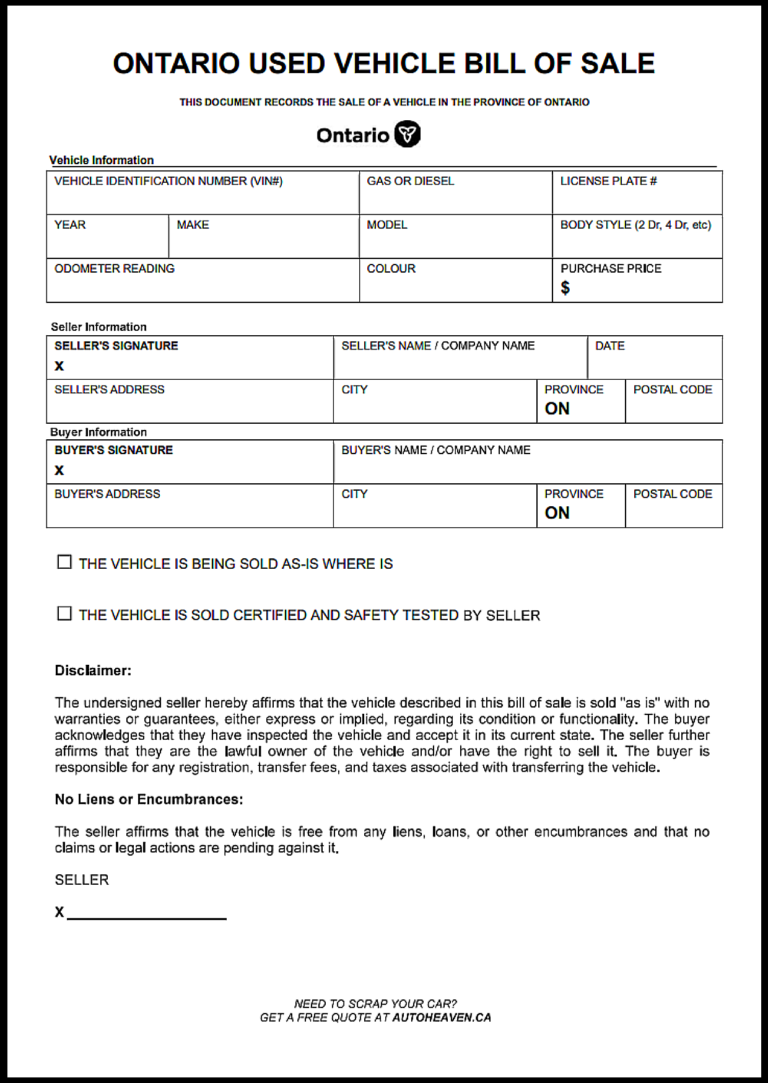
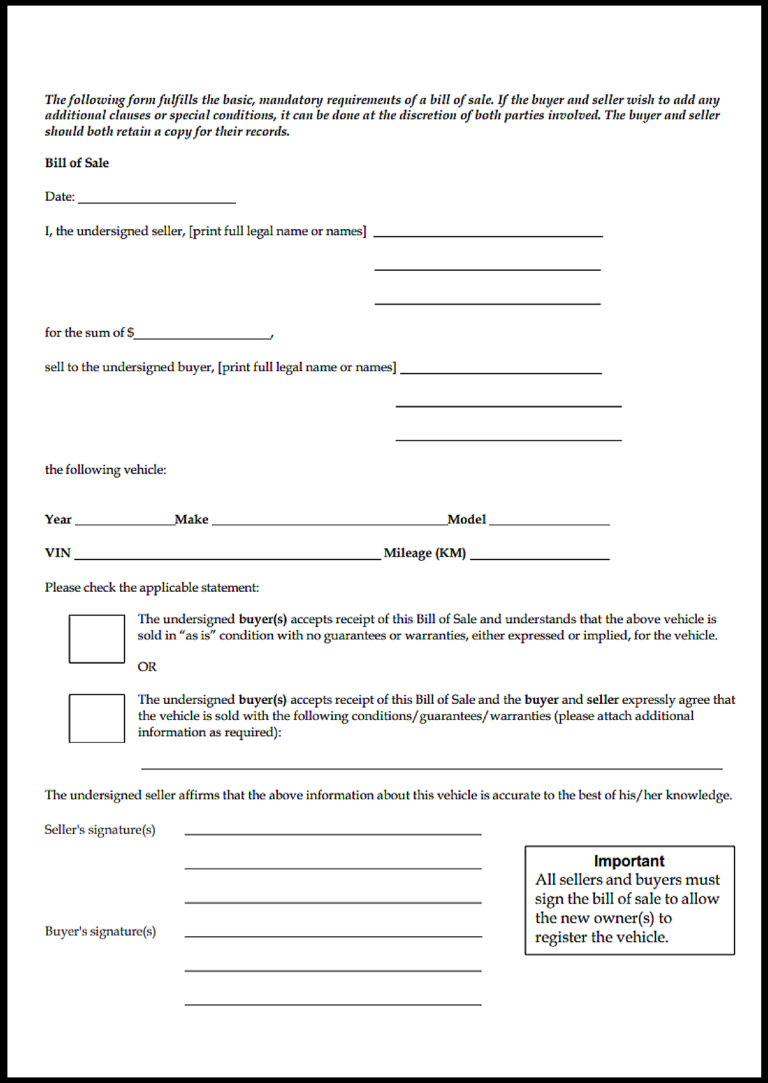
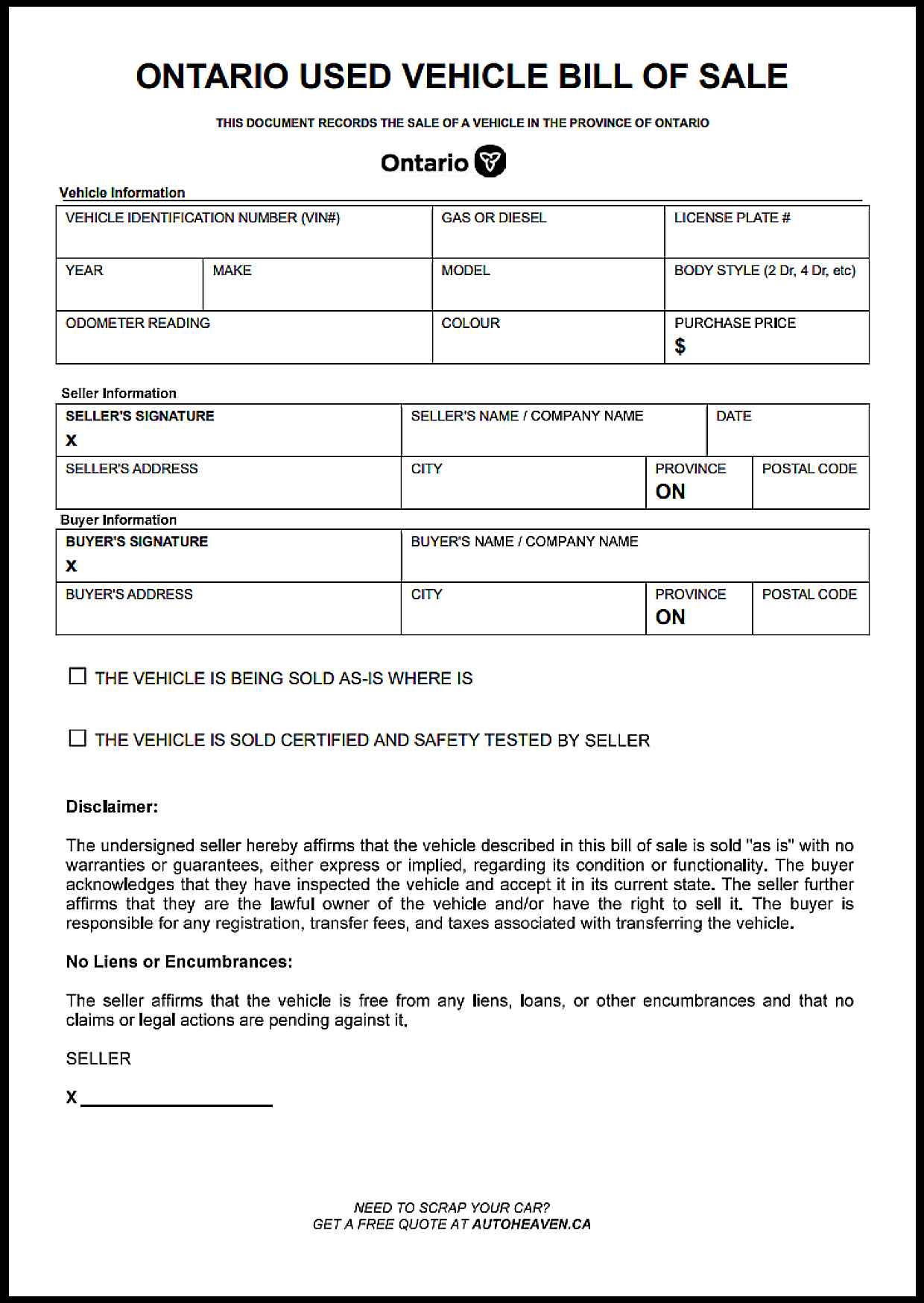
Free Ontario Bill of Sale Template
Below is a general-purpose Ontario bill of sale template. It works for most personal transactions like selling furniture, electronics, or small equipment.
Ontario Bill of Sale Laws and Registration Rules You Should Know
| Topic / Issue | Ontario Legal Rule | Governing Statute |
|---|---|---|
| Governing law for sale of goods | The sale of goods in Ontario is governed primarily by the Sale of Goods Act, R.S.O. 1990, c. S.1, together with any other law that applies to the particular transaction. | Sale of Goods Act, R.S.O. 1990, c. S.1 |
| Vehicle transfer requirements | Used motor vehicle transfers and registration are subject to specific requirements under Ontario’s Highway Traffic Act and related government procedures. | Highway Traffic Act, R.S.O. 1990, c. H.8 |
| Consumer transactions | Ontario’s current Consumer Protection Act, 2002 generally applies to consumer transactions involving a supplier and consumer. A purely private sale between individuals generally does not fall within the Act’s definition of a consumer transaction. The Consumer Protection Act, 2023 has been enacted but is not yet in force. | Consumer Protection Act, 2002; Consumer Protection Act, 2023, S.O. 2023, c. 23, Sched. 1 |
| Federal jurisdiction | There is no single federal statute governing an ordinary Ontario bill of sale for general goods, although federal laws may apply to particular goods or transactions. | Federal laws where applicable |
| Recent legislative update | The Consumer Protection Act, 2023 has been enacted but is not yet in force; its commencement awaits a proclamation by the Lieutenant Governor. | Consumer Protection Act, 2023 |
| Who can sign | For a general bill of sale, Ontario law does not impose a universal signature requirement for every sale of goods. For a used vehicle, however, Ontario requires a signed Bill of Sale containing specified information. | Sale of Goods Act; Highway Traffic Act requirements |
| Witness requirement | Ontario does not generally require a witness for an ordinary bill of sale, although specific transactions may have additional formal requirements. | N/A |
| Notarization | A bill of sale for an ordinary private sale generally does not need to be notarized in Ontario. | N/A |
| Age and legal capacity | Contractual capacity is governed by Ontario law; the Sale of Goods Act specifically addresses sales to minors and provides a rule for necessaries. | Age of Majority and Accountability Act; Sale of Goods Act, s. 3 |
| Vehicle registration deadline | A buyer must register the vehicle and apply for a new permit within 6 days after becoming the owner. | Highway Traffic Act |
| Mandatory “As Is” disclosure | Do not rely on a generic “as-is” clause to satisfy Ontario vehicle-transfer or safety requirements. Vehicle sellers should follow the specific disclosure, safety and transfer requirements that apply to the vehicle and transaction. | Applicable Ontario vehicle legislation and regulations |
| Filing requirement for general goods | An ordinary private sale of general goods does not generally require a bill of sale to be filed with the Ontario government. | N/A |
| Vehicle registration filing | For a used vehicle transfer, the buyer must provide the required Bill of Sale and other documents when registering the vehicle through ServiceOntario. | Highway Traffic Act requirements |
| Security interest registration | If a seller takes a security interest to secure payment, PPSA registration may be necessary to protect that interest against third parties. | Personal Property Security Act (PPSA) |
| Missing VIN | A vehicle Bill of Sale should accurately record the vehicle identification number and match the vehicle and ownership documents. | Highway Traffic Act requirements |
| UVIP requirement | A person selling or transferring a used motor vehicle must generally provide a valid Used Vehicle Information Package (UVIP) to the purchaser or transferee. | Highway Traffic Act, s. 11.1 |
| Undisclosed liens | Under Ontario’s Sale of Goods Act, a contract of sale generally carries an implied warranty that the goods are free from third-party charges or encumbrances that were not declared or known to the buyer when the contract was made. | Sale of Goods Act, s. 13 |
| Ontario-specific vehicle rule | Ontario requires a Used Vehicle Information Package (UVIP) for most private used-motor-vehicle transfers. | Highway Traffic Act, s. 11.1 |
| Retail Sales Tax on private vehicle sales | For many privately purchased specified vehicles, Ontario charges 13% RST and calculates the tax using the applicable fair-market-value rules. For an automobile, van or truck with an empty weight of 2,200 kg or less, fair market value generally means the greater of the purchase price or the applicable Canadian Red Book value. Special appraisal rules and exemptions may apply. | Retail Sales Tax Act, R.S.O. 1990, c. R.31; applicable regulations |
Ontario has some very specific Bill of Sale rules that many buyers and sellers do not realize until a problem happens. If you are selling a used vehicle privately in Ontario, the paperwork is more specific than it is for an ordinary household item. The seller must provide the buyer with a valid UVIP, and the buyer must register the vehicle within six days after becoming the owner. Those two requirements are worth checking before the vehicle changes hands, because a missing document can turn a straightforward sale into a registration problem.
Before signing, compare the vehicle identification number on the vehicle with the ownership documents and Bill of Sale. Ontario also requires sellers to provide a UVIP, which can reveal money owing on the vehicle. If an undisclosed encumbrance is discovered, the buyer may have a claim based on the implied warranty in the Sale of Goods Act, although the remedy will depend on the circumstances.
A few minutes spent checking the vehicle documents can prevent a much bigger problem after the sale. For a general sale, the template can help you record the parties, item, price and date; for a vehicle, make sure the separate Ontario transfer requirements are also completed.
Types of Bill of Sale in Ontario
Not all sales are the same. Under Ontario law, some items require extra details or documents.
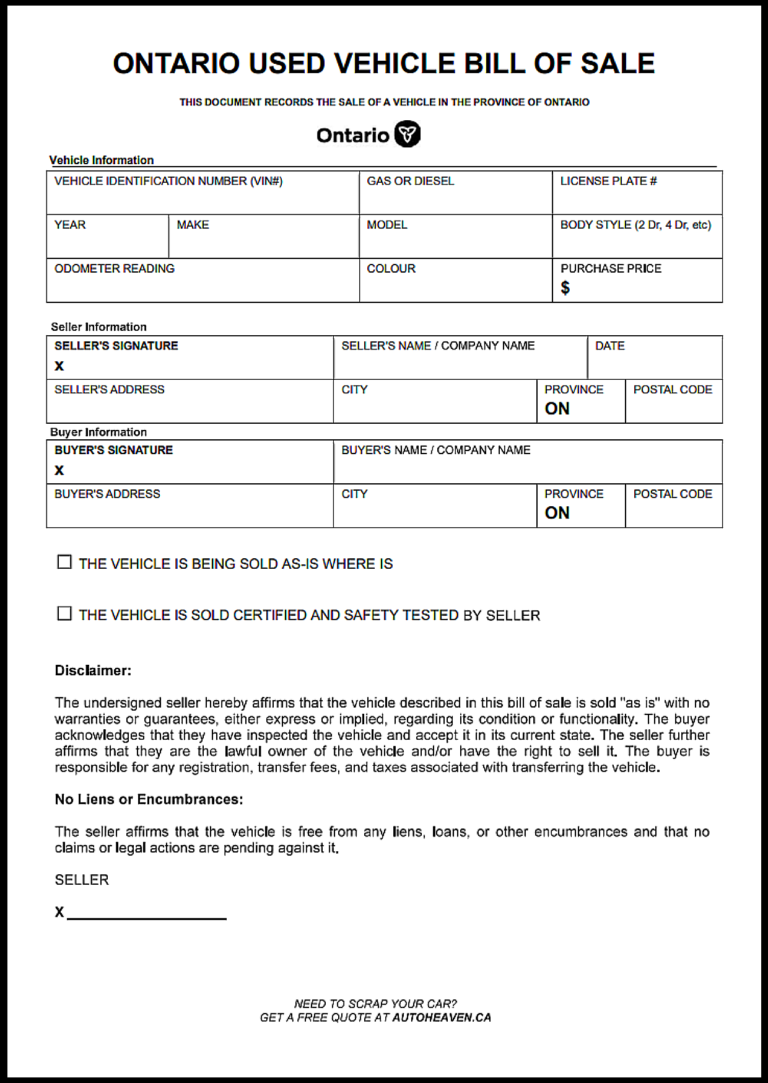
Vehicle Bill of Sale (Car / Motorcycle / Truck)
In Ontario, vehicle transfers usually also require a Used Vehicle Information Package (UVIP). You can verify official requirements through ServiceOntario.
Used when selling a vehicle privately.
Must include:
- VIN (Vehicle Identification Number)
- Make, model, year
- Mileage
- Sale price
In Ontario, vehicle transfers usually also require a Used Vehicle Information Package (UVIP).
Boat (Vessel) Bill of Sale
Used for boats and watercraft.
Includes:
- Hull Identification Number (HIN)
- Engine details
- Registration info
Important for:
- Ownership proof
- Insurance
- Future resale
When dealing with ownership transfer in Ontario, this article helps you understand how a bill of sale works as a legally recognized proof of transaction. Whether you’re handling a vehicle or personal asset, documents like the vehicle bill of sale template in Ontario and the car sale agreement format are commonly used to record key transaction details.
Firearm Transfer Restrictions (Federal Preemption)
- A bill of sale alone does not authorize a firearm transfer in Canada; firearm transfers must comply with the federal Firearms Act and applicable regulations. For a non-restricted firearm, the transferee must hold a licence authorizing acquisition and possession, and the Registrar must issue a valid reference number before the transfer. Failure to comply with the federal firearm-transfer requirements can have legal consequences, including offences under applicable federal firearms law.
- Firearms Act, S.C. 1995, c. 39; Criminal Code, R.S.C. 1985, c. C-46
Trailer Bill of Sale
Used for trailers, campers, or utility units.
Includes:
- VIN (if available)
- Weight and type
- Condition
Sometimes required for registration in Ontario.
Equipment / Personal Property Bill of Sale
Used for:
- Furniture
- Electronics
- Tools
- Machinery
Flexible and simple format.
Business Asset Bill of Sale
Used when selling business-related items.
Includes:
- Inventory
- Equipment
- Tools
Often part of a larger agreement.
Depending on the type of asset, you may need more specific formats such as a boat bill of sale document or a trailer ownership transfer form. For a broader understanding of legal compliance, it’s also helpful to review the bill of sale requirements in Ontario.
Real-Life Use Cases (When You Need a Bill of Sale)
Here are common situations where a bill of sale is very useful:
- Selling a used car privately in Ontario
- Buying a second-hand boat from an individual
- Selling equipment like generators or tools
- Selling items on platforms like Facebook Marketplace
- Keeping proof for tax or legal records
Example & Adjudicative Forum:
If a dispute arises regarding contract terms, undisclosed liens, or vehicle defects, the Bill of Sale can serve as important documentary evidence. For claims within its monetary jurisdiction, the Ontario Small Claims Court can hear claims of up to $50,000. Claims above $50,000 generally fall within the Superior Court of Justice, subject to the applicable rules and any waiver of the excess amount.
Key Elements of a Valid Ontario Bill of Sale
To be legally useful, your document must include the following:
Buyer and Seller Information
- Full legal names
- Contact details
Description of the Item
- Clear and detailed
- Include serial numbers (if available)
Purchase Price and Payment Terms
- Exact amount
- Payment method
Date of Sale
- When ownership changes
Signatures of Both Parties
- Makes the document valid proof
- As-Is” and Statutory Waiver Clause (Critical for Seller Liability)
In an Ontario sale of goods, an express agreement can in some circumstances exclude or vary rights, duties or liabilities that would otherwise arise by implication of law under section 53 of the Sale of Goods Act. The effectiveness of an exclusion clause depends on its wording and the circumstances of the transaction.
- The buyer accepts the item in its current state and condition, “as is, where is,” with all faults.
- If the parties intend to exclude or vary implied rights under the Sale of Goods Act, the wording should clearly identify the rights being excluded or varied and should be reviewed in light of section 53 and any applicable consumer-protection legislation.
How to Create or Complete a Bill of Sale in Ontario
Follow these simple steps:
Step 1: Identify the type of item
Is it a vehicle, boat, or general item?
Step 2: Use the correct template
Avoid using a general template for regulated items.
Step 3: Fill in accurate details
Double-check numbers, names, and price.
Step 4: Review terms
Especially the “as-is” clause.
Step 5: Sign and keep copies
Both parties should keep a signed copy.
Legal Overview in Ontario
Ontario does not use one universal bill-of-sale form for every private sale. The document is mainly useful because it records the deal in a form the parties can keep and refer to later. Used vehicle sales are different: the buyer and seller must follow Ontario’s separate UVIP, Bill of Sale and registration requirements.
The practical benefit is straightforward: if the parties later disagree about the price, item, condition or date of the sale, the signed record gives them something concrete to check. It does not eliminate every dispute, but it can make the agreed terms much easier to prove.
If you’re unsure whether this document is mandatory in your situation, you can explore when a bill of sale is required in Ontario or compare it with other ownership documents like in this bill of sale vs ownership guide.
Common Mistakes to Avoid
Avoid these common errors:
- Using a generic template for a vehicle sale
- Missing key details (VIN, serial numbers)
- Using an unclear or overbroad “as-is” clause without considering the transaction and applicable law
- Forgetting signatures
- Not keeping a copy
Tip: Small mistakes can cause big problems later—especially in vehicle sales.
Choosing the Right Bill of Sale
| Situation |
Which Bill of Sale to Use
|
| Selling a vehicle |
Vehicle Bill of Sale
|
| Selling a boat | Boat Bill of Sale |
| Selling firearms |
Follow federal firearm-transfer requirements; a bill of sale alone is not sufficient
|
| Selling everyday items |
General Bill of Sale
|
| Selling business assets |
Business Bill of Sale
|
FAQs
Is a bill of sale legally required in Ontario?
No, Ontario does not impose one universal bill-of-sale requirement for every private sale. However, a written bill of sale is strongly recommended because it records the transaction and can help establish the agreed terms. Some types of transactions, such as used vehicle transfers, have separate documentation requirements.
Can I write my own bill of sale?
Yes. You can generally create your own bill of sale, but the information required depends on the transaction. For a used vehicle, Ontario requires specific information and signatures.
Does a bill of sale need to be notarized?
No, a bill of sale for an ordinary private sale generally does not need to be notarized in Ontario. Specific transactions may have additional formal requirements.
What is the difference between a bill of sale and a receipt?
A bill of sale records the terms and details of a sale, while a receipt primarily records payment. Depending on the transaction, either document may help establish what occurred.
Can a bill of sale be used as proof of ownership?
A bill of sale can be important evidence of a purchase and may help establish ownership, but it is not always the only document needed to establish or register ownership.
What happens if I don’t use one?
Without a written bill of sale, it may be harder to prove the agreed price, condition, date of sale or other terms if a dispute later arises.
Legal Disclaimer
This content is for general information only and is not legal advice. Laws may change or vary depending on your situation. Always verify details with official Ontario government sources or consult a qualified legal professional.