Ontario Service Agreement | Free Contract Template & Guide
An Ontario Service Agreement can prevent a straightforward business relationship from turning into a costly dispute when expectations aren’t clearly documented from the start. In Ontario, consumer-facing service contracts are subject to requirements under the Consumer Protection Act, including rules that place significant weight on written terms and proper disclosure.
I’ve seen situations where a contractor completed additional work believing it had been approved, only to face a payment dispute because the extra services were never added to the agreement in writing. In those cases, the disagreement often centres on what can actually be proven rather than what either side remembers discussing.
Whether you’re hiring a service provider or offering services yourself, having a properly drafted agreement helps clarify responsibilities, payment terms, timelines, and dispute procedures, and this page explains the key clauses, Ontario requirements, and practical considerations to include.
Last Updated: September 2026
Table of Contents
ToggleFree Ontario Service Agreement Template
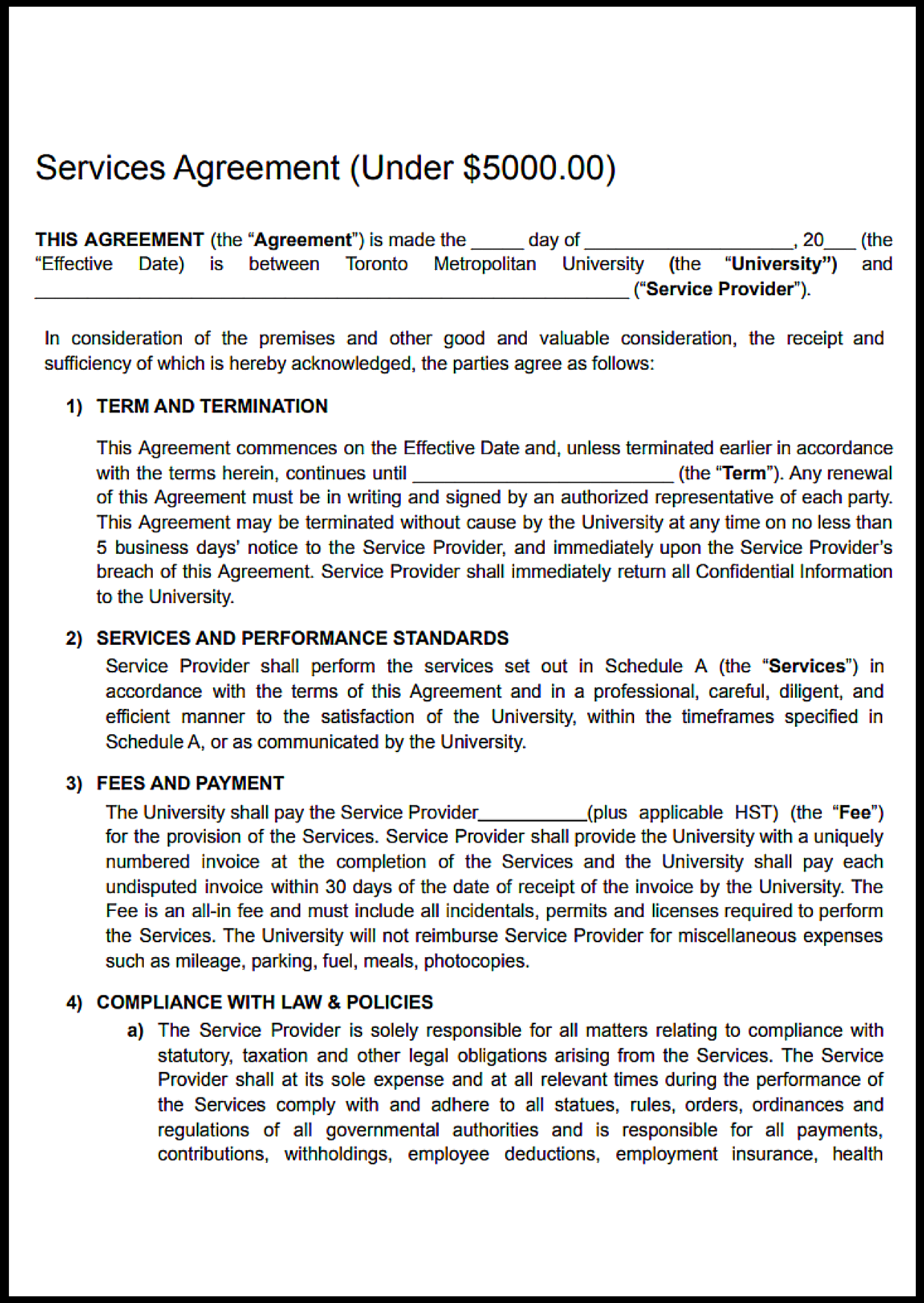
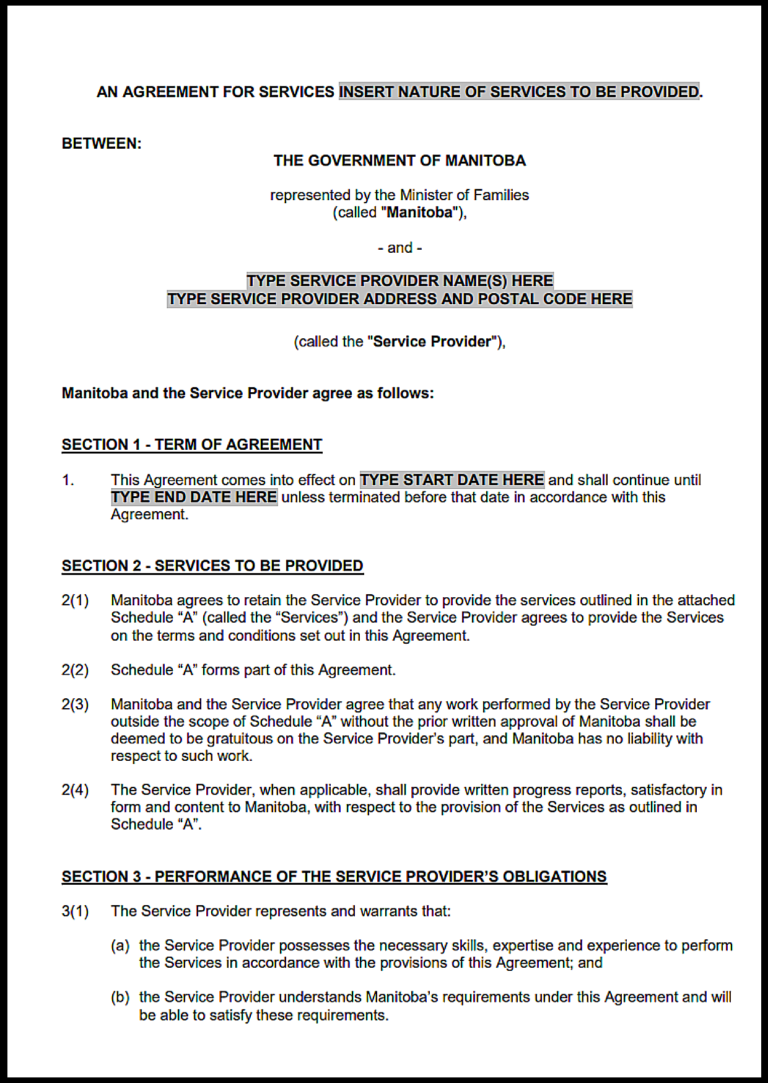
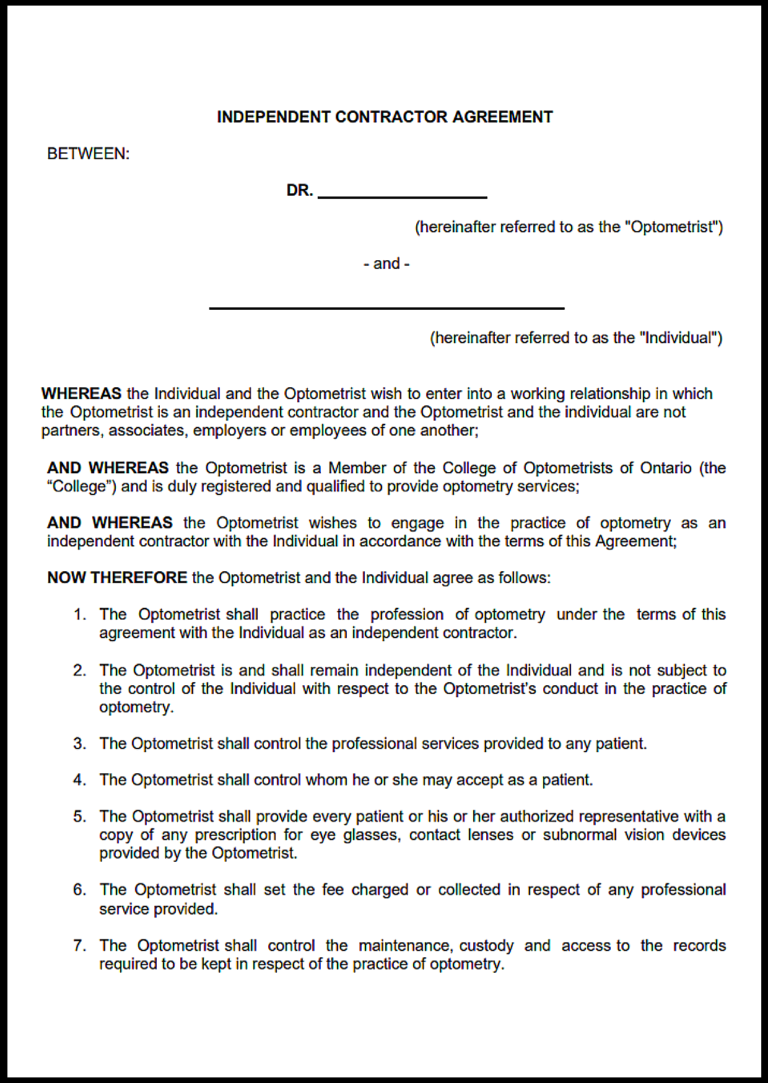
Below is a simple, ready-to-use template you can copy and edit for your needs.
Ontario Service Agreement Laws, Consumer Rights & Contract Rules
| Topic / Issue | Ontario Legal Rule | Governing Statute |
|---|---|---|
| Governing legislation | B2B service agreements are primarily governed by common-law contract principles and any legislation applicable to the particular transaction. Consumer service agreements may be subject to the Consumer Protection Act, 2002. Privacy obligations may also arise under applicable federal or provincial privacy legislation. | Common Law; Consumer Protection Act, 2002, S.O. 2002, c. 30, Sched. A; applicable privacy legislation |
| Jurisdiction | Contract formation and enforcement are generally governed by Ontario law, while privacy obligations depend on the applicable privacy legislation and the nature of the parties and their activities. | Ontario contract law; applicable privacy legislation |
| Who can sign | An individual with contractual capacity may enter into a service agreement, while a corporation should sign through a person with appropriate authority to bind the corporation. | Applicable Ontario contract and corporate law |
| Witness requirement | An ordinary service agreement generally does not require a witness merely to be enforceable, although a particular transaction or document may have additional formal requirements. | N/A |
| Notarization | An ordinary service agreement generally does not need to be notarized merely to be enforceable. | N/A |
| Age requirement | Ontario’s age of majority is 18, but the contractual capacity and enforceability of an agreement involving a minor can depend on the circumstances and applicable legal rules. | Age of Majority and Accountability Act, s. 1 |
| Mental capacity | Under the Substitute Decisions Act, 1992, a person who is 18 or older is presumed to be capable of entering into a contract, subject to the Act’s rules concerning capacity. | Substitute Decisions Act, 1992, s. 2 |
| Time limit to sue | The basic limitation period in Ontario is generally two years from when the claim is discovered, subject to exceptions and other applicable limitation rules. | Limitations Act, 2002, ss. 4–5 |
| Implied warranty of quality | Under section 9 of the Consumer Protection Act, 2002, a supplier is deemed to warrant that services supplied under a consumer agreement are of reasonably acceptable quality. | Consumer Protection Act, 2002, s. 9 |
| Itemized disclosure requirements | Certain consumer agreements are subject to specific disclosure and content requirements under the Consumer Protection Act, 2002, depending on the type of agreement and the circumstances. | Consumer Protection Act, 2002 |
| No waiver of consumer rights | Section 7 of the Consumer Protection Act, 2002 generally prevents a consumer from waiving substantive and procedural rights under the Act. | Consumer Protection Act, 2002, s. 7 |
| Filing requirement | Ordinary service agreements generally do not require government filing or registration merely because they are contracts. | N/A |
| Security interest exception | A Notice of Security Interest (NOSI) is a specific registration mechanism under the Personal Property Security Act that may apply in transactions involving qualifying collateral, such as certain fixtures. It should not be treated as a standard filing requirement for service agreements. | Personal Property Security Act |
| Mandatory arbitration clauses | Consumer agreements should be reviewed for compliance with the Consumer Protection Act, 2002 and other applicable law before relying on an arbitration provision. The enforceability of a particular arbitration clause depends on the circumstances and applicable legislation. | Consumer Protection Act, 2002; Arbitration Act, 1991 |
| Unfair or unconscionable agreements | The Consumer Protection Act, 2002 contains protections against certain unfair practices, including false, misleading or deceptive representations and unconscionable representations, and provides remedies in specified circumstances. | Consumer Protection Act, 2002, ss. 14–18 |
| Failure to provide copy | For certain future-performance agreements covered by Part IV of the Consumer Protection Act, 2002, a consumer may have a cancellation right if the required written copy is not received. | Consumer Protection Act, 2002 |
| Ontario’s unified contract approach | Ontario’s consumer-protection requirements vary according to the type of consumer agreement, so the applicable disclosure and cancellation rules should be identified before relying on a standard form. | Consumer Protection Act, 2002 |
| NOSI reform | Ontario has introduced legislative measures addressing misuse of Notices of Security Interest (NOSIs), including provisions in the Better for Consumers, Better for Businesses Act, 2023. The timing and application of those measures should be checked against the legislation currently in force. | Better for Consumers, Better for Businesses Act, 2023 |
Ontario’s current consumer-protection rules go beyond signatures and can impose specific requirements depending on the type of consumer agreement. For example, section 9 of the Consumer Protection Act, 2002 deems a supplier to warrant that services supplied under a consumer agreement are of reasonably acceptable quality.
Another major issue is disclosure. For consumer agreements covered by specific provisions of the Consumer Protection Act, 2002, missing required disclosures can create statutory remedies or cancellation rights. The exact requirements depend on the type of agreement.
Arbitration clauses should also be reviewed carefully in consumer agreements because their enforceability can depend on applicable legislation and the wording of the clause. The Consumer Protection Act, 2023 should not be presented as the current source of a consumer arbitration restriction because that Act is still not in force.
Using a properly written Ontario service agreement helps reduce disputes and gives both parties a clearer record of their obligations. You can use the free Ontario Service Agreement template below as a starting point and customize it for your business.
What Is an Ontario Service Agreement?
A service agreement is a legal contract between two parties:
- One party provides a service
- The other party pays for it
A service agreement generally requires the elements of a valid contract, which can include offer, acceptance, consideration, an intention to create legal relations and sufficiently certain terms.
When drafting a service contract, you may also need to include confidentiality terms, which are explained in the [Ontario NDA template guide] for protecting sensitive information.
Verbal vs Written Agreements
| Type | Valid in Ontario? | Risk Level |
| Verbal Agreement | Yes, in appropriate circumstances |
Higher evidentiary risk
|
| Written Agreement | Yes |
Lower evidentiary risk
|
A verbal agreement can be legally binding in appropriate circumstances, but proving the agreed terms can be more difficult. A written agreement provides a clearer record of the parties’ arrangement.
Who Uses Service Agreements?
- Freelancers (designers, writers, developers)
- Consultants
- Agencies
- Small businesses
- Contractors
When Do You Need a Service Agreement in Ontario?
A written Service Agreement is particularly useful when the services involve significant payment, ongoing work, detailed deliverables, confidential information, or responsibilities that need to be clearly documented.
Common situations where a service agreement may be useful include hiring a freelancer or independent contractor, offering professional services, managing ongoing business relationships, or handling one-time projects. For example, a web designer creating a website, a cleaning company servicing offices, a marketing agency running ads, or a consultant advising a startup may benefit from a clear agreement.
When money and services are involved, putting the important terms in writing can reduce uncertainty and make the parties’ obligations easier to prove.
This agreement is frequently paired with a [consulting agreement structure] or a [vendor agreement format], depending on the type of services being delivered.
Key Clauses in an Ontario Service Agreement
Scope of Services
Clearly explain:
- What work will be done
- What is NOT included
Describe the work in enough detail that both parties can tell what is included and what falls outside the agreed scope. If exclusions matter, state them expressly rather than leaving them to assumption.
Payment Terms
Include:
- Total fee
- Payment method
- Deadlines
- Late payment penalties
For example:
- 50% upfront, 50% after completion
State the total fee or pricing method, payment dates, accepted payment method and any agreed late-payment charge. If payment depends on milestones, identify the milestone and the amount payable.
Timeline & Deliverables
Define:
- Start date
- End date
- Milestones
- Revision limits
Set the start date, expected completion date, important milestones and any limits on revisions or additional work. This gives both parties a practical reference if the project changes.
Confidentiality Clause
Protects sensitive information like:
- Business plans
- Client data
- Trade secrets
For stronger protection, you can also use an Ontario NDA Template for confidentiality support.
Independent Contractor Clause
This clause can describe the parties’ intended relationship, but the label alone does not determine whether a worker is legally an independent contractor. Ontario’s employment standards rules can apply based on the actual relationship.
This is legally important because:
- Employees may be entitled to mandatory minimum employment standards under the Employment Standards Act, 2000, including applicable rules concerning wages, hours, overtime, vacation, termination and, where the statutory requirements are met, severance.
- A genuine independent contractor may generally be responsible for their own tax obligations and business expenses, but tax, WSIB and other obligations depend on the worker’s actual status and the applicable rules.
- Misclassification can expose a business to claims for applicable employment standards and other legal obligations. Section 5.1 of the Employment Standards Act, 2000, S.O. 2000, c. 41, prohibits an employer from treating an employee as if the person were not an employee and places the burden on the employer or alleged employer in specified proceedings to prove that the person is not an employee.
Ontario’s worker-classification rules therefore should not be determined solely by the wording of the service agreement.
Misclassification can lead to significant legal and financial consequences in Ontario.
Termination Clause
Explains:
- How either party can end the agreement
- Agreed notice period, if any
State how either party may terminate the agreement, whether notice is required, and which events permit termination without notice. The applicable notice period should come from the contract rather than an assumed Ontario-wide 7–14-day rule.
Liability & Indemnity
Sets out how certain legal and financial risks will be allocated between the parties.
Example:
- The service provider is not responsible for specified indirect losses, subject to applicable law and the terms of the agreement.
Governing Law (Ontario)
This clause identifies Ontario law as the governing law for the agreement, subject to the wording of the contract and any mandatory rules that apply.
Without a clear governing-law clause, determining which law applies can become more complicated, particularly where the parties are located in different jurisdictions.
Is a Service Agreement Legally Enforceable in Ontario?
A service agreement can be enforceable in Ontario when the requirements for contract formation are satisfied and the terms are enforceable. Offer, acceptance and consideration are important elements, but the analysis can also involve intention, certainty, capacity, authority and applicable legislation.
It is also important that the parties agree to the terms and that the agreement does not contain terms that are unenforceable or contrary to mandatory legal requirements.
For example, a service agreement can create problems if the terms are too vague, if a party lacked authority or capacity, if the agreement involves unlawful terms, or if the parties never reached a sufficiently clear agreement.
Ontario law also recognizes qualifying electronic signatures and electronic contracts. Under the Electronic Commerce Act, 2000, an electronic signature can satisfy a legal requirement for a signature subject to the Act, and a contract is not invalid or unenforceable merely because it is in electronic form.
How to Fill Out an Ontario Service Agreement (Step-by-Step)
Step 1: Add party details
Use full legal names and correct addresses.
Step 2: Define services clearly
Avoid vague descriptions like “design work.” Be specific.
Step 3: Set payment structure
Choose:
- Hourly
- Fixed
- Milestone-based
Step 4: Include timelines
Mention deadlines and delivery expectations.
Step 5: Add legal clauses
Include:
- Confidentiality
- Termination
- Liability
You can also refer to an Ontario Independent Contractor Agreement for better structure.
Step 6: Review and sign
The parties should clearly demonstrate acceptance of the agreement. Ontario law recognizes qualifying electronic signatures and electronic contracts, so a physical signature is not necessarily required.
Common Mistakes to Avoid
- Vague service descriptions
- Missing payment details
- No termination clause
- Copy-pasting templates without editing
- Failing to properly document acceptance or execution
Tip: Before signing, compare the agreement with the actual project. Confirm that the scope, payment structure, deadlines, termination rights and any confidentiality or liability provisions reflect what the parties actually agreed.
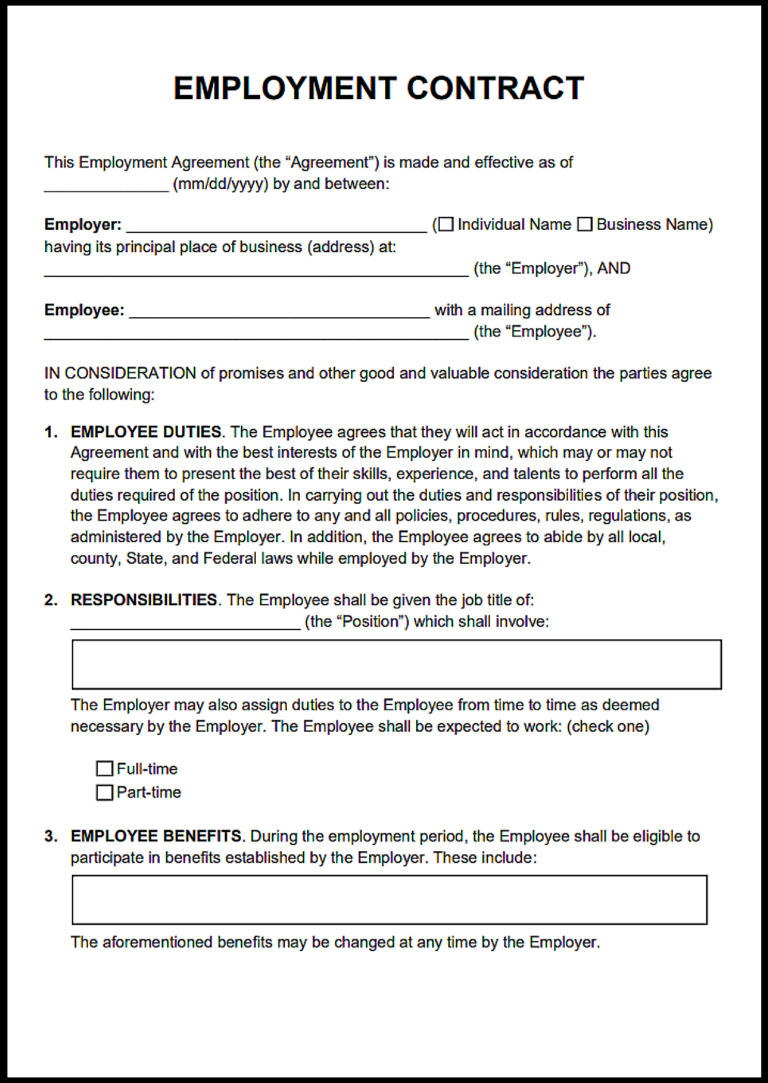
Service Agreement vs Employment Contract
| Feature | Service Agreement |
Employment Contract
|
| Relationship | Contractor relationship may be intended |
Employee relationship
|
| Benefits | Depends on actual legal status and agreement |
Employees may receive statutory and contractual benefits
|
| Taxes | May be handled by the contractor, depending on actual status |
Employer generally handles required payroll deductions
|
| Control | May involve greater independence |
Employer generally has greater control over the employment relationship
|
Misclassifying a worker can lead to serious legal issues. If unsure, compare with an Ontario Employment Contract before deciding and consider whether the actual working relationship matches the intended classification.
Real-Life Example of a Service Agreement Use Case
A small business hires a freelance designer to create a logo.
Without agreement:
- No clear price
- Unlimited revisions
- Delayed delivery
With agreement:
- Fixed price ($500)
- 2 revision limit
- Delivery in 10 days
The written terms give both sides a practical reference for the agreed price, number of revisions and delivery deadline if a disagreement arises.
Legal Tips to Make Your Agreement Stronger
- Use written contracts when the transaction warrants detailed documentation
- Keep terms clear and specific
- Avoid one-sided clauses that may conflict with applicable law
- Use separate agreements when the transaction involves different legal relationships or risks
For example:
- Use an Ontario Consulting Agreement for advisory work
- Visit the Business Contract Hub Page to explore more templates
For high-value or complex contracts, consider legal review.
Frequently Asked Questions (FAQs)
Is a verbal service agreement valid in Ontario?
Yes, a verbal service agreement can be legally binding in Ontario in appropriate circumstances. However, proving the agreed terms can be more difficult, so a written agreement is often preferable.
Do I need a lawyer to create a service agreement?
No, you don’t always need a lawyer to create a service agreement. For a straightforward arrangement, a customized template may be a useful starting point. For complex, high-value or heavily negotiated contracts, legal advice can help identify risks before signing.
Can I cancel a service agreement after signing?
A party can end a service agreement according to its termination provisions, subject to applicable law. Certain consumer agreements may also have statutory cancellation rights, but there is no universal right to cancel every service agreement after signing.
What happens if someone breaches the agreement?
If a party breaches the agreement, the other party may have contractual or legal remedies, which can include damages or other relief depending on the terms of the agreement and the circumstances.
Can I use the same template for all services?
You can reuse a basic template as a starting point, but each service agreement should be customized to the actual services, payment structure, deliverables, risks and applicable legal requirements.


Thank-you for providing this free document, and the helpful resources! Is there a free version of an Ontario service agreement for services over $5,000.00?