British Columbia Rent Receipt Template (Free & Guide)
British Columbia Rent Receipt is a simple document that proves a tenant has paid rent to a landlord. In most rental situations, this small paper (or digital file) can prevent big problems later.
In British Columbia, both tenants and landlords benefit from rent receipts. For tenants, it acts as proof of payment. For landlords, it helps maintain proper financial records. Under British Columbia law, especially guided by the Residential Tenancy Act, having clear payment records can make dispute resolution much easier.
I’ve seen British Columbia tenants struggle during Residential Tenancy Branch disputes because they paid rent in cash or e-transfer but had no proper receipt to prove it later. I always tell clients that keeping a simple rent receipt can save a lot of stress when payment records suddenly become the centre of a legal disagreement.
Last Updated: August 2026
A rent receipt becomes very important in cases like:
- Disputes over unpaid rent
- Tax or financial record keeping
- Shared housing where payments may get confusing
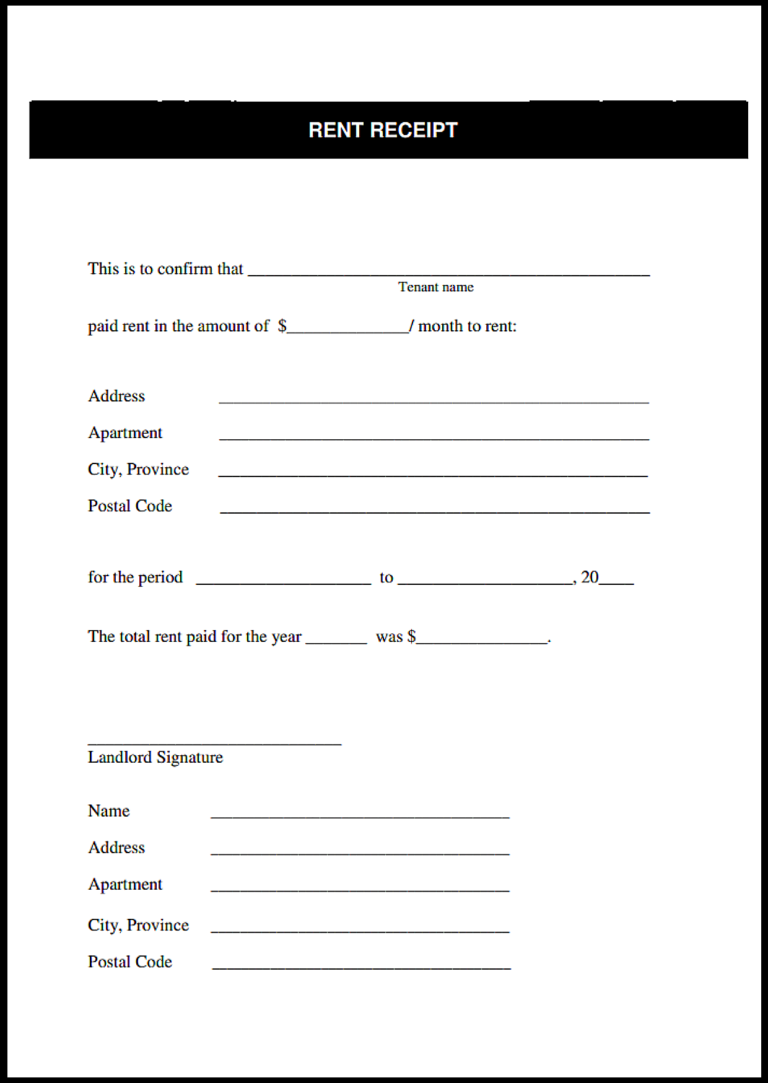
Free British Columbia Rent Receipt Template
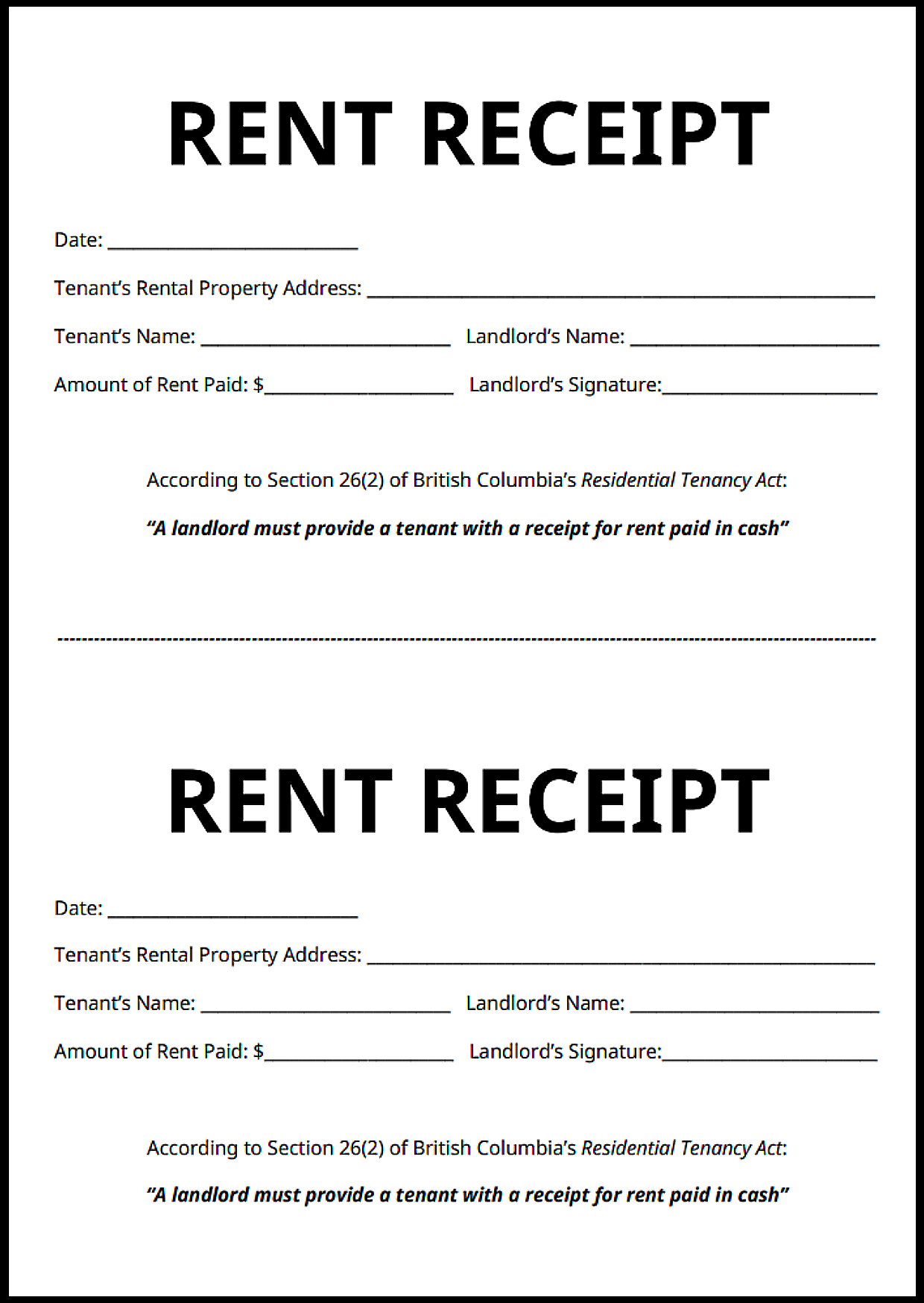
Below is a clean and ready-to-use template. You can copy, print, or save it digitally.
British Columbia Rent Receipt Laws and Legal Recordkeeping Rules
| Topic / Issue | British Columbia Legal Rule | Governing Statute |
|---|---|---|
| Governing legislation | Rent receipts in BC are governed primarily by the Residential Tenancy Act, including its rules about rent payments and receipts. | Residential Tenancy Act [SBC 2002] c. 78 |
| Federal law | Residential tenancy rules, including the receipt requirement for cash rent, are governed by British Columbia’s provincial tenancy legislation. | British Columbia provincial tenancy legislation |
| 2024 amendments | The Tenancy Statutes Amendment Act, 2024 amended several BC tenancy rules, including rules concerning ending tenancies and generated notices. Section 26(2) of the Residential Tenancy Act continues to require a receipt for rent paid in cash. | Residential Tenancy Statutes Amendment Act, 2024 (Bill 14) |
| Who can sign | The Residential Tenancy Act requires the landlord to provide a receipt for rent paid in cash; it does not prescribe the specific signature wording stated here. | Residential Tenancy Act, s. 1 |
| Witness requirement | Section 26 of the Residential Tenancy Act does not require a witness signature for a rent receipt. | Residential Tenancy Act, s. 26 |
| Notarization | Section 26 of the Residential Tenancy Act does not require a rent receipt to be notarized. | Residential Tenancy Act, s. 26 |
| Legal capacity | The Residential Tenancy Act does not impose the age-19 receipt-signing requirement stated here. | Age of Majority Act [RSBC 1996] c. 7 |
| Cash payment receipts | A landlord must provide a tenant with a receipt for rent paid in cash. | Residential Tenancy Act, s. 26(2) |
| Important receipt details | For practical recordkeeping, a rent receipt should identify the payment date, amount, rental address, parties, payment method and rental period covered. | Residential Tenancy Act |
| Filing requirement | Rent receipts are not generally filed or registered with the Residential Tenancy Branch. | Residential tenancy framework |
| Record retention | The Residential Tenancy Act generally requires an application for arbitration to be filed within 2 years after the tenancy ends when no other filing period applies. Keeping payment records for the relevant period can therefore be useful. | Residential Tenancy Act, s. 60 |
| Failure to issue cash receipt | Failing to provide a receipt for rent paid in cash does not comply with section 26(2) of the Residential Tenancy Act. | Residential Tenancy Act, s. 26(2) |
| Unclear allocation of funds | Receipts should clearly identify what a payment is for, such as rent, a deposit or another charge, to reduce the risk of payment disputes. | Residential Tenancy Act |
| Inconsistent payment dates | Incorrect or conflicting payment dates can make payment records less clear and may affect how persuasive the records are in a dispute. | Residential Tenancy Act |
| Cash receipt rule difference | BC law specifically requires a receipt for rent paid in cash. For other payment methods, tenants and landlords should keep reliable payment records, such as e-transfer confirmations or other records. | Residential Tenancy Act, s. 26 |
| Deposit distinction rule | Security deposits and rent are different types of payments and should be identified separately in payment records. | Residential Tenancy Act |
One of the clearest receipt rules in British Columbia is that landlords must provide a receipt when rent is paid in cash. Keeping that receipt can also help establish the payment history if the parties later disagree about rent.
It is useful to identify what each payment represents, especially when a tenant pays rent and another amount at the same time. Clear records can make it easier for an RTB arbitrator to understand the payment history if a dispute arises.
The Residential Tenancy Act generally gives parties 2 years after a tenancy ends to file an arbitration application when no other filing period applies. Keeping organized payment records for the relevant period can therefore be useful if a dispute arises later.
Incorrect dates, missing payment details or incomplete records can make a payment history harder to understand. BC’s RTB guidance recommends evidence that is relevant, reliable, authentic, complete and legible.
Keeping written proof of rental payments is important for both landlords and tenants, especially during long-term tenancy arrangements. These records are usually connected to a standard residential rental contract, which outlines the payment terms and due dates agreed upon by both parties.
What Is a Rent Receipt and Why It Matters in BC
A rent receipt is a record confirming that rent was paid. It can be paper or electronic, provided the record is accessible and useful for later reference.
For example, if a tenant pays rent in cash and the landlord later disputes whether a payment was made, the receipt can be used as part of the tenant’s evidence. Other records, such as payment confirmations and correspondence, may also be relevant.
In real life, rent receipts are useful for:
- Tenants → Proof of payment
- Landlords → Organized financial records
- Disputes → Evidence under tenancy laws
Receipts are especially important in situations like cash payments or shared accommodations where tracking money can be difficult.
Property owners often issue these receipts monthly after collecting rent under a flexible tenancy arrangement or a traditional fixed-term agreement. When tenancy conditions change over time, landlords may also prepare a lease extension document to continue the rental relationship without creating entirely new paperwork.
Is a Rent Receipt Legally Required in British Columbia?
Under British Columbia law, a landlord must provide a receipt when rent is paid in cash. The Residential Tenancy Act does not create the same express receipt requirement for every non-cash payment.
- If rent is paid in cash, the landlord must provide a receipt
- For other payment methods, tenants and landlords should keep reliable payment records
The Residential Tenancy Act contains a specific requirement for cash-rent receipts. Payment records can also help both parties document the tenancy and reduce misunderstandings.
If rent is paid in cash, the landlord must provide a receipt. If a dispute reaches the Residential Tenancy Branch, receipts and other payment records can be submitted as evidence.
Payment records can be relevant in disputes involving alleged unpaid rent. If a landlord seeks to end a tenancy for unpaid rent, the parties may need evidence showing the payment history and the amounts allegedly owing. Documents such as a formal eviction notice may also be relevant to the tenancy dispute.
Key Details Every BC Rent Receipt
Basic Identification Information
Every receipt should clearly identify both parties and the property:
- Full name of landlord
- Full name of tenant
- Rental property address
Payment Details
For practical recordkeeping, the payment section should be accurate and complete:
- Exact amount paid
- Date of payment
- Rental period (for example, March 2026 rent)
Payment Method Clarity
Mentioning how the payment was made is very important:
- Cash
- E-transfer
- Cheque
This detail helps avoid confusion during disputes, especially if bank records are involved.
Signature and Verification
For practical recordkeeping, a receipt can include:
- Landlord signature (or digital confirmation)
- Optional receipt number for tracking
How to Fill Out a Rent Receipt (Step-by-Step)
A clear rent receipt is simple to complete. The important part is making sure the payment information matches the actual transaction.
Step 1: Add tenant and landlord details clearly
Step 2: Enter the correct rental period (month/year)
Step 3: Record the exact amount paid (no rounding)
Step 4: Mention the payment method properly
Step 5: Sign the receipt and give a copy to the tenant
Example:
For example, if a tenant pays $1,200 by e-transfer for April 2026, the parties can keep the e-transfer confirmation together with a receipt or other payment record identifying the month and amount paid.
Common Mistakes to Avoid
Many issues happen because of small mistakes in receipts. Avoid these common errors:
- Missing rental period
- Not writing the payment method
- Using unclear or messy handwritten receipts
- Not keeping a copy for records
- Changing formats every month (inconsistency)
Keeping payment records in an organized and consistent format makes them easier to review if a dispute later arises.
When Should You Use a Rent Receipt?
Rent receipts are useful in many situations, not just cash payments.
You should use them when:
- Paying rent in cash (very important)
- Making partial payments
- Paying late rent
- Renting a room or shared space
- Tenant asks for proof
For cash rent, receipts are required by the Residential Tenancy Act. For other payment methods, keeping reliable payment records is a practical way to document the tenancy.
Rent Receipt vs Lease Agreement
| Feature | Rent Receipt |
Lease Agreement
|
| Purpose | Proof of payment | Rental contract |
| Timing | After payment | Before tenancy |
| Legal Role | Evidence in disputes |
Legally binding agreement
|
You can explore our British Columbia lease agreement template for full rental contracts and legal terms.
Tax and Financial Benefits of Rent Receipts
Rent receipts are not just for disputes. They also help with financial management.
For tenants, receipts can:
- Support rent-related claims (if applicable)
- Help track monthly expenses
- Provide proof for financial records
For landlords, receipts help:
- Track rental income
- Prepare tax filings
- Maintain audit-ready records
Keeping organized payment records can make it easier to track rental payments and support financial records when needed.
What Happens If You Don’t Use Rent Receipts?
| Situation | Risk Without Receipt |
Benefit With Receipt
|
| Rent dispute | No proof of payment | Clear evidence |
| Cash payments | Harder to establish payment |
Clear payment record
|
| Record keeping | Poor tracking |
Organized records
|
| Legal issues | Less supporting evidence |
Better documentation
|
Without clear payment records, it can be harder for either party to establish what was paid if a dispute arises.
Real-Life Scenario (Practical Example)
A tenant pays rent in cash for several months but never asks for receipts. Later, the landlord claims one month’s rent is missing.
Without a receipt, the tenant may have to rely on other evidence, such as bank records, messages or witness evidence, to establish the payment.
Now imagine the same situation with receipts. Each payment is recorded and signed. The receipt can be used together with other evidence to help establish the payment history.
The example illustrates why keeping clear payment records can be useful when the parties later disagree about rent.
FAQs About British Columbia Rent Receipts
Do landlords have to give receipts in BC?
Yes. If rent is paid in cash, the landlord must provide a receipt under section 26(2) of the Residential Tenancy Act.
Can I use digital rent receipts?
Electronic payment records can be useful evidence. Electronic records may also receive legal recognition where the Electronic Transactions Act applies, provided the record can be accessed and retained for later reference.
Is a handwritten receipt valid?
A handwritten receipt can be useful evidence if it clearly records the payment and can be read and understood later.
What if my landlord refuses to provide one?
If a landlord does not provide a receipt for rent paid in cash, the tenant can raise the issue through the Residential Tenancy Branch dispute-resolution process if appropriate.
Can rent receipts be used in disputes?
Yes. Receipts and other payment records can be evidence in a tenancy dispute, although their weight depends on the facts and the quality of the records.