Saskatchewan Lease Agreement (Free PDF Template & Guide)

The 7-Business-Day Deposit Return Deadline
Once a tenancy ends and the tenant vacates, The Residential Tenancies Act, 2006 gives landlords a strict 7 business days (excluding weekends and statutory holidays) to either return the full security deposit with interest (if applicable) or serve a formal written notice of claim against the deposit. If a landlord fails to send a claim notice or return the funds within this 7-business-day window, the tenant can apply directly to the Office of Residential Tenancies (ORT) for an immediate order compelling full repayment.
Utilities, Services, and Facility Breakdown
The lease should clearly explain responsibility for:
- Heat
- Water
- Electricity
- Internet
- Parking
- Snow removal
- Lawn care
- Laundry access
Unclear utility wording creates many ORT disputes.
Mandatory Standard Conditions
Saskatchewan requires all written leases to include the standard tenancy conditions found in Schedule 1 of the Residential Tenancies Regulations, 2007.
These conditions cover:
- Quiet enjoyment
- Repairs
- Entry rights
- Maintenance duties
- Notice rules
Even if landlords forget to include them, the law still treats them as part of the agreement.
Signatures and Copy Delivery Requirements
Although witnesses are not legally required, signed written leases create stronger evidence during disputes.
Landlords must provide tenants with a signed lease copy within 20 days after tenancy starts.
How to Create or Complete a Saskatchewan Lease Agreement
Step 1 — Identify the Correct Lease Type
Choose the correct document for the situation:
- Residential lease
- Month-to-month lease
- Room rental agreement
- Commercial lease
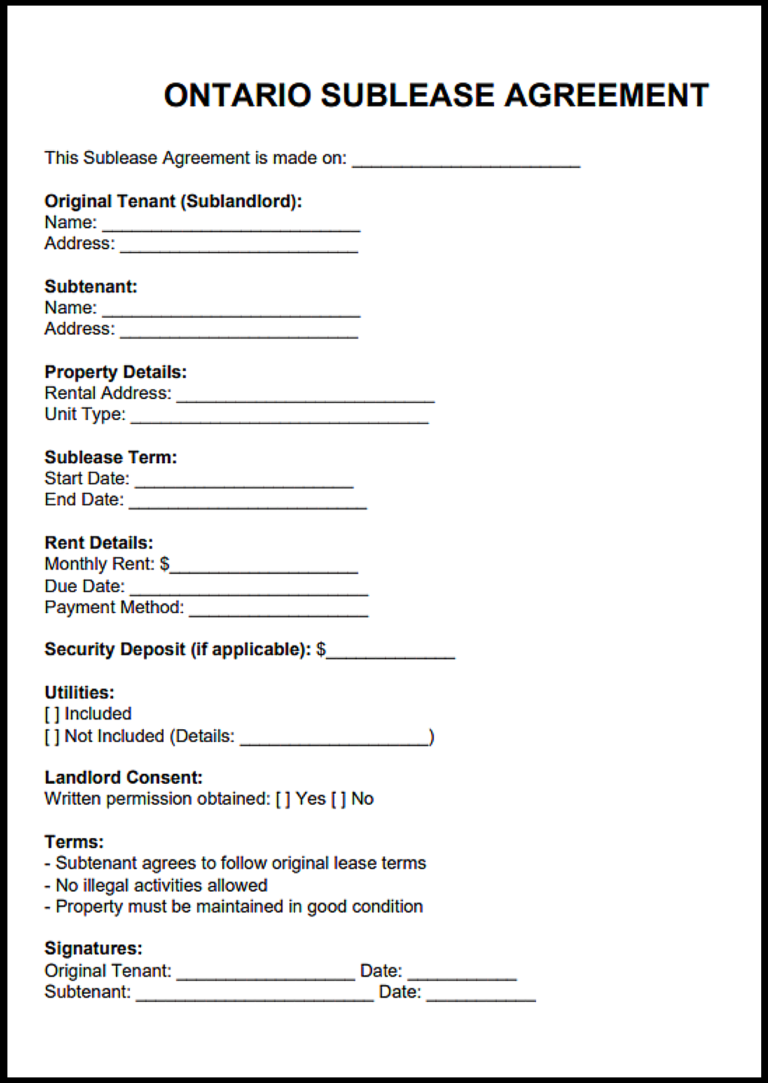
- Sublease agreement
Using the wrong form can create legal confusion.
Step 2 — Add Complete Rental Terms
The lease should clearly address:
- Rent
- Utilities
- Deposits
- Pets
- Occupancy limits
- Parking
- Maintenance duties
Avoid vague wording.
Step 3 — Review Saskatchewan Rental Rules
Before signing, confirm compliance with Saskatchewan rules involving:
- Deposit caps
- Illegal fees
- Tenant rights
- Landlord obligations
Many online U.S. templates violate Saskatchewan law.
Step 4 — Sign and Deliver Copies
Both parties should keep signed copies.
Practical tips many landlords miss:
- Save digital backups
- Photograph move-in conditions
- Complete inspection reports immediately
These records help during deposit disputes.
Legal Overview in Saskatchewan
Saskatchewan residential leases are private contracts, but provincial law still controls many important rules.
The Office of Residential Tenancies handles disputes involving:
- Deposits
- Evictions
- Repairs
- Rent increases
- Lease interpretation
The ORT acts as the first major decision-maker in most residential tenancy disputes.
Summary of Applicable Laws
| Topic | Rule |
Governing Statute
|
| Residential lease framework | Governs tenancy relationships |
The Residential Tenancies Act, 2006
|
| Standard lease conditions | Mandatory tenancy terms |
The Residential Tenancies Regulations, 2007
|
| Legal contract age | Age of majority is 18 |
The Age of Majority Act
|
| Rental dispute resolution | Administrative dispute authority |
Office of Residential Tenancies
|
Common Saskatchewan Lease Agreement Mistakes
Charging Illegal Application or Processing Fees
Under Saskatchewan law, landlords are generally not allowed to charge rental application fees.
Trying to collect these fees can create ORT problems.
Using Non-Refundable Deposit Clauses
Many landlords incorrectly add:
- Non-refundable cleaning fees
- Mandatory carpet cleaning clauses
Saskatchewan law only requires tenants to leave the unit reasonably clean.
Forgetting Mandatory Standard Conditions
Missing Schedule 1 conditions often creates enforcement issues.
The ORT may still apply those conditions automatically.
Poor Move-In Inspection Documentation
Many deposit disputes happen because neither side documented the unit condition properly.
Best practices include:
- Photos
- Videos
- Written inspection forms
- Signed checklists
Illegal Rent Acceleration Clauses
Landlords cannot legally demand all remaining lease payments immediately after one missed rent payment.
These clauses are generally void under Saskatchewan law.
Relying Only on Verbal Agreements
Verbal agreements are harder to prove during disputes.
Written leases provide much stronger evidence.
Choosing the Right Rental Document
For Standard Long-Term Housing
→ Use a Saskatchewan Residential Lease Agreement
For Flexible Ongoing Rentals
→ Use a Saskatchewan Month-to-Month Lease
For Shared Housing or Roommates
→ Use a Saskatchewan Room Rental Agreement
For Business or Retail Property
→ Use a Saskatchewan Commercial Lease Agreement
For Temporary Tenant Replacement
→ Use a Saskatchewan Sublease Agreement
For Tenant Screening Before Approval
→ Use a Saskatchewan Rental Application Form
FAQs
Does a Saskatchewan lease agreement need to be notarized?
No. Saskatchewan residential leases do not require notarization to be legally valid.
Can a landlord charge an application fee in Saskatchewan?
In most residential rental situations, landlords are not allowed to charge application fees.
What is the maximum security deposit allowed?
The maximum security deposit is one month’s rent, including combined pet deposits.
Is a verbal lease agreement enforceable in Saskatchewan?
Some verbal agreements may still be enforceable, but written leases provide much stronger legal protection.
Can a landlord require post-dated cheques?
No. Landlords cannot force tenants to provide post-dated cheques or mandatory automatic withdrawals.
What happens if a tenant never receives a signed lease copy?
Under Saskatchewan law, the tenant’s obligation to pay rent may be suspended until the signed copy is delivered.