Photo Release Form Alberta Template (PDF & Word)
Photo Release Form Alberta is a document many businesses, photographers, schools, charities, and event organisers use before publishing someone’s photograph or video, but taking a picture doesn’t automatically mean it can be used for every purpose. Alberta’s Personal Information Protection Act expects organizations to obtain meaningful consent for the collection, use, and disclosure of personal information, which includes identifiable images in many situations.
I’ve seen community groups in Calgary rely on a quick verbal agreement at an event, only to face complaints later when photographs appeared in promotional material that participants never expected to see. A well-prepared Alberta-specific photo release helps avoid those misunderstandings by clearly explaining how the images may be used and documenting the individual’s consent from the outset. Below you’ll find a Photo Release Form Alberta template together with guidance on who can sign it, when consent may be withdrawn, and the drafting mistakes that most often lead to disputes.
Photo Release Form Alberta
Does a Photo Release Form Hold Up Under Alberta Privacy Law?
A signed photo release is far more than a simple permission slip. For most private businesses and organizations in Alberta, consent relating to identifiable photographs is governed by the Personal Information Protection Act (PIPA), while Alberta public bodies such as government departments, school boards, and public post-secondary institutions are generally subject to the Freedom of Information and Protection of Privacy Act (FOIP). The legal requirements differ depending on who is collecting the images, which is why copying a form from another province isn’t always a good idea.
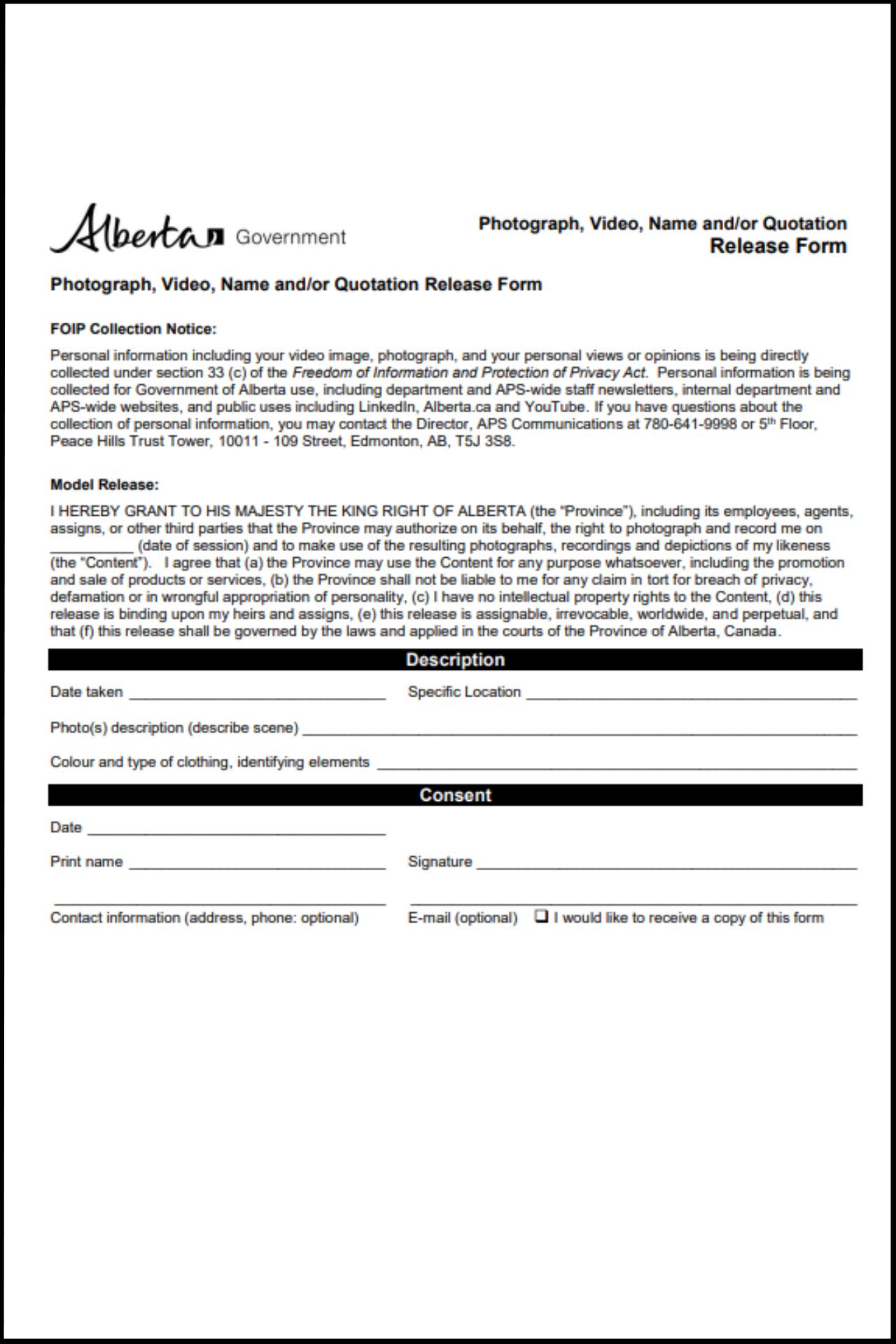
For organizations governed by the Personal Information Protection Act, section 8(3) and section 13(1) require the consent process to identify the purpose for collecting, using, or disclosing the photographs and to provide contact information for a person who can answer questions about the collection. If the organization is an Alberta public body governed by the Freedom of Information and Protection of Privacy Act, section 34(2) requires additional information, including the statutory authority for collecting the photographs, the purpose of the collection, and contact information for an officer who can respond to privacy enquiries.
Imagine a small retail business in Calgary launching a new advertising campaign featuring real customers. The photographer obtains signed forms allowing photographs to be taken, but the release never explains that the images will appear on the company’s website, printed brochures, and social media accounts. Even though everyone willingly posed for the photographs, failing to explain the intended use can create unnecessary disputes about whether informed consent was actually provided.
There are limits as well. A photo release cannot override Alberta’s privacy legislation, and it should never be used to obtain broader consent than is reasonably necessary for the purpose being described.
The Right to Withdraw Consent (PIPA § 9)
Under Section 9 of PIPA, an individual has the statutory right to withdraw or vary their consent at any time upon providing reasonable notice to the organization, unless doing so would frustrate the performance of a legal contract.
For businesses and commercial photographers, this means once an individual withdraws consent, you must stop using their image in new digital campaigns, social media posts, or future print runs. Including clear contractual language stating that the model release is supported by valid consideration (e.g., payment, free photo files, or event entry) provides stronger legal backing to prevent an individual from demanding the immediate destruction of existing, expensive printed materials.
If your project involves photographing children, you’ll also need to consider who has authority to sign the consent.
Our Alberta Guardian Consent Form and Child Travel Consent Letter Alberta discuss similar guardian-signature requirements, while commercial photographers working with freelance creatives may also benefit from our Alberta Independent Contractor Agreement.
Alberta vs Other Provinces: Why PIPA Makes This Different
Alberta handles photo releases differently from many other provinces. Private businesses and non-profit organizations must follow Alberta’s Personal Information Protection Act (PIPA) instead of relying mainly on federal privacy rules. Because of this, a model release form Alberta needs more than a signature. It should explain why the organization collects the photo, how it plans to use it, and who can answer privacy questions.
I once reviewed a release used by a photographer in Red Deer. It simply said the photos could be used for “marketing purposes.” Later, the client questioned why the images appeared in online advertising. A more detailed release would have prevented that misunderstanding.
Alberta also takes a different approach to privacy complaints. Unlike British Columbia, Manitoba, and Saskatchewan, Alberta does not have a separate Privacy Act that creates its own statutory privacy claim. Instead, complaints usually fall under Alberta’s privacy laws or the common law. That makes a clear written release even more valuable.
If a parent needs to approve a child’s photo, see our Alberta Guardian Consent Form. If you’re hiring a photographer, our Alberta Independent Contractor Agreement can also help.
Common Mistakes That Make a Photo Release Legally Weak
Most disputes start because the release says too little. A missing detail often causes more problems than a missing signature.
Common mistakes include:
- Not explaining exactly how the photos or videos will be used.
- Using vague wording like “marketing purposes.”
- Leaving out contact information for privacy questions.
- Letting a child sign without a parent or legal guardian.
- Asking someone to give broader consent than the situation requires.
I saw this happen at a fitness studio in Calgary. Members signed a release before an open-house event. The business later used the photos in paid social media ads. Several members complained because the form never mentioned online advertising. A clearer release would have avoided the dispute.
Don’t confuse a photo release with a liability waiver. A photo release gives permission to use someone’s image. A liability waiver limits legal claims after an activity. If you need that type of document, see our Alberta Liability Waiver Template.
Summary of Applicable Laws
| Topic | Alberta Rule | Governing Statute |
|---|---|---|
| Private-sector photo consent | State the purpose and provide contact information | Personal Information Protection Act, SA 2003, c P-6.5, ss. 8(3), 13(1) |
| Public body photo collection | State legal authority, purpose, and contact information | Freedom of Information and Protection of Privacy Act, RSA 2000, c F-25, s. 34(2) |
| Minor’s consent | A parent or guardian must sign | Family Law Act, SA 2003, c F-4.5, s. 21 |
| Independent consent | The person must be 18 or older | Age of Majority Act, RSA 2000, c A-6, s. 1 |
| Witness | No statutory requirement | Common law |
| Notarization | No statutory requirement | Common law |
A Real Example: A Marketing Shoot in Edmonton
A café in Edmonton wanted real customers in its advertising. The owner hired a photographer and collected signed photo releases before the shoot.
The forms allowed the café to use the photos for “marketing.” They did not mention websites, social media, or printed advertisements.
A customer later questioned why their photo appeared in several online campaigns. The business believed it had permission. The customer expected the photos to stay inside the café.
A detailed Photo Release Form Alberta helps prevent this problem. It explains exactly where the images may appear before anyone signs.
Frequently Asked Questions
Do I need a photo release form to post customer photos on social media in Alberta?
If you plan to use identifiable customer photos for advertising or promotion, you should obtain written consent. Alberta’s Personal Information Protection Act requires organizations to explain why they collect and use personal information.
Can a minor sign their own photo release form?
No. A parent or legal guardian should sign for anyone under 18.
What happens if a business uses my photo without permission?
The issue may fall under Alberta’s privacy legislation. Depending on the facts, a complaint may also go to the Office of the Information and Privacy Commissioner (OIPC).
Does a school need a photo release form for yearbook photos?
Public schools generally follow the Freedom of Information and Protection of Privacy Act (FOIP). Many schools use their own consent forms to meet those rules.
Is verbal consent enough?
Verbal consent may be accepted in some situations. A written release provides a much clearer record of what everyone agreed to.