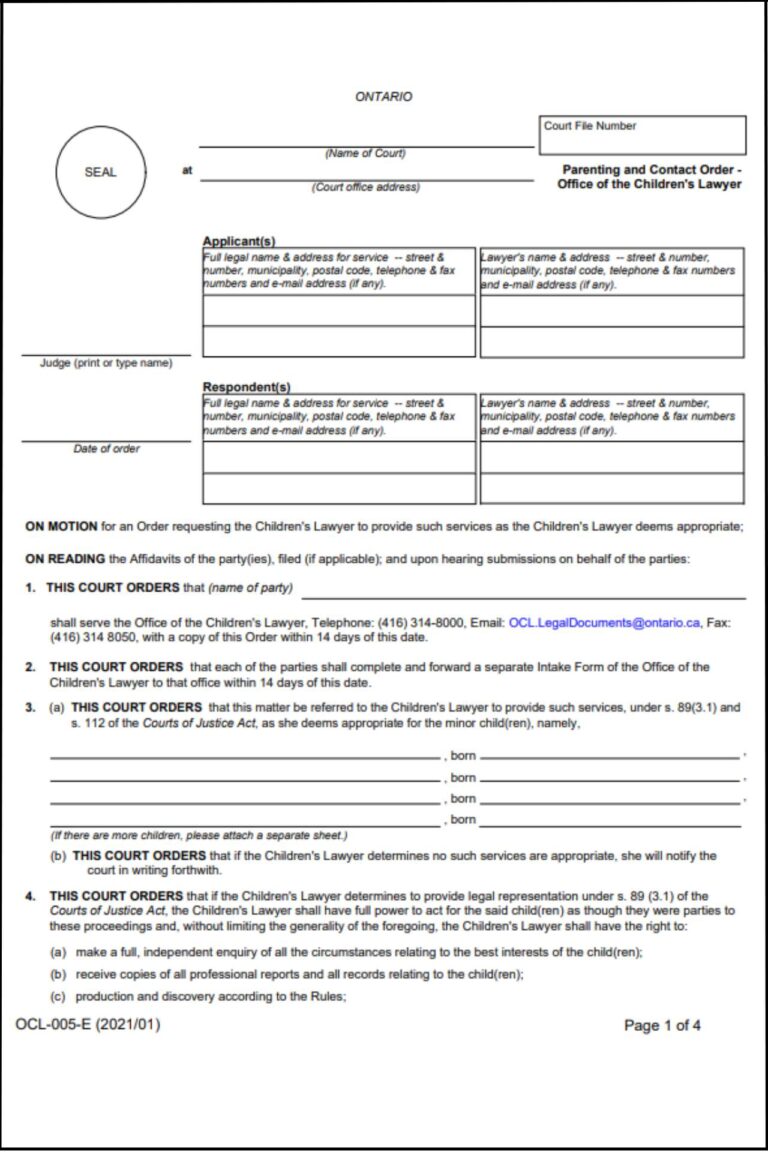
Alberta Child Custody Agreement PDF Template
An Alberta Child Custody Agreement can help parents record their parenting arrangements after separation, but it should reflect Alberta’s family law rather than relying on a generic Canadian template. I’ve seen parents appear before the Court of King’s Bench of Alberta believing their agreement settled everything, only to find that vague parenting schedules and missing decision-making provisions left important issues unresolved.
Because Alberta family law centres on the best interests of the child, a well-prepared agreement should address far more than where a child sleeps each week. Below you’ll find an Alberta-focused template together with practical guidance on drafting parenting arrangements, avoiding common mistakes, and understanding when a Consent Order may be appropriate.
Table of Contents
ToggleAlberta Child Custody Agreement
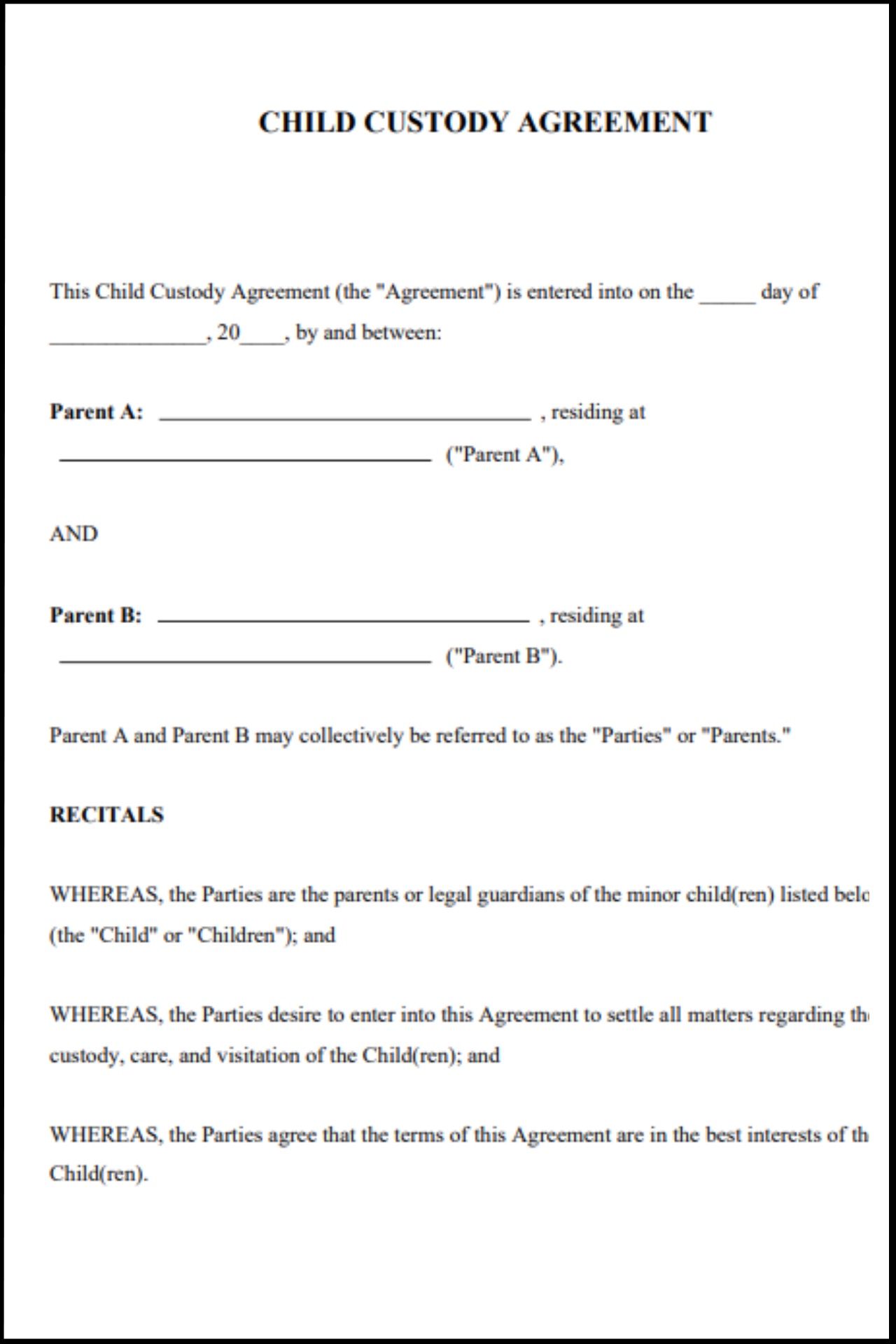
Key Clauses in a Parenting Agreement
Every Parenting Agreement should clearly explain how parents will care for their child after separation. Although every family’s circumstances are different, Alberta law expects parenting arrangements to reflect the child’s best interests rather than the parents’ convenience. A detailed agreement reduces misunderstandings and provides a practical framework that parents can follow as their child grows.
Guardianship
Guardianship identifies who has the legal authority to exercise parental responsibilities and make important decisions for a child under the Alberta Family Law Act. This is especially important for some unmarried fathers, whose guardianship status depends on the statutory requirements set out in Alberta law. In Edmonton, for example, an unmarried father believed he could simply sign a parenting agreement after separation, only to discover he first needed to establish guardianship before the arrangement could properly reflect his legal rights. That is one of the biggest differences between Alberta and several other provinces, where generic custody templates often overlook Alberta’s unique guardianship rules.
Decision-Making Responsibility
The terms “custody” and “access” have been replaced in Alberta family law by decision-making responsibility and parenting time. Decision-making responsibility covers major issues affecting a child’s life, including education, health care, religious upbringing, cultural matters, and extracurricular activities. Parents may decide to share these responsibilities jointly or allocate certain decisions to one parent if that arrangement better reflects their family’s circumstances. A parenting agreement should clearly explain how decisions will be made rather than relying on informal discussions after disagreements arise. In Calgary, parents who simply agreed to “shared custody” later disagreed about changing their child’s school because their agreement never identified who had authority to make educational decisions. Using Alberta’s current legal terminology helps avoid these preventable disputes.
Parenting Time and Contact
Parenting time establishes when the child will live with or spend time with each parent. A well-drafted agreement should include regular weekly schedules, weekends, holidays, birthdays, school breaks, transportation arrangements, exchange locations, and procedures for making temporary changes. Some families also include contact arrangements for grandparents or other important people in the child’s life where appropriate. Simply stating that parents will “share equal time” rarely provides enough guidance because everyday parenting involves far more than dividing days on a calendar. Parents in Red Deer often discover that detailed schedules help avoid disagreements about school events, vacations, and extracurricular activities long before those issues develop into family conflict.
Child Support (Why You Can’t Waive It)
One of the most common mistakes people make when preparing a parenting agreement is assuming they can exchange child support for additional parenting time or decision-making responsibility. Under Alberta law, child support cannot be traded away or waived through a private agreement because it exists for the benefit of the child. Parenting arrangements and financial support are separate legal obligations that should be addressed independently within the agreement. For example, parents in Calgary cannot agree that one parent will receive extra parenting time in return for giving up child support. A properly prepared Parenting Agreement should instead recognise that child support continues to apply under the applicable legal framework while keeping parenting arrangements focused on the child’s daily care and well-being.
Is a Parenting Agreement Legally Enforceable in Alberta?
While it is binding between the parties, parents who want direct court enforcement remedies can apply to convert the agreement into a formal Consent Order supported by an affidavit through the Alberta Court of Justice or the Court of King’s Bench.
To ensure a Parenting Agreement remains legally sound and ready for court conversion, parents should ensure that it:
- Uses Alberta’s current statutory terminology.
- Reflects the child’s best interests throughout the agreement.
- Confirms that everyone signing has the necessary guardianship status.
- Keeps child support separate from parenting arrangements.
- Includes clear parenting schedules, decision-making provisions, and dispute-resolution procedures instead of broad or ambiguous wording.
Parents in Lethbridge sometimes prepare informal parenting agreements without addressing holidays, school decisions, or communication between households because they expect cooperation to continue indefinitely. When circumstances later change, converting a detailed written agreement into a Consent Order often provides greater certainty and reduces future disputes.
Rights and Obligations of Each Parent Under the Agreement
A Parenting Agreement gives each parent ongoing rights and responsibilities while promoting stability for the child. Every agreement should explain how parents will communicate, share information, exercise decision-making responsibility, and follow the agreed parenting schedule. These responsibilities continue throughout the agreement and should always reflect the child’s best interests rather than the convenience of either parent.
Parents commonly agree to:
- Follow the parenting schedule unless they mutually agree to changes.
- Share important information about the child’s education, health, and daily well-being.
- Consult one another before making major decisions where decision-making responsibility is shared.
- Encourage the child’s relationship with the other parent whenever appropriate.
- Meet child support obligations separately from parenting arrangements.
- Review the agreement whenever there is a significant change affecting the child’s needs.
A practical example is a family in Calgary whose original parenting schedule worked well while their child was in elementary school. As school activities, sports, and transportation needs changed over time, the parents updated their written agreement to reflect the child’s new routine instead of relying on informal verbal arrangements. Regular reviews help ensure that the agreement continues to support the child’s best interests as circumstances evolve.
What Happens If One Parent Breaks the Agreement?
When one parent stops following the Parenting Agreement, the first step is usually to try resolving the issue through discussion, mediation, or another form of alternative dispute resolution. If the agreement has already been converted into a Consent Order, the court has formal enforcement powers that are not available for a private agreement. Under the Court of King’s Bench Family Focused Protocol, effective January 2, 2026, parents involved in contested parenting matters must generally complete the Parenting After Separation (PAS) course, provide early disclosure where required, and participate in alternative dispute resolution before seeking contested court enforcement.
A parent in Calgary, for example, may repeatedly refuse to follow the agreed parenting schedule or deny scheduled parenting time. If informal discussions fail, converting the agreement into a Consent Order allows the parent to ask the Alberta Court of Justice or the Court of King’s Bench of Alberta to enforce the parenting arrangement. This process does not apply where parents have never formalized their agreement through the court, making court conversion an important consideration for families who want additional legal protection.
When You Don’t Need a Lawyer vs. When You Do
Many parents can prepare a Parenting Agreement without extensive legal assistance when they agree on guardianship, parenting time, decision-making responsibility, and child support. A carefully prepared written agreement often provides enough structure for cooperative parents who simply want to document their arrangements.
Legal advice becomes much more important when:
- One parent disputes guardianship.
- An unmarried father has not obtained legal guardianship status.
- Parents disagree about decision-making responsibility.
- There are concerns involving family violence or child safety.
- Either parent wants the agreement converted into a court Consent Order.
- One parent believes the agreement no longer reflects the child’s best interests.
For example, an unmarried father in Edmonton who did not live with the child’s mother before birth may first need to establish guardianship before entering into a Parenting Agreement. Preparing an agreement without addressing that issue can delay future court proceedings and create unnecessary legal complications.
Summary of Applicable Laws
| Topic | Alberta Rule | Governing Statute |
|---|---|---|
| Decision-making responsibility and parenting time (divorcing parents) | Modern statutory terminology replaces “custody” and “access” | Divorce Act |
| Guardianship and parenting arrangements | Provincial parenting regime | Family Law Act, ss. 18 & 20 |
| Minimum age to sign | Signatories must generally be 18 years or older | Age of Majority Act, s. 1 |
| Child support | Cannot be waived through a Parenting Agreement | Family Law Act, s. 49; Divorce Act, s. 11(1)(b) |
| Court enforcement | Agreement may be converted into a Consent Order | Alberta Court of Justice or Court of King’s Bench of Alberta |
Unmarried Fathers and Guardianship: A Key Alberta Difference
One feature that distinguishes Alberta from several other provinces is its guardianship framework for unmarried fathers. Under the Family Law Act, biological parenthood alone does not always establish legal guardianship. Depending on the circumstances, an unmarried father may need to satisfy Alberta’s statutory requirements before exercising full guardianship rights or signing a Parenting Agreement that reflects those rights.
This issue frequently surprises parents who download generic Canadian custody templates. An Edmonton father may assume he automatically has the same legal authority as the child’s mother, only to discover that guardianship must first be established before certain parenting arrangements can be fully recognized. Addressing guardianship at the beginning of the process helps avoid delays and ensures the agreement accurately reflects each parent’s legal status.
Common Mistakes That Make a Parenting Agreement Invalid
Several drafting mistakes regularly create problems for Alberta families:
- Using outdated “custody” and “access” terminology instead of modern statutory language.
- Ignoring the child’s best interests when preparing parenting arrangements.
- Attempting to exchange parenting time for reduced or waived child support.
- Signing the agreement without confirming legal guardianship status.
- Creating vague parenting schedules that omit holidays, education, medical decisions, or transportation arrangements.
- Assuming a private agreement automatically has the same enforcement powers as a court Consent Order.
Many of these issues only become apparent after a disagreement arises. Taking the time to prepare a detailed agreement at the beginning often prevents costly court proceedings later.
Frequently Asked Questions
Is “Child Custody Agreement” still the correct legal term in Alberta?
Not exactly. Alberta law now uses Parenting Agreement, Parenting Plan, decision-making responsibility, and parenting time, although many people continue searching online for “Child Custody Agreement.”
Do we have to file our Parenting Agreement with the court?
No. A Parenting Agreement begins as a private agreement. Parents who want court enforcement may later apply to convert it into a Consent Order.
Can grandparents or other relatives be included?
Yes, where appropriate, parents may include contact arrangements for grandparents or other important people, provided those arrangements continue to reflect the child’s best interests.
What happens if we do not complete the Parenting After Separation course?
Where the Family Focused Protocol applies, completion of the Parenting After Separation (PAS) course forms part of the required court process before contested parenting enforcement proceedings.
Can a Parenting Agreement be changed later?
Yes. Parents may update the agreement by mutual written consent or ask the court to consider changes where there has been a material change in circumstances affecting the child.