Ontario Roommate Agreement Template – Free Download & Guide
Ontario Roommate Agreement is something many renters ignore—until problems start. If you’re sharing a place with a friend, stranger, or even a partner, a simple written agreement can save you from major stress.
Imagine this: you move in with a friend, agree to “split everything,” and assume it will work out. A few months later, one person stops paying utilities, the other invites guests every weekend, and suddenly small issues turn into big arguments.
This happens often because nothing was written down. I’ve seen Ontario roommates end up in small claims disputes over things they thought were ‘understood’ but were never actually written down. When there’s no clear agreement, people are often shocked to learn how limited their legal protections can be under Ontario roommate arrangements.
In Ontario, this is even more important because roommate relationships are not fully covered under the Residential Tenancies Act (RTA). That means you need your own written rules.
Last Updated: September 2026
Table of Contents
ToggleFree Ontario Roommate Agreement Template
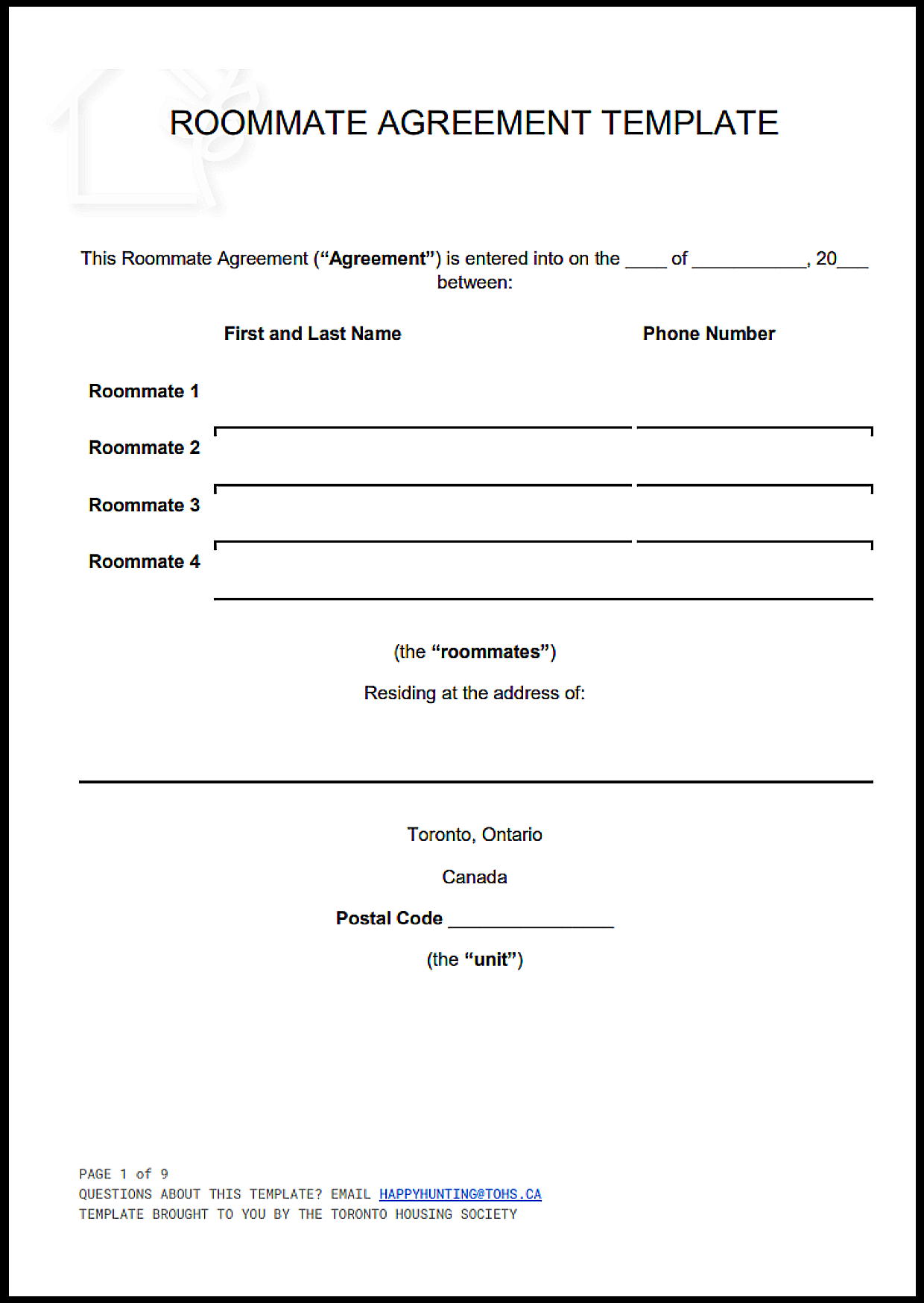
Use this simple template to create your own agreement. Fill it out together before moving in.
Ontario Roommate Agreement Laws & Legal Rules You Should Not Ignore
| Topic / Issue | Ontario Legal Rule | Governing Statute |
|---|---|---|
| Governing Legislation | Roommate arrangements may involve the Residential Tenancies Act, 2006. Whether the RTA applies depends on the actual living arrangement and the legal status of the occupants. | Residential Tenancies Act, 2006, S.O. 2006, c. 17 |
| Owner Exception | If an occupant is required to share a kitchen or bathroom with the owner or specified family members who live in the building, the accommodation may be excluded from the RTA under section 5(i). | Residential Tenancies Act, 2006, s. 5(i) |
| Who Can Sign | A person with contractual capacity may enter into a roommate agreement. The age of majority in Ontario is 18, although contract-enforceability rules can depend on the circumstances. | Age of Majority and Accountability Act, R.S.O. 1990, c. A.7, s. 1 |
| Age Requirement | The age of majority in Ontario is 18, although being under 18 does not by itself answer every question about contractual enforceability. | Age of Majority and Accountability Act, R.S.O. 1990, c. A.7 |
| Mental Capacity | A signer must have the legal capacity required to enter into the agreement and understand the nature and consequences of the arrangement. | Ontario contract law |
| Witness Requirement | Ontario law does not generally require a roommate agreement to be witnessed. | Contract law |
| Notarization | Ontario law does not generally require notarization for a roommate agreement. | Contract law |
| Time Limit for Legal Claims | The basic limitation period for many Ontario claims is two years from when the claim is discovered, subject to statutory exceptions and other limitation rules. | Limitations Act, 2002, S.O. 2002, c. 24, Sch. B, s. 4 |
| Ontario Standard Lease Requirement | The Ontario standard lease is required for most residential tenancy agreements covered by the RTA, subject to statutory exceptions. | O. Reg. 9/18 |
| Filing Requirement | A private roommate agreement does not generally need to be filed with ServiceOntario or the Landlord and Tenant Board merely because it is a roommate agreement. | No general filing requirement |
| Invalid Clauses | For an RTA-covered tenancy, a term that attempts to take away a right or responsibility under the Act is generally void and unenforceable. | Residential Tenancies Act, 2006, s. 3 |
| Human Rights Violations | Ontario’s Human Rights Code protects equal treatment in the occupancy of residential accommodation, subject to statutory exceptions, including certain shared-accommodation situations. | Human Rights Code, R.S.O. 1990, c. H.19, ss. 2, 21 |
| Roommate Deposits | Do not assume that damage, security, or pet deposits are automatically legal simply because the parties are roommates. The legal treatment depends on the relationship and whether the RTA applies. For an RTA-covered tenancy, section 105 restricts the security deposit a landlord may collect. | Residential Tenancies Act, 2006, ss. 105–106 |
| No-Pet Clauses | If the RTA applies, a general no-pet term is generally void, subject to the Act and applicable exceptions. If the arrangement falls outside the RTA, the contractual rules may differ based on the actual living arrangement. | Residential Tenancies Act, 2006, s. 14 |
One of the biggest surprises for many renters in Ontario is that the Residential Tenancies Act does not cover every shared-living arrangement. For example, section 5(i) excludes certain accommodation where the occupant shares a kitchen or bathroom with the owner or specified family members who live in the building.
Deposit and pet rules depend on whether the Residential Tenancies Act applies to the living arrangement. For RTA-covered tenancies, Ontario restricts security deposits and generally makes no-pet terms void, subject to the Act and applicable exceptions. A private roommate arrangement should not be treated as automatically exempt from these rules.
These rules matter in real life because a badly written roommate agreement can create financial disputes, housing problems, or even failed court claims later. Even small mistakes — like adding terms that conflict with the main lease or statutory rights — can make parts of the agreement unenforceable.
Download the free Ontario Roommate Agreement template below and create clear rules before problems start.
What Is a Roommate Agreement (And Why It Matters in Ontario)
A roommate agreement is a private contract between people sharing a rental unit. It is not the same as a lease.
- A lease is between tenant and landlord
- A roommate agreement is between roommates
Real-life example
Two students rent a condo in Toronto. Only one signs the lease with the landlord. The other pays their share directly to that tenant.
In this case:
- The written lease identifies the named tenant or tenants
- The roommate’s legal status depends on the actual arrangement and applicable law
This is where a roommate agreement becomes important.
Why verbal agreements fail
The trouble usually starts when roommates remember the original conversation differently. A promise to “split everything” may not answer who pays the internet bill, how guests are handled, or what happens when someone moves out.
Verbal promises like “we’ll split everything” can lead to:
- Confusion
- Different expectations
- No clear proof if disputes happen
A written agreement does not remove every legal dispute, but it gives the roommates a clearer record of what they agreed to about rent, utilities, guests, shared expenses, and move-out arrangements.
When multiple tenants share a property, a roommate agreement in Ontario helps define responsibilities alongside the main lease agreement. It is also important to understand tenant rights and comply with Ontario rental laws. You may also need a rent receipt and consider a sublease agreement if occupants change.
Is a Roommate Agreement Legally Binding in Ontario?
Under Ontario law, a roommate agreement can be legally enforceable, but its effect depends on the parties, the terms of the agreement, and whether the Residential Tenancies Act applies to the living arrangement.
When it is enforceable:
- It is written clearly
- The relevant roommates sign it
- Terms are reasonable and specific
- The terms do not conflict with applicable legislation or enforceable rights
Important limits:
- LTB Jurisdiction: A roommate agreement between occupants does not automatically determine whether the Landlord and Tenant Board has jurisdiction. Whether the LTB can deal with a dispute depends on whether the living arrangement and parties fall within the Residential Tenancies Act. A dispute outside the LTB’s jurisdiction may need to be addressed through the appropriate court or other legal process.
- Privity of Contract: If the landlord is not a party to the roommate agreement, the agreement generally does not impose contractual obligations on the landlord.
- Subordination: A roommate agreement should not conflict with the lawful terms of the main tenancy agreement or rights and obligations imposed by Ontario law. A private agreement cannot be used to circumvent statutory protections that apply to the parties.
Example: If the roommate’s occupancy is governed by an RTA-covered tenancy, a general no-pet term may be void. If the arrangement is outside the RTA, the effect of a pet restriction depends on the applicable contractual rules.
When Should You Use a Roommate Agreement?
You should use this agreement in almost every shared living situation:
- Moving in with friends
- Renting with strangers
- Subletting a room
- Couples splitting rent
- Student housing
If you are sharing rent, bills, or living space, a written agreement is strongly recommended.
Key Clauses Every Ontario Roommate Agreement Must Include
Rent Split & Payment Terms
Decide clearly:
- Fixed split (50/50)
- Percentage split (based on room size)
Also include:
- Payment due date
- Late payment rules
Example: “If rent is late by 3 days, roommate pays $25 penalty.”
Make sure any fee or penalty is drafted carefully and does not conflict with applicable law or the main tenancy agreement.
Utility Sharing
Choose a method:
- Equal split
- Usage-based
Also decide:
- Who pays the bills
- How others reimburse
House Rules
Write rules that you can actually follow. A short rule about cleaning, quiet hours, or shared purchases is more useful than a long list nobody reads.
Include:
- Cleaning schedules
- Noise limits
- Shared items
Guests & Overnight Stays
Set clear boundaries:
- How many guests are allowed
- How often overnight stays are okay
- Whether advance notice is expected
For an RTA-covered tenancy, remember that the main lease cannot simply remove statutory rights concerning guests or other occupants. Ontario’s standard lease guidance identifies terms that prohibit guests or roommates as examples of potentially void terms.
Exit & Replacement Rules
Important but often ignored.
Include:
- Notice period agreed between the roommates, where legally appropriate
- Who finds a replacement roommate
- What happens to shared bills
- How shared purchases are handled
How to Fill Out the Ontario Roommate Agreement (Step-by-Step)
Step 1: Add full names & address
Use legal names and the full rental address.
Step 2: Decide rent & bill split clearly
Write exact amounts. Avoid vague wording.
Step 3: Write realistic house rules
Write rules that are practical and consistent with the main lease and applicable Ontario law.
Step 4: Agree on exit strategy
Decide what happens if a roommate leaves early, including notice, unpaid bills, shared purchases, and the search for a replacement.
Step 5: Sign and keep copies
Each roommate should keep a signed copy.
Tip: Always talk through everything before writing it down.
Common Problems This Agreement Helps Prevent
1. One roommate not paying rent
Without agreement: no clear responsibility.
With agreement: payment terms are written clearly.
2. Utility bill disputes
Example: One uses AC all day, others complain.
Solution: Define the split method before the bills arrive.
3. Mess and cleaning fights
Example: dishes pile up, and no one takes responsibility.
Solution: Assign practical chores and cleaning responsibilities.
4. Too many guests
Example: one roommate brings friends every weekend.
Solution: Set clear house rules while respecting any rights protected by applicable tenancy law.
5. Sudden move-outs
Example: roommate leaves without notice.
Solution: Set out an agreed process for notice, shared bills, and replacement arrangements.
Legal Risks & Mistakes to Avoid
Avoid these common mistakes:
- Relying only on verbal agreements
- Copying lease terms incorrectly
- Not defining payment deadlines
- Ignoring landlord lease conditions
- Not updating agreement when the situation changes
- Adding terms that conflict with the Residential Tenancies Act
A roommate agreement should not conflict with the lawful terms of the main tenancy agreement or rights imposed by Ontario law. For an RTA-covered tenancy, a term attempting to take away a right or responsibility under the Act is generally void.
Roommate Agreement vs Lease Agreement (Ontario)
| Feature | Roommate Agreement |
Lease Agreement
|
| Applies to | Roommates or occupants who are parties to the agreement |
Tenant & landlord
|
| Legal protection | Depends on the living arrangement and applicable law |
RTA protections apply where the tenancy is covered by the RTA
|
| Covers rent terms | Yes, for the internal arrangement |
Yes, for the tenancy
|
| Enforceable in court | Potentially, depending on the agreement and circumstances |
Yes, subject to applicable law
|
| Landlord involved | Not unless the landlord is a party | Yes |
Ontario Rules You Should Know Before Signing
1. Lease rules still apply
The main lease remains important, but it must be read together with the Residential Tenancies Act and other applicable Ontario law. A roommate agreement cannot override statutory rights or impose obligations on the landlord if the landlord is not a party to the agreement.
2. Landlord rights vs roommate rights
- The landlord’s contractual relationship is normally with the named tenant or tenants
- Another occupant’s legal status depends on the actual living arrangement and applicable law
- A roommate agreement does not automatically give the roommate rights against the landlord
3. Subletting rules
If the Residential Tenancies Act applies and you are subletting the rental unit, landlord consent is required under section 97 of the Act.
- You need landlord permission to sublet
- A true sublease is different from simply having a roommate
- The statutory rules for subletting should be followed where the RTA applies
4. Privacy expectations
Shared spaces should be governed by clear house rules, while each occupant’s privacy and applicable legal rights should also be respected.
- Bedrooms are generally treated as private spaces within the shared arrangement
- Common areas are shared
FAQs
Can a roommate agreement override a lease in Ontario?
No. A roommate agreement should not conflict with the lawful terms of the main tenancy agreement or rights imposed by Ontario law. For an RTA-covered tenancy, a term that attempts to take away a right or responsibility under the Act is generally void.
What happens if a roommate refuses to pay rent?
You may need to take civil action depending on the legal relationship and the terms of your agreement. If you are a tenant under the main lease, your obligations to the landlord do not automatically disappear because another roommate fails to contribute.
Can I evict my roommate in Ontario?
Not necessarily. Whether the Landlord and Tenant Board can make an order depends on whether the roommate is a tenant or another person covered by the Residential Tenancies Act and on the facts of the arrangement.
If the arrangement falls outside the RTA, the appropriate legal process may instead depend on the parties’ agreement and applicable common law. Do not assume that a roommate who is not named on the lease can automatically be removed by changing the locks.
Do all roommates need to sign the agreement?
All roommates who are intended to be bound by the agreement should sign it. A signed agreement makes it much easier to establish what each person agreed to.
Is a verbal roommate agreement valid?
An oral agreement may be enforceable depending on the circumstances, but proving the agreed terms can be much harder. A written agreement is strongly recommended.