Ontario Lease Agreement Laws (Free Download & Legal Guide)
Ontario Lease Agreement Laws are the rules that control how rental agreements work between landlords and tenants in Ontario. If you’re about to rent a place or list your property, understanding these laws is not optional — it protects you from legal trouble and money loss.
I’ve seen many Ontario tenants and landlords run into serious problems simply because they relied on verbal promises or outdated lease forms they found online. When disputes reach the Landlord and Tenant Board, small mistakes in the lease can quickly turn into expensive delays, unpaid rent issues, or notices that don’t legally hold up.
In simple terms, Ontario has strict rules under the Residential Tenancies Act (RTA). This article will walk you through everything clearly — plus give you a free, ready-to-use lease template so you don’t make costly mistakes.
Last Updated: September 2026
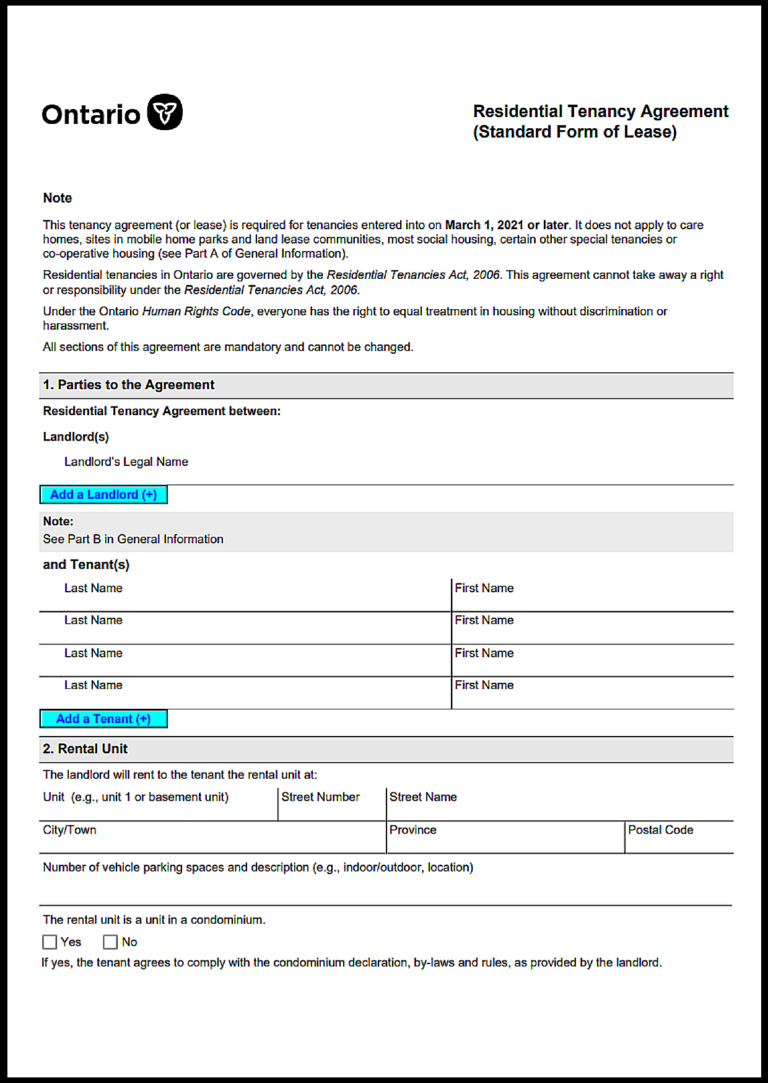
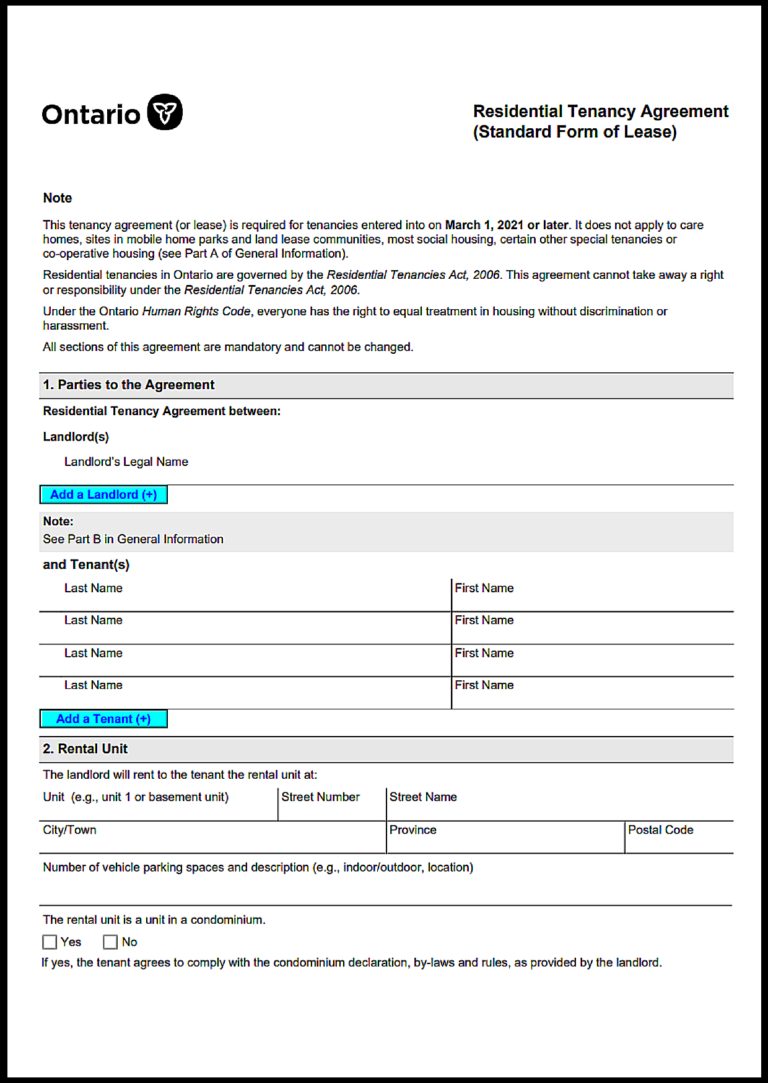
Free Ontario Lease Agreement Template
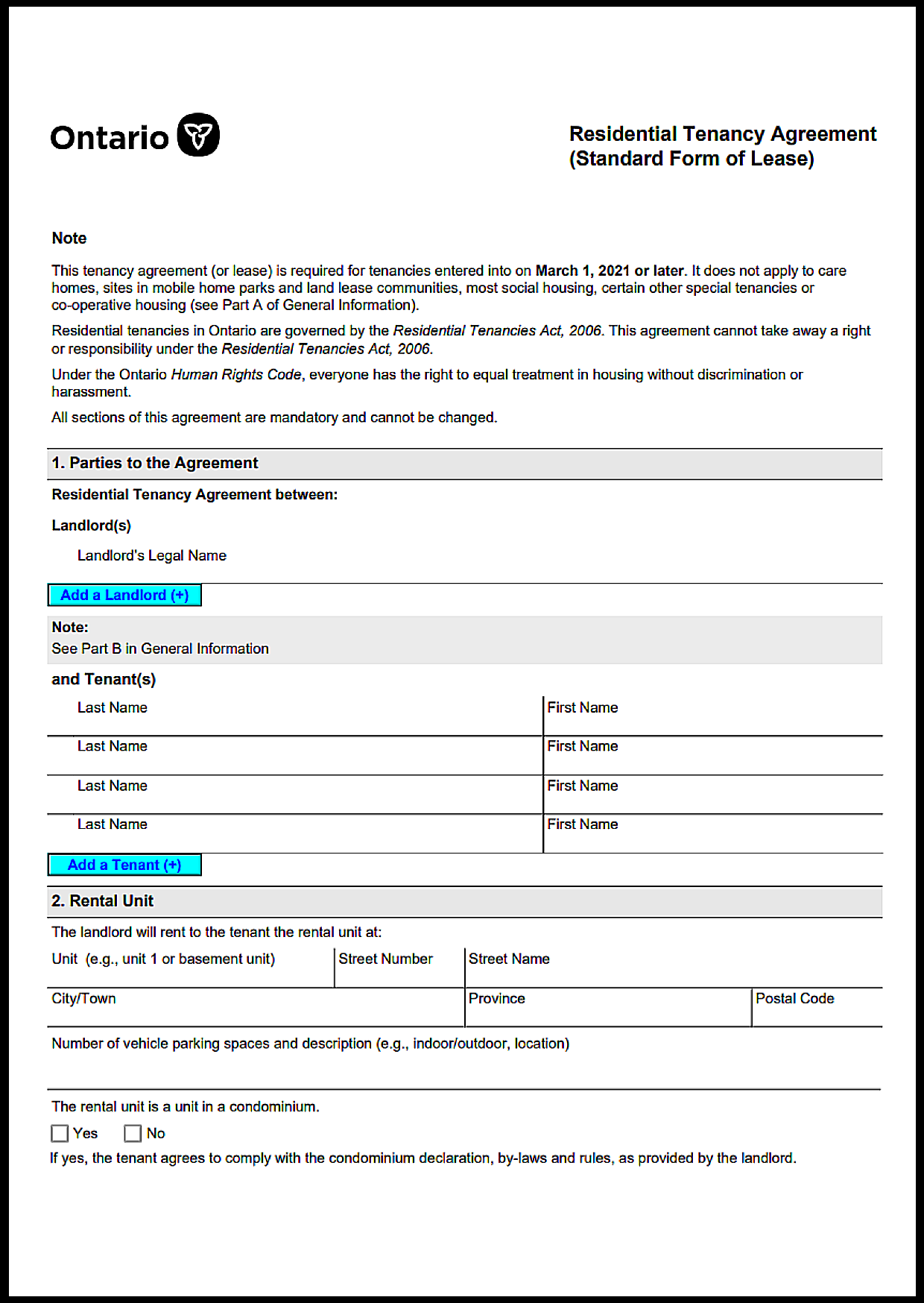
Statutory Compliance Warning: Under Section 12.1 of the Residential Tenancies Act, 2006, it is a strict regulatory violation to utilize a custom, drafted, or unofficial template for residential tenancies in Ontario. Landlords must exclusively utilize the official Ontario Standard Form of Lease (Form 2229E). Proffering an unofficial ‘templated’ alternative gives the tenant the immediate statutory right to demand the official form in writing.
If the landlord fails to supply Form 2229E within 21 calendar days of the demand, the tenant is legally authorized to withhold one month’s rent pursuant to s. 12.1(2) of the Act. If the landlord fails to provide the lease within 30 days after the withholding begins, the landlord forfeits that month’s rent entirely under s. 12.1(4).
Ontario Lease Agreement Laws Most Landlords & Tenants Miss
| Topic / Issue | Ontario Legal Rule | Governing Statute |
|---|---|---|
| Governing legislation | Most residential tenancies in Ontario are governed by the Residential Tenancies Act, 2006 (RTA), subject to the Act’s exemptions. | Residential Tenancies Act, 2006, S.O. 2006, c. 17 |
| Federal involvement | Residential tenancy agreements in Ontario are primarily governed by Ontario’s Residential Tenancies Act, 2006 and related provincial regulations. | Residential Tenancies Act, 2006 |
| Recent amendments | Ontario’s RTA was amended by the Fighting Delays, Building Faster Act, 2025. Several Schedule 12 amendments have different commencement dates, including provisions coming into force in 2026. | Residential Tenancies Act, 2006, as amended by S.O. 2025, c. 14 |
| Who can sign | The landlord and tenant, or their properly authorized representatives, should sign the tenancy agreement according to the agreement’s execution terms. | Residential Tenancies Act, 2006; Ontario Standard Lease |
| Witness requirement | The Ontario standard lease does not generally require a witness signature for an ordinary residential tenancy agreement. | Ontario Standard Lease |
| Notarization | An ordinary Ontario residential tenancy agreement generally does not need to be notarized. | Ontario Standard Lease |
| Age requirement | Ontario’s age of majority is 18. In addition, a 16- or 17-year-old who has withdrawn from parental control has specific rights concerning occupancy and accommodation contracts under section 4 of the Human Rights Code. | Age of Majority and Accountability Act; Human Rights Code |
| Mental capacity | For contract capacity, Ontario law generally presumes a person who is 18 or older is capable of entering into a contract unless there are reasonable grounds to believe otherwise. | Substitute Decisions Act, 1992 |
| Lease copy deadline | If a written tenancy agreement is entered into, the landlord must give the tenant a copy signed by the landlord and tenant within 21 days after the tenant signs it and gives it to the landlord. | Residential Tenancies Act, 2006, s. 12(2) |
| Rent increase notice | A landlord must generally give at least 90 days’ written notice of a rent increase using the form approved by the Landlord and Tenant Board. | Residential Tenancies Act, 2006, s. 116 |
| Mandatory standard lease | The Ontario standard lease is required for most residential tenancy agreements signed on or after April 30, 2018, subject to specified exemptions. | O. Reg. 9/18 |
| Mandatory appendix | The standard lease includes the required information for landlords and tenants, including the general information that accompanies the standard form. | O. Reg. 9/18 |
| Standard terms | The standard lease sets out required terms, but additional terms may be included only if they comply with the RTA, its regulations, and the standard lease requirements. | O. Reg. 9/18; Residential Tenancies Act, 2006 |
| Landlord contact details | The landlord must provide the tenant with the landlord’s legal name and an address for service as required by section 12 of the RTA. | Residential Tenancies Act, 2006, s. 12 |
| Filing requirement | Ordinary residential tenancy agreements are generally not filed with the Ontario government. | Residential Tenancies Act, 2006 |
| Long-term lease registration | Registration of a long-term lease is a separate land-registration issue and may depend on the property and the applicable land-registration rules. | Land Titles Act |
| Illegal lease clauses | Subject to the RTA’s exceptions, a tenancy-agreement provision that is inconsistent with the RTA or its regulations is void under section 4. | Residential Tenancies Act, 2006, s. 4 |
| Illegal deposits | Ontario landlords generally cannot collect a damage deposit. The RTA permits a rent deposit subject to section 106 and separately regulates key deposits. | Residential Tenancies Act, 2006, ss. 105–106 |
| Failure to use standard form | For a tenancy covered by section 12.1, if at least 21 days have elapsed after the tenant’s written demand and the landlord has not complied, the tenant may withhold rent subject to the Act’s conditions and a maximum total withholding equal to one month’s rent. | Residential Tenancies Act, 2006, s. 12.1 |
| Automatic month-to-month renewal | When a fixed-term tenancy ends without being renewed or terminated, section 38 generally deems it renewed as a monthly tenancy on the same terms, subject to lawful rent increases. | Residential Tenancies Act, 2006, s. 38 |
| “No pets” clauses | A provision in an Ontario tenancy agreement prohibiting animals in or about the residential complex is void under section 14 of the RTA, although other applicable rules may still matter. | Residential Tenancies Act, 2006, s. 14 |
Ontario has several residential tenancy rules that are important to understand before signing a lease, including rules on standard leases, rent deposits, rent increases and tenancy continuation. One of the biggest is the rule limiting security deposits. Ontario landlords generally cannot collect a separate damage deposit. The RTA instead regulates rent deposits and key deposits.
Another important rule is the automatic month-to-month continuation system. Many people wrongly assume a tenant must leave once the fixed lease ends. In Ontario, the tenancy generally continues under section 38 unless it is properly terminated or otherwise changed under the RTA.
The mandatory standard lease is also important in practice. Where section 12.1 applies and the tenancy agreement does not comply with the prescribed requirements, a tenant can make a written demand for a compliant agreement. If the landlord does not comply within the statutory period, the tenant may have a limited right to withhold rent, subject to the conditions in section 12.1.
Before signing anything, review the Ontario lease agreement template and make sure the tenancy agreement follows the applicable Ontario requirements.
What Ontario Lease Agreement Laws Actually Require
Under Ontario law, most residential tenancy agreements are governed by the Residential Tenancies Act (RTA), subject to statutory exemptions. This law applies to most rental homes, including:
- Apartments
- Houses
- Basement units
- Condos
When the RTA does NOT apply
Some exceptions include:
- Living accommodation where the tenant is required to share a bathroom or kitchen facility with the owner, or an immediate family member of the owner, and the owner or family member resides in the same principal residence (RTA, s. 5(i)).
- Transient or short-term living accommodation provided in a hotel, motel, motor home, resort, tourist home, or seasonal trailer park (RTA, s. 5(a)).
- Accommodation provided by an educational institution to its students or staff where the applicable statutory exemption applies.
Why this matters
For a typical Ontario residential tenancy, the landlord needs to start with the required standard lease where it applies, charge only lawful rent and deposits, and follow the RTA throughout the tenancy. The agreement cannot be used to contract out of statutory protections.
A tenancy agreement can exist without a written document, but written terms provide important evidence of what the parties actually agreed to and help avoid disputes over rent, services, occupants and other terms.
Is the Ontario Standard Lease Mandatory?
Yes — the Ontario standard lease is required for most residential tenancy agreements signed on or after April 30, 2018, subject to specified exemptions.
What if a landlord refuses?
Where section 12.1 applies, the tenant can make a written demand for a compliant tenancy agreement. If at least 21 days pass without compliance, the tenant may have a limited right to withhold rent, subject to the conditions and maximum amount set by the RTA.
This is a specific statutory protection under Ontario law and should not be treated as a general right to stop paying rent whenever a landlord uses the wrong form.
Key Legal Clauses Every Ontario Lease Must Include
Rent Rules (Legal Limits & Increases)
Ontario rent increases are governed by several rules rather than a single annual notice requirement. Section 119 generally requires 12 months to have passed since the previous increase, while section 116 generally requires at least 90 days’ written notice. The guideline and exemptions also need to be checked for the particular rental unit.
Illegal charges can include:
- Fees or penalties that are not permitted by the RTA
- Charging the tenant for repairs that are the landlord’s responsibility
Security Deposit Laws
Ontario sharply limits what a landlord can collect as a security deposit:
- A rent deposit may be collected subject to the limits in the RTA.
- A separate damage deposit is not permitted.
If a landlord asks for a damage deposit, a clause requiring it cannot override the RTA.
Lease Term Types
There are two common tenancy arrangements:
- Fixed-term tenancy (e.g., 1 year)
- Month-to-month tenancy
After a fixed lease ends:
- It generally continues as a monthly tenancy if it has not been properly terminated or renewed in another lawful form.
- The tenant does not normally need to sign a new agreement simply to remain in the unit.
The Ontario government’s standard-lease guide confirms that the end of a fixed term does not by itself require the tenant to move out or sign a new agreement.
Maintenance & Repairs Responsibility
Landlords must:
- Maintain the residential complex and rental unit in a good state of repair
- Keep the rental unit fit for habitation
- Comply with applicable health, safety, housing and maintenance standards
Tenants must:
- Maintain ordinary cleanliness of the rental unit
- Be responsible for undue damage caused by their willful or negligent conduct, subject to the RTA
Even if the lease says otherwise, landlords cannot avoid maintenance duties imposed by the RTA.
Rules About Pets & Guests
Ontario’s standard lease rules are important here:
- A provision prohibiting animals in or about the residential complex is generally void under section 14 of the RTA.
- A term that attempts to prohibit guests, roommates or additional occupants may also be void where it conflicts with the RTA.
Restrictions must comply with the RTA and other applicable rules rather than giving the landlord unlimited control over a tenant’s personal life.
Understanding Ontario lease agreement laws is essential before using any lease template. These laws also impact documents like a legal eviction notice and rent increase notice. To stay compliant, review the tenant rights guide and learn how to write a lease agreement correctly.
What Makes a Lease Agreement Illegal in Ontario
The RTA does not let a landlord and tenant contract around every statutory protection. Under section 4, a tenancy-agreement term that conflicts with the Act or its regulations is generally void, subject to the Act’s stated exceptions.
Common illegal terms:
- Charging a prohibited damage or security deposit
- Forcing tenants to give up rights protected by the RTA
- Adding penalties or charges not permitted under the RTA
- Discriminating against tenants
Real example
A landlord asks for:
- First month rent
- Last month rent
- $500 damage deposit
The separate damage deposit is generally not permitted under Ontario’s RTA.
Even if the tenant signs, a tenancy agreement cannot override the statutory limits on deposits.
How to Fill an Ontario Lease Agreement (Step-by-Step)
Step 1: Use the Standard Lease Form
Start with Ontario’s official standard lease where the standard-lease requirement applies.
Step 2: Add Accurate Tenant & Property Details
Double-check names, address, rental-unit details and contact information.
Step 3: Clearly Define Rent & Payment Terms
Include:
- Amount
- Due date
- Payment method
The standard lease also identifies services and utilities and explains how rent is treated under the agreement.
Step 4: Review Legal Clauses Carefully
Remove anything illegal or unclear. Additional terms should be consistent with the RTA and the mandatory terms of the standard lease.
Step 5: Sign & Share Copies
The landlord and tenant should sign the agreement and each keep a copy.
Tip: Always keep a signed copy. It’s useful evidence if a dispute arises.
Common Mistakes Landlords & Tenants Make
These mistakes can create avoidable rental disputes:
- Using outdated or non-compliant lease forms
- Not tracking rent payments
- Ignoring rent increase rules
- Not understanding eviction laws
- Relying on verbal agreements when written terms would be clearer
Avoiding these mistakes can reduce the risk of preventable rental disputes.
Real-Life Example (Simple Scenario)
Let’s say:
A tenant signs a lease and pays:
- First month rent
- Last month rent
- $500 damage deposit
Later, the tenant learns that a separate damage deposit is not permitted under Ontario’s RTA.
What happens next?
If a prohibited deposit has been collected, the tenant can seek an appropriate remedy through the Landlord and Tenant Board or another available legal process, depending on the circumstances.
This is why understanding lease laws before signing is so important.
Ontario Lease vs Rental Agreement (Quick Comparison)
| Feature | Fixed-Term Tenancy | Monthly Tenancy |
|---|---|---|
| Term | Runs for the fixed period stated in the agreement | Continues monthly unless properly terminated |
| Continuation | Generally continues as a monthly tenancy when the fixed term ends | Renews monthly under the RTA |
| Ending | Governed by the RTA’s termination rules | Governed by the RTA’s termination rules |
FAQs
Is a handwritten lease legal in Ontario?
A handwritten agreement is not automatically invalid, but most Ontario residential tenancies are subject to the standard-lease requirement. Where that requirement applies, the official Ontario form should be used rather than treating a handwritten document as a substitute.
Can a landlord increase rent anytime?
No. A lawful rent increase generally requires at least 12 months to have passed since the previous increase and at least 90 days’ written notice, with additional rules and exceptions applying to some rental units.
What if a tenant breaks the lease early?
A tenant who wants to leave a fixed-term tenancy early may still have obligations, but the result depends on the reason for termination, any agreement between the parties, assignment or subletting rules, and the landlord’s duty to minimize losses.
Are verbal agreements valid?
A tenancy agreement can exist without a written document, but written terms provide important evidence of what the landlord and tenant agreed to. Written agreements can also make it easier to establish the parties’ rights and responsibilities if a dispute arises.
Can a landlord enter without notice?
Generally, a landlord must give at least 24 hours’ written notice before entering for reasons covered by section 27, but the RTA also permits entry without notice in specified circumstances, including emergencies and tenant consent.