British Columbia Independent Contractor Agreement [Free Template]
British Columbia Independent Contractor Agreement is one of the most important legal tools a business can use when hiring freelancers or service providers. If you’re working with someone who is not your employee, this agreement protects both sides and avoids future problems.
An independent contractor agreement is a written contract between a business (client) and a person or company (contractor) who provides services. For example, if you hire a freelance designer, marketing consultant, or IT expert, you need this agreement.
I’ve seen businesses in British Columbia run into expensive disputes because they treated a worker like an independent contractor on paper, but the actual working relationship looked more like employment under BC law. When clients come to me after missed payments, unclear deadlines, or CRA concerns, it’s usually because important terms were never properly written down from the start.
In British Columbia, written agreements are not just helpful—they are often essential. They reduce confusion, clearly define expectations, and help avoid legal disputes.
Last Updated: September 2026
Free Independent Contractor Agreement Template (British Columbia)
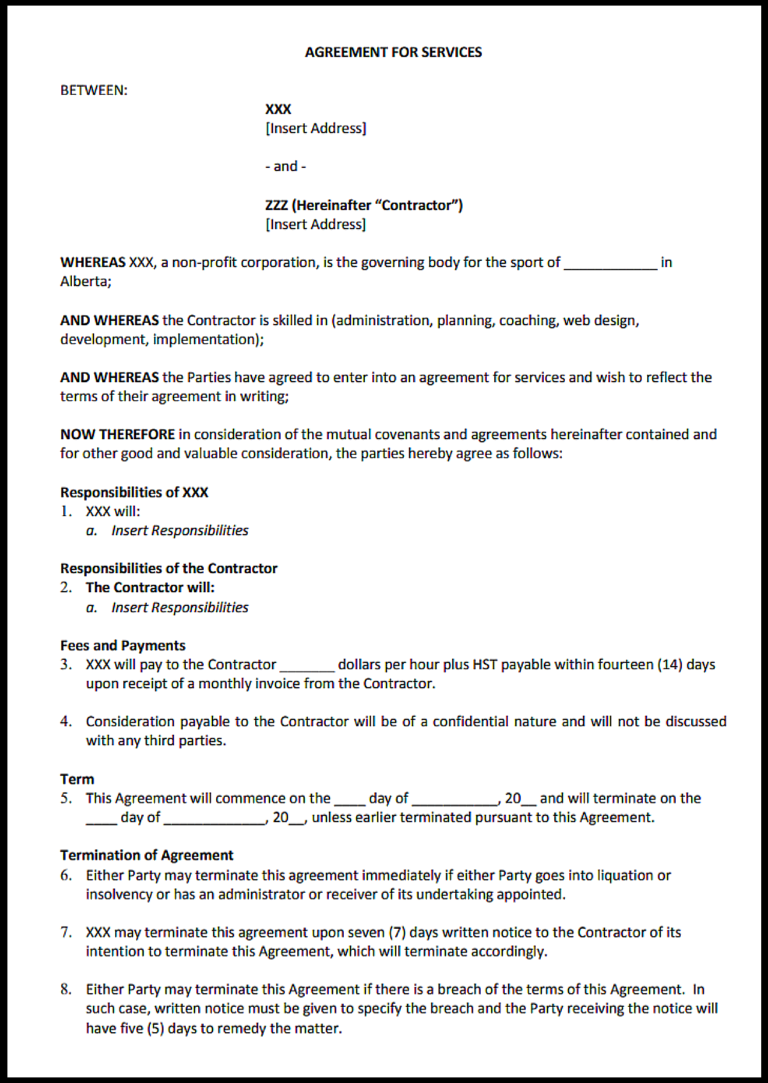
You can copy, edit, and use the template below for your business needs.
British Columbia Independent Contractor Agreement Laws You Cannot Ignore
| Topic / Issue | British Columbia Legal Rule | Governing Statute |
|---|---|---|
| Governing legislation | Independent contractor agreements in British Columbia are governed by common-law contract principles together with any provincial or federal laws that apply to the particular relationship, such as employment standards, workplace safety, privacy, and tax rules. | Workers Compensation Act, RSBC 2019, c 1; Human Rights Code, RSBC 1996, c 210; Personal Information Protection Act (PIPA), SBC 2003, c 63; Income Tax Act, RSC 1985, c 1 (5th Supp); Excise Tax Act, RSC 1985, c E-15 |
| Recent legislative change | The Workers Compensation Act was reorganized and re-enacted in 2019, effective April 6, 2020. | Workers Compensation Act, RSBC 2019, c 1 |
| Who can sign | Any individual or authorized corporate signatory with legal capacity may sign the agreement. | No general statutory signing requirement for an ordinary services agreement |
| Witness requirement | A witness is generally not required for an ordinary independent contractor agreement, although having a witness can provide additional evidence about execution. | No general statutory witnessing requirement |
| Notarization | An ordinary independent contractor agreement generally does not need to be notarized. Separate execution requirements can apply if the document is also a land instrument, power of attorney, or another document governed by specific legislation. | Depends on the document and applicable legislation |
| Age and legal capacity | British Columbia’s age of majority is 19. A contract made by a person who was an infant when it was made is generally unenforceable against that person under s. 19 of the Infants Act, subject to statutory exceptions. | Infants Act, RSBC 1996, c 223, ss. 1, 18–20 |
| Time limit for disputes | The basic limitation period for a court proceeding is generally 2 years from the day the claim is discovered, subject to exceptions and other rules in the Limitation Act. | Limitation Act, SBC 2012, c 13, ss. 6 and 8 |
| Multiple-employer worksites | At a multiple-employer workplace, the Workers Compensation Act identifies the prime contractor and assigns occupational health and safety coordination duties. If someone other than the owner is to be the prime contractor, the owner and that person must have a written agreement for the designation. | Workers Compensation Act, RSBC 2019, c 1, ss. 13 and 24 |
| Filing requirements | An ordinary independent contractor agreement does not generally need to be filed with the BC government merely to be valid. | No general filing requirement |
| WorkSafeBC obligations | WorkSafeBC coverage and registration depend on the actual working relationship and the nature of the business. A contractor may in some circumstances be treated as a worker of the hiring business rather than as an independent business. | Workers Compensation Act, RSBC 2019, c 1 |
| GST registration | A contractor may have to register for GST/HST when the applicable $30,000 small-supplier threshold is exceeded, including under the rules for a single calendar quarter or four consecutive calendar quarters. | Excise Tax Act, RSC 1985, c E-15 |
| Worker misclassification | A worker may be treated as an employee even if the agreement calls the person an independent contractor, because legal status depends on the actual working relationship and the applicable legal test. | Employment Standards Act, RSBC 1996, c 113; federal tax rules may also apply |
| Dependent contractor risk | A contractor who is economically dependent on a client may fall into the dependent-contractor category and may have common-law notice rights, depending on the facts. | Common law; see Marbry Distributors Ltd. v. Avrecan International Inc., 1999 BCCA 172 |
| Illegal or discriminatory clauses | A contract cannot be used to avoid mandatory legal requirements, and discriminatory conduct may be prohibited under the British Columbia Human Rights Code. The effect of a particular clause depends on the law governing it. | Human Rights Code, RSBC 1996, c 210; Workers Compensation Act, RSBC 2019, c 1 |
| BC age of majority difference | British Columbia’s age of majority is 19, unlike provinces where the age of majority is 18. | Infants Act, RSBC 1996, c 223 |
| Prime Contractor default liability | At a multiple-employer workplace, if there is no written agreement designating another person as prime contractor, the owner is the prime contractor and has the coordination duties set out in the Workers Compensation Act. | Workers Compensation Act, RSBC 2019, c 1, s. 13 |
| Privacy compliance | A business subject to BC’s Personal Information Protection Act must comply with PIPA when handling personal information, including using reasonable security arrangements to protect information in its custody or control. | Personal Information Protection Act (PIPA), SBC 2003, c 63, s. 34 |
One of the biggest surprises for many businesses in British Columbia is that simply calling someone an “independent contractor” does not automatically make it legally true. If the working relationship looks like employment in practice, the worker may be treated as an employee. This can affect tax treatment, employment obligations, and other legal responsibilities.
Another important issue is the “Prime Contractor” rule under the Workers Compensation Act. This is a specialized rule for a multiple-employer workplace. It does not mean every ordinary independent contractor agreement needs a Prime Contractor clause. Where the Act applies, however, the written designation and workplace safety coordination duties matter.
The age of majority rule can also affect contractor arrangements. In British Columbia, the age of majority is 19, and Part 3 of the Infants Act contains specific rules for contracts made while a person is an infant.
Privacy compliance under BC’s PIPA is another area businesses often overlook, especially when contractors handle customer information or internal company data. Organizations subject to PIPA must use reasonable security arrangements to protect personal information in their custody or control.
These rules matter because a drafting mistake can create uncertainty about payment, ownership, worker classification, privacy, or termination. Use the free British Columbia Independent Contractor Agreement template below as a starting point, and make sure its terms reflect the actual arrangement.
Independent contractor agreements help define project responsibilities, payment terms, and working relationships between businesses and self-employed professionals. To better understand how these agreements fit into commercial documentation, you can review with the guide for writing contracts in British Columbia.
What Is an Independent Contractor Agreement (and Why It Matters in BC)
An independent contractor agreement sets out the terms on which a person or business will provide services to a client.
The agreement can record the parties’ intention to operate as an independent business relationship, but the wording alone does not determine legal worker status. The actual working relationship and applicable legal tests still matter.
Contractor vs Employee
| Factor | Independent Contractor | Employee |
| Control | Generally has greater independence over how the services are performed |
Employer generally exercises greater control over the work
|
| Tools | Often provides their own tools or equipment |
Employer may provide tools or equipment
|
| Taxes | Generally handles their own applicable tax obligations |
Employer generally handles payroll deductions
|
| Benefits | Generally does not receive employee benefits from the client |
May receive employment benefits under the applicable arrangement and law
|
For example, hiring a freelance graphic designer for one project is different from hiring a full-time designer. The distinction should be reflected not only in the contract, but also in how the work is actually performed.
Verbal arrangements can create problems because the parties may later remember the scope, price, deadline, or ownership terms differently. A written agreement gives them clearer evidence of what was agreed.
Contractor arrangements are commonly used alongside related service agreements depending on the scope of work involved. Companies hiring outside specialists may also require a consulting agreement, while creative professionals often rely on a freelance contract template for project-based work.
When Should You Use This Agreement?
You should consider using this agreement when a business engages an outside person or company to provide services and wants the commercial terms documented clearly.
Common situations include:
- Hiring freelancers such as designers, writers, or developers
- Working with consultants or advisors
- Engaging agencies for marketing or IT work
- Short-term or project-based jobs
- Remote or gig-based work
Small businesses and startups in British Columbia can particularly benefit from having clear written agreements because payment, deliverables, intellectual property, and termination terms are easier to identify before a dispute arises.
Businesses sharing private operational information with contractors may additionally use a non-disclosure agreement to help protect confidential records and client information.
Key Clauses You Must Include
Scope of Work
Clearly describe:
- What work will be done
- Deliverables
- Deadlines
Avoid vague terms like “general support” or “as needed work.” The more specific the description, the easier it is for both parties to understand what the contractor has actually agreed to deliver.
Payment Terms & Invoicing
Define:
- Fixed fee or hourly rate
- Payment schedule
- Late payment rules
Also consider GST. A contractor’s GST obligations depend on the federal GST/HST rules, including the applicable small-supplier threshold and whether the contractor is registered or required to register.
Independent Contractor Clause
This clause can record the parties’ intention that the contractor is operating an independent business and is responsible for their own applicable business expenses and tax obligations.
However, the clause does not conclusively establish that the worker is an independent contractor. The actual working relationship still matters.
Confidentiality Clause
This protects:
- Business secrets
- Client data
- Internal processes
Confidentiality terms can be especially important when a contractor has access to customer information, business records, software, pricing information, or other sensitive material.
Where personal information is involved, contractual confidentiality terms do not replace applicable privacy obligations.
Intellectual Property Ownership
This is critical for creative work.
Decide:
- Who owns the final work
- Whether ownership transfers after payment
For copyright-protected work, ownership may remain with the contractor unless the agreement or applicable law provides otherwise. A copyright assignment must be in writing and signed by the copyright owner or an authorized agent.
Liability and Indemnity
This explains:
- Who is responsible if something goes wrong
- Who pays for damages or losses
The parties should make sure these clauses match the actual services, risks, insurance arrangements, and applicable law.
Termination Clause
Define:
- How either party can end the agreement
- Any contractual notice period
- What happens to outstanding payments and unfinished work
- What obligations continue after termination
There is no universal notice period for every independent contractor agreement. Depending on the relationship and circumstances, contractual terms and common-law rights may both matter.
Contractor vs Employee in British Columbia (Critical Legal Difference)
Under British Columbia law, worker classification depends on the actual working relationship and the applicable legal test, not simply the label used in the contract.
For federal tax purposes, the CRA considers the total relationship, including the parties’ intention and factors such as control, tools and equipment, subcontracting, financial risk, investment and management, and opportunity for profit.
Why It Matters
Misclassifying a worker can lead to:
- Tax consequences
- Employment law claims
- Liability for benefits or other employment-related obligations
The exact consequences depend on which legal regime applies and the facts of the relationship.
Key Factors Courts Consider
| Factor | What It Means |
| Control |
Who decides how the work is done
|
| Ownership of tools |
Who provides equipment and other working resources
|
| Chance of profit |
Whether the worker has an opportunity to increase profit through business decisions
|
| Risk of loss |
Whether the worker bears business expenses or financial risk
|
| Subcontracting |
Whether the worker can hire others or subcontract the work
|
| Permanency or exclusivity |
Whether the relationship is long-term, dependent, or exclusive
|
Example
If a “contractor” works fixed hours, uses company tools, and is subject to significant direction about how the work must be performed, those facts may support employee status even if the contract says otherwise.
Conversely, a worker who operates an independent business, serves multiple clients, controls how services are performed, bears business expenses, and has a genuine opportunity for profit may have characteristics more consistent with independent contractor status.
Legal Rules for Contractor Agreements in British Columbia
For an ordinary BC contract, offer, acceptance and consideration are core formation requirements. Other issues can also affect enforceability, including legal capacity, certainty, lawful purpose, statutory requirements, and the circumstances in which the agreement was made.
In most business contract situations:
- Written agreements are strongly recommended
- Clear terms reduce uncertainty and disputes
- A written record can provide important evidence of what the parties agreed
A signature is useful evidence of agreement, but the absence of a signature does not automatically mean that no contract exists. The legal effect depends on the circumstances and the applicable rules.
Digital signatures and electronic records can also be used in contractual transactions in British Columbia. The Electronic Transactions Act provides that contractual matters can be expressed electronically and that a contract is not invalid or unenforceable solely because an electronic record was used.
Tax Considerations (GST & Income Responsibilities)
A genuinely self-employed contractor generally reports their own business income and handles their own applicable tax obligations. However, tax treatment depends on whether the worker is actually self-employed rather than an employee.
Key points:
- Contractors generally report their own business income
- A client generally does not make employee payroll deductions for a genuinely self-employed contractor
- GST may apply if the contractor is registered or required to register
Simple Example
If a contractor charges $1,000 for a project:
- They may charge GST if they are registered or required to be registered and the supply is taxable
- They generally report the income for tax purposes
- The client pays the amount required under the agreement
The federal $30,000 GST/HST small-supplier rule is not simply an annual income test. Registration can be triggered when the applicable threshold is exceeded in a single calendar quarter or over the relevant four-consecutive-calendar-quarter period.
Common Mistakes to Avoid
One costly mistake is assuming the label “independent contractor” settles the issue. In British Columbia and for federal tax purposes, the actual working relationship matters. Before signing, compare the agreement with the way the work will really be performed, then check the payment, intellectual property, confidentiality, and termination clauses against that reality.
Risks of Not Using an Agreement
A written agreement gives both sides a clearer record of the services, payment terms, ownership rights, confidentiality obligations, and termination arrangements.
It will not decide a worker’s legal status by itself, but it can reduce uncertainty about what the parties actually agreed.
Without clear written terms, disagreements can arise over:
- Payment
- Ownership of work
- Scope and deadlines
- Confidential information
- Termination
How to Fill and Use This Template (Step-by-Step)
Follow these steps to use the template correctly:
Step 1: Add accurate party details
Include full legal names and addresses.
Step 2: Clearly define services
Be specific about tasks and deliverables.
Step 3: Set payment structure
Mention amounts, schedule, and method.
Step 4: Review clauses carefully
Make sure the contract reflects the actual working relationship rather than simply labelling the worker an independent contractor.
Step 5: Sign and store safely
Keep a copy for both parties and retain supporting documents such as invoices, statements of work, and important amendments.
Real-Life Example Scenario
A small business in British Columbia hires a freelance web developer to build a website.
With an agreement:
- The scope is clearly defined
- Payment milestones are agreed
- Ownership of the website is addressed in writing
- Deadlines and delivery requirements are easier to establish
Without an agreement:
- The parties may disagree about ownership of the code
- Payment disputes may arise
- The scope or deadlines may be difficult to establish
The value of the agreement is not that it guarantees a dispute-free project. Clear terms give both sides a better record of what they agreed before the work begins.
FAQs
Is an independent contractor agreement legally binding in BC?
It can be legally binding if the agreement satisfies the requirements of contract law and is not affected by another legal problem. Offer, acceptance, and consideration are important, but they are not the only issues a court may consider.
Can a contractor become an employee later?
Yes. If the actual working relationship changes, or if the original arrangement was not genuinely independent, the worker may be treated as an employee under the applicable legal regime. Factors can include control, tools, financial risk, opportunity for profit, and other aspects of the relationship.
Do I need a lawyer to create this agreement?
Not always. A straightforward commercial arrangement may be documented using a suitable template. However, professional legal advice can be valuable where the arrangement is long-term, exclusive, high-value, involves significant intellectual property, or raises worker-classification concerns.
Who pays taxes in a contractor agreement?
A genuinely self-employed contractor generally handles their own applicable income-tax obligations. GST registration and collection are separate questions and depend on the federal GST/HST rules. If the worker is actually an employee, different payroll rules can apply.
Can I terminate the agreement anytime?
It depends on the contract and the circumstances. A written agreement should state whether termination is for cause, on notice, at the end of a fixed term, or under another agreed mechanism. Common-law rights can also matter, particularly where a contractor relationship has characteristics of a dependent-contractor arrangement.
Legal Disclaimer: This article provides general legal information for British Columbia and is not legal advice. Contractor classification, tax treatment, termination rights, intellectual property ownership, and other legal issues depend on the specific facts and applicable law. Consider obtaining professional legal advice for a complex or disputed arrangement.