
Representation Agreement BC Template (Free PDF)
Representation Agreement BC Template is often searched by people who want someone they trust to make health care and personal care decisions if they can no longer make those decisions themselves. British Columbia uses a unique legal framework under the Representation Agreement Act, so documents prepared for other provinces may not satisfy the province’s execution requirements or decision-making structure.
I’ve seen families struggle after a loved one lost capacity because they relied on a generic healthcare document instead of a properly executed Representation Agreement, creating unnecessary questions about who had authority to act. This page explains when a Representation Agreement is appropriate in British Columbia, what it should include, and the steps that help ensure it reflects provincial legal requirements.
Representation Agreement BC Template
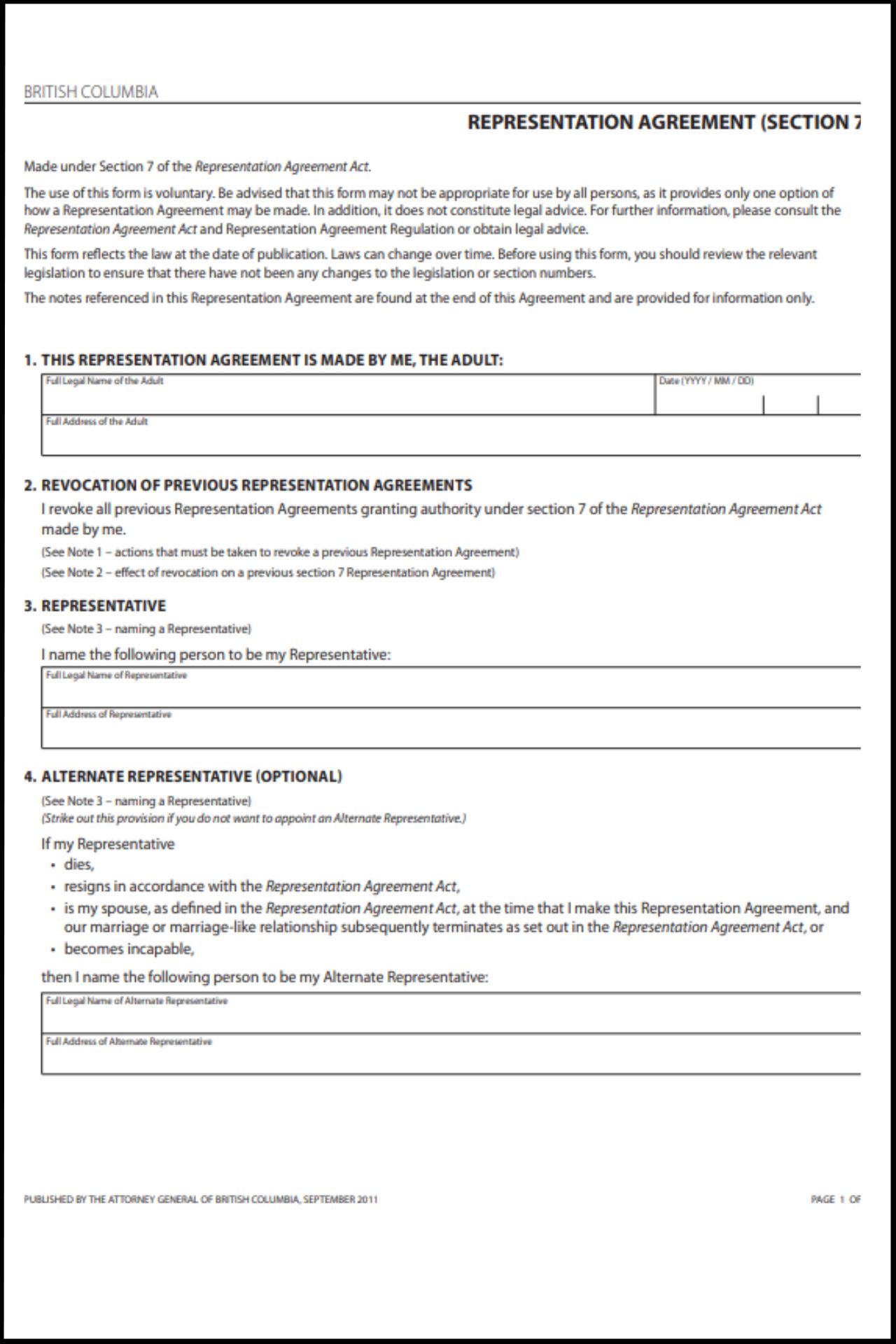
Key Clauses in a BC Representation Agreement
Scope of Authority Clause (Section 7 vs Section 9)
One of the biggest decisions is choosing between a Section 7 and Section 9 Representation Agreement. They are designed for different situations and have different legal requirements.
A Section 9 Representation Agreement allows your representative to make broad health care and personal care decisions. Because of the authority it grants, the adult must have full mental capacity when signing under section 9 of the Representation Agreement Act. It does not authorize the representative to manage real estate, banking, or other complex financial matters.
A Section 7 Representation Agreement serves a different purpose. Under section 8, it was created for adults who have already experienced some cognitive decline, such as early dementia or a brain injury. It allows a trusted representative to assist with routine financial matters and minor health care decisions even where the adult would not meet the traditional legal capacity needed to sign an ordinary contract.
For example, a family in Victoria may prepare a Section 9 agreement while a parent is still fully capable of making personal decisions. By contrast, a family in Kelowna may need a Section 7 agreement after early dementia has affected day-to-day decision-making. Choosing the wrong type of agreement is one of the most common mistakes people make because the two documents are not interchangeable.
Mandatory Exceptions Clause
A Representation Agreement Act does not give unlimited authority. Under section 11 of the Representation Agreement Act, a representative cannot refuse consent for involuntary psychiatric treatment under the Mental Health Act, nor can the representative authorize euthanasia. Those limits apply regardless of the wording included in the agreement.
For example, a representative in Surrey may assume they can make every medical decision on behalf of the adult. The Act places clear statutory limits on that authority, so the agreement cannot override those restrictions.
Enforceability Requirements for a BC Representation Agreement
Under the Representation Agreement Act, the adult’s signature must normally be witnessed by two adult witnesses. If one witness is a BC lawyer or a member in good standing of the Society of Notaries Public of British Columbia, only one witness is required. These witnessing rules appear in section 13 and are among the most important execution requirements in the Act.
The agreement must also include the required statutory certificates. Depending on the circumstances, these include Form 1 (Certificate of Representative or Alternate Representative), Form 2 (Certificate of Monitor), Form 3 (Certificate of Person Signing for the Adult), and Form 4 (Certificate of Witnesses). Missing one of these prescribed certificates can prevent the document from being used even if everyone signed the agreement.
Witness eligibility also matters. A person named as the Representative, Alternate Representative, or Monitor cannot normally act as a witness. The same restriction generally applies to that person’s spouse, child, or parent unless the witness is a lawyer or notary. Using a disqualified witness is one of the most common reasons a Representation Agreement becomes invalid.
For example, a family in Vancouver may carefully complete the agreement but ask the representative’s adult child to witness the signature. Although everyone intended the document to work, the witness is disqualified under the Act and the agreement may not be accepted when it is needed.
Rights and Obligations of the Representative and Adult
A Representation Agreement allows the adult to decide who will act on their behalf and, where appropriate, to appoint Alternate Representatives and a Monitor.
The Representative must act only within the authority granted in the agreement. A Section 9 agreement cannot be expanded to cover powers that the Act does not permit, and every Representative remains subject to the statutory limitations contained in section 11.
Where a Section 7 agreement gives authority over routine financial affairs, a Monitor is generally required unless one of the statutory exceptions applies, such as where the representative is the adult’s spouse, a credit union, a trust company, or the Public Guardian. This safeguard helps provide additional oversight when routine financial authority is included.
For example, a couple in Victoria may assume a monitor is always optional. That is not always correct. If the agreement grants routine financial authority under Section 7, failing to appoint a required monitor can make the agreement invalid.
What Happens If the Agreement Is Missing Required Certificates
A Representation Agreement may appear complete but still fail because the statutory certificates were never attached.
The most common problem is the absence of Form 1 or Form 4. Under the Representation Agreement Act and the Representation Agreement Regulation, these prescribed certificates form part of the execution requirements rather than optional paperwork.
A Section 7 agreement can also fail if it grants routine financial authority but does not include a required Monitor, unless one of the statutory exceptions applies.
I’ve seen a family in Kelowna complete every page of a Section 9 Representation Agreement and carefully collect the signatures. When the representative later tried to rely on the document at a hospital, staff could not accept it because the required witness certificate had never been completed. A single missing form delayed the use of an otherwise well-prepared document.
Summary of Applicable Laws
| Topic | Rule | Governing Statute |
|---|---|---|
| Witness requirement | Two adult witnesses, or one if a BC lawyer or notary acts as the witness | Representation Agreement Act, RSBC 1996, c. 405, s. 13 |
| Mandatory certificates | Forms 1–4 must accompany the agreement where applicable | Representation Agreement Act, s. 13(2); Representation Agreement Regulation, BC Reg 199/2001 |
| Section 7 capacity threshold | Agreement may be made even where the adult lacks capacity to manage their own affairs or enter a standard contract | Representation Agreement Act, s. 8 |
| Section 9 capacity threshold | Requires full mental capacity | Representation Agreement Act, s. 9 |
| Disqualified witnesses | Representatives, Alternates, Monitors and certain relatives cannot normally witness | Representation Agreement Act, s. 13(5) |
| Monitor requirement | Required for certain Section 7 agreements granting routine financial authority, subject to statutory exceptions | Representation Agreement Act, s. 12(1) |
A Kelowna Family’s Missing Certificate Problem
A Kelowna family prepared a Section 9 Representation Agreement before an elderly parent’s planned surgery. The agreement was signed correctly, but Form 4 (Certificate of Witnesses) was never attached.
When the representative later attempted to rely on the agreement during the parent’s hospital stay, the missing certificate prevented the document from being accepted until the execution issue was resolved. The problem was not the wording of the agreement. It was the missing statutory certificate.
Section 7 vs Section 9: Which One Do You Need?
A simple way to decide is:
- Choose Section 9 if you currently have full mental capacity and want someone to make comprehensive health and personal care decisions if you later lose capacity.
- Choose Section 7 if you or a loved one has already experienced cognitive decline and needs assistance with routine financial matters and limited health care decisions under the lower statutory capacity threshold.
The two agreements serve different purposes. Selecting the wrong one can prevent the document from meeting the adult’s needs.
Why a Representation Agreement Can’t Handle Your Finances Alone
Many people assume a Representation Agreement replaces every other advance planning document. Under British Columbia law, that is not the case.
A Section 9 Representation Agreement covers health and personal care decisions only. It cannot authorize someone to deal with banking, investments, real estate, or other comprehensive financial matters. For those decisions, British Columbia uses a separate Enduring Power of Attorney under the Power of Attorney Act.
If you also need someone to manage your finances, see our British Columbia Power of Attorney Template. If you want to provide written medical instructions rather than appoint a decision-maker, our BC Advance Directive Template explains that separate document. Readers comparing the two documents may also find our Representation Agreement vs Advance Directive BC guide helpful. If your circumstances involve diminished capacity, our BC Section 7 Representation Agreement Guide explains that option in greater detail. Estate planning readers may also wish to review our BC Wills, Estates and Succession Act (WESA) Guide.
Frequently Asked Questions
What’s the difference between a Section 7 and Section 9 Representation Agreement in BC?
A Section 9 agreement requires full mental capacity and covers comprehensive health and personal care decisions. A Section 7 agreement is intended for adults with diminished capacity and may include routine financial matters and limited health care authority.
Do I need a lawyer to make a Representation Agreement in BC?
No. However, using a BC lawyer or BC notary as the witness reduces the normal witness requirement from two witnesses to one.
Can a Representation Agreement give someone control over my bank accounts?
Only in the limited way permitted under a Section 7 agreement for routine financial matters. Comprehensive financial authority requires a separate Enduring Power of Attorney.
Who can’t witness my Representation Agreement in BC?
A named Representative, Alternate Representative, Monitor, and certain close relatives of those individuals are generally disqualified from acting as witnesses unless the witness is a lawyer or notary.
Does a Representation Agreement need to be registered in BC?
No. It is a private document and does not need to be filed with a BC government body. The verified legal facts note that registration with the Nidus Personal Planning Resource Centre and Registry is recommended but not legally required.
Can my Representative consent to medical assistance in dying for me?
No. Under section 11 of the Representation Agreement Act, a Representative cannot authorize euthanasia.
