British Columbia Loan Agreement Template & Guide
British Columbia Loan Agreement is a simple legal document that records a promise to repay money. It protects both the lender and the borrower by clearly writing down the terms.
If you lend money to a friend, employee, or small business, things can go wrong without written proof. In real life, many disputes happen because people “assumed” terms instead of writing them. A proper agreement helps avoid confusion and keeps you legally safe in British Columbia.
I’ve seen lenders in British Columbia struggle to recover even small personal loans because nothing was written down clearly at the start. When repayment dates, interest, or missed payment terms are vague, simple loans between friends or family can quickly turn into stressful legal disputes.
A loan agreement is a written promise where one person gives money and the other agrees to repay it under certain terms.
For example, you might lend $5,000 to a friend to start a small shop. Without a written agreement, it becomes difficult to prove repayment terms later.
Under British Columbia law, a properly written contract is much easier to enforce than a verbal promise.
Last Updated: September 2026
Free British Columbia Loan Agreement Template
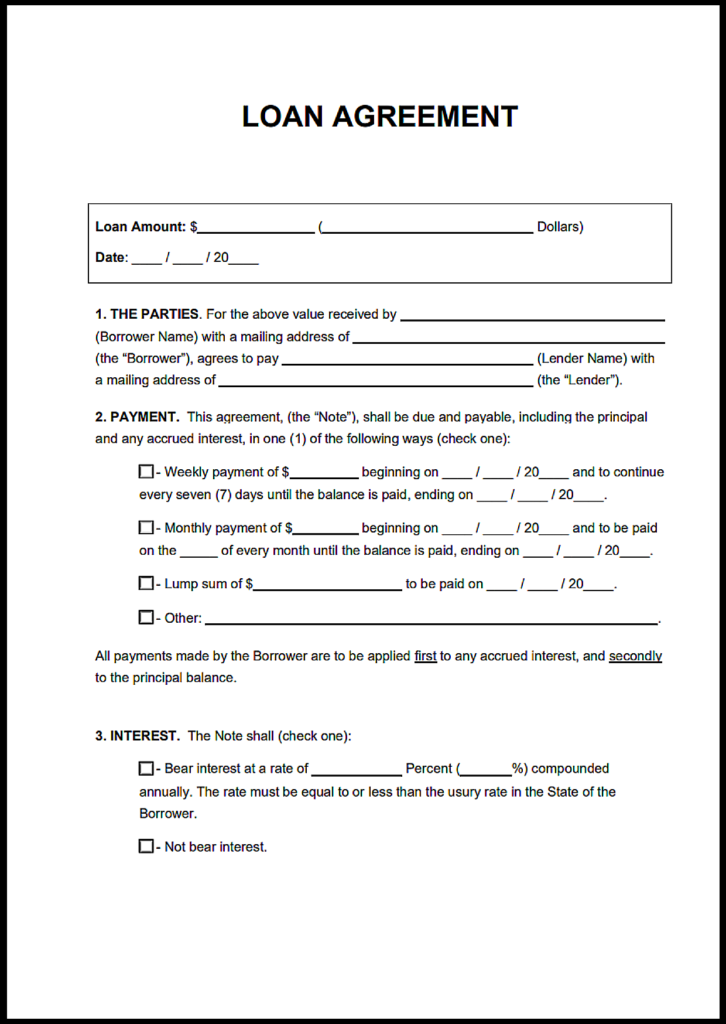
Below is a simple, ready-to-use template. You can copy, edit, and use it based on your situation.
Important British Columbia Loan Agreement Laws You Should Know
| Topic / Issue | British Columbia Legal Rule | Governing Statute |
|---|---|---|
| Governing Consumer Credit Law | British Columbia’s consumer-credit disclosure rules apply to specified credit agreements within Part 5 of the Business Practices and Consumer Protection Act, including certain consumer loans made by credit grantors in the ordinary course of business. | Business Practices and Consumer Protection Act [SBC 2004] c. 2 |
| Federal Interest Rate Rules | Federal law includes the Interest Act rules on certain interest-rate disclosures and the Criminal Code rules governing the criminal rate of interest. | Interest Act; Criminal Code, s. 347 |
| Age Requirement | British Columbia’s general age of majority is 19. A contract made by a person under 19 is subject to the special rules in Part 3 of the Infants Act, rather than being automatically enforceable or unenforceable simply because of age. | Age of Majority Act, s. 1; Infants Act, s. 19 |
| Corporate Signing Authority | A British Columbia corporation may enter into agreements through persons who have the authority to act for the company; section 146 of the Business Corporations Act contains rules about when a company may rely on or assert certain issues concerning the authority of its directors, officers and agents. | Business Corporations Act, s. 146 |
| Witness Requirement | An ordinary loan agreement does not generally require a witness, although separate security documents may have their own execution requirements. | No general statutory requirement |
| Notarization Requirement | An ordinary loan agreement does not generally require notarization. A mortgage or other land-title security document can have separate statutory execution, witnessing and registration requirements. | Land Title Act |
| Mental Capacity | Until the contrary is demonstrated, every adult is presumed to be capable of making decisions about the adult’s financial affairs under section 3 of the Adult Guardianship Act. | Adult Guardianship Act, s. 3 |
| Debt Claim Time Limit | Subject to the Limitation Act and its exceptions, the basic limitation period for a court proceeding is generally 2 years from the day the claim is discovered. | Limitation Act, ss. 6 and 8 |
| Cost of Borrowing Disclosure | For consumer credit agreements to which Part 5 of the Business Practices and Consumer Protection Act applies, the credit grantor must provide the required disclosure, including information about the interest rate, charges and other prescribed credit terms. | Business Practices and Consumer Protection Act, Part 5 |
| Interest Rate Disclosure Rule | Under the federal Interest Act, section 3 provides a 5% rate where interest is payable but no rate is fixed by agreement or law. Section 4 separately addresses contracts that state interest for a period shorter than a year without an express equivalent yearly rate. | Interest Act, ss. 3–4 |
| High-Cost Credit Disclosure | Specified payday loans and high-cost credit products in British Columbia are subject to separate statutory disclosure, cancellation, cost and other requirements. The applicable rules depend on the type of credit product and whether the transaction falls within the statutory definitions. | Business Practices and Consumer Protection Act |
| Secured Loan Registration | For security interests in personal property, registration of a financing statement is one method of perfection under the Personal Property Security Act; whether registration is appropriate depends on the collateral and the applicable perfection and priority rules. | Personal Property Security Act |
| Real Estate Security Registration | A mortgage over land has separate Land Title Act requirements for execution and registration. Registration of charges is also relevant to notice and priority between registered charges. | Land Title Act, s. 238 |
| Criminal Interest Limit | Under section 347 of the Criminal Code, the criminal rate is generally an annual percentage rate exceeding 35% on the credit advanced, subject to statutory and regulatory exceptions. | Criminal Code, s. 347 |
| Unconscionable Agreements | Section 8 of British Columbia’s Business Practices and Consumer Protection Act addresses unconscionable acts or practices by a supplier in a consumer transaction; its application depends on the transaction falling within the Act. | Business Practices and Consumer Protection Act, s. 8 |
| Minor Borrowers | A contract made by a person under 19 is subject to Part 3 of the Infants Act. Section 19 sets out circumstances in which the contract may be enforceable against the infant, including affirmation, specified performance after reaching majority, or failure to repudiate within the statutory period. | Infants Act, s. 19 |
| BC-Specific Cooling-Off Rights | Specified payday loans and high-cost credit products can have statutory cancellation rights; an ordinary private loan does not automatically have a cooling-off period under these provisions. | Business Practices and Consumer Protection Act |
| Recent High-Cost Credit Amendments | British Columbia’s High-Cost Credit Products Regulation took effect on May 1, 2022, establishing rules for regulated high-cost credit products, including prescribed APR criteria and other requirements. | High-Cost Credit Products Regulation |
British Columbia’s general age of majority is 19. A contract made by a person under 19 is subject to the special contract rules in Part 3 of the Infants Act rather than being automatically enforceable simply because the borrower has signed it.
Interest requires more careful drafting than simply writing a percentage into the agreement. The federal Interest Act and Criminal Code address different aspects of interest, so the agreement should state the rate and calculation method clearly. Under section 347 of the Criminal Code, the criminal rate is generally an annual percentage rate exceeding 35% on the credit advanced, subject to statutory and regulatory exceptions.
The basic limitation period for a court proceeding in British Columbia is generally 2 years from the day the claim is discovered, subject to the exceptions and discovery rules in the Limitation Act. That means a lender should not assume that a missed payment automatically starts a simple two-year clock without considering when the claim was legally discovered and whether another provision applies.
Security also requires careful drafting. For personal property, registration of a financing statement is one method of perfecting a security interest, while mortgages over land have separate execution and registration requirements under the Land Title Act.
The British Columbia Loan Agreement template below gives the parties a starting point for recording the principal, repayment terms, interest, and other agreed conditions.
What Is a Loan Agreement and When Do You Need One?
A British Columbia loan agreement can be an enforceable contract between a lender and a borrower when the parties have formed a valid contract and the terms are enforceable under the circumstances and applicable law. It records how much money is being advanced and the agreed repayment terms.
You may need one in situations like:
- Lending money to friends or family
- Funding a small business startup
- Giving an employee a loan
- Providing short-term financial help
A written agreement is especially useful when the amount is significant or the parties have agreed to detailed repayment, interest, security, or default terms. A verbal arrangement can leave the parties arguing later about what was actually agreed.
Financial agreements are commonly connected with other business documents depending on the transaction structure. Companies working with outside service providers may also use a service agreement template, while businesses entering long-term collaborations often require a partnership agreement.
Is a Loan Agreement Legally Valid in British Columbia?
A loan agreement can be enforceable in British Columbia when the parties have formed a valid contract and the terms are enforceable under the circumstances and applicable law.
A loan agreement does not become enforceable merely because it contains a particular checklist of words. The important questions include whether the parties reached an agreement, whether there was consideration where required, whether the terms are sufficiently certain, whether the parties had contractual capacity, and whether any applicable legislation affects enforceability.
A written agreement is not generally required for every loan, but putting the terms in writing gives the parties much stronger evidence of what they agreed to.
Key Elements of a Strong Loan Agreement
A good agreement is clear, complete, and tailored to the actual transaction.
Loan Amount and Purpose
Always mention the exact loan amount in Canadian dollars.
You can also include the purpose, such as personal use or business investment. The purpose can help explain the nature of the transaction and distinguish the loan from a gift or another type of payment arrangement.
Interest Rate and Legal Limits
Interest can be charged, but the rate, charges and calculation method must comply with applicable federal and British Columbia law.
The agreement should state the interest rate clearly and identify how it is calculated. Where interest is stated for a period shorter than a year, the federal Interest Act can require an express yearly equivalent in order to recover interest above 5% in the circumstances covered by section 4.
The federal Criminal Code also generally treats an annual percentage rate exceeding 35% on credit advanced as a criminal rate, subject to statutory and regulatory exceptions.
Repayment Schedule
State how and when payments will be made:
- Monthly installments
- Weekly payments
- Lump sum at the end
The agreement should identify the first payment date, regular payment dates, final maturity date, and any conditions for early repayment.
Security (Secured vs Unsecured Loan)
Some loans are backed by specified assets, while others are unsecured.
If collateral is provided, the agreement should identify the collateral and the security documents or registration steps needed to establish and protect the lender’s rights.
Default and Penalties
Set out what happens if the borrower fails to pay, including any contractual default interest, permitted charges, acceleration terms, enforcement rights and applicable security remedies.
For example:
- Late fees or permitted charges
- Legal action
- Enforcement of valid security rights, where applicable
Any interest, fee, penalty or other charge included in the agreement must comply with applicable law, including the federal criminal-interest rules where they apply.
Signatures and Witnessing
Both parties should sign the agreement.
An ordinary loan agreement does not generally require a witness or notarization, although particular security documents can have separate execution requirements. A mortgage over land, for example, must comply with applicable Land Title Act execution and witnessing rules before registration.
When sensitive financial information is shared during negotiations, parties sometimes include a confidentiality agreement to help protect private business records and repayment details.
Secured vs Unsecured Loans in British Columbia
Understanding this difference is important before drafting your agreement.
| Feature | Secured Loan |
Unsecured Loan
|
| Risk for lender | Rights against specified collateral, subject to applicable security rules |
No specific collateral securing the debt
|
| Collateral required | Yes | No |
| Example | Car loan | Loan to a friend |
| Legal protection | Security rights may improve the lender’s position if properly created and perfected |
Lender generally relies on the borrower’s obligation to repay
|
A secured loan gives the lender rights in specified collateral under the applicable security agreement and registration rules. With personal property collateral, the Personal Property Security Act contains rules governing attachment, perfection and priority.
An unsecured lender does not have that specific collateral security and generally relies on the borrower’s obligation to repay.
How to Fill Out the Loan Agreement (Step-by-Step)
Start with the parties’ legal names and the exact principal amount. Small errors in those fields can make the final document harder to interpret.
Step 1: Add correct legal names
Use full legal names as shown on official documents.
If a corporation is involved, identify the corporation by its legal name and ensure the person signing on its behalf has appropriate authority.
Step 2: Clearly mention loan amount
Write the exact amount in CAD to avoid confusion.
Specify whether the full amount is advanced on signing or will be advanced in instalments.
Step 3: Decide interest and repayment
Agree on the interest rate and payment schedule before signing.
State whether interest is simple or compounded, how it accrues, when it becomes payable, and the final date on which the principal must be repaid. The wording should also comply with the federal Interest Act and Criminal Code where applicable.
Step 4: Add payment method
Mention how payments will be made, such as bank transfer or cheque.
It can also help to state where payments must be sent and when a payment is considered received.
Step 5: Review and sign
Both parties should carefully review the agreement before signing.
Tip: Use simple language and make the repayment, interest, default and security terms easy to identify.
Interest Rates and Legal Rules in Canada
In Canada, interest charges are regulated by federal law and, for certain consumer-credit transactions, provincial legislation.
| Rule | Explanation |
| Criminal interest rate |
Generally, an annual percentage rate exceeding 35% on the credit advanced is a criminal rate under section 347 of the Criminal Code, subject to statutory and regulatory exceptions.
|
| Interest Act default rate |
Where interest is payable but no rate is fixed by agreement or law, section 3 of the Interest Act provides a rate of 5% per annum.
|
| Express yearly rate |
Section 4 of the Interest Act imposes a separate rule where interest is stated for a period shorter than a year without an express yearly equivalent, subject to the section’s exceptions.
|
| Transparency |
The agreement should state the interest rate and calculation method clearly.
|
Interest charges must comply with applicable federal and British Columbia law. In particular, the federal Criminal Code generally treats an annual percentage rate exceeding 35% as a criminal rate, subject to statutory and regulatory exceptions.
The 5% rule under the Interest Act should not be described as a blanket replacement for an omitted annual rate. Section 3 applies where interest is payable but no rate is fixed by agreement or law, while section 4 deals with rates expressed for periods shorter than a year.
Tax Implications of Loans in British Columbia
Loans can have tax effects depending on the parties, purpose of the loan, interest charged, and how the funds are used.
- Principal advanced on a personal loan: The repayment of principal is generally not income to the lender; interest received can be taxable income.
- Interest received on loans: Interest income is generally taxable and must be reported, subject to applicable tax rules.
- Interest-free or low-interest loans: Specific federal tax rules can apply in some circumstances, depending on who receives the loan and why it was made.
For larger, business-related, employee, shareholder, or cross-border loans, the tax treatment can become more complicated. An accountant or tax professional can assess the particular arrangement.
Common Mistakes to Avoid
Most drafting problems are avoidable. The key is to record the repayment date, interest calculation, default terms and any security before the parties sign.
Avoid these:
- Not writing clear repayment terms
- Charging an interest rate or other charges that violate applicable law
- Missing a default clause
- Mixing personal and business loans without documenting the purpose and parties clearly
- Not keeping proper records
Clear records should include the signed agreement, proof of the amount advanced, payment history, amendments, and communications relating to repayment.
What Happens If the Borrower Does Not Repay?
If the borrower fails to repay, the lender has several options.
- Send reminders and try to negotiate
- Issue a written notice where the agreement or applicable law calls for one
- Start a court proceeding in the appropriate forum, such as the Provincial Court’s Small Claims Court where the claim falls within its monetary jurisdiction
In British Columbia, the Provincial Court can hear qualifying debt claims within the $35,000 monetary limit, excluding interest and costs. Claims above that amount may proceed in the BC Supreme Court, although a claimant may abandon part of a qualifying claim to bring it within the Small Claims limit.
A written agreement gives the lender clearer evidence of the amount advanced and the repayment terms, but having an agreement does not guarantee a particular outcome in court.
Loan Agreement vs Promissory Note
These two documents are similar but not the same.
| Feature | Loan Agreement |
Promissory Note
|
| Detail level | Often records detailed loan terms, representations, defaults and security |
Usually focuses on the promise to pay and related payment terms
|
| Legal strength | Depends on the document and applicable law |
Depends on the document and applicable law
|
| Use case | Business or complex loans |
Often used for straightforward promises to pay
|
A loan agreement can be useful when the transaction involves detailed obligations, security, default provisions, representations, or other conditions. A promissory note can be appropriate where the parties mainly need a written promise to repay a specified amount.
Frequently Asked Questions
Do I need a lawyer for a loan agreement in BC?
No, not always. For a straightforward loan, you can use a template and tailor it to the transaction. For a large or complex loan, legal advice can be useful, particularly where security, business financing, guarantees, real property, or complicated default provisions are involved.
Can I charge interest on a personal loan?
Yes, but the interest rate and associated charges must comply with applicable federal law and any British Columbia rules that apply to the transaction. The Criminal Code generally defines a criminal rate as an annual percentage rate exceeding 35% on credit advanced, subject to statutory and regulatory exceptions.
Is a verbal loan agreement valid?
It can be valid in appropriate circumstances, but proving the agreed principal, repayment date, interest and other terms can be much more difficult without written evidence. A written agreement is generally the safer way to document the transaction.
Can I change terms after signing?
Only if both parties agree to the change and the amendment is legally enforceable. Putting the revised terms in a signed written amendment can provide a clear record of what changed.
What if borrower refuses to sign?
If the borrower refuses to sign, there may be no written agreement containing the proposed terms. Whether a loan is nevertheless enforceable depends on the evidence of the parties’ actual agreement and the circumstances of the transaction.