Free British Columbia NDA Template Guide
A British Columbia NDA is a simple legal contract used to protect confidential information. In basic terms, it means one person agrees not to share certain private details with others.
In British Columbia, NDAs are very common. Businesses use them when hiring employees, working with freelancers, starting partnerships, or sharing ideas. They help protect things like business plans, customer data, and trade secrets.
I’ve seen people in British Columbia rely on handshake deals or copy NDA templates from the internet, only to realize later that key confidentiality terms were too vague to enforce when a dispute came up. When someone is already stressed about protecting a business idea or sensitive information, even one missing clause can create expensive problems that are hard to fix after the information has already been shared.
In this article, I’ll walk you through everything in a clear and simple way. You’ll get a free NDA template you can actually use, understand the different types of NDAs in British Columbia, and learn the basic legal rules that really matter. I’ll also show you how to create and use an NDA properly, so you don’t end up making small mistakes that could cause problems later.
Last Updated: September 2026
Free British Columbia NDA Template
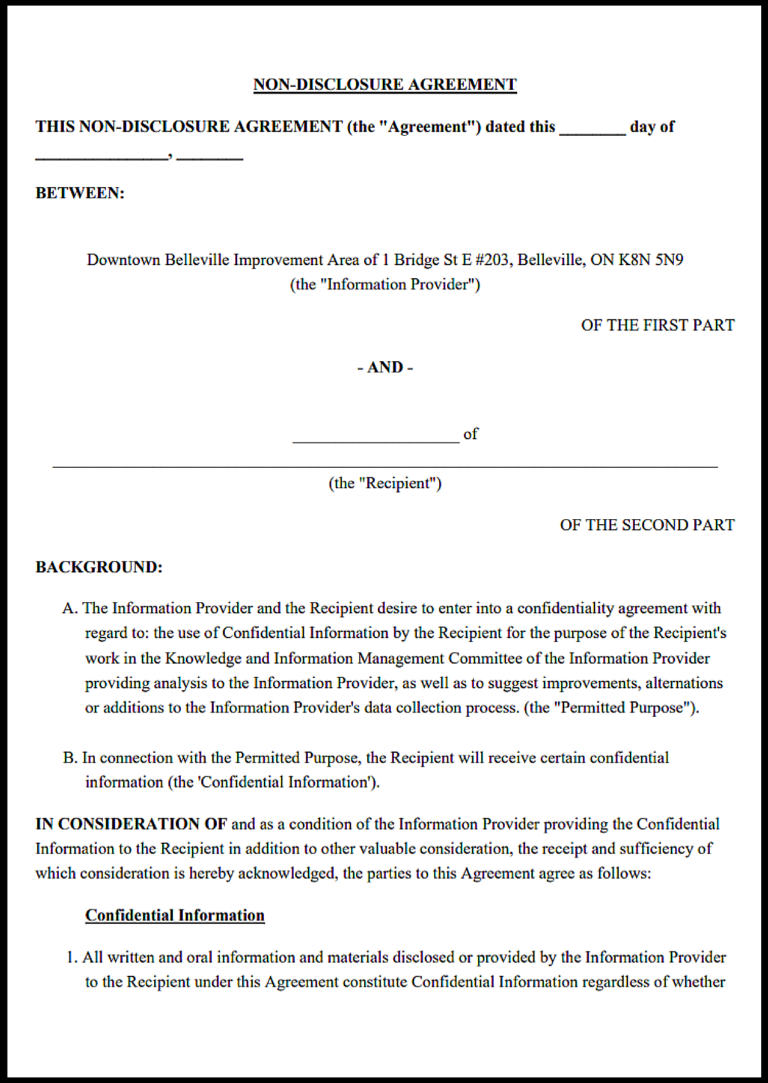
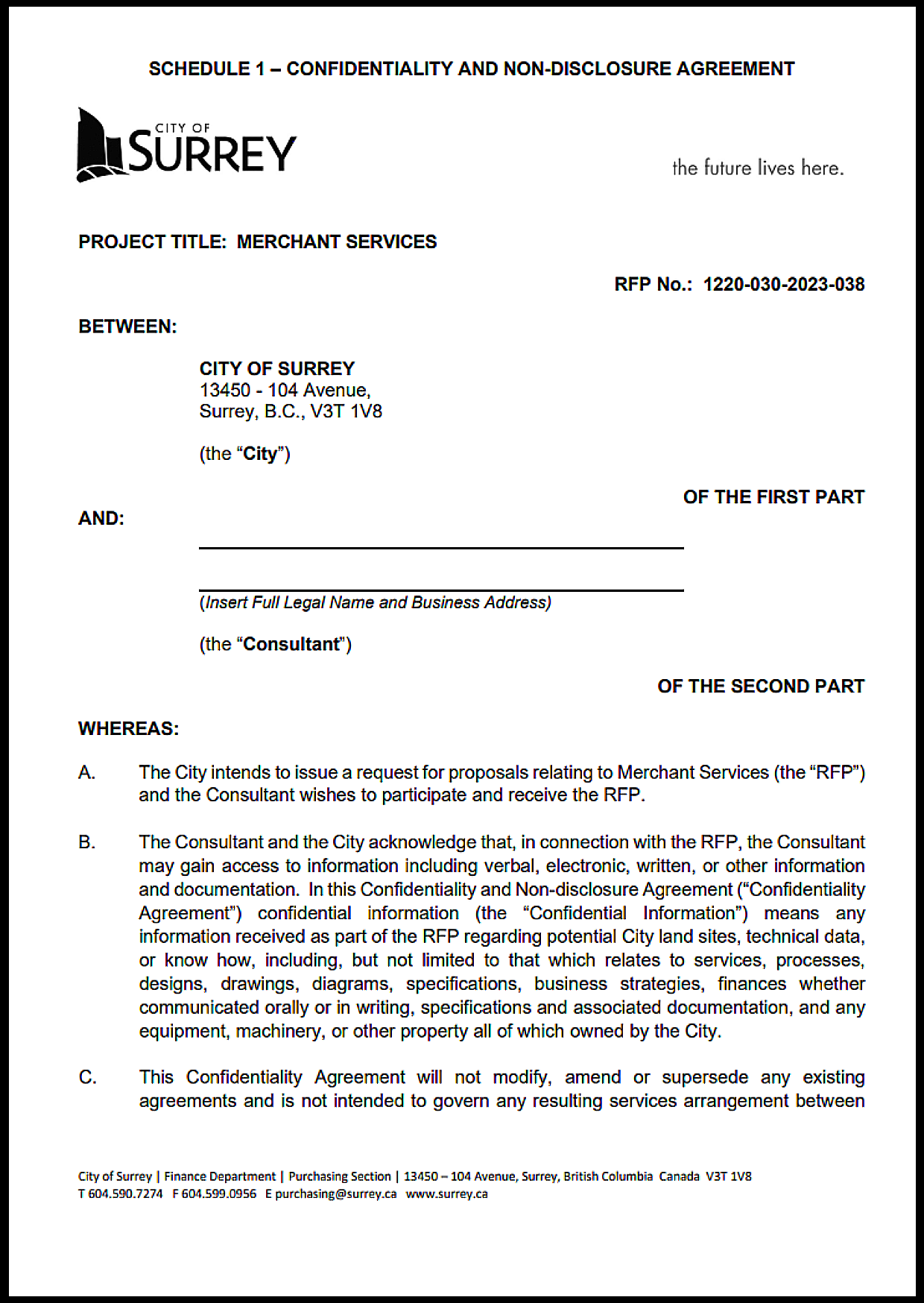
Below is a simple, general-purpose NDA template you can use for most situations.
British Columbia NDA Laws, Enforceability Rules & Legal Limitations
| Topic / Issue | British Columbia Legal Rule | Governing Statute |
|---|---|---|
| Governing legislation | NDAs in British Columbia are generally governed by provincial contract law principles and any legislation that applies to the particular relationship or transaction. | Law and Equity Act, RSBC 1996, c. 253 |
| Federal evidence limitation | An NDA should not be drafted to prohibit disclosures that a person is legally entitled or required to make, including compliance with lawful process. | Canada Evidence Act, RSC 1985, c. C-5 |
| Nature of law | NDAs are generally provincial contract matters, although federal legislation can apply to particular disclosures, industries, or proceedings. | Constitution Act, 1867 |
| Who can legally sign | An individual may sign an NDA personally, while a company should have the agreement signed by a person who has authority to bind the company. | Business Corporations Act, SBC 2002, c. 57 |
| Witness requirements | Witnessing is not generally required for an NDA to be legally effective in British Columbia. | No general statutory requirement |
| Notarization requirement | NDAs generally do not require notarization in British Columbia. | No general statutory requirement |
| Age of majority | British Columbia’s general age of majority is 19, while contractual capacity is a separate issue governed by the applicable law and circumstances. | Age of Majority Act, RSBC 1996, c. 7, s. 1 |
| Mental capacity | The signer should have the legal capacity required to enter into the agreement and understand the nature of the contractual obligations being accepted. | Applicable contract and capacity law |
| Time limit for claims | The BC Limitation Act generally requires a court proceeding to be started within 2 years after the claim is discovered, subject to the Act’s exceptions and other limitation rules. | Limitation Act, SBC 2012, c. 13, s. 6 |
| Mandatory wording | There is no standard government NDA form or prescribed statutory wording for an ordinary private NDA in British Columbia. | General contract law |
| Contract validity requirements | An NDA must satisfy the applicable requirements of contract law, including agreement and enforceable contractual obligations; consideration can be an important issue depending on how and when the NDA is made. | Common law contract principles |
| Fresh consideration rule | An NDA introduced after employment has already begun can raise a consideration and enforceability issue, particularly where the employee receives no new consideration for the new restriction. | Contract law / applicable case law |
| Filing requirement | Ordinary NDAs are private contracts and are not generally filed with a government registry. | Private contractual practice |
| Whistleblower protection exception | An NDA should not be drafted to prohibit disclosures that a person is legally entitled or required to make, including protected regulatory or law-enforcement disclosures. | Applicable federal and provincial law |
| Unreasonable restraint issue | An NDA that goes beyond protecting legitimate confidential information and functions like a restrictive covenant may face enforceability problems under the applicable common-law rules. | Common law contract principles |
| Ambiguous confidentiality definitions | A vague definition of confidential information can make an NDA harder to interpret and enforce. | Common law contract principles |
| BC age difference | British Columbia’s general age of majority is 19. | Age of Majority Act, s. 1 |
| Privacy law interaction | Where an NDA concerns personal information handled by an organization, the organization must also comply with applicable privacy-law requirements, including BC’s Personal Information Protection Act where it applies. | Personal Information Protection Act, SBC 2003, c. 63 |
| Standard-form unconscionability | Unfairness and unequal bargaining power can affect enforceability in appropriate cases, but the applicable legal test depends on the type of agreement and the circumstances of the transaction. | Applicable contract and consumer law |
British Columbia does not prescribe a government NDA form or mandatory NDA wording. A template still needs to be tailored to the parties, the information being protected, permitted disclosures, duration, and the circumstances in which the agreement is signed.
An NDA introduced after employment has already begun can raise a consideration issue, particularly where the employee receives no new consideration for the new restriction. The enforceability question depends on the particular circumstances and the terms of the agreement.
An NDA should also include appropriate exceptions for disclosures that are legally required or legally protected. A confidentiality clause should not be written so broadly that it purports to prevent lawful reporting, compliance with legal process, or other protected disclosures.
These details matter because enforceability depends on the wording and circumstances of the agreement. A carefully drafted NDA should identify the confidential information and the obligations clearly rather than relying on a generic confidentiality statement.
An NDA helps businesses protect confidential information shared during professional discussions, commercial negotiations, and working relationships. To understand how these agreements fit into broader commercial documentation, you can review with the guide explaining what an NDA is in British Columbia.
Types of NDA in British Columbia
The appropriate NDA structure depends on who is sharing information and the relationship between the parties.
Unilateral NDA (One-Way NDA)
This is used when only one party shares confidential information.
Common situations:
- Employers hiring new employees
- Businesses sharing ideas with contractors
A unilateral NDA is often appropriate where one party is the main source of confidential information.
Mutual NDA (Two-Way NDA)
Both parties share confidential information.
Used in:
- Business partnerships
- Joint ventures
- Company negotiations
A mutual NDA can be useful when each side expects to exchange proprietary or commercially sensitive information.
Employee NDA
This protects confidential business information disclosed to employees.
Usually signed during hiring or onboarding. It can cover:
- Client data
- Internal systems
- Trade secrets
Employers should ensure employee confidentiality terms are clearly drafted and appropriately tailored to the legitimate information they are intended to protect.
Independent Contractor NDA
Used when hiring freelancers or consultants.
Common industries:
- Marketing
- IT services
- Content creation
The NDA should identify what confidential information the contractor may receive and limit use or disclosure to the agreed business purpose.
Business Sale NDA (Confidentiality in M&A)
Used when selling or buying a business.
It can protect:
- Financial records
- Customer data
- Operational details
The agreement can set the rules for reviewing business information during due diligence and negotiations.
Investor NDA
Used when pitching business ideas to investors.
It can address:
- Business models
- Strategies
- Confidential commercial information
Some investors may decline to sign an NDA before an initial pitch, so confidentiality protections should be considered in light of the particular fundraising process.
Non-Circumvention + NDA Agreements
This type combines confidentiality obligations with provisions intended to restrict a party from bypassing another party in a business opportunity.
Used in:
- Deal brokering
- Partnerships
Because non-circumvention terms can go beyond ordinary confidentiality obligations, they should be drafted carefully and tailored to the actual commercial relationship.
Confidentiality agreements are commonly used alongside service and contractor documents depending on the business arrangement involved. Companies hiring outside professionals may also require an independent contractor agreement, while consulting relationships often involve a consulting agreement template.
Real-Life Use Cases of NDAs in British Columbia
Businesses use NDAs in several practical settings where confidential information must be shared.
Here are some simple examples:
- A startup shares an app idea with a developer and wants confidential information kept private
- A company hires a freelance designer and shares branding materials
- Two businesses explore a partnership and exchange financial data
- A business owner shares records while planning to sell the company
- A company protects customer lists and internal processes
Businesses entering operational partnerships may additionally rely on a partnership agreement to establish management responsibilities together with confidentiality protections.
Key Elements of a Valid NDA
A well-drafted NDA should address several core issues that can affect how clearly its obligations can be interpreted and enforced.
Clear Definition of Confidential Information
You should clearly identify what information is protected.
Include:
- Business plans
- Financial data
- Customer lists
- Technical or commercial information where appropriate
Exclude:
- Public information
- Information already lawfully known by the receiving party
A more precise definition can reduce arguments about whether particular information falls within the agreement.
Obligations of the Receiving Party
The agreement should explain what the receiving party can and cannot do.
Typical rules:
- No unauthorized disclosure
- No copying or misuse
- Use only for the agreed purpose
Duration of Confidentiality
The confidentiality term should state how long the particular information must remain protected.
It can be:
- Fixed (e.g., 2–5 years)
- Potentially ongoing for information that continues to qualify as a trade secret, subject to the agreement and applicable law
There is no universal BC rule that every NDA must last 2–5 years.
Permitted Disclosures
Sometimes information must be shared legally.
Examples:
- Court orders
- Government requirements
- Legal or regulatory obligations
The NDA should allow disclosures required or protected by law.
Consequences of Breach
This explains what can happen if someone breaches the NDA.
Possible outcomes:
- Legal action
- Financial damages
- Other contractual remedies available under the agreement and applicable law
Jurisdiction Clause (British Columbia)
A BC governing-law clause can provide greater certainty about which law the parties intend to apply to the agreement.
It is not generally a mandatory clause for an NDA to be legally effective.
How to Create or Complete an NDA
Creating an NDA is easier when the agreement is tailored to the actual information-sharing relationship.
Step-by-step:
- Identify both parties clearly
- Define confidential information in simple terms
- Choose the right NDA type (see types section above)
- Set an appropriate confidentiality period
- Add permitted-disclosure exceptions
- Add jurisdiction and dispute-resolution terms where appropriate
- Review carefully before signing
In most cases, clarity is more important than unnecessary complexity.
Legal Overview in British Columbia
In British Columbia, NDA disputes are generally analyzed using contract-law principles together with any legislation that applies to the particular relationship or disclosure.
For an NDA to be enforceable:
- There should be agreement between the parties
- The terms should be sufficiently clear
- The contractual obligations should be enforceable in the circumstances
Courts may scrutinize unclear, excessive, or otherwise unenforceable contractual restrictions, depending on the wording and circumstances of the agreement.
Potential problems can include:
- Too broad
- Unfair in the circumstances
- Vague or unclear
The parties should understand the contractual obligations they are accepting. A poorly drafted NDA can create interpretation and enforcement problems.
Common Mistakes to Avoid
Common NDA problems often come from unclear definitions, excessive restrictions, missing disclosure exceptions, or terms that do not fit the relationship.
Avoid these:
- Using vague definitions like “all information”
- Making the NDA too broad or unrealistic
- Not specifying how long it lasts
- Treating a BC governing-law clause as mandatory when it is not
- Using a one-way NDA when both parties share information
- Copy-pasting templates without editing
A well-drafted NDA should be clear, balanced, and practical.
Choosing the Right NDA (Decision Guide)
Here’s a quick way to decide which NDA you need:
| Situation |
Recommended NDA Type
|
| Only one party shares info | Unilateral NDA |
| Both parties share info | Mutual NDA |
| Hiring employees | Employee NDA |
| Working with freelancers | Contractor NDA |
| Selling a business |
Business Sale NDA
|
| Pitching investors | Investor NDA |
This table provides a starting point for matching the NDA structure to the type of information-sharing relationship.
Is an NDA legally enforceable in British Columbia?
An NDA may be enforceable when it forms a valid contract and its terms are sufficiently clear and enforceable under the circumstances. The exact outcome depends on the agreement and applicable law.
Do NDAs need to be notarized in BC?
No. Notarization is not generally required for an ordinary NDA in British Columbia. A signed agreement is usually sufficient, assuming the agreement otherwise satisfies the applicable legal requirements.
How long should an NDA last?
It depends on the information being protected and the agreement. Some confidentiality obligations have a fixed term, while trade-secret protection may need to continue while the information remains confidential.
Can an NDA protect business ideas?
An NDA can protect confidential information relating to a business idea when the information is sufficiently identified and the agreement clearly defines the confidentiality obligations. An NDA does not, by itself, guarantee protection for an idea that is already public or not legally protectable.
What happens if someone breaks an NDA?
The affected party may be able to seek a legal remedy, which can include damages or other relief depending on the agreement and circumstances. The available remedy will depend on the applicable law and the facts of the breach.
Are NDAs valid without payment or consideration?
Consideration can be an important issue in contract formation, particularly where an NDA is introduced after an existing employment relationship has begun. Whether fresh consideration is required depends on the circumstances and applicable contract law.
Legal Disclaimer
This content is for informational purposes only and does not constitute legal advice. Laws may change, and every situation is different. You should consult a qualified legal professional in British Columbia for advice specific to your case.