British Columbia Last Will and Testament Guide + Free Template
A British Columbia Last Will and Testament is a legal document that explains what happens to your property after you pass away. It helps protect your family, avoid disputes, and make sure your wishes are followed. Without a will, BC law decides who gets your assets — and that may not match what you want.
In most estate planning situations, having a will is one of the most important steps you can take. Under British Columbia law, your will controls how your estate is handled, who manages it, and who benefits from it. If you pass away without one, your loved ones may face delays, legal costs, and confusion during an already difficult time.
I’ve seen families in British Columbia spend months dealing with court delays and disputes simply because a will was missing, outdated, or not signed properly under BC law. When people come to me after a death in the family, many are shocked to learn how quickly confusion over executors, beneficiaries, or handwritten changes can turn into expensive legal problems.
Last Updated: September 2026
Table of Contents
ToggleFree British Columbia Last Will and Testament Template
Below is a simple and realistic template you can use. This format follows basic requirements under British Columbia law and can work for straightforward estates.
Tip: This template works best for simple estates. If you own multiple properties, a business, or have blended family situations, getting legal advice is strongly recommended.
British Columbia Will Laws You Should Understand Before Signing
| Topic / Issue | British Columbia Legal Rule | Governing Statute |
|---|---|---|
| Governing Legislation | Wills and succession in British Columbia are principally governed by the Wills, Estates and Succession Act (WESA), together with other applicable legislation and court rules. | Wills, Estates and Succession Act, SBC 2009 c. 13 |
| Federal Exception | Some estates or property may be subject to federal legislation or another legal regime. The applicable rules depend on the person’s circumstances and the property involved. | WESA and applicable federal law |
| Who Can Sign | The will-maker may sign the will personally, or another person may sign in the will-maker’s presence and at the will-maker’s direction, as permitted by WESA. | WESA s. 37 |
| Witness Requirements | For a formal will, 2 or more witnesses must generally be present at the same time when the will-maker signs or acknowledges the signature, and the witnesses must sign in the will-maker’s presence. | WESA s. 37 |
| Witness Disqualification | Each signing witness must be 19 years of age or older. A beneficiary may witness the will, but a gift to the witness or the witness’s spouse may be void under WESA s. 43 unless the court declares the gift effective. | WESA ss. 40, 43 |
| Notarization | WESA does not generally require a will to be notarized. A formal will must instead satisfy the applicable execution requirements. | WESA s. 37 |
| Age Requirement | A person who is 16 years of age or older and mentally capable of making a will may make a will under WESA. | WESA s. 36 |
| Armed Forces Exception | A qualifying member of the armed forces on active service may make a will regardless of age, subject to the special rules in WESA s. 38. | WESA s. 38 |
| Mental Capacity | The will-maker must be mentally capable of making the will. | WESA s. 36 |
| Mandatory Wording | WESA does not generally require particular “magic words” for a will, but the document must satisfy the Act’s applicable statutory requirements. | WESA |
| Attestation Clause | An attestation clause can help document how a will was signed and witnessed, but WESA does not make an attestation clause a general condition of will validity. | WESA |
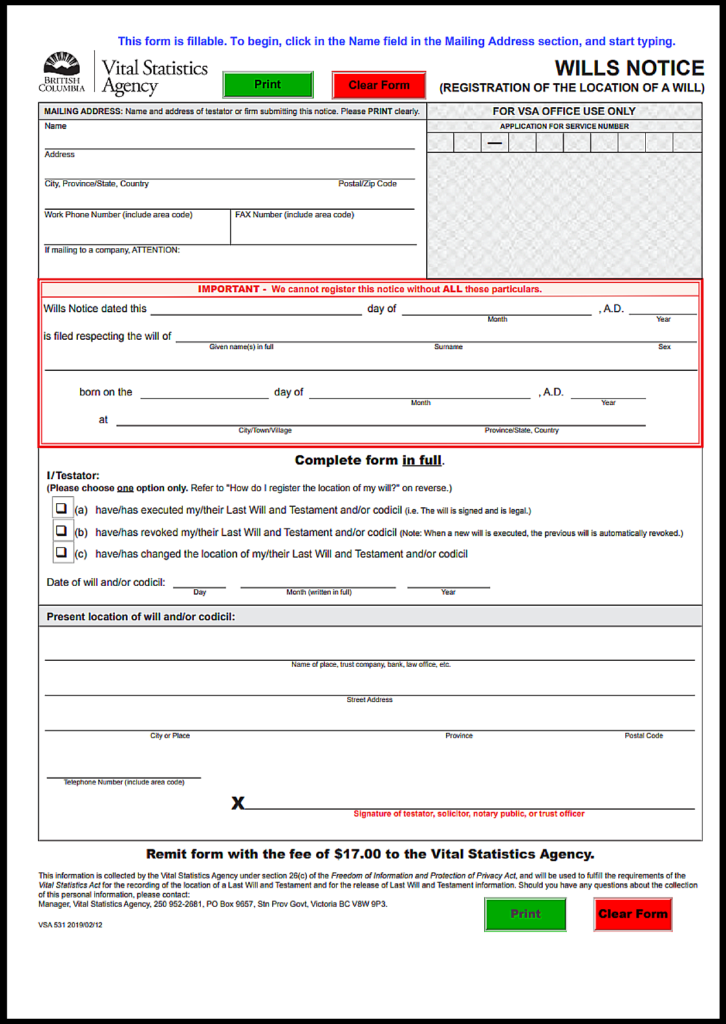
| Wills Registry Filing | A Wills Notice may be filed to record the location of a will. Filing a Wills Notice is optional. | WESA s. 73; BC Wills Registry |
| Registry Search Requirement | When applying for an estate grant, the applicant must comply with the Supreme Court Civil Rules concerning the search for testamentary documents, including the applicable Wills Notice requirements. | Supreme Court Civil Rules, Rule 25-3 |
| Improper Witnessing | A will that does not comply with WESA’s formal execution requirements is generally invalid unless an applicable statutory exception or a court order applies. | WESA ss. 37, 58, 80 |
| Signature Placement | For a formal will, the will-maker’s signature must comply with WESA’s requirements. WESA also contains rules dealing with the placement of the signature and writing or gifts appearing after it. | WESA ss. 37, 39 |
| Undue Influence | WESA s. 52 creates a rebuttable presumption of undue influence where the statutory conditions are established. | WESA s. 52 |
| Curative Power | Under WESA s. 58, the court may order a non-compliant record, document, writing, or marking to be fully effective as a will if it represents the deceased person’s testamentary intentions. | WESA s. 58 |
| Electronic Wills | British Columbia recognizes electronic wills, electronic signatures and electronic presence for witnessing, subject to WESA’s requirements. | WESA ss. 35.1–35.3 |
| Low Minimum Age | British Columbia permits a mentally capable person who is 16 or older to make a will. | WESA s. 36 |
For a formal BC will, the witness process matters. WESA s.37 generally requires 2 or more witnesses to be present at the same time when the will-maker signs or acknowledges the signature, with the witnesses then signing in the will-maker’s presence.
WESA s.58 gives the BC Supreme Court a curative power that can matter when a document does not meet the Act’s formal requirements. The court can order a non-compliant record or document to be fully effective as a will when it represents the deceased person’s testamentary intentions.
British Columbia recognizes electronic wills, electronic signatures and electronic presence for witnessing under WESA. These provisions have applied since December 1, 2021.
An execution error or unclear provision can create problems during estate administration. Depending on the issue, the result can include a disputed gift, an application to cure a formal defect, or additional court work.
A last will and testament helps individuals outline how their property, finances, and personal belongings should be distributed after death. To better understand how this document fits into long-term legal planning, you can review the British Columbia will template guide together with the guide explaining whether you need a will in British Columbia.
What Is a Last Will and Testament in British Columbia?
A will is a testamentary document that sets out a person’s intended dispositions of property and other testamentary matters, subject to WESA and other applicable law.
It can state:
- Who receives property under the will
- Who is appointed to administer the estate
- Your wishes concerning guardianship of minor children, subject to the Family Law Act and any applicable court order
For example, if you own a house in British Columbia and want your child to inherit it, you can make a gift of the property through your will, subject to the terms of the will and applicable law. If you die without a will, WESA’s intestacy provisions determine how the estate is distributed.
Who Should Make a Will in British Columbia?
Many adults benefit from having a will, particularly when they have property, family responsibilities, or specific wishes about their estate.
It can be especially useful if you:
- Own property, savings, or investments
- Have children or other dependants
- Run a business or own real estate
- Want to record specific gifts or choose an executor
Even young adults may benefit from a basic will if they have financial accounts, investments, or other assets.
Many people preparing inheritance instructions also organize additional legal authority documents as part of their estate planning strategy. Financial responsibilities are often handled through a British Columbia power of attorney template, while healthcare preferences may be documented using a living will form.
Key Parts of a Valid Will in British Columbia
Testator Information
This includes your full legal name, address, and a clear indication that the document is intended to operate as your will.
Executor Appointment
The executor is the person appointed to administer the estate and carry out the will-maker’s instructions, subject to the applicable law and court process.
Beneficiaries
These are the people or organizations the will-maker intends to benefit.
Specific Gifts
You can leave particular property, such as jewellery, a vehicle, or another item, to a specified person or organization.
Residual Clause
A residual clause is intended to dispose of property that is not otherwise specifically gifted under the will.
Guardian Clause (if applicable)
If you have children who may need a guardian after your death, you can state your wishes concerning guardianship in your will, subject to the Family Law Act and any applicable court order.
Signatures and Witnesses
A formal will must be signed or acknowledged and witnessed in accordance with WESA. For a formal will, 2 or more witnesses must generally be present at the same time, and the witnesses must sign in the will-maker’s presence.
Family and relationship changes can also affect estate distribution decisions over time. Individuals managing shared assets or long-term partnerships may benefit from reviewing a British Columbia cohabitation agreement or a prenuptial agreement template when updating inheritance plans.
Legal Requirements for a Will in British Columbia
Under the Wills, Estates and Succession Act (WESA), a formal will generally must follow certain requirements.
| Requirement | Explanation |
| Age |
A mentally capable person aged 16 or older may make a will
|
| Capacity |
The will-maker must be mentally capable of making the will
|
| Witnesses |
A formal will generally requires at least 2 witnesses
|
| Signature |
Required in accordance with WESA
|
| Testamentary intention |
The document must represent the will-maker’s testamentary intentions
|
Although BC courts may cure certain formal defects under WESA s.58, relying on that process may require a court application. Following the formal requirements from the outset can reduce the need for that additional step.
How to Make a Will in British Columbia (Step-by-Step)
Step 1 – List Your Assets
Include property, bank accounts, investments, business interests, and personal items that you want to consider as part of your estate plan.
Step 2 – Choose Beneficiaries
Decide who should receive particular gifts and who should receive the residue of your estate. Avoid vague descriptions where possible.
Step 3 – Appoint an Executor
Choose someone you trust to administer your estate. You may also name a substitute executor.
Step 4 – Write the Will
You can use a template for a straightforward estate or obtain professional legal advice where your circumstances are more complex.
Step 5 – Sign with Witnesses
For a formal will, follow WESA’s execution rules. The will-maker must sign or acknowledge the signature in the presence of 2 or more witnesses who are present at the same time, and the witnesses must sign in the will-maker’s presence.
Common Mistakes That Make a Will Invalid in BC
Common problems include:
- Not following the formal witnessing requirements
- Having a beneficiary witness the will without understanding the possible effect on that beneficiary’s gift
- Failing to update the will after major life changes
- Writing unclear or contradictory instructions
- Losing track of the original will or failing to tell the executor where it is stored
A beneficiary can witness a will, but a gift to the witness or the witness’s spouse may be void under WESA s.43 unless the court declares the gift effective.
Practical tip: Keep your original will in a safe and known location and tell your executor where it is stored.
What Happens If You Die Without a Will in British Columbia?
This situation is called intestacy. WESA contains specific rules governing how an intestate estate is distributed.
For example, where a deceased person leaves a spouse and descendants, the spouse may receive a preferential share before the balance is divided under the Act. The amount depends on whether the descendants are also descendants of the surviving spouse.
| Situation | What Happens |
| Spouse and descendants |
Distribution follows WESA’s statutory spouse and descendant rules, including the spouse’s preferential share
|
| Spouse but no descendants |
The spouse generally receives the intestate estate, subject to WESA
|
| No spouse but descendants |
The estate generally passes to descendants under WESA’s intestacy rules
|
| No spouse or descendants |
WESA provides the order in which other relatives may inherit
|
| No eligible intestate successor |
Property may ultimately pass to the government under the applicable statutory rules
|
The exact distribution can depend on the family structure and the type and value of property involved.
Can a Will Be Challenged in British Columbia?
Yes, a will can be challenged or an application can be made to vary it depending on the circumstances and the legal grounds relied on.
Common issues include:
- Questions about the will-maker’s mental capacity
- Allegations of undue influence
- Claims under WESA by a spouse or child concerning adequate provision from the estate
- Questions about whether the will was properly executed
Spouses and children may have rights under WESA to apply for variation where the statutory requirements are met. A court does not change a will merely because a beneficiary considers the distribution unfair.
When Should You Update Your Will?
There is no single rule requiring you to update a will on a fixed schedule. Review it when important circumstances change, such as:
- Marriage or separation
- Birth or adoption of children
- Buying or selling significant property
- Moving to another province
- Major changes in finances
- Changes to your intended beneficiaries or executor
Regular reviews can help keep the estate plan aligned with your current wishes.
Do You Need a Lawyer to Make a Will in BC?
You are not legally required to use a lawyer simply to create a will in British Columbia.
For simple estates:
- A template may provide a useful starting point
For complex situations:
- Professional legal advice is often worthwhile
Pros of DIY wills:
- Lower preparation cost
- Quick to prepare
Cons:
- Greater risk of drafting or execution mistakes
- May not address complex assets or family circumstances
FAQs
Is a handwritten will legal in British Columbia?
A handwritten will that does not meet the formal requirements of WESA may still be considered under the court’s curative power in s.58, depending on the evidence of the deceased person’s testamentary intentions. It should not be assumed that every handwritten document is automatically a valid will.
How much does a will cost in BC?
The cost varies depending on how the will is prepared and the complexity of the estate. A template may have little or no professional preparation cost, while a lawyer or other professional may charge more for advice and drafting.
Can I change my will after signing it?
You can generally change a will while you have the required capacity, but the method used must comply with WESA. For a non-electronic will, an alteration must generally be made in the manner required by s.54. An electronic will must be altered through a new will under s.54.1.
Where should I store my will?
Keep the original in a secure place where it can be found after your death. Tell your executor where it is stored. You may also file a Wills Notice to record the location of the will.
Does marriage cancel a will in BC?
Marriage does not automatically revoke a will under current BC law. However, changes in family circumstances can affect an estate plan, so reviewing the will after marriage is sensible.
Legal Disclaimer: This article provides general legal information about wills in British Columbia and is not legal advice. Whether a will is valid, how an estate is administered, and whether a court can cure a formal defect depend on the specific facts and applicable law.