
Free Manitoba Last Will And Testament | PDF Template
A Manitoba Last Will And Testament usually becomes urgent right after life gets complicated — remarriage, farmland, blended families, a small business, or somebody realizing their kids would inherit chaos instead of clarity if things went sideways tomorrow. I’ve sat with Winnipeg parents who thought scribbling wishes on notebook paper or relying on “my spouse already knows” was enough, only to discover Manitoba’s The Wills Act has actual execution rules that do not care about good intentions.
In Manitoba, most formal wills must generally be signed by the testator in the presence of two witnesses who also sign, and those witness choices matter more than people expect because the wrong witness can create ugly legal complications. Homeowners, parents, farmers, business owners, retirees, and anyone with property or dependents here should not assume a generic plan covers Manitoba probate reality.
No valid will can mean far more than inconvenience — estates can fall under intestacy rules, family disputes can escalate, executors can face delays, and assets may be distributed in ways the deceased never intended. I once worked with a Brandon family where unclear will paperwork triggered months of probate friction over property and beneficiary expectations, and wow, that got messy fast. If you own property, support family, or want control over what happens after death in Manitoba, use the proper Manitoba Last Will And Testament template before guesswork becomes somebody else’s legal problem.
Last Updated: November 2026
Table of Contents
ToggleFree Manitoba Last Will And Testament Template
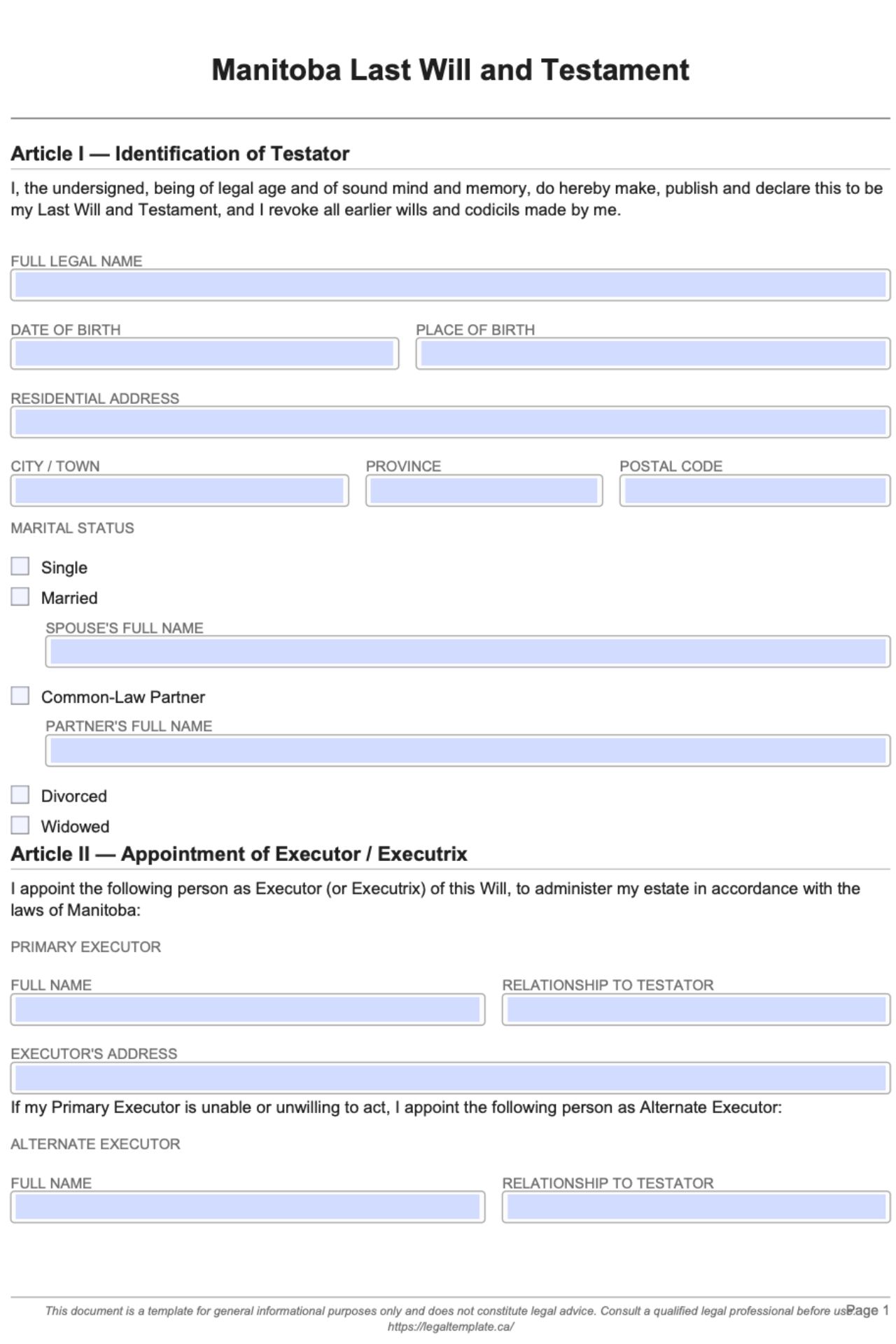
Get PDF
This free Manitoba Last Will and Testament template is designed for general educational use. Complex estates, blended families, business ownership, disabled dependants, or major real estate holdings should be reviewed carefully before signing.
Manitoba Will Revocation Rules and Execution Mistakes Most Families Miss
| Topic / Issue | Manitoba Legal Rule | Governing Statute |
|---|---|---|
| Governing legislation | Manitoba’s formal will requirements, holograph wills, revocation rules, and related matters are principally governed by provincial legislation. Other laws may affect property and claims against an estate. | The Wills Act, C.C.S.M. c. W150 |
| Formal will execution | A formal will must be in writing, signed at its end by the testator or another person acting in the testator’s presence and at their direction, and witnessed by at least two witnesses present together when the testator signs or acknowledges the signature. | The Wills Act, ss. 3–4 |
| Remote witnessing | Remote witnessing is permitted if the statutory procedure is followed. One of the two or more witnesses must be a practising member in good standing of the Law Society of Manitoba. The lawyer and other witness or witnesses must be physically together. | The Wills Act, s. 4.1; Remote Witnessing Regulation, M.R. 81/2021 |
| Witness gifts | A gift to an attesting witness, or to that witness’s then spouse or common-law partner, is generally void as to that person. A court may validate the gift in the circumstances set out in the Act. | The Wills Act, s. 12 |
| Age requirement | A person under 18 generally cannot make a valid will unless an exception applies, including being or having been married, being a member of the regular force of the Canadian Forces, or falling within the military and mariner provision. | The Wills Act, ss. 5 and 8 |
| Holograph will | A holograph will must be wholly in the testator’s own handwriting and signed at the end. It does not require witnesses. | The Wills Act, s. 6 |
| Marriage | Marriage generally revokes an existing will unless a statutory exception applies, including a declaration that the will was made in contemplation of the marriage. | The Wills Act, s. 17 |
| Divorce | Divorce can revoke gifts and executor or trustee appointments made in favour of a former spouse, unless the will shows a contrary intention. | The Wills Act, s. 18(2) |
| Termination of a common-law relationship | The Act also addresses the effect of terminating a common-law relationship on gifts and appointments made in favour of the former partner. | The Wills Act, s. 18(4) |
| Court’s dispensation power | A court may order that a document be effective as a will, or as a revocation, alteration, or revival, despite non-compliance with formal requirements, if the statutory test is met. | The Wills Act, s. 23 |
| Homestead rights | A surviving spouse or qualifying common-law partner may have a life interest in the family home, even if the will leaves the property to someone else. | The Homesteads Act |
| Family property claims | A surviving spouse or common-law partner may apply for an accounting and equalization of family property. The usual deadline is six months after probate or letters of administration are granted, subject to the Act’s extension provisions. | The Family Property Act, C.C.S.M. c. F25, s. 29 |
| Dependant support | A court may order maintenance from an estate for eligible dependants who were substantially dependent on the deceased, where the statutory requirements are met. | The Dependants Relief Act, C.C.S.M. c. D37 |
Marriage, divorce, witness selection, and remote signing deserve particular attention. For example, marriage generally revokes an existing will unless an exception under section 17 applies. Divorce may revoke certain gifts and appointments in favour of a former spouse. These rules are not interchangeable, so reviewing a will after a relationship change is important.
Remote witnessing also has specific requirements. It is not enough to arrange an ordinary video call and ask two people to sign later. The regulation sets out who may act as witnesses, how the video connection must work, identity checks, document handling, and the required witness statement. A lawyer should supervise this process.
Manitoba’s court dispensation power is another important point. Section 23 allows a court to validate certain documents that do not meet all formal requirements if the court is satisfied that the document records the deceased’s testamentary intentions. This is a court decision, not a guarantee that an improperly signed document will be accepted.
Manitoba Will Validity Rules — What Makes a Will Legal?
Age and Legal Capacity
Under section 8 of The Wills Act, a person generally must be at least 18 years old to make a valid will in Manitoba. The Act provides exceptions for certain people under 18, including a person who is or has been married and certain members of the Canadian Forces.
Age is only one part of the issue. The person making a will must also have the mental capacity required to understand the nature and effect of the document and the decisions being made.
In practical terms, the person should understand that they are making a will, have a general understanding of the property they own, and appreciate who may reasonably expect to benefit from their estate. Capacity can become an issue if a person is seriously ill, experiencing cognitive difficulties, or making a will under unusual pressure.
Writing Requirement
Section 3 of The Wills Act requires a will to be in writing. A formal will should clearly identify the person making it and set out how their estate is to be dealt with.
For a formal will, the signing requirements in section 4 generally include:
- The will must be signed at its end by the testator or by someone signing in the testator’s presence and at their direction.
- The testator must sign or acknowledge the signature in the presence of at least two witnesses who are present together.
- At least two witnesses must attest and sign the will in the testator’s presence.
Two Simultaneous Witnesses
For an ordinary formal will, the two witnesses must be present together when the testator signs or acknowledges the signature. The witnesses must then sign in the testator’s presence.
Do not assume that having two people sign the document at different times will satisfy the ordinary execution requirements. If the witnesses cannot attend together, ask a Manitoba lawyer about the statutory remote-witnessing procedure rather than improvising a signing arrangement.
Witness Disqualification Rules
A beneficiary should not act as a witness if another suitable person is available. Under section 12, a gift to an attesting witness, or to that witness’s then spouse or common-law partner, is generally void as to that person.
This rule does not automatically invalidate the entire will. The Act also permits a court to validate a gift in certain circumstances if the court is satisfied that the witness or their spouse or common-law partner did not exercise improper or undue influence.
The safer approach is to choose independent adult witnesses who are not receiving gifts under the will.
Holograph Wills
Manitoba recognizes holograph wills. Section 6 of The Wills Act allows a person to make a valid will entirely in their own handwriting and sign it at the end, without witnesses.
A holograph will is different from a printed template with handwritten names or changes. The document must be wholly handwritten by the testator. A typed or pre-printed document does not become a holograph will simply because the testator writes a few details on it.
Although a holograph will can be legally valid, it may still create interpretation or administration problems if the instructions are unclear. A carefully prepared formal will is often easier for an executor to administer.
Summary of Applicable Laws
| Topic | Rule |
Governing statute
|
| Formal will execution | Written, signed at the end, and witnessed by at least two witnesses present together |
The Wills Act, ss. 3–4
|
| Remote witnessing | Permitted only under the statutory procedure, including the Manitoba lawyer witness requirement |
The Wills Act, s. 4.1; Remote Witnessing Regulation
|
| Holograph will | Entirely handwritten and signed at the end |
The Wills Act, s. 6
|
| Homestead protection | A qualifying surviving spouse or common-law partner may have a life interest in the family home |
The Homesteads Act
|
| Family property rights | A surviving spouse or common-law partner may seek an accounting and equalization of assets |
The Family Property Act
|
| Dependant support | Eligible dependants may seek maintenance from the estate |
The Dependants Relief Act
|
Choosing the Right Executor in Manitoba
An executor is the person named in a will to administer the estate. In Manitoba, this person may need to locate the original will, identify estate assets, deal with debts and taxes, apply for probate where required, and distribute property according to the will.
Choose someone who is organized, trustworthy, and able to communicate with beneficiaries. The person does not necessarily need to be a family member. They should understand that the role can involve paperwork, deadlines, financial decisions, and difficult conversations.
Core Executor Duties
Common executor responsibilities include:
- Locating and reviewing the original will.
- Identifying and securing estate assets.
- Arranging valuations where necessary.
- Paying valid debts and expenses.
- Filing tax returns and dealing with tax obligations.
- Applying for probate where required.
- Keeping accurate estate accounts.
- Distributing the estate according to the will and applicable law.
The exact work depends on the estate. An estate with a house, farmland, business interests, or assets in more than one jurisdiction may require additional professional assistance.
Common Executor Mistakes
Executors can create avoidable problems when they act before understanding their responsibilities. Common mistakes include distributing assets too early, failing to keep proper records, overlooking debts, ignoring tax obligations, and failing to communicate with beneficiaries.
An executor should not treat estate property as personal property. Estate money should be kept separate from personal funds, and important decisions should be documented.
Alternate Executor Planning
It is sensible to name an alternate executor in case the first person cannot or does not wish to act. The alternate can provide a backup if the original executor dies, becomes incapable, or declines the appointment.
If no named executor is able to act, someone may need to apply to the court for authority to administer the estate. This can add time and expense.
When Co-Executors Create Problems
Naming two or more executors may be appropriate when the estate is complex or when shared responsibility is important to the family. However, co-executors must be able to cooperate.
Disagreements can delay decisions about property sales, investments, distributions, or professional advice. If you appoint co-executors, consider whether they can communicate and make decisions together.
Beneficiary Planning Beyond Simple Asset Splits
A will should do more than divide property into percentages. It should identify the people or organizations you want to benefit and explain how your estate should be handled if a beneficiary dies before you.
Consider what should happen to personal belongings, real estate, savings, investments, business interests, and the residue of your estate. Clear instructions can reduce uncertainty for your executor.
Spouses and Common-Law Partners
A will can provide for a spouse or common-law partner, but it cannot necessarily remove that person’s statutory rights. Manitoba legislation may give a surviving partner rights relating to the family home, family property, or support from the estate.
The legal definition of a common-law partner can differ depending on the legislation involved. Do not assume that one definition automatically applies to every estate issue.
Children From Prior Relationships
Blended families often need more detailed planning. A person may want to provide for a current spouse while preserving an inheritance for children from an earlier relationship.
A will can set out specific gifts, divide the residue, or create testamentary trusts where appropriate. However, the plan must also account for homestead rights, family property claims, and potential dependant support claims.
Minor Children
Parents may use a will to express their wishes about who should care for minor children if both parents die. However, a guardianship nomination in a will does not remove the need to consider the child’s circumstances and applicable court processes.
Parents should also consider how money left to a minor child will be managed. A trust or other arrangement may help ensure funds are used for the child’s needs until they reach the age specified in the estate plan.
Disabled Dependants
A dependant who relies on the deceased for financial support may have rights under The Dependants Relief Act. A will that leaves a financially dependent family member without adequate provision may lead to a claim against the estate.
If a beneficiary receives disability-related benefits or needs long-term support, get legal advice before leaving them a direct inheritance. A suitable trust arrangement may need to be considered.
Specific Gifts vs Residue
A specific gift identifies a particular asset or amount. For example, a will may leave a named piece of jewellery to one person or a set amount of money to a charity.
The residue is what remains after estate debts, expenses, taxes, and specific gifts have been dealt with. A residuary clause is important because it explains who receives the remaining estate.
Without a clear residue clause, part of the estate may not pass as intended.
What Divorce Automatically Changes in Manitoba
Divorce can change the effect of an existing will. Under section 18(2) of The Wills Act, if a will gives a beneficial interest in property to a spouse or appoints that spouse as executor or trustee, the relevant gift or appointment is generally revoked when the marriage is terminated by an absolute divorce decree, unless the will shows a contrary intention.
The Act also addresses the termination of a common-law relationship. Section 18(4) deals with gifts and appointments in favour of a former common-law partner.
These rules do not mean that every part of a will is automatically cancelled after divorce or separation. They apply to particular gifts, appointments, and powers described in the legislation.
Separation alone should not be treated as a substitute for reviewing and updating a will. If your relationship has ended, review your executor appointment, beneficiaries, property arrangements, insurance designations, and any agreements or court orders that may affect your estate.
Spousal Rights Manitoba Wills Cannot Override
A will does not operate in isolation. Manitoba has legislation that can affect what a surviving spouse or common-law partner receives or retains after a death.
These rights can be important where the deceased owned the family home, had accumulated family property during the relationship, or supported a dependant.
Homestead Protections
The Homesteads Act gives a qualifying surviving spouse or common-law partner rights in the family home. In certain circumstances, the survivor has a life interest in the home even if the deceased’s will leaves the property to another person.
For a family farm, the homestead may include the dwelling and up to 320 acres of land. The legislation has specific rules about who qualifies and how existing homestead rights may affect a later relationship.
This means that leaving the family home to children does not necessarily mean they can immediately occupy, sell, or use it free of the surviving partner’s rights.
Family Property Equalization
Under The Family Property Act, a surviving spouse or common-law partner may be entitled to seek an accounting and equalization of family property after the other partner dies.
The usual limitation period is six months from the grant of probate or letters of administration. The Act allows a court to extend the time in certain circumstances, subject to its statutory conditions.
This is not simply an automatic right to receive half of every asset in the estate. The calculation depends on the legislation, the property involved, the parties’ circumstances, and applicable exclusions or adjustments.
Dependant Relief Claims
The Dependants Relief Act may allow eligible family members who were substantially dependent on the deceased for support to ask the court for maintenance from the estate.
Eligible claimants can include a spouse, common-law partner, children, parents, grandparents, siblings, and certain former spouses or partners with support rights under an agreement or court order.
The court may make an order where the will does not make adequate provision for a qualifying dependant. This is intended to address financial support needs, not to give every disappointed relative a right to challenge an inheritance simply because they expected more.
Real-Life “I Left Everything to My Kids” Risk
Leaving everything to children may reflect a parent’s wishes, especially in a blended family. However, the will may not be the only legal issue affecting the estate.
For example, a surviving spouse or qualifying common-law partner may have rights under The Homesteads Act. A family property equalization claim may also affect the estate. If the survivor was financially dependent on the deceased, The Dependants Relief Act may be relevant.
This does not mean children cannot inherit. It means the estate plan should consider the legal rights that may apply before the estate is distributed.
If you want children from a previous relationship to inherit a home, farm, or business, get advice on how to coordinate the will with ownership arrangements, family property rights, and any agreements with a spouse or partner.
DIY Will Risks That Cause Probate Trouble
A do-it-yourself will can be useful for a straightforward estate, but small drafting or signing mistakes can create major problems later.
Wrong Witnesses
Choosing witnesses who are also beneficiaries can affect gifts under the will. It is safer to use independent witnesses who are not receiving anything under the document.
Beneficiary as Witness
Under section 12 of The Wills Act, a gift to an attesting witness or that witness’s then spouse or common-law partner is generally void as to that person. The rest of the will may remain valid.
A court can validate the gift in certain circumstances, but relying on a later court application is avoidable risk.
Missing Signatures
A formal will generally needs the testator’s signature and the signatures of at least two witnesses, with the required presence and acknowledgment steps.
A missing signature or incorrect signing process can create a dispute about validity. A court may have power to dispense with formal requirements in a qualifying case, but no one should rely on that possibility when preparing a will.
Contradictory Clauses
A will should use clear and consistent instructions. If one clause leaves a property to a child and another appears to leave the same property to a spouse, the executor may need legal advice or a court’s interpretation.
Review the whole document after making changes. Do not simply add a new paragraph without checking how it affects the rest of the will.
Lost Originals
A signed original will is important. If the executor cannot locate it, the estate may face additional work establishing what happened to the document and whether a copy can be relied on.
Tell your executor where the original is stored. Avoid making multiple signed originals without legal advice, because uncertainty about which document is operative can create complications.
Improper Remote Signing
Remote witnessing is permitted in Manitoba, but the Remote Witnessing Regulation sets out a detailed process. It requires a practising Manitoba lawyer to act as one of the witnesses, with the lawyer and additional witness or witnesses physically together.
The testator and witnesses must establish the required audio-visual connection. The regulation also addresses identity verification, signing, transmission and handling of the original document, and the lawyer’s witness statement.
An ordinary video call does not automatically meet these requirements. If remote signing is needed, arrange it with a Manitoba lawyer who can follow the regulation.
Probate Myths vs Manitoba Reality
“A will avoids probate.”
Not necessarily. Probate may still be needed to confirm the executor’s authority or deal with certain estate assets. Whether an application is required depends on the estate, the assets, and the institutions involved.
“Notarizing a will makes it stronger.”
Notarization is not a substitute for the execution requirements in The Wills Act. A formal will generally needs the testator’s signature and two witnesses, unless a different statutory form applies.
“My spouse automatically gets everything.”
Not in every situation. The result depends on the will, the nature of the assets, intestacy rules if there is no valid will, and any rights under family property, homestead, or dependant support legislation.
“I never need to update my will.”
A will should be reviewed after major life changes. Marriage, divorce, the end of a common-law relationship, the birth or adoption of a child, a significant property purchase, or a change in executor circumstances may affect the plan.
“A handwritten edit is always valid.”
Not necessarily. The Wills Act has requirements for alterations and changes to wills. A handwritten change on a printed will may not satisfy those requirements. A new will or properly executed codicil may be safer.
Where To Store Your Manitoba Will Safely
Once your will is properly signed, make sure the original can be found when it is needed. A valid will can still cause practical problems if nobody knows where it is stored.
Home Storage Risks
Keeping the original at home may be convenient, but consider the risks of fire, water damage, accidental disposal, or a family member being unable to locate it.
If you store it at home, use a secure and clearly identified location. Tell your executor where to find it without making the document unnecessarily accessible to people who should not handle it.
Lawyer Storage
A lawyer may be able to store the original will as part of an estate-planning file. Ask how the document will be retained and what the executor will need to do to obtain it after your death.
If you move or change lawyers, make sure you know where the original is held.
Court of King’s Bench Deposit Option
Ask the Manitoba Court of King’s Bench about its current procedures for depositing a will for safekeeping. Confirm the requirements directly with the court before relying on this option.
Do not assume that depositing a will is the same as registering it for legal validity. The signing and execution requirements still matter.
Executor Access
Your executor should know where the original will is kept and how to access it. You do not need to give them unrestricted access to all your private records during your lifetime, but they should not have to guess where the document is after your death.
Keep a record of the storage location and any lawyer or institution holding the original.
Updating After Marriage, Divorce, or Births
Review your will when your family or financial circumstances change. A new child, marriage, divorce, separation, death of a beneficiary, or change in executor may require an update.
Use a properly executed new will or codicil rather than relying on informal notes or handwritten edits. If you revoke an earlier will, make sure the new document clearly reflects your intentions and is executed correctly.
Manitoba Formal Will vs Holograph Will Comparison
| Feature | Formal Will | Holograph Will |
| Witnesses | At least two witnesses are generally required |
No witnesses required
|
| Writing | Must be in writing |
Must be wholly in the testator’s own handwriting
|
| Signature | Signed at the end, with the statutory witnessing process |
Signed at the end by the testator
|
| Typing allowed | Yes | No |
| Remote witnessing | Permitted if the statutory procedure is followed | Not required |
| Drafting flexibility | Can include detailed clauses and structured provisions |
Can be harder to organize clearly
|
| Probate considerations | Depends on the document and estate |
May require closer examination if wording is unclear
|
| Blended family planning | Can set out detailed gifts and arrangements |
May be less suitable for complex planning
|
A formal will is often more practical for people with several beneficiaries, property, or complicated family arrangements. A holograph will can be valid, but it should still be clear and complete.
When To Update or Replace Your Will
Review your will after important life events, including:
- Marriage or a new common-law relationship.
- Divorce or termination of a common-law relationship.
- Birth or adoption of a child.
- Death of a beneficiary or executor.
- A major property purchase or sale.
- Starting, selling, or transferring a business.
- A significant change in financial circumstances.
- Acquiring property outside Manitoba.
- A change in your wishes about guardianship or inheritance.
Do not assume that a relationship change automatically updates every part of your estate plan. The Wills Act contains specific rules about marriage, divorce, and termination of common-law relationships. Other documents, such as insurance or registered-account beneficiary designations, may also need separate review.
Common Family Disputes Manitoba Courts See
Estate disputes can arise even when someone has prepared a will. Common issues include:
Unequal Child Inheritance
A parent may leave different amounts to children because of financial need, past gifts, caregiving, or personal wishes. Clear explanations and carefully drafted provisions can help reduce misunderstandings, although they cannot guarantee that no dispute will arise.
Spousal Exclusion Attempts
A will may leave little or nothing to a spouse or common-law partner. However, homestead rights, family property equalization, and dependant support legislation may still be relevant.
Capacity Challenges
A family member may question whether the person making the will understood the document and its consequences. Concerns may arise where the person was seriously ill, experiencing cognitive decline, or dependent on someone who benefited under the will.
Undue Influence Claims
A will may be challenged if someone alleges that the testator was pressured or improperly influenced. Independent legal advice and careful signing practices can help create a clearer record of the testator’s intentions.
Missing Original Wills
If the original will cannot be located, the executor may face additional steps to establish what document should govern the estate. Keeping the original safe and telling the executor where it is stored can prevent avoidable uncertainty.
Many estate disputes arise because a plan is unclear, outdated, or difficult to administer. A properly prepared will cannot prevent every disagreement, but it can make your intentions easier to understand.
FAQs
Does Manitoba require a lawyer for a will?
No. Manitoba law does not generally require a lawyer to prepare a will. However, legal advice can be helpful if you have a blended family, significant property, a business, dependants, or questions about spousal rights.
Can I write my own will in Manitoba?
Yes. Manitoba recognizes formal wills and holograph wills. A formal will must meet the applicable signing and witnessing requirements. A holograph will must be wholly handwritten by the testator and signed at the end.
Can a beneficiary witness my will?
A beneficiary should not act as a witness. Under section 12 of The Wills Act, a gift to an attesting witness or that witness’s then spouse or common-law partner is generally void as to that person. The court may validate a gift in certain circumstances.
Does marriage revoke a will in Manitoba?
Generally, yes. Section 17 of The Wills Act provides that marriage revokes an existing will unless an exception applies. One exception is where the will declares that it was made in contemplation of the marriage.
Does divorce cancel my entire will?
Not necessarily. Under section 18(2), divorce generally revokes certain gifts and appointments in favour of the former spouse unless the will shows a contrary intention. The effect of ending a common-law relationship is also addressed separately in section 18(4).
Can I sign my Manitoba will remotely?
Yes, but only if the statutory remote-witnessing procedure is followed. One of the witnesses must be a practising Manitoba lawyer, and the lawyer and other witness or witnesses must be physically together. The regulation also requires specific video, identity, document-handling, and witness-statement steps.
Where should I store my original will?
Keep the original in a secure place where your executor can locate it. You may ask a lawyer about storing it with their office or contact the Manitoba Court of King’s Bench about its current will-deposit procedures.
What happens if I die without a will in Manitoba?
Your estate will generally be distributed under Manitoba’s intestacy legislation, The Intestate Succession Act. The distribution depends on your surviving spouse or common-law partner, children, and other family circumstances.
Can my spouse claim property even if my will leaves everything to my children?
Possibly. A surviving spouse or qualifying common-law partner may have rights under The Homesteads Act or The Family Property Act. Eligible dependants may also have rights under The Dependants Relief Act.
Can a Manitoba court validate an improperly signed will?
In certain circumstances, yes. Section 23 of The Wills Act gives the court power to dispense with formal requirements if the statutory test is met. It is not automatic, and a court application may be necessary.

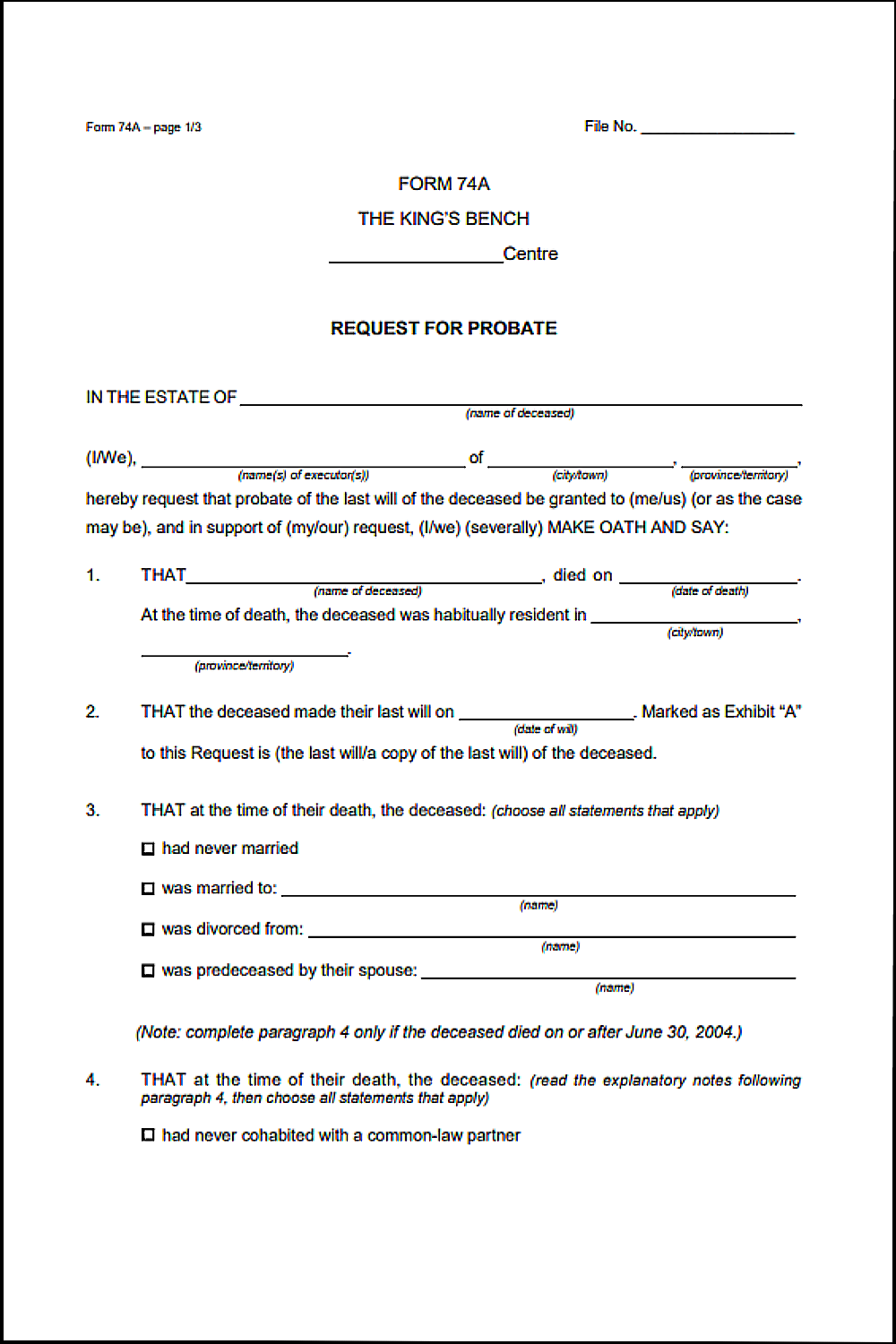
Where is the will template? All you have here is a request for probate form, and an inventory and valuation form.
Hi Mark, Kindly check the first template right after second heading! we have PDF fillable Manitoba Last Will And Testament template.