Ontario Separation Agreement PDF | Free Legal Form
Ontario Separation Agreement is a written legal contract that explains what happens when a couple separates. It helps both partners avoid confusion, disputes, and future court issues.
When a relationship ends, emotions can run high. Under Ontario law, separating couples—whether married or common-law—are expected to settle key issues like property, support, and parenting. A clear written agreement makes this process smoother and legally safer.
I have seen many Ontario couples rely on verbal promises during separation, only to end up in expensive disputes later when one person changes their position about support, parenting time, or shared property. I always tell clients that a properly drafted separation agreement is not just paperwork—it is often the document courts and lawyers look at first when problems arise after the breakup.
Last Updated: September 2026
This article is for:
- Married couples planning separation or divorce
- Common-law partners ending a relationship
- Parents who need clear child arrangements
Table of Contents
ToggleFree Ontario Separation Agreement Template
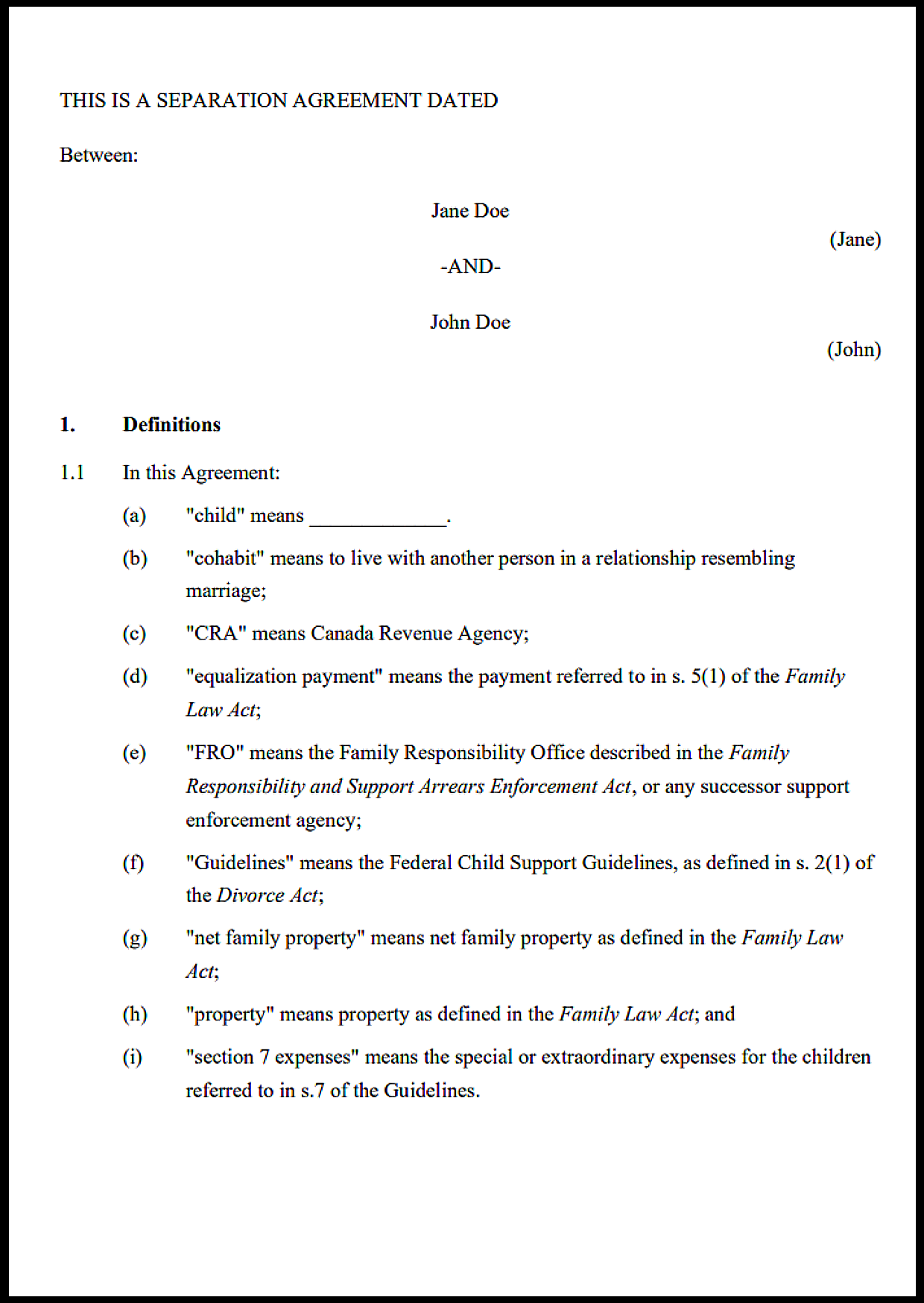
Below is a simple, practical template you can use as a starting point. Always customize it based on your situation.
Ontario Separation Agreement Laws, Property Rights, and Court Rules
| Topic / Issue | Ontario Legal Rule | Governing Statute |
|---|---|---|
| Primary provincial law | In Ontario, separation agreements are domestic contracts governed primarily by Part IV of the Family Law Act. | Family Law Act, R.S.O. 1990, c. F.3 |
| Federal law for married spouses | The Divorce Act applies to divorce proceedings and certain related family-law matters involving married spouses. Ontario’s Family Law Act and Children’s Law Reform Act also apply to matters within their respective provincial jurisdiction. | Divorce Act, R.S.C. 1985, c. 3 (2nd Supp.); Family Law Act, R.S.O. 1990, c. F.3 |
| Modernized Parenting Terminology | Ontario and federal family law use terms such as “decision-making responsibility” and “parenting time” in place of the older custody and access terminology. For parents whose matter falls under Ontario law rather than the Divorce Act, the applicable provincial legislation is the Children’s Law Reform Act. | Children’s Law Reform Act, R.S.O. 1990, c. C.12; Divorce Act, R.S.C. 1985, c. 3 (2nd Supp.) |
| Legal signatories | Two people who cohabited and are living separate and apart may enter into a separation agreement addressing their respective rights and obligations. | Family Law Act, s. 54 |
| Witness requirements | A domestic contract is unenforceable unless it is in writing, signed by the parties, and witnessed, as required by s. 55(1) of the Family Law Act. | Family Law Act, s. 55(1) |
| Notarization | Ontario’s Family Law Act does not require a separation agreement to be notarized. The statutory requirement is that the domestic contract be in writing, signed by the parties, and witnessed. | Family Law Act, s. 55(1) |
| Contractual Capacity and Minors | A minor can have capacity to enter into a domestic contract, but the contract is subject to court approval under s. 55(2) of the Family Law Act. | Family Law Act, s. 55(2) |
| Equalization limitation period | An application for equalization under s. 7(3) generally must be brought by the earliest applicable deadline: two years after divorce or nullity, six years after separation where there is no reasonable prospect of resuming cohabitation, or six months after the first spouse’s death. | Family Law Act, s. 7(3) |
| Child support rules | Where the Family Law Act applies, Ontario’s Child Support Guidelines, O. Reg. 391/97, govern child-support orders. The regulation incorporates the Federal Child Support Guidelines tables with necessary modifications. | Family Law Act; O. Reg. 391/97 |
| Understanding the agreement | A court may set aside a domestic contract if a party did not understand its nature or consequences. Independent legal advice can be important in assessing whether each party understood the agreement. | Family Law Act, s. 56(4)(b) |
| Filing requirement | A separation agreement does not generally have to be filed with a court simply because it was made. Court filing becomes important where a party wants certain enforcement mechanisms, such as FRO enforcement of support provisions. | Family Law Act; Ontario court and government procedures |
| FRO enforcement filing | If you want the Family Responsibility Office (FRO) to enforce child or spousal support provisions in a domestic contract, the agreement must first be filed with the appropriate Ontario court using Form 26B and then registered with FRO. | Ontario Court of Justice / Family Responsibility Office |
| Required filing form | Form 26B is the Affidavit for Filing Domestic Contract with Court used when filing a domestic contract so that its support provisions can be enforced or changed as permitted by law. | Form 26B: Affidavit for Filing Domestic Contract |
| Failure to disclose assets | A court may set aside a domestic contract or provision if a party failed to disclose significant assets, significant debts, or other significant liabilities that existed when the contract was made. | Family Law Act, s. 56(4)(a) |
| Lack of understanding | A court may set aside a domestic contract or provision if a party did not understand its nature or consequences. | Family Law Act, s. 56(4)(b) |
| Duress or undue influence | A domestic contract may also be set aside where the requirements of the applicable law of contract are met, including circumstances recognized by contract law. | Family Law Act, s. 56(4)(c) |
| Matrimonial home rights | Both spouses generally have an equal right to possession of a matrimonial home during the marriage, even where only one spouse has an interest in the property. | Family Law Act, ss. 18–19 |
| Equalization system | For married spouses, Ontario generally uses an equalization system based on the spouses’ net family properties rather than simply dividing each asset item by item. | Family Law Act |
| Common-law property rights | Common-law partners do not have the same statutory net-family-property equalization regime that applies to married spouses in Ontario. Property rights instead depend on ownership and other applicable legal principles. | Family Law Act; applicable common law |
One of the most important Ontario rules is the requirement for meaningful financial disclosure. A court may set aside a domestic contract if a party failed to disclose significant assets, debts, or other significant liabilities that existed when the agreement was made. This is one reason it is important to exchange relevant financial information before signing.
Ontario’s matrimonial home rules also have special significance for married spouses. Both spouses generally have an equal right to possession of a matrimonial home during the marriage, even if only one spouse owns the property. The specific rights can depend on the circumstances and the statutory rules that apply.
Common-law partners are not subject to the married-spouse equalization regime in Part I of the Family Law Act. Depending on the circumstances, property disputes may instead involve ownership rights or equitable claims such as unjust enrichment or constructive trust.
Download the free Ontario Separation Agreement template below to create a clearer separation plan.
What Is an Ontario Separation Agreement (And Who Needs It?)
A separation agreement is a domestic contract between two people who have decided to live apart. It can set out their agreed rights and responsibilities concerning matters such as property, support, and parenting.
It applies to:
- Married couples
- Common-law partners
Simple Example
- With kids: A couple agrees on decision-making responsibility, parenting time, and child support.
- Without kids: The agreement may focus on property, debts, and support.
A written agreement is especially important in Ontario because a domestic contract is unenforceable unless it is made in writing, signed by the parties, and witnessed.
When Should You Use a Separation Agreement?
You can make a separation agreement after the parties have separated and are living separate and apart. In Ontario, the agreement can address property, support, and other matters permitted under s. 54 of the Family Law Act.
Most people use it:
- Before filing for divorce
- When children are involved
- When property or money must be divided
Common Situations
- Peaceful separation: Both partners agree and want clear written terms.
- High-conflict situation: A written agreement records the terms the parties have agreed to and can reduce uncertainty about their obligations.
Timing can also matter because married spouses have statutory deadlines for bringing an equalization application under the Family Law Act.
A separation agreement outlines how assets, debts, and responsibilities are addressed after a relationship ends. To see how this document fits into long-term estate planning, you can refer to the Ontario will and estate planning guide, which explains how prior agreements can affect estate planning. In many cases, individuals also update their last will and testament after separation.
What Should Be Included in an Ontario Separation Agreement?
A strong agreement covers the major legal and financial issues that apply to the couple.
Parenting & Child Custody Terms
- Decision-making responsibility (education, health, etc.)
- Parenting schedule (weekdays, weekends)
- Holidays and special occasions
Child Support Details
Where the Family Law Act applies, Ontario’s Child Support Guidelines, O. Reg. 391/97, govern child-support orders. The regulation incorporates the Federal Child Support Guidelines tables with necessary modifications.
- Monthly payment amount
- Who pays and how
- Adjustments if income changes
Spousal Support Terms
- Who pays support
- Duration (temporary or long-term)
- Conditions for ending support
Division of Assets and Debts
This includes:
- Property, savings, pensions, investments
- Credit cards, loans, mortgages
For married spouses, Ontario generally uses equalization of net family properties. The spouse with the lower net family property is generally entitled to one-half of the difference, subject to the rules and exceptions in the Family Law Act.
Matrimonial Home Rules
The matrimonial home has special legal status for married spouses.
- Who stays in the home
- Whether it will be sold
- Who pays the mortgage
Is a Separation Agreement Legally Valid in Ontario?
For a domestic contract to be enforceable, it must meet the requirements of Ontario’s Family Law Act.
| Requirement | Why It Matters |
| Written document |
A domestic contract must be in writing to be enforceable
|
| Signed by both parties |
The parties must sign the contract
|
| Witnessed |
The contract must be witnessed
|
| Financial disclosure |
Significant non-disclosure can provide grounds for setting aside a contract
|
| Understanding the agreement |
A court may set aside a contract if a party did not understand its nature or consequences
|
Under Ontario law, courts may set aside agreements if:
- One party failed to disclose significant financial information
- The requirements of applicable contract law were not met
- A party did not understand the nature or consequences of the agreement
How to Make a Separation Agreement Step-by-Step
Before signing, work through the issues the agreement needs to cover, including property and debts, support, parenting arrangements where applicable, and any other terms the parties want recorded.
Step 1: List all assets, debts, and responsibilities
Step 2: Discuss and agree on key terms
Step 3: Draft the agreement using a template
Step 4: Review with lawyers (recommended)
Step 5: Sign the document with witnesses
Legal review can be particularly useful where the agreement involves significant property, support, pensions, children, or terms that one party does not fully understand. Section 56(4) of the Family Law Act allows a court to set aside a domestic contract in specified circumstances, including significant non-disclosure or lack of understanding.
This agreement is closely related to other relationship-based legal documents. For example, couples may initially create a prenup agreement in Ontario or a cohabitation agreement before separation occurs. These documents can address rights and obligations before separation and may affect how later separation issues are handled.
Common Mistakes That Can Make Your Agreement Invalid
Many agreements create problems because important legal or financial details are overlooked.
Watch out for:
- Hiding or forgetting significant financial details
- Terms that may be challenged under applicable contract law
- Signing without fully understanding the agreement or its consequences
- Not signing or witnessing the agreement properly
- Copy-paste templates without adapting them to the parties’ circumstances
Separation Agreement vs Divorce in Ontario
Many people confuse these two, but they are different.
|
Separation Agreement
|
Divorce |
| Private domestic contract between parties |
Court process that legally ends a marriage
|
| Can address finances, support, parenting, and property |
Determines the legal dissolution of the marriage and may address related matters under the Divorce Act
|
| Can be made after separation and while the parties are living separate and apart |
Requires a legal divorce proceeding
|
A separation agreement can be made before a divorce, but a separation agreement is not a legal requirement for obtaining a divorce.
A properly made agreement may also be considered or enforced by a court if a dispute later arises, subject to the applicable legislation and contract law.
What Happens If One Party Breaks the Agreement?
If someone does not follow the agreement, the available options depend on what provision was breached and whether the agreement is enforceable.
Enforcement Options
- File the agreement with the court where filing is required for the particular enforcement process
- Ask the court to enforce applicable obligations
- Use legal action for non-compliance
Example
If one parent stops paying child support:
- The other parent may use the applicable court or enforcement process
- FRO enforcement may be available where the support provisions have been properly filed and registered
Do You Need a Lawyer for a Separation Agreement?
You are not generally required to hire a lawyer to draft a separation agreement, but legal advice can be particularly useful when the agreement involves significant property, support, pensions, children, or complicated financial circumstances.
Benefits of Legal Advice
- Helps identify legal issues in the agreement
- Helps each party understand the agreement and its consequences
- Helps protect each party’s legal interests
DIY vs Lawyer
- DIY: may reduce upfront professional fees but leaves the parties responsible for identifying and addressing legal issues themselves
- Lawyer-assisted: provides an opportunity for each party to obtain advice about the agreement and its consequences
For complex finances, significant property, support issues, or parenting arrangements, consider obtaining independent legal advice before signing.
Costs of Creating a Separation Agreement in Ontario
Costs vary depending on how you create the agreement and how much legal or professional assistance is involved.
| Option |
Typical cost consideration
|
| Free template |
No drafting fee for the template itself; other legal or administrative costs may still apply
|
| Online service |
Pricing varies by provider and service level
|
| Lawyer-drafted |
Fees vary according to the lawyer, complexity, and amount of work required
|
Legal advice may be particularly useful if:
- You have children
- You own significant property or have complex finances
- There is disagreement about the terms
FAQs About Ontario Separation Agreements
Is a separation agreement legally binding?
A properly made separation agreement can be legally enforceable, but meeting the signing and witnessing requirements does not prevent a court from considering whether the agreement or a provision should be set aside under s. 56 of the Family Law Act or applicable contract law.
Can it be changed later?
Yes, parties can generally change their agreement by making a new written domestic contract that meets the applicable legal requirements. A significant change in circumstances may also affect whether particular support or parenting provisions can be changed or enforced.
Do common-law couples need one?
Common-law partners are not subject to the married-spouse equalization regime in Part I of Ontario’s Family Law Act. A written agreement can therefore be useful for clearly recording agreed property, support, and other rights and obligations.
Is it required before divorce?
No. A separation agreement is not legally required before a divorce. A married couple can proceed with a divorce without first signing a separation agreement.
Can we write it ourselves?
Yes, parties can prepare their own separation agreement, but they remain responsible for ensuring that it satisfies Ontario’s legal requirements and accurately reflects their circumstances. Legal review can help identify issues before the agreement is signed.