N11 Form Ontario | Free Fillable PDF
N11 Form Ontario is the document used when a landlord and tenant mutually agree to end a residential tenancy under Ontario’s Residential Tenancies Act, 2006, rather than through a notice or eviction process. In practice, many disputes arise because people assume signing an N11 is simply another way for a landlord to require a tenant to leave, even though the agreement must reflect genuine consent from everyone involved.
Matters before the Ontario Landlord and Tenant Board (LTB) have shown that when a tenant later disputes whether the agreement was voluntary, the Board may refuse to rely on the form and the tenancy can continue until the proper legal process is followed. Whether you’re a landlord looking to document an agreed move-out date or a tenant trying to understand the consequences before signing, knowing when the N11 should be used is just as important as completing it correctly. The information below explains when the form is appropriate, how to complete it, and the mistakes that commonly lead to problems.
N11 Form Ontario (Free Agreement Template) 
Key Clauses Of An Ontario N11 Agreement
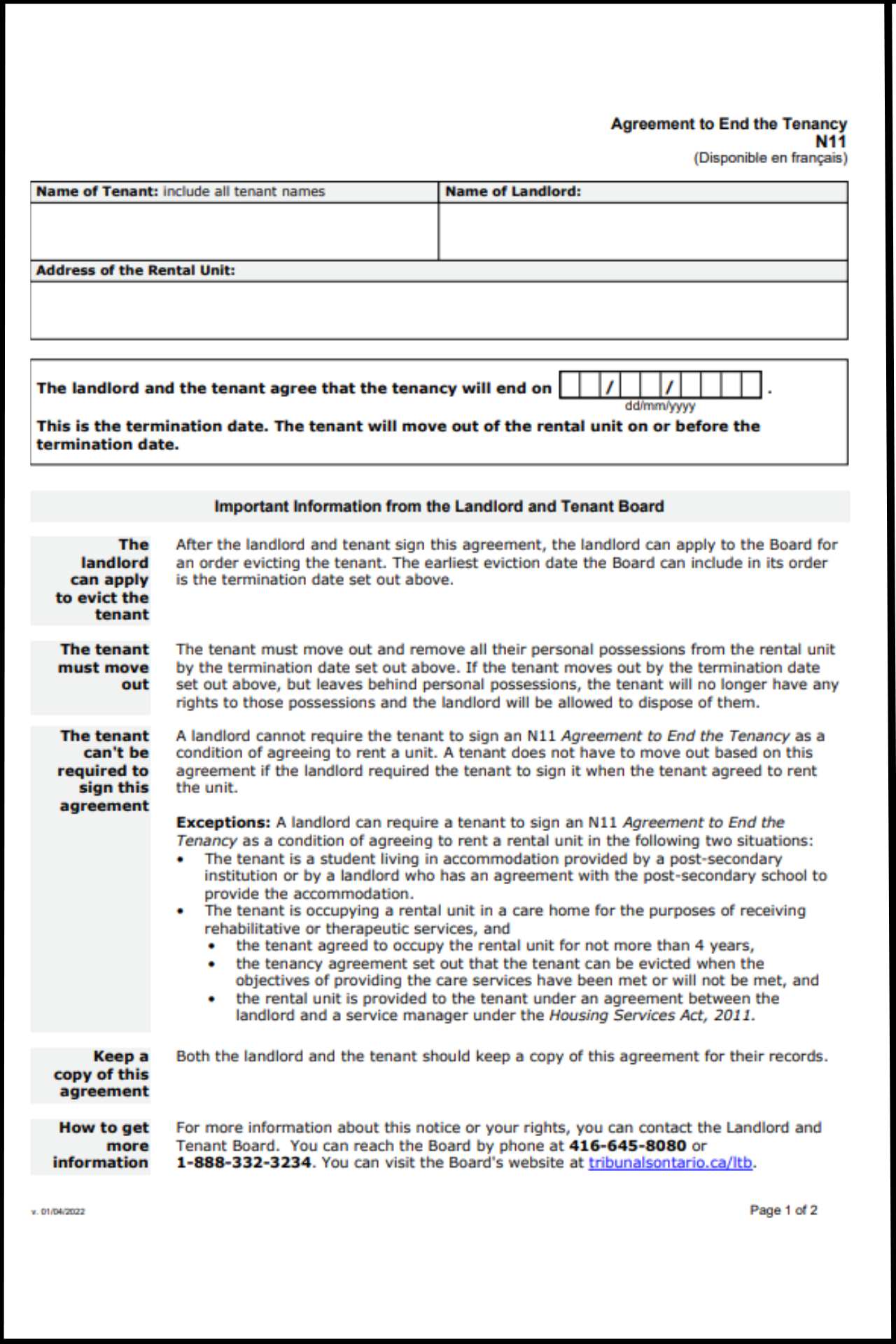
An N11 agreement works because it clearly records the shared decision of the landlord and tenant to end the tenancy. Each part of the agreement has a specific purpose, and missing important details can create problems if the parties later disagree.
The Mutual Agreement Declaration Clause
The most important part of an N11 agreement is the statement that both the landlord and tenant voluntarily agree to terminate the tenancy. This is what separates an N11 from a notice of termination, which is normally started by one party.
Under Ontario law, the agreement must show that both sides accepted the end of the tenancy. Residential Tenancies Act, 2006
For example, a landlord in Ottawa may sell a rental property and discuss an early move-out date with the tenant. If both parties agree, an N11 can document that decision. However, the landlord cannot present the agreement as mandatory or force the tenant to sign simply because the landlord wants the unit vacant.
A mutual agreement is only valid when there is genuine consent. A tenant who signs because they were pressured may have grounds to challenge the circumstances surrounding the agreement.
The Termination Date Clause
An N11 agreement must clearly state the exact date the tenancy will end. This date determines when the tenant is expected to leave and when the landlord may rely on the agreement if the tenant remains in the unit.
Unlike some other tenancy notices, there is no statutory minimum notice period for an N11 agreement. The landlord and tenant can agree to end the tenancy on any date they choose, including a date shortly after signing.
For example, a tenant in Mississauga who has already found another apartment may agree with the landlord to leave at the end of the month. The N11 records that agreed date instead of following a separate notice process.
The limitation is that both parties must actually agree to the date. A landlord cannot insert a termination date without the tenant’s acceptance.
The Joint Tenant Signature Clause
All tenants named on a joint tenancy should sign the agreement. A single roommate cannot normally end the entire tenancy by signing an N11 alone.
This issue commonly appears in shared apartments. For example, if three roommates in Hamilton are listed on one lease and only one roommate signs an N11, the agreement may not properly terminate the tenancy for everyone.
The Residential Tenancies Act requires the agreement to reflect the parties involved in the tenancy. Missing signatures can create disputes because the remaining tenants may argue that they never agreed to leave.
A landlord should confirm that every tenant listed on the lease has signed before relying on the agreement.
The Post-Commencement Signing Clause
An N11 agreement must be signed after the tenancy has already started. A landlord cannot require a tenant to sign an N11 at the same time as the original lease agreement as a condition of renting the property.
Under the Residential Tenancies Act, 2006, s. 37(4), an agreement signed as a condition of entering into a tenancy is void.
This is one of the most common mistakes people make. For example, a landlord in Brampton cannot give a new tenant a one-year lease and require the tenant to sign an N11 on the same day so the landlord can guarantee the tenant leaves after twelve months.
The purpose of this rule is to prevent landlords from using a mutual agreement as a replacement for proper legal procedures.
What Makes An Ontario N11 Agreement Legally Enforceable
A valid N11 agreement depends on proper consent and accurate information. The document should identify the rental unit, the landlord, the tenant or tenants involved, and the agreed termination date.
The key requirements are:
- The landlord and tenant must both agree to end the tenancy.
- All required tenants must sign, especially in a joint tenancy.
- The agreement must be signed after the tenancy has begun.
- The termination date must be clearly stated.
- There is no statutory requirement for witnesses or notarization.
official LTB forms page However, the law does not require a specific LTB-branded form for a mutual termination agreement to exist.
A landlord in London, Ontario, for example, may keep a signed N11 agreement privately after both parties agree to end the tenancy. It does not need to be filed with the LTB simply for the tenancy to end on the agreed date.
The exception is when a dispute occurs. If a tenant signs an N11 but refuses to leave, the landlord must use the proper LTB process rather than taking personal action.
Rights And Obligations Of Each Party To The N11 Agreement
Signing an N11 creates responsibilities for both sides. The tenant agrees to leave the rental unit on the agreed date, while the landlord gains a written record showing that the tenancy was intended to end.
For tenants, the biggest concern is understanding what rights may be affected. An N11 is different from a landlord-issued notice because the tenant is agreeing voluntarily rather than receiving a notice that triggers separate legal protections.
For example, a landlord in Vaughan who wants to move into a rental unit may ask a tenant to sign an N11 instead of using another termination process. A tenant should understand why the landlord is requesting the agreement before signing.
A landlord cannot use an N11 to avoid legal requirements by pressuring a tenant into signing. The agreement must remain voluntary.
If a tenant does not leave after signing the N11, the landlord cannot remove the tenant without an order from the Landlord and Tenant Board. The landlord must follow the enforcement process provided under Ontario tenancy law.
What Happens If A Party Doesn’t Honour The N11 Agreement
An N11 agreement creates a clear expectation that the tenancy will end on the agreed date. However, signing the agreement does not allow either party to ignore Ontario’s legal process if problems occur afterward.
If a tenant signs an N11 and does not move out on the agreed termination date, the landlord cannot remove the tenant personally, change the locks, or take possession without an order. LTB application and hearing process
Under the Residential Tenancies Act, 2006, S.O. 2006, c. 17, s. 77(3), a landlord has a strict 30-day period after the agreed termination date to file the required application if the tenant does not leave.
For example, a landlord in Ottawa and a tenant may sign an N11 agreeing that the tenancy ends on June 30. If the tenant remains in the unit after that date, the landlord must act within the required timeframe. Waiting beyond the deadline can affect the landlord’s ability to rely on the agreement.
The L3 Early-Filing Advantage for Landlords
A commonly overlooked statutory feature under Section 77(1) of the RTA is that a landlord does not have to wait until the agreed move-out date passes to file an L3 application with the LTB. Once an N11 is fully executed, the landlord can submit a Form L3 application immediately.
Because an N11 represents a mutual agreement, the LTB can issue an ex parte eviction order without holding a full formal hearing. Securing this order early provides peace of mind before lining up new tenants or buyers. However, the order will still reflect the agreed termination date, and the landlord’s absolute deadline to file remains 30 days after that agreed date under Section 77(3).
Increased Penalties for Coercive N11s (July 2026 Update)
Tenants should also note that pressuring someone into signing an N11 or presenting it as a mandatory requirement constitutes an offence under the RTA. Following statutory updates that took effect on July 1, 2026 (via Bill 60), provincial fines for bad-faith landlord conduct doubled to a maximum of $100,000 for individuals and $500,000 for corporations.
The limitation is important: an N11 does not give a landlord permission to carry out a self-help eviction. The LTB process must still be followed.
The limitation is important: an N11 does not give a landlord permission to carry out a self-help eviction. The LTB process must still be followed.
When You Don’t Need A Lawyer Vs When You Do
Many N11 agreements are completed without legal assistance when both parties understand the agreement and there is no disagreement about the move-out date or tenancy terms.
For example, a tenant in Waterloo who has purchased a home may agree with the landlord to leave early. If everyone understands the agreement and signs voluntarily, the official N11 process may be enough.
However, legal advice becomes more important when the circumstances are complicated, such as:
- A landlord asks for an N11 immediately when a new lease is signed.
- A tenant feels pressured or threatened into signing.
- Multiple tenants share the lease but not everyone agrees.
- The agreement is connected to a dispute about compensation or eviction rights.
A lawyer or paralegal can help review whether the agreement was properly signed and whether any legal protections may have been affected.
The limitation is that not every N11 dispute requires legal representation. Simple agreements with full cooperation between the parties may not require additional help.
Summary of Applicable Laws
| Topic | Rule | Governing Statute |
|---|---|---|
| Who can sign | Landlord and tenant(s) must agree; joint tenants should all sign | Residential Tenancies Act, 2006, S.O. 2006, c. 17, s. 37(1) |
| Pre-signed condition trap | An N11 signed as a condition of entering the tenancy is void | Residential Tenancies Act, 2006, S.O. 2006, c. 17, s. 37(4) |
| Filing deadline after refusal to leave | Landlord must file within 30 days after the agreed termination date | Residential Tenancies Act, 2006, S.O. 2006, c. 17, s. 77(3) |
| Enforcement process | LTB process is required if the tenant does not leave | Residential Tenancies Act, 2006, S.O. 2006, c. 17, s. 77(1) |
| Notice period | Parties can agree on any termination date | Residential Tenancies Act, 2006, S.O. 2006, c. 17 |
Why Landlords Sometimes Prefer An N11 Over An N12
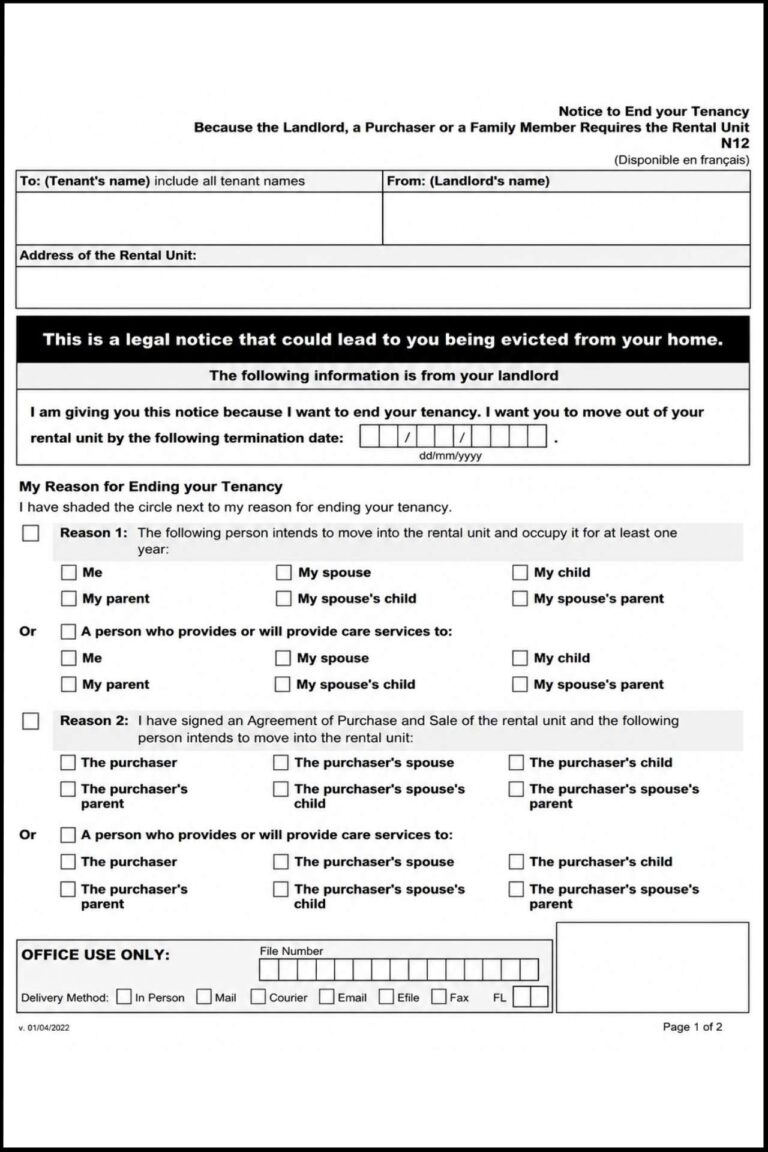
An N11 and an N12 serve very different purposes. An N11 is a mutual agreement where both parties agree to end the tenancy. An N12 is used when a landlord needs to end a tenancy for specific reasons, such as the landlord, purchaser, or certain family members needing the rental unit.
A common situation involves a landlord who wants to move into a rental property. Instead of following the N12 process, some landlords may ask the tenant to sign an N11 because it creates a voluntary agreement to leave.
For example, a landlord in Toronto may tell a tenant that they need the unit for personal use. The tenant should understand the difference between signing an N11 and receiving an N12 before agreeing to anything.
An N12 process includes protections that do not apply in the same way to a voluntary N11 agreement. Signing an N11 may affect a tenant’s ability to rely on protections connected with a landlord-initiated termination.
The limitation is that landlords cannot use pressure or misleading information to obtain an N11. The agreement must be voluntary.
Myth-Busting: Common Confusion About The N11 Form
Myth: “Signing an N11 is just the same as receiving a normal move-out notice.”
Reality: An N11 is a mutual agreement. It shows that both parties agreed to end the tenancy, rather than one party giving notice under a separate legal process.
Myth: “One roommate can sign an N11 and end the whole lease.”
Reality: In a joint tenancy, all tenants named on the lease should sign. One tenant’s signature may not be enough to terminate the tenancy for everyone.
Myth: “A landlord can require an N11 before I move in.”
Reality: An N11 signed as a condition of entering into the tenancy is void under the Residential Tenancies Act, 2006, s. 37(4).
Myth: “A landlord can wait forever to enforce an N11.”
Reality: If a tenant does not leave after the agreed date, the landlord must follow the required LTB process within the applicable timeframe.
Frequently Asked Questions
Does an N11 form need to be filed with the LTB to be valid?
No. An N11 is generally a private agreement between the landlord and tenant. It does not need to be filed with the Landlord and Tenant Board simply for the tenancy to end on the agreed date.
Filing becomes relevant if the tenant does not leave and the landlord needs an LTB order.
Can my landlord make me sign an N11 when I sign my lease?
No. An N11 cannot be used as a condition of starting a tenancy. Under the Residential Tenancies Act, 2006, s. 37(4), an agreement signed in this situation is void.
A tenant should not sign an N11 simply because it is included with the original lease paperwork.
What happens if I sign an N11 but do not move out?
The landlord must use the Landlord and Tenant Board process. The landlord cannot remove the tenant without following the legal procedure.
The landlord also has a strict deadline to take action after the agreed termination date.
Do all roommates need to sign an N11 in a shared apartment?
Yes. Where multiple tenants are listed on the same tenancy agreement, all joint tenants should sign the N11 for the agreement to properly reflect the end of the tenancy.
A single roommate cannot usually make decisions that end the rights of the other tenants.
Why would a landlord ask me to sign an N11 instead of using an N12?
An N11 may be requested because it is a voluntary agreement between the parties. An N12 is a landlord-initiated process with different legal requirements.
A tenant should understand the consequences before signing an N11, especially if the landlord’s reason for ending the tenancy relates to personal use of the unit.
Can the LTB issue an eviction order based on an N11?
Yes. Under the Residential Tenancies Act, 2006, s. 77(1), the LTB has a process for enforcing certain agreements to end a tenancy.