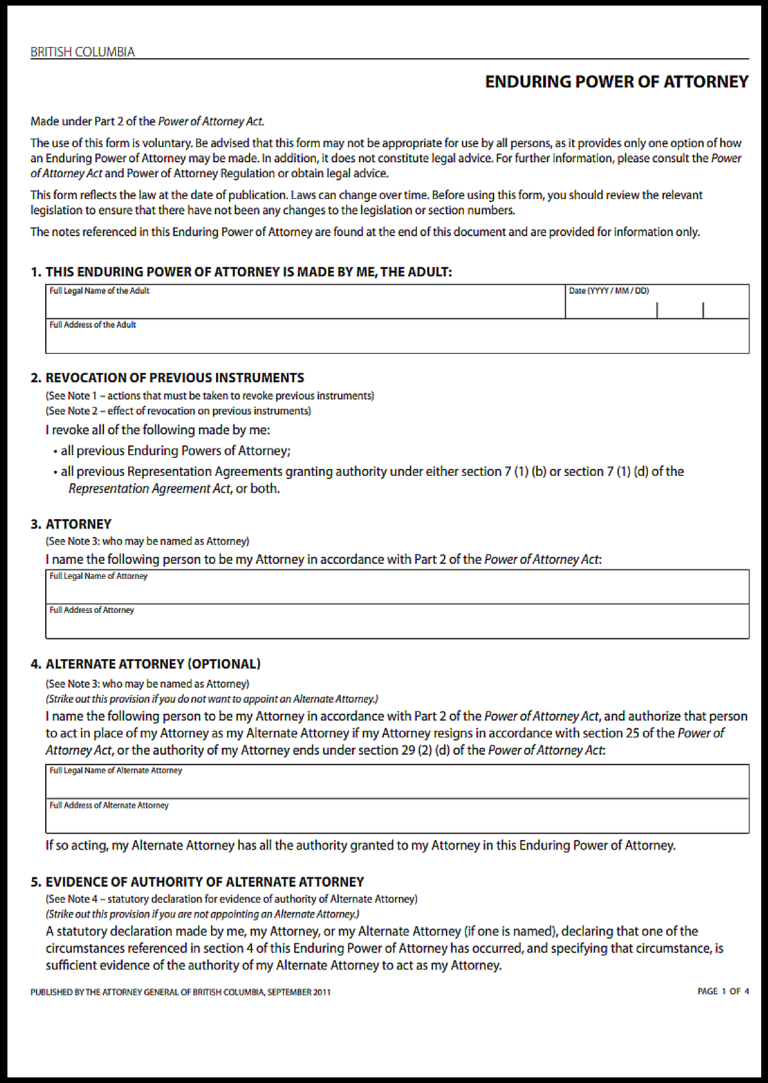
British Columbia Financial Power of Attorney (Free Template & Guide)
Free British Columbia Financial Power of Attorney Template
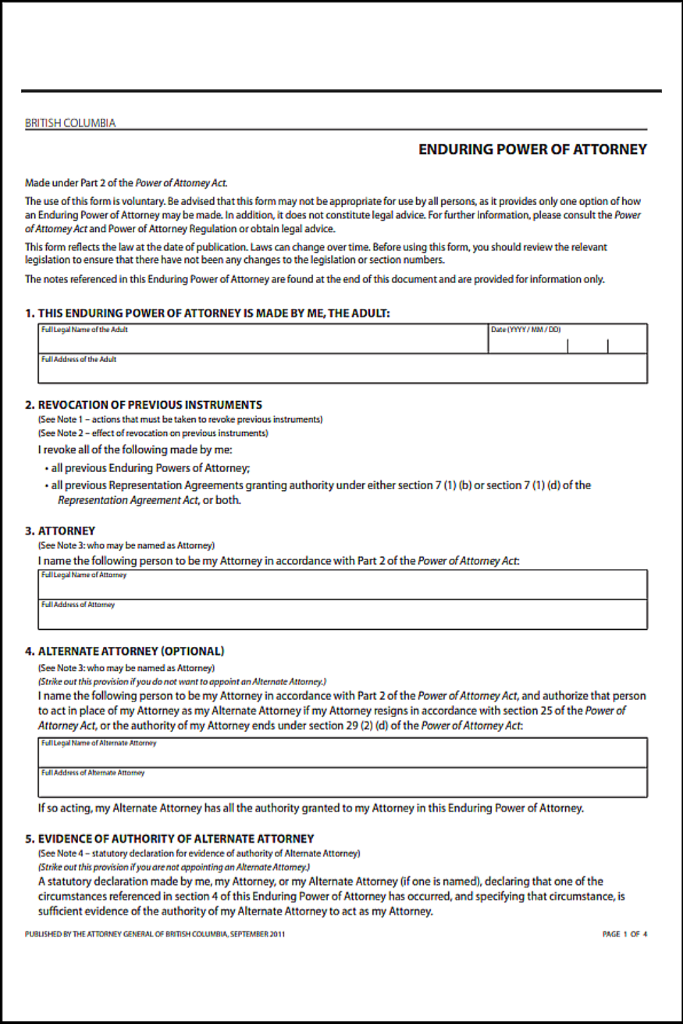
Use this simple, customizable template. You can copy and fill it based on your needs.
British Columbia Enduring Power of Attorney Rules Most Families Miss
| Topic / Issue | British Columbia Legal Rule | Governing Statute |
|---|---|---|
| Governing Legislation | Financial Powers of Attorney that survive incapacity are governed under BC’s Enduring Power of Attorney framework. | Power of Attorney Act, R.S.B.C. 1996, c. 370 |
| Federal Jurisdiction | Financial agency and property management rules fall strictly under provincial jurisdiction. | Power of Attorney Act, R.S.B.C. 1996, c. 370 |
| Electronic Signing & Remote Witnessing | British Columbia permanently allows electronic signing and remote witnessing for EPOAs. | Power of Attorney Regulation, B.C. Reg. 20/2011 |
| Who Can Legally Sign | The adult must sign and date the EPOA, or direct another person to sign in their physical presence. | Power of Attorney Act, s. 16(1)-(2) |
| Standard Witness Requirements | Two witnesses are normally required for valid execution. | Power of Attorney Act, s. 16(1) |
| Lawyer or Notary Witness Exception | Only one witness is required if the witness is a practicing BC lawyer or BC notary. | Power of Attorney Act, s. 16(4)-(5) |
| Disqualified Witnesses | Attorneys, their spouses, children, parents, employees, agents, and anyone under 19 cannot witness the document. | Power of Attorney Act, s. 16(6)(b)-(c) |
| Notarization Requirements | Notarization is generally not legally required for validity. | Power of Attorney Act, s. 16 |
| Real Estate Filing Exception | Real estate transactions may require filing with BC’s Land Title and Survey Authority. | Land Title Act, R.S.B.C. 1996, c. 250, s. 51 |
| Age & Mental Capacity | The adult must be at least 19 and understand the consequences of granting financial authority. | Power of Attorney Act, s. 11, s. 12(1)-(2) |
| Expiration Rules | An EPOA stays effective until revoked, terminated by death, or ended by court order. | Power of Attorney Act, s. 29 |
| Mandatory Enduring Language | The document must clearly state that authority continues despite later mental incapacity. | Power of Attorney Act, s. 14(1)(a)-(b) |
| Springing Power Rules | The document may state that powers begin only after incapacity occurs. | Power of Attorney Act, s. 14(1)(b) |
| Filing Requirements | Registration is generally not mandatory unless real estate authority is involved. | Land Title Act, s. 51(1) |
| Attorney Signature Requirement | The attorney must also sign the EPOA before acting under it legally. | Power of Attorney Act, s. 17(1) |
| Invalid Witnessing Risk | Using a relative of the attorney as witness can invalidate the execution entirely. | Power of Attorney Act, s. 16(6)(b)-(c) |
| Gift-Giving Restrictions | Attorneys cannot freely make gifts or donations unless authorized within strict statutory limits. | Power of Attorney Act, s. 20(1); Power of Attorney Regulation, s. 3 |
| BC Dual-Signing Rule | British Columbia requires both the adult and attorney to execute the document properly. | Power of Attorney Act, s. 17(1) |
| Statutory Gift Threshold | Gift authority is capped at the lesser of $5,000 or 10% of the adult’s prior taxable income unless broader authority exists. | Power of Attorney Regulation, s. 3 |
One of the biggest surprises in British Columbia is that an Enduring Power of Attorney is not fully usable just because the adult signs it. Under BC law, the attorney must also sign their own section before they can legally act. I’ve seen families discover this only after banks or land title offices refused to honor the document during a medical emergency. Another major issue involves witnesses. Many people casually use a spouse or child of the attorney as a witness without realizing BC law specifically disqualifies them, which can invalidate the entire execution.
British Columbia also has unusually strict rules around gifting. If an attorney starts giving away money, making donations, or helping family members financially without proper written authority, those transactions can violate the Power of Attorney Act and trigger legal disputes or suspension of authority. Real estate transactions add another layer because the document may need filing with the Land Title and Survey Authority before property transfers can proceed. Small execution mistakes can leave families locked out of bank accounts, delay property sales, or force costly court applications during an already stressful time.
A financial power of attorney allows an individual to authorize someone else to manage banking, property, and other financial matters on their behalf. To understand how these legal authority documents fit into broader estate planning arrangements, you can review the main estate planning documents guide together with the guide on getting power of attorney in British Columbia.
What Is a Financial Power of Attorney in British Columbia?
Under British Columbia law, a financial power of attorney allows someone to make money and property decisions only—not healthcare decisions.
There are two main forms:
- General Financial POA → stops if you lose mental capacity
- Enduring Power of Attorney (EPOA) → continues even after incapacity
In most estate planning situations, people choose an Enduring Power of Attorney. It ensures your finances are still managed if you become mentally incapable due to illness or injury.
When Do You Need a Financial Power of Attorney?
Real-life examples include:
- You are traveling abroad for months
- You own rental or investment property
- You are planning for aging or retirement
- You face serious illness or disability
Without a POA, your family may need to apply to court to manage your finances. This process can be slow, expensive, and stressful.
Different situations may require different authority forms depending on the responsibilities being assigned. General financial matters are often handled through a British Columbia power of attorney template, while healthcare-related decisions may involve a medical power of attorney document or an advance care directive.
Types of Financial Power of Attorney in BC
General Power of Attorney
A general POA is usually temporary. It is often used for short-term needs like travel or business.
- Ends if you lose mental capacity
- Simple and limited use
Enduring Power of Attorney
An Enduring POA continues even after you become mentally incapable.
- Most common in estate planning
- Protects long-term financial management
- Requires stricter legal rules
Limited / Specific Power of Attorney
This type is used for one task only.
Example:
- Selling a house while you are out of the country
It ends once the task is complete.
Quick Comparison
| Type | When It’s Used |
Ends on Incapacity?
|
| General POA | Short-term needs | Yes |
| Enduring POA | Long-term planning | No |
| Limited POA | One specific task | Depends |
People organizing long-term inheritance and financial planning records may also benefit from reviewing the British Columbia last will and testament template to ensure property distribution and financial responsibilities are properly documented.
What Powers Can You Give Your Attorney?
You can give broad or limited powers. It depends on your situation.
Banking and Payments
Your attorney can:
- Access bank accounts
- Pay bills and debts
Property and Real Estate
They may:
- Buy or sell property
- Manage rentals or leases
Investments and Business
This includes:
- Managing stocks or investments
- Running a business
Taxes and Government Benefits
They can:
- File tax returns
- Communicate with CRA
- Manage pensions or benefits
Custom Restrictions
You can limit powers, such as:
- No property sale without consent
- Spending limits
- Reporting requirements
Legal Requirements in British Columbia
Under the Power of Attorney Act (BC), certain rules must be followed.
Key requirements:
- The donor must be mentally capable when signing
- The document must be signed and properly witnessed
- Enduring POAs have stricter witnessing rules
- Clear wording is essential for validity
Witnessing Rules (Important)
| Requirement | General POA | Enduring POA |
| Number of witnesses | 1 |
Usually 2 (or 1 lawyer/notary)
|
| Who can witness | Adult (not attorney) |
Stricter rules apply
|
| Attorney can witness? | No | No |
If these rules are not followed, the document may be invalid.
How to Fill Out a Financial Power of Attorney (Step-by-Step)
Step 1 – Choose a Trusted Attorney
This is the most important decision.
Choose someone who:
- Is honest and responsible
- Understands finances
- Is available when needed
Step 2 – Define Financial Powers Clearly
Avoid vague language.
Instead of saying “handle everything,” clearly list:
- Banking
- Property
- Investments
This reduces confusion and misuse.
Step 3 – Decide When It Starts
You can choose:
- Immediate → starts right away
- Springing → starts only if you become incapable
Springing POAs are safer for some people but may require proof of incapacity.
Step 4 – Add Limits or Safeguards
You can protect yourself by:
- Appointing co-attorneys
- Requiring regular reports
- Setting spending limits
Step 5 – Sign and Witness Properly
Follow BC legal rules carefully. Improper signing is one of the most common reasons POAs fail.
Choosing the Right Attorney (Critical Decision)
Your attorney will control your finances. This is a serious responsibility.
Look for:
- Trustworthiness
- Financial knowledge
- Availability and willingness
Risks of choosing the wrong person include:
- Misuse of money
- Poor financial decisions
- Family disputes
You can appoint:
- One attorney
- Multiple attorneys (joint or separate roles)
Common Mistakes to Avoid in BC
Many people make avoidable errors:
- Not making the POA “enduring”
- Choosing someone unreliable
- Giving overly broad powers
- Improper witnessing
- Not updating after life changes
Even a small mistake can make the document unusable.
Risks and Safeguards (Protect Yourself from Abuse)
A financial POA gives significant power. There is a real risk of misuse.
Common risks:
- Unauthorized withdrawals
- Selling assets without consent
- Poor record-keeping
Ways to reduce risk:
- Require detailed records
- Appoint joint attorneys
- Limit large transactions
- Ask for regular updates
Transparency is key. Clear instructions reduce problems.
Financial POA vs Other Estate Planning Documents
POA vs Will
- POA works during your lifetime
- A will works after death
POA vs Representation Agreement
- POA → financial decisions
- Representation Agreement → health and personal care
POA vs Guardianship
- POA → voluntary choice
- Guardianship → court-appointed
Each document serves a different purpose. Most people need more than one.
How to Revoke or Change a Financial Power of Attorney
You can cancel or update your POA at any time if you are mentally capable.
Steps to revoke:
- Create a written revocation
- Inform your attorney
- Notify banks and institutions
You should update your POA if:
- You divorce or separate
- Your attorney dies
- Trust changes
Keeping your document updated avoids future problems.
FAQs About Financial Power of Attorney in British Columbia
Can I have more than one attorney?
Yes. You can appoint multiple attorneys to act together or separately.
Does it work outside BC?
Usually yes, but some institutions in other provinces or countries may require additional steps.
Do I need a lawyer?
Not always. Simple cases can use a template. Complex situations benefit from legal advice.
Can an attorney pay themselves?
Only if the document allows it or law permits reasonable compensation.
When does it end?
It ends when:
- You revoke it
- You pass away
- The document expires