Free Alberta Financial Power of Attorney Template
Alberta Financial Power of Attorney is a simple but powerful legal document that helps you stay in control of your finances, even when you cannot manage them yourself.
Life doesn’t always go as planned. You might be traveling, dealing with a medical issue, or simply too busy to handle financial tasks. In such situations, having someone you trust to manage your money, pay bills, or handle property matters can make things much easier.
I’ve seen families in Alberta struggle when a Power of Attorney was never signed or was completed incorrectly, especially during sudden medical emergencies or when banks refused to accept unclear documents. In many cases, people assume their spouse or adult children can automatically manage their finances, but Alberta law does not work that way without proper legal authority.
Under Alberta law, you are allowed to appoint a trusted person to act on your behalf. This not only protects your finances but also helps avoid court delays, confusion, and stress for your family.
Last Updated: August 2026
Table of Contents
ToggleFree Alberta Financial Power of Attorney Template
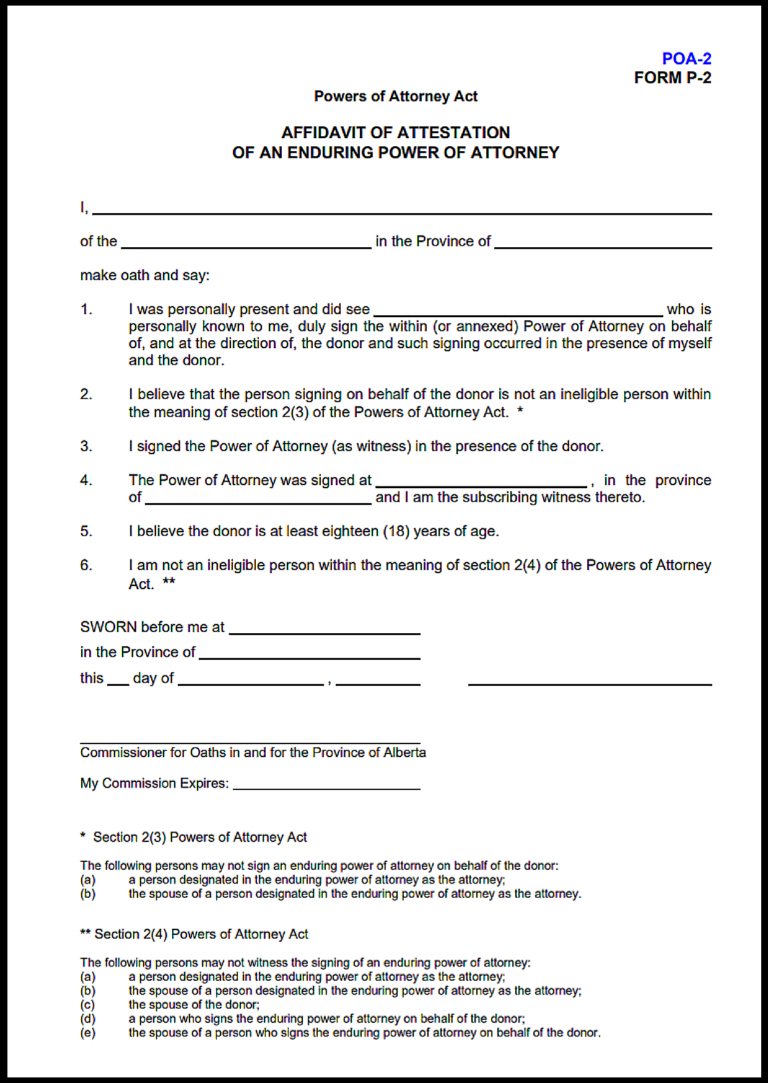
Below is a clean and ready-to-use template. You can copy it and fill in your details based on your needs. Make sure it follows Alberta legal requirements when signing.
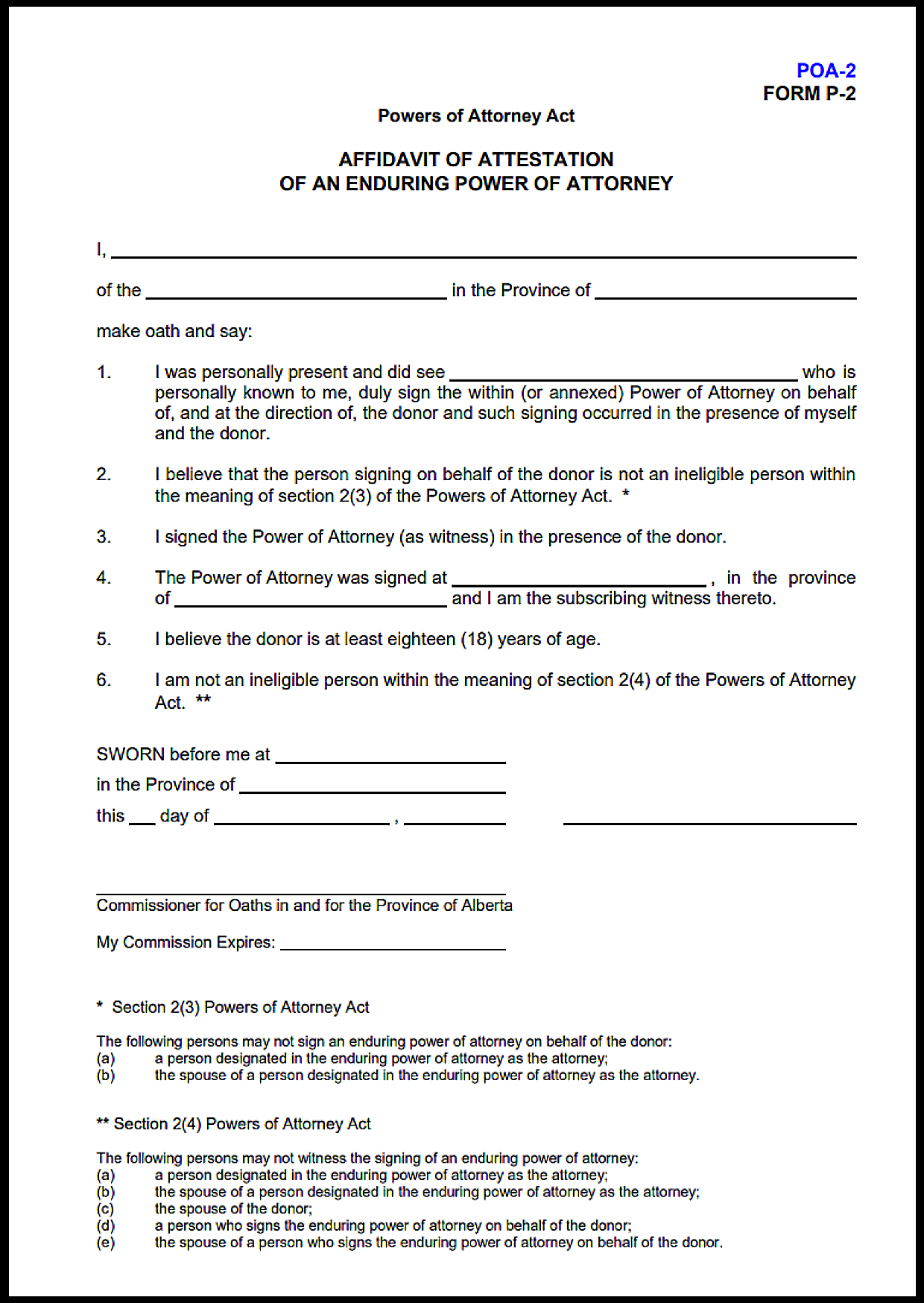
Alberta Financial Power of Attorney Legal Requirements and Validity Rules
| Topic / Issue | Alberta Legal Rule | Governing Statute |
|---|---|---|
| Governing Legislation | An Alberta Financial Power of Attorney is primarily governed by Alberta’s Powers of Attorney Act, although other laws or institutional requirements may be relevant to particular transactions. | Powers of Attorney Act, RSA 2000, c P-20 |
| Who Can Sign (Donor) | The donor must meet Alberta’s capacity requirements, and the document must be signed in accordance with the execution requirements of Alberta’s Powers of Attorney Act. | Powers of Attorney Act, s. 2(1) |
| Witness Requirements | An Enduring Power of Attorney must be witnessed in accordance with Alberta’s statutory requirements. | Powers of Attorney Act, s. 2(1)(b) |
| Disqualified Witnesses | Certain people cannot witness an Enduring Power of Attorney, including the attorney, the attorney’s spouse or adult interdependent partner, the donor’s spouse or adult interdependent partner, and certain persons who sign on the donor’s behalf. | Powers of Attorney Act, s. 2(4) |
| Notarization | Alberta law does not generally require notarization simply because a Financial Power of Attorney is being created, although a particular transaction or institution may have additional requirements. | N/A |
| Age Requirement | For an Enduring Power of Attorney, the donor must be an adult when the document is executed. | Powers of Attorney Act |
| Mental Capacity | The donor must have the mental capacity required to understand the nature and effect of the Enduring Power of Attorney when it is executed. | Powers of Attorney Act |
| Deadlines / Expiry | An Enduring Power of Attorney can end when the donor dies, the donor revokes it while capable, the court cancels it, a trusteeship order is granted, or the attorney dies or loses capacity without an alternate attorney available. | Powers of Attorney Act |
| Required Enduring Clause | An Enduring Power of Attorney must state that it continues despite the donor’s subsequent mental incapacity or infirmity, or that it takes effect upon the donor’s mental incapacity or infirmity. | Powers of Attorney Act, s. 2(1)(c) |
| Filing Requirements | Alberta does not have a general central registry for ordinary Powers of Attorney. | N/A |
| Land Titles Registration | When a Power of Attorney is used in a land transaction, the applicable Alberta Land Titles registration and execution requirements must be followed. | Land Titles Act |
| Affidavit of Execution for Land | A land transaction may require an Affidavit of Execution or other supporting document under Alberta Land Titles requirements, depending on the transaction and document being registered. | Land Titles Act |
| Invalid Due to Improper Witness | Using a person who is disqualified from witnessing an Enduring Power of Attorney can affect whether the document satisfies Alberta’s statutory execution requirements. | Powers of Attorney Act |
| Invalid Due to Missing Enduring Clause | Without the required enduring wording, the document does not qualify as an Enduring Power of Attorney and does not provide the statutory enduring effect after incapacity. | Powers of Attorney Act, s. 2(1)(c) |
| Invalid Due to Missing Writing or Signature | An Enduring Power of Attorney must be in writing, dated and signed in accordance with Alberta’s statutory execution requirements. | Powers of Attorney Act, s. 2(1) |
| Alberta’s Single Witness Rule | An Enduring Power of Attorney in Alberta is subject to Alberta’s own statutory witnessing requirements, including the requirement for a witness. | Powers of Attorney Act, s. 2(1)(b) |
| Springing Power Specificity | If an Enduring Power of Attorney is made to take effect when the donor loses capacity, the document should state who must make the written declaration. If it does not, two medical practitioners must make a written declaration. | Powers of Attorney Act, s. 5(4) |
For an Enduring Power of Attorney in Alberta, the witnessing requirements differ from the rules that apply to some other legal documents. The enduring statement is equally important: the document must state that it continues despite later mental incapacity or infirmity, or that it takes effect upon incapacity. Without that wording, it does not have the statutory enduring effect.
Land transactions can involve additional Alberta Land Titles requirements. The exact documents and supporting affidavits depend on the transaction, so a Power of Attorney used for a property transaction should be checked against the current Land Titles requirements before it is submitted.
An execution error or missing enduring wording can create problems when the attorney needs to rely on the document. Depending on the circumstances, the issue may affect whether a financial institution, Land Titles office, or other organization will accept the authority.
The template below can help you organize the document, but the completed Power of Attorney should still be checked against Alberta’s current legal and transaction-specific requirements.
What Is a Financial Power of Attorney in Alberta?
A Financial Power of Attorney authorizes another person, called the attorney, to act on your behalf in financial matters. The authority can cover specific transactions or broader financial responsibilities, depending on the wording of the document.
It is important to understand that this document only covers financial matters. It does not allow the person to make medical or personal care decisions. For that, you need a separate Personal Directive.
Under Alberta’s Powers of Attorney Act, the document must satisfy the applicable statutory requirements to be legally effective.
When Would You Actually Need One?
You do not have to wait until old age to use a Power of Attorney. It can be useful for a temporary absence, a specific transaction, or long-term planning for possible incapacity.
You may need it in situations like:
- Traveling outside Canada for a long time
- Recovering from surgery or illness
- Helping aging parents manage finances
- Planning for future incapacity
Planning ahead can avoid uncertainty later. If you lose capacity without an effective Enduring Power of Attorney, a family member or other person may need to apply to court to become your trustee.
A financial power of attorney handles money-related decisions if you are unable to act. It supports your overall estate plan described in the Alberta will guide.
Types of Financial Authority You Can Give
There are different types of Power of Attorney depending on your needs. Choosing the right one is very important.
General Power of Attorney gives broad authority to handle financial matters. Its duration and effect depend on the wording of the document and the applicable Alberta law.
An Enduring Power of Attorney is designed for incapacity planning. It can take effect immediately and continue if you lose capacity, or it can be drafted to take effect when you lose capacity.
A limited or specific Power of Attorney can authorize a particular transaction or defined financial task. Its duration depends on the wording of the document and any conditions or termination provisions it contains.
What Powers Can an Attorney Legally Have?
The scope of the attorney’s authority depends on the powers granted in the document. You can give broad authority or set specific limits and conditions.
Common powers include:
- Managing bank accounts
- Paying bills and debts
- Handling investments
- Buying or selling property
- Filing taxes
- Managing a business (if clearly mentioned)
It is very important to write these powers clearly. If the wording is unclear, it can create confusion or even misuse.
This document is often paired with a general power of attorney or guidance on setting up legal authority.
Alberta Legal Rules You Must Follow
Alberta’s Powers of Attorney Act sets specific execution requirements for an Enduring Power of Attorney, including requirements relating to writing, signing, witnessing, capacity and the enduring statement.
- The document must be in writing
- It must be signed by the donor
- It must be properly witnessed
- The donor must have mental capacity at the time of signing
- An enduring clause is required if it should continue after incapacity
The attorney and certain related persons are disqualified from witnessing an Enduring Power of Attorney. The document should be signed using the statutory witnessing requirements so that its execution is not challenged.
How to Fill Out the Template (Step-by-Step)
Before completing the template, decide who should act for you, what authority they need, and when that authority should begin. Those choices determine how the document should be drafted.
Start by choosing someone you fully trust. This person will have control over your finances, so they should be responsible and reliable.
Next, decide whether you need a general authority for a temporary or specific purpose or an Enduring Power of Attorney for incapacity planning.
Then clearly list all the powers you want to give. If needed, you can also add restrictions to limit authority.
The document can state when the attorney’s authority begins. An Enduring Power of Attorney may take effect immediately or when a specified event, such as incapacity, occurs.
Finally, sign the document in front of a proper witness to satisfy the applicable Alberta execution requirements.
Common Mistakes That Can Make It Invalid
Execution and drafting errors can create problems when a Power of Attorney needs to be used. The most important checks are the type of document, the scope of authority, the enduring wording and the signing requirements.
Common mistakes include:
- Choosing the wrong type of Power of Attorney
- Not including an enduring clause
- Improper witnessing
- Writing unclear or vague powers
- Not updating the document after major life changes
Checking these details before signing can reduce the risk of problems when the attorney later needs to rely on the document.
Risks and Misuse (What to Watch Out For)
A Power of Attorney can give an attorney substantial control over financial matters. Choose the attorney carefully and consider whether limits, reporting requirements or more than one attorney are appropriate.
Some risks include financial misuse, lack of transparency, and family disputes. Giving too much authority without limits can also create problems.
To reduce risk, you can:
- Appoint more than one attorney
- Add reporting requirements
- Limit certain powers
- Choose someone with strong financial responsibility
Financial Power of Attorney vs Personal Directive
Both documents are important in estate planning, but they serve different purposes.
| Feature | Financial Power of Attorney |
Personal Directive
|
| Purpose | Handles money and property |
Handles personal and healthcare decisions
|
| Used for | Bills, banking, assets |
Medical care, treatment
|
| Legal basis | Powers of Attorney Act |
Personal Directives Act
|
The two documents address different types of decisions, so many people prepare both as part of broader incapacity planning.
Real-Life Example
A common example is an elderly parent who appoints their child as attorney. The child manages bank accounts, pays bills, and ensures taxes are filed on time.
This arrangement may help the attorney manage routine financial responsibilities and reduce the need for a separate court application, provided the Power of Attorney is effective and accepted for the relevant transactions.
Can You Cancel or Change It Later?
You can generally revoke an Enduring Power of Attorney while you have the capacity to revoke it. The document and Alberta law should be reviewed to determine the appropriate revocation steps.
To revoke it, you should write a revocation document and inform all relevant institutions like banks. It is also important to destroy old copies to prevent confusion.
FAQs
Is a lawyer required in Alberta?
No, a lawyer is not required for a basic Power of Attorney. However, for complex situations like business or large estates, legal advice is recommended.
Does it need to be notarized?
Not always. Alberta law does not generally require notarization simply because a Financial Power of Attorney is being created, although a particular transaction or institution may have additional requirements.
When does it take effect?
It can take effect immediately or when you become mentally incapable, depending on what the Enduring Power of Attorney provides.
Can more than one attorney be appointed?
Yes, you can appoint multiple attorneys. The document should clearly state whether they must act together or may act separately.
Is it valid outside Alberta?
It may be accepted in other provinces or countries, but it depends on the applicable local laws and the requirements of the institution or authority relying on the document. It is best to check before relying on it outside Alberta.