Free British Columbia Medical Power of Attorney (Template & Guide)
Many people searching for a British Columbia Medical Power of Attorney are actually trying to solve a different problem: making sure someone they trust can make health care decisions if they’re no longer able to speak for themselves. In BC, that authority is usually created through a Representation Agreement rather than the financial planning documents many people assume will cover medical issues, which is why the witnessing and signing rules under the Representation Agreement Act matter so much.
I’ve seen families arrive at a hospital carrying an Enduring Power of Attorney, only to discover that it doesn’t give them the authority they thought it did when urgent treatment decisions have to be made. Those situations often start with a generic Canadian template that ignores how British Columbia separates financial authority from personal and health care decision-making.
This page explains how these documents work in BC, when a Representation Agreement may be needed, and the execution requirements people often overlook until it’s too late.
Last Updated: September 2026
Free British Columbia Medical Power of Attorney Template
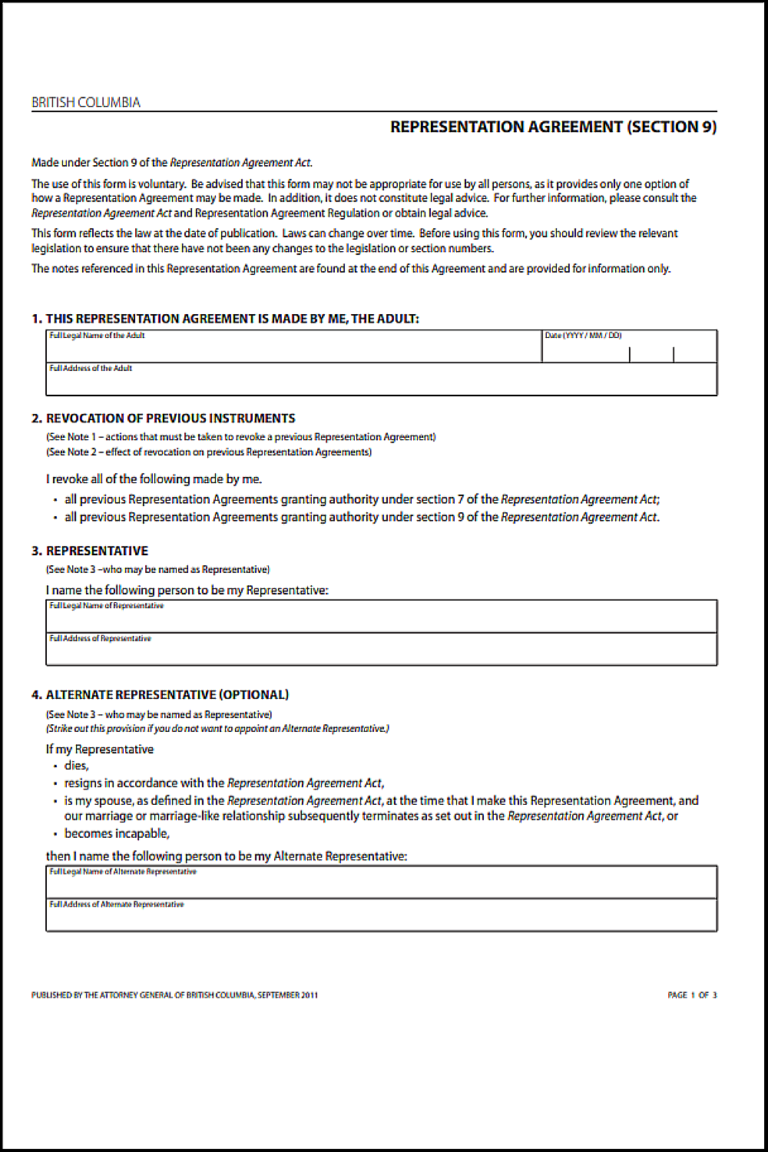
In British Columbia, a Medical Power of Attorney is commonly created through a Representation Agreement. Below is a clean, ready-to-use template you can copy and fill out.
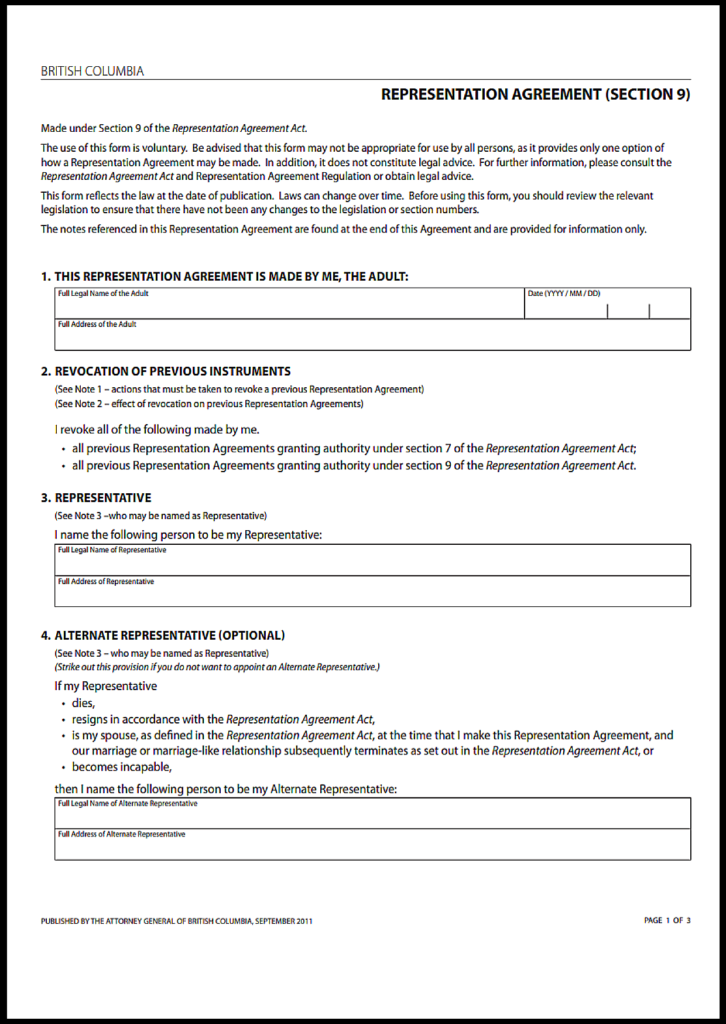
British Columbia Representation Agreement Laws You Should Know
| Topic / Issue | British Columbia Legal Rule | Governing Statute |
|---|---|---|
| Correct Legal Document Name | In British Columbia, the statutory document used to appoint someone to make certain health care and personal care decisions is a Representation Agreement. “Medical Power of Attorney” is commonly used as a descriptive term, but it is not the name of the BC statutory document. | Representation Agreement Act, RSBC 1996, c. 405 |
| Governing Health Consent Law | If an adult is incapable of giving or refusing health care consent and has no available representative or other authorized decision-maker, a health care provider may choose a temporary substitute decision maker under the statutory hierarchy. | Health Care (Consent) and Care Facility (Admission) Act, RSBC 1996, c. 181 |
| Who Can Sign | An adult must generally be 19 or older and capable of making the Representation Agreement. If the adult is physically incapable of signing, another eligible adult may sign on the adult’s behalf when the requirements in section 13 are met. | Representation Agreement Act, s. 13 |
| Witness Requirements | The adult’s signature must generally be witnessed by two witnesses. Only one witness is required if that witness is a lawyer or a member in good standing of the Society of Notaries Public of British Columbia. | Representation Agreement Act, s. 13 |
| Disqualified Witnesses | A representative or alternate representative, certain relatives of the representative, certain employees or agents, a person under 19, and a person who cannot understand the adult’s communication generally cannot act as a witness, subject to the statutory exceptions. | Representation Agreement Act, s. 13 |
| Notarization Rule | Separate notarization is not required merely because one witness is used. One witness is sufficient when that witness is a lawyer or a member in good standing of the Society of Notaries Public of British Columbia. | Representation Agreement Act, s. 13 |
| Capacity Requirement | Section 7 has a distinct statutory capacity test. An adult may make a section 7 agreement even if the adult cannot make a contract or manage certain affairs, provided the requirements in section 8 are satisfied. A section 9 agreement requires the adult to understand the nature and consequences of the proposed agreement. | Representation Agreement Act, ss. 8–10 |
| Expiry Rules | A Representation Agreement can end for several statutory reasons, including the adult’s death, effective revocation, court cancellation, or the representative’s resignation, death or incapability, subject to statutory exceptions. | Representation Agreement Act, s. 29 |
| Mandatory Certificates | The Representation Agreement Act and Regulation require prescribed certificates in specified circumstances, including certificates for section 7 representatives, monitors, certain people signing for the adult, and witnesses. | Representation Agreement Act; Representation Agreement Regulation, B.C. Reg. 468/2003 |
| Section 7 Financial Authority | A section 7 Representation Agreement can authorize the representative to handle the adult’s routine financial affairs, including matters such as paying bills and receiving and depositing income. | Representation Agreement Act, s. 7 |
| Registration Requirement | The Representation Agreement Act provides for a representation agreement registry and procedures for registration; the legal effect and registration requirements should be checked for the particular agreement and circumstances. | Representation Agreement Act |
| Voluntary Registry | The Representation Agreement Act provides a statutory framework concerning registration and searches of representation agreements. | Representation Agreement Act |
| Invalid Witnessing Consequence | A Representation Agreement that does not satisfy the statutory witnessing requirements has an execution defect, although section 13(7) provides a court process that may address certain defects. | Representation Agreement Act, s. 13 |
| Limits on Section 7 Authority | A section 7 Representation Agreement cannot authorize a representative to refuse health care necessary to preserve life. Broader authority may be provided through a section 9 agreement if the statutory requirements are met. | Representation Agreement Act, ss. 7 and 9 |
| Missing Certificates Problem | Missing a certificate required by the Act can create an execution problem and may affect whether the agreement can be relied on. | Representation Agreement Act; Representation Agreement Regulation |
| BC Capacity Standard | British Columbia’s section 8 test for a section 7 Representation Agreement considers factors including the adult’s communication of a desire for representation, demonstrated choices and preferences, awareness of the agreement’s effect, and the relationship of trust with the representative. | Representation Agreement Act, s. 8 |
| BC Terminology | British Columbia uses the statutory term “Representation Agreement” for these planning documents rather than calling the document a Power of Attorney for Personal Care. | Representation Agreement Act |
One of the most important rules in British Columbia is that a Medical Power of Attorney is actually referred to in provincial law as a Representation Agreement. The scope of that agreement matters, too. A section 7 or section 9 agreement can give different types of authority, so using the correct document and provisions is important when planning for future health care decisions.
The witnessing rules also matter. The adult’s signature generally requires two witnesses, although one witness is sufficient when that witness is a lawyer or a member in good standing of the Society of Notaries Public of British Columbia. A representative and certain related people are disqualified from acting as witnesses under the statutory rules.
The Section 7 and Section 9 distinction is important because the two agreements have different capacity and authority rules. Section 7 can be made under the special capacity test in section 8, but it cannot authorize refusal of health care necessary to preserve life. Section 9 provides broader health and personal-care authority, subject to its own statutory requirements.
The certificates required by the Representation Agreement Act should not be treated as optional paperwork. Depending on the type of agreement and the people appointed, prescribed certificates may be required for the agreement to be properly executed.
A medical power of attorney allows someone you trust to make healthcare decisions on your behalf if you become unable to communicate your wishes. To understand how these legal authority documents fit into broader planning arrangements, you can review the main estate planning documents guide together with the power of attorney in British Columbia.
What Is a Medical Power of Attorney in British Columbia?
A Medical Power of Attorney in BC is commonly used to describe a Representation Agreement that allows you to choose someone to make certain health care and personal care decisions for you if you become incapable of making those decisions yourself.
Under British Columbia law, this is done through a Representation Agreement.
It can cover:
- Medical treatment decisions
- Personal care, such as living arrangements or daily care
- Depending on the type and terms of the agreement, certain routine financial affairs and other matters
A Representation Agreement can also cover certain financial matters. A section 7 agreement may authorize routine financial management, while a section 9 agreement can provide broader authority if its statutory requirements are met.
Example:
If an adult becomes incapable of making a health care decision, a representative with authority for that type of decision may be able to give or refuse substitute consent, subject to the agreement and applicable health-care law.
Without an authorized representative or other decision-maker, a health care provider may have to use the temporary substitute decision-maker rules under British Columbia law. Court involvement can arise in some disputes or other circumstances.
When Should You Create One? (Real-Life Situations)
Advance planning is most useful before a crisis, while the adult can satisfy the applicable capacity requirements and choose who should act as representative.
You should consider creating one if:
- You are planning surgery or want to prepare for possible future incapacity
- You have aging parents and want to plan ahead
- You live alone or don’t have close family nearby
- You travel often or want someone trusted to understand your health care wishes
Real-life example:
If an adult has no representative with the required authority, a health care provider may have to use the temporary substitute decision-maker rules under the Health Care (Consent and Care Facility (Admission) Act).
Healthcare planning often involves several related legal forms depending on the type of medical or personal care instructions being prepared. Some individuals also prepare an advance directive in British Columbia to give or refuse consent to specified health care, while a Representation Agreement can appoint a representative with the authority provided by the agreement.
How It Works in BC (Legal Overview Made Simple)
British Columbia has specific rules for Representation Agreements, and the requirements depend on whether the agreement is made under section 7 or section 9.
Who can make one?
- You must generally be at least 19 years old
- The applicable capacity requirements must be satisfied
- Section 7 and section 9 agreements have different statutory capacity tests
Who can act as a representative?
- An eligible adult who is willing and able to act
- A person who can carry out the authority granted by the agreement
- The representative must comply with the duties imposed by British Columbia law
Witness requirements:
- The adult’s signature generally requires 2 eligible witnesses
- One witness is sufficient if that witness is a lawyer or a member in good standing of the Society of Notaries Public of British Columbia
- Certain representatives, relatives, employees and other persons are disqualified from witnessing
When it becomes active:
- A Representation Agreement generally becomes effective when it is executed unless the agreement provides that it or a provision becomes effective later
- The agreement can provide for effectiveness on a specified event where the applicable requirements are satisfied
Section 7 vs Section 9 Agreements
| Type | What It Covers | When Used |
|---|---|---|
| Section 7 | Personal care, routine financial affairs, certain health care and specified legal matters | Uses the statutory section 8 capacity test |
| Section 9 | Broader personal care and health care authority, including specified consent or refusal of health care | Used where broader authority is intended and the section 9 capacity requirement is satisfied |
Section 9 agreements provide broader authority than section 7 agreements in important areas of health and personal care. Section 7 has a distinct capacity test and cannot authorize a representative to refuse health care necessary to preserve life.
People organizing broader financial and estate planning records may also benefit from reviewing the British Columbia power of attorney template or a financial power of attorney document for managing property and financial responsibilities.
Key Parts of a Strong Medical POA in BC
Choosing the Right Representative
Pick someone you trust deeply. This person should:
- Communicate clearly with doctors
- Stay calm in stressful situations
- Respect your wishes and follow the authority given under the agreement
You may also want to name an alternate representative where the agreement permits it, so there is another person available if your first choice cannot act.
Defining Healthcare Powers Clearly
Be clear about what your representative is authorized to do:
- Give or refuse consent to health care within the authority granted
- Make personal care decisions within the authority granted
- Request health information and records relating to the adult’s incapability or an area of authority granted under the Representation Agreement
The exact scope depends on whether the agreement is made under section 7 or section 9.
Adding Personal Care Instructions
This is where you can guide your future care:
- Where you prefer to live
- Daily routines and comfort needs
- Cultural or religious practices
These instructions can help your representative understand your preferences when making decisions within the authority granted by the agreement.
End-of-Life Decisions
This is an area where the type of document matters.
For broader authority concerning health care, including refusal of life-supporting care, a section 9 Representation Agreement may be relevant. An advance directive can also give or refuse consent to specified health care.
You can include:
- Life support preferences
- Pain management wishes
- Treatment preferences
- Instructions concerning specified health care
Being specific about your wishes can help your representative and health care providers understand the decisions you would want made.
Medical POA vs Other BC Legal Documents
Many people confuse different estate planning documents. Here’s a simple comparison:
| Document | Covers | Purpose |
|---|---|---|
| Medical POA (Representation Agreement) | Health and personal care, with scope depending on section 7 or section 9 | Decision-making authority |
| Financial Power of Attorney | Financial affairs and property within the authority granted | Financial decisions |
| Living Will | Informal term that may refer to written treatment wishes | Not the statutory name of the BC document |
| Advance Directive | Specified health care instructions | Gives or refuses consent to health care described in the directive, subject to statutory rules |
Each document serves a different role. Whether you need a Representation Agreement, an Enduring Power of Attorney, an advance directive, or more than one document depends on the decisions and authority you want to arrange.
How to Fill Out the BC Medical POA Template (Step-by-Step)
Before filling out the template, identify whether you need section 7 or section 9 authority. That choice affects the capacity standard and the scope of decisions the representative can make.
Step 1: Add personal details
Write your full legal name, address, and other identifying information requested by the document.
Step 2: Choose your representative
Pick someone you trust and include the contact details requested in the agreement.
Step 3: Define powers
Clearly state what decisions the representative is authorized to make.
Step 4: Add instructions
Include personal care and medical preferences that will help guide decisions within the authority granted.
Step 5: Sign with witnesses
Follow the applicable British Columbia signing and witnessing requirements for the type of Representation Agreement you are making.
Step 6: Share copies
Give copies to:
- Your doctor or appropriate health care provider
- Family members who need to know
- Your representative
Keep the signed agreement somewhere accessible and make sure the representative and relevant health care providers know where it can be found.
Legal Rules You Must Follow in British Columbia
British Columbia law sets specific formal requirements for making and executing a Representation Agreement, including different capacity and authority rules for section 7 and section 9 agreements.
- The applicable capacity requirements must be satisfied
- Witnesses must meet the legal requirements
- Your representative must comply with the statutory duties that apply to the role
A document may have problems if:
- It is not properly signed
- Witness rules are broken
- Required certificates are not completed where the Act requires them
- There are concerns about execution, undue pressure or other legal issues
These rules help protect the adult and ensure the representative acts within the authority granted.
Common Mistakes That Can Cause Problems
The mistakes that matter most in BC are usually not formatting issues. They involve choosing the wrong type of Representation Agreement, misunderstanding the authority it grants, or failing to complete the required execution steps.
- Choosing an agreement without understanding the difference between section 7 and section 9
- Not being clear about the health care authority being granted
- Forgetting to update after major life changes
- Missing required signatures, witnesses or certificates
- Not informing the representative or relevant health care providers
An execution problem can affect whether the agreement can be relied on, while unclear instructions can make it harder for a representative to understand your wishes.
Risks of Not Having a Medical Power of Attorney
If you do not appoint a representative with the authority you need, BC’s substitute decision-maker rules may determine who can make particular health care decisions when you are incapable.
Possible issues include:
- Family members may disagree about decisions
- A health care provider may need to use the statutory substitute decision-maker process
- A dispute may require additional legal steps
- Someone other than the person you would have chosen may become involved in the decision-making process
Advance planning allows you to identify the person you want to act within the authority you give them, subject to the applicable British Columbia law.
Can a Medical Power of Attorney Be Changed or Cancelled?
Yes. An adult can change or revoke a Representation Agreement while capable of making the agreement, subject to the statutory requirements.
To revoke it:
- Prepare the required written revocation
- Give notice to each representative, alternate representative and monitor, if any, as required by law
You should review your document if:
- You get married or divorced
- Your representative is no longer suitable
- Your health situation changes
- Your wishes or planning needs change
Keeping it current is just as important as creating it.
FAQs
Is a Medical Power of Attorney the same as a Representation Agreement in BC?
A “Medical Power of Attorney” is commonly used as a descriptive term, but the statutory BC document is a Representation Agreement. The scope of authority depends on whether it is made under section 7 or section 9.
Do I need a lawyer in British Columbia?
Not always. A person can prepare a Representation Agreement without necessarily hiring a lawyer, but professional advice can be useful when the situation is complex or broader authority is being considered.
Can family override my representative?
Not simply because a family member disagrees. A representative’s authority depends on the valid agreement, the scope of authority granted and other applicable BC law.
Does it cover financial decisions?
Not necessarily only through a separate Power of Attorney. A section 7 Representation Agreement can authorize routine financial management, while broader financial authority may require an Enduring Power of Attorney or another appropriate planning document.
Where should I keep the document?
Keep it in a safe but accessible place and share copies with:
- Your representative
- Your doctor or appropriate health care provider
- Close family members who need to know
Make sure the people who may need the document know where the signed version can be found.