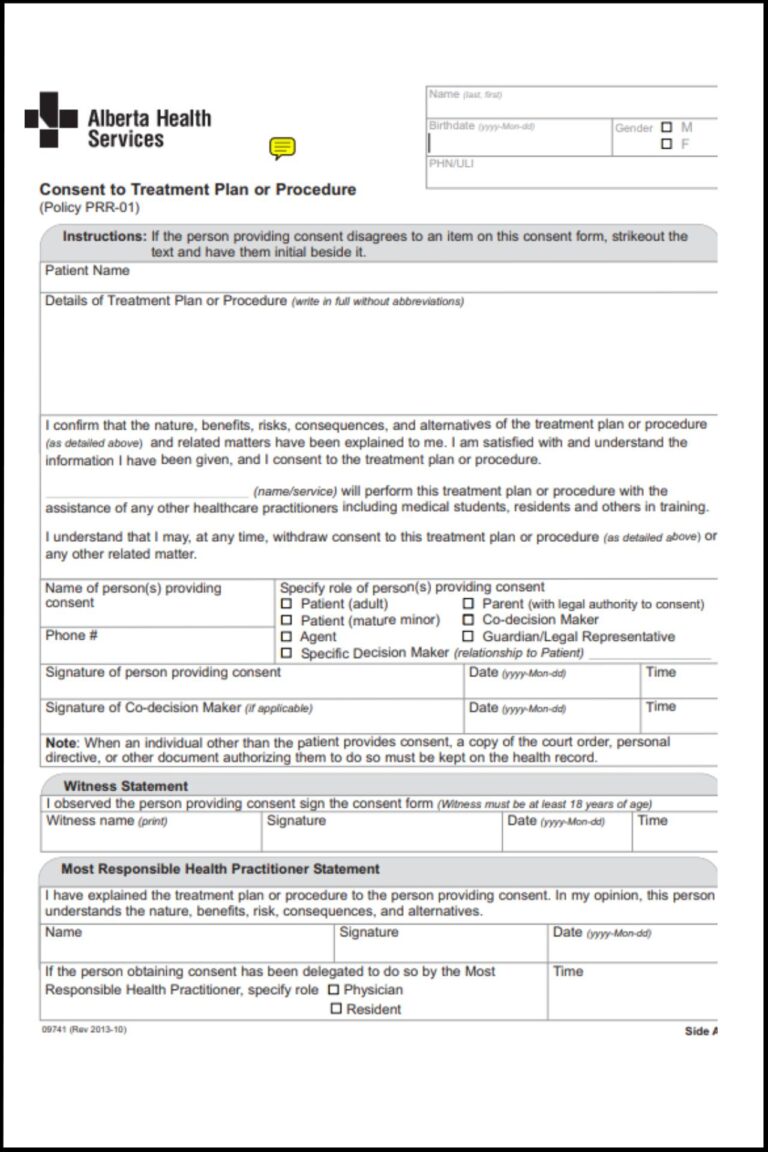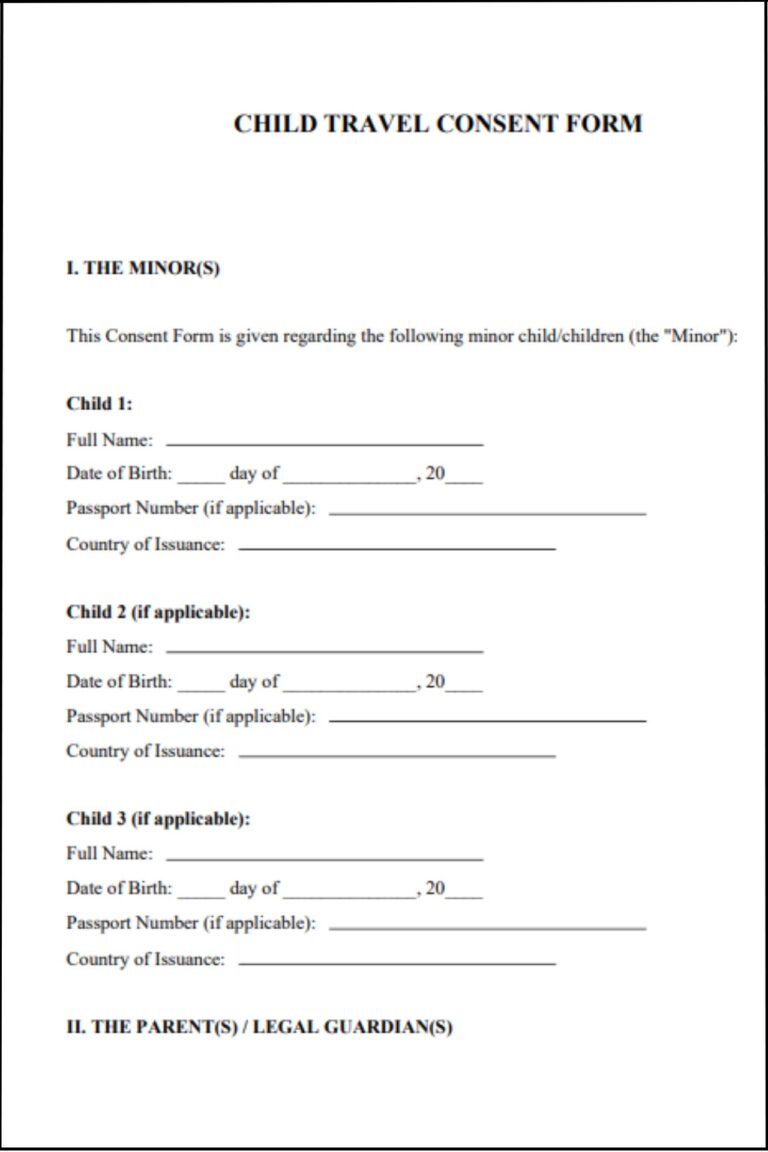
Ontario Medical Consent Form (Free & Editable PDF)
If you’re looking for an Ontario Medical Consent Form, you’re probably preparing for a medical procedure, enrolling a child in a program, or making sure treatment won’t be delayed because the paperwork is incomplete. A signed form is only part of the process because Ontario law requires consent to be informed, voluntary, and connected to the specific treatment being proposed, not simply recorded on paper.
I’ve seen situations where a clinic relied on a generic consent form, only for questions about the patient’s understanding of the procedure to surface before the Consent and Capacity Board after the treatment had already taken place. This page explains when a medical consent form should be used, what information it should include, who can provide consent, and how to prepare a document that reflects Ontario’s legal requirements.
Table of Contents
ToggleOntario Medical Consent Form (Free, Editable Template)

Does An Ontario Medical Consent Form Hold Up Legally?
Yes, provided it satisfies Ontario’s legal requirements for informed consent.
Under the Health Care Consent Act, 1996, consent must meet four essential conditions before it is legally effective. The consent must relate to the specific treatment being proposed, it must be informed, it must be given voluntarily, and it cannot be obtained through fraud or misrepresentation. These requirements appear in section 11(1) of the Act and form the legal foundation of every valid medical consent decision.
I’ve seen people assume that signing any hospital form automatically authorizes doctors to provide whatever treatment they think is necessary. That isn’t how Ontario law works. The consent must relate to the particular treatment being discussed.
Imagine Sarah visits a Toronto hospital for knee surgery. Before the procedure, her surgeon explains the operation, expected recovery, significant risks, possible complications, and reasonable alternatives. Sarah asks questions, understands the information, and voluntarily signs the consent form. That is the type of informed consent Ontario law expects.
Now consider a different situation. A clinic asks a patient to sign a one-page document stating only, “I consent to all necessary medical treatment,” without discussing the proposed procedure, risks, benefits, or available alternatives. Even though the patient signed the form, this type of blanket consent may fail the informed consent requirements because section 11(2) requires information that a reasonable person would need to make the decision.
This is one of the most common mistakes people make when relying on generic forms downloaded from the internet. A signature alone does not create valid consent.
Another important point is that Ontario law does not require routine clinical medical consent forms to be witnessed or notarized. Instead, healthcare providers assess whether the patient had the necessary capacity and whether the consent requirements were actually met. That rule is different from documents such as a Power of Attorney for Personal Care, which has separate witnessing requirements under the Substitute Decisions Act, 1992.
Who Can Sign An Ontario Medical Consent Form
The first person entitled to sign is the patient, provided they have the mental capacity to make the treatment decision.
Ontario does not use a fixed minimum age for medical consent. Instead, capacity determines whether someone can legally consent. A child, teenager, or adult may sign their own medical consent form if they understand the information relevant to the treatment and appreciate the reasonably foreseeable consequences of accepting or refusing it under section 4 of the Health Care Consent Act, 1996.
This often surprises parents. A mature minor who understands a proposed treatment may legally provide consent without parental approval.
For example, imagine a 13-year-old in Ottawa who fully understands a recommended medical procedure after discussing it with the treating physician. If the healthcare provider determines the child meets the statutory capacity test, the child can provide their own consent even though they are under 18.
The situation changes if the patient lacks capacity because of illness, injury, cognitive decline, or another reason affecting their ability to understand the decision.
In that case, a Substitute Decision-Maker (SDM) must execute the document instead. Ontario law mandates a strict statutory hierarchy under section 20 of the Health Care Consent Act to determine who holds this proxy authority. Crucially, section 20(2) dictates that any eligible SDM must be at least 16 years of age (unless they are the biological parent of an incapable minor). Furthermore, under section 21, the signing SDM is not free to make arbitrary decisions; they are legally compelled to act strictly in accordance with any prior capable wishes expressed by the patient, or alternatively, the patient’s objective best interests.
Suppose Michael suffers a serious brain injury after an accident and cannot understand the proposed treatment. His spouse is available and willing to make decisions. A sibling cannot simply complete the consent form because they prefer to do so. The healthcare provider must follow the statutory order established by Ontario law.
There is another distinction worth remembering.
Routine clinical consent forms do not require witnesses. However, if someone is creating a Power of Attorney for Personal Care to appoint a future medical decision-maker, two independent witnesses are required. Those are different legal documents serving different purposes.
When You’ll Need An Ontario Medical Consent Form
An Ontario Medical Consent Form is deployed when a capable individual or an authorized proxy formally authorizes a proposed clinical treatment plan. However, under section 25 of the Health Care Consent Act, a formal consent form is completely bypassed during emergency scenarios. If an individual is determined to be incapable and is facing severe suffering or imminent serious bodily harm, and their designated SDM is not immediately available, healthcare providers are legally authorized to treat the patient without prior documentation.
You’ll commonly need this form in situations such as:
- Planned surgeries or medical procedures.
- Diagnostic tests involving meaningful risks.
- Treatments requiring informed patient approval.
- Situations where a Substitute Decision-Maker must consent for an incapable patient.
- Advance planning involving a Power of Attorney for Personal Care or Advance Care Directive under the Substitute Decisions Act, 1992.
For example, imagine David is scheduled for elective shoulder surgery in Hamilton. Before the operation, the surgeon explains the expected benefits, potential complications, recovery period, and available alternatives. David reviews the information, asks questions, and signs the consent form before treatment begins.
Now consider a different situation. Maria develops a serious medical condition that leaves her temporarily incapable of making healthcare decisions. Because she cannot legally consent herself, the healthcare provider turns to the appropriate Substitute Decision-Maker identified under Ontario’s statutory hierarchy.
Remember that consent remains ongoing, even with a living will. Under section 14 of the Health Care Consent Act, 1996, a patient may withdraw or change consent orally at any time before treatment is actually administered. Signing the form does not permanently remove that right.
What Invalidates An Ontario Medical Consent Form
A signed form is not automatically a legally valid form. Ontario law focuses on the quality of the consent rather than the existence of a signature.
The following mistakes commonly invalidate a medical consent document.
The “Blanket Consent” Error
A general statement such as “I consent to all necessary medical treatment” is not enough if it fails to explain the proposed treatment, material risks, expected benefits, or available alternatives.
Section 11 of the Health Care Consent Act requires informed consent. If those discussions never occurred, the signed form may not satisfy Ontario’s legal requirements.
Signing Without Capacity
Capacity is assessed at the time consent is given.
If someone signs while unable to understand the information or appreciate the reasonably foreseeable consequences because of cognitive decline, intoxication, trauma, or another condition affecting decision-making, the consent may be invalid.
For instance, asking a patient immediately after heavy sedation to sign a consent form could raise serious legal concerns if they were incapable of making an informed decision at that moment.
The Wrong Substitute Decision-Maker Signs
Ontario follows an absolute, non-negotiable statutory hierarchy. Suppose an adult patient lacks capacity and both their spouse and a sibling are available. The sibling cannot sign simply because they are present or hold a specific preference. The healthcare provider must secure consent from the highest-ranking eligible entity under section 20 who is available, willing, and meets the mandatory 16-year age floor (unless they are the patient’s parent).
Summary of Applicable Laws
| Topic / Issue | Precise Legal Rule | Governing Statute / Code |
| Consent Elements | Establishes that medical consent is completely invalid unless it relates to the specific treatment, is informed, given voluntarily, and free of fraud. | Health Care Consent Act, 1996, S.O. 1996, c. 2, Sched. A, s. 11(1) |
| Capacity Standard | Defines capacity as the cognitive ability to understand relevant treatment data and appreciate the subsequent consequences of a decision. | Health Care Consent Act, 1996, s. 4(1) |
| Patient Age Line | Confirms there is no fixed chronological age minimum for medical choice; capacity alone determines authority. | Health Care Consent Act, 1996, s. 4 |
| Proxy Hierarchy | Outlines a strict legal hierarchy of family and legal representatives authorized to sign on behalf of an incapable patient. | Health Care Consent Act, 1996, s. 20 |
| Proxy Age Floor | Disqualifies any family member from acting as a Substitute Decision-Maker unless they are at least 16 years old (excepting parents). | Health Care Consent Act, 1996, s. 20(2) |
| Mandated SDM Duty | Compels the active proxy to strictly follow the patient’s prior capable wishes or prioritize their absolute best interests. | Health Care Consent Act, 1996, s. 21 |
| Oral Revocation | Grants patients the absolute right to change or completely withdraw their consent orally at any moment prior to clinical administration. | Health Care Consent Act, 1996, s. 14 |
| Emergency Bypass | Authorizes immediate treatment without any signed paperwork if an incapable patient faces severe suffering or imminent bodily harm. | Health Care Consent Act, 1996, s. 25 |
| Future Proxy Track | Governs the strict execution requirements (including the two-witness mandate) to legally appoint a future health proxy. | Substitute Decisions Act, 1992, S.O. 1992, c. 30 |
Resolving Disputes Over An Ontario Medical Consent Form
Disagreements sometimes arise about whether a patient has capacity or whether the correct person is acting as the Substitute Decision-Maker.
Ontario has a specialized tribunal called the Consent and Capacity Board (CCB) that deals with these issues. Unlike provinces where similar disputes may require lengthy court proceedings, the CCB can hear matters quickly, often within days, allowing urgent healthcare decisions to move forward without unnecessary delay.
Imagine an elderly patient whose children disagree about whether their parent is capable of making treatment decisions. Instead of waiting months for court proceedings, the dispute may be brought before the Consent and Capacity Board for a specialized determination.
If you’re preparing related planning documents, you may also find our Ontario Power of Attorney for Personal Care template useful because it explains how future healthcare decision-makers are appointed. Parents dealing with shared parenting arrangements may also benefit from our Ontario Parenting Plan Template and Ontario Child Custody Agreement Template, as those documents often address responsibility for important medical decisions.
Myth-Busting: Common Confusion About Ontario Medical Consent Forms
Myth: A parent must sign every medical consent form for their child.
Reality: Ontario has no fixed minimum age for medical consent. If a minor understands the treatment and appreciates its consequences, they may legally provide their own consent under section 4 of the Health Care Consent Act.
Myth: Doctors can simply choose someone to sign if the patient cannot.
Reality: Ontario law provides a legally binding hierarchy of Substitute Decision-Makers. Healthcare providers must follow that order rather than selecting whoever is most convenient.
Myth: One signed consent form covers every future treatment.
Reality: Consent must relate to the particular treatment being proposed. A general consent form does not automatically authorize unrelated procedures that were never discussed with the patient.
Frequently Asked Questions
Can a minor sign their own medical consent form in Ontario?
Yes. Ontario has no fixed minimum age for medical consent. A minor may sign their own consent form if they understand the treatment and appreciate its reasonably foreseeable consequences under section 4 of the Health Care Consent Act.
Who signs a medical consent form if the patient can’t decide for themselves?
The highest-ranking eligible Substitute Decision-Maker signs according to the statutory hierarchy established by section 20 of the Health Care Consent Act.
Does a medical consent form need to be witnessed in Ontario?
No. Standard clinical medical consent forms do not require witnesses. However, a Power of Attorney for Personal Care requires two independent witnesses.
What makes a medical consent form invalid in Ontario?
Common reasons include failing to provide informed consent, signing without the required mental capacity, or having someone sign who is not the correct Substitute Decision-Maker under Ontario law.
Can I withdraw medical consent after I’ve signed the form?
Yes. Consent may be withdrawn or changed orally at any time before the treatment is administered under section 14 of the Health Care Consent Act.
What happens if there’s a dispute over who can sign a medical consent form?
The matter may be referred to Ontario’s Consent and Capacity Board, which provides specialized hearings to resolve disputes involving capacity and substitute decision-making.