Photo Release Form Ontario (Free Template PDF & Word)
Photo Release Form Ontario is a search I often see from photographers, employers, schools, charities, and event organizers who want written permission before using someone’s image beyond the moment it was taken. While Ontario doesn’t prescribe one standard form for every situation, privacy rules under legislation such as PIPEDA place real importance on obtaining informed consent that reflects how photographs will actually be used, rather than relying on a vague signature.
I’ve seen disputes arise after an organization posted photos online even though the signed document never clearly mentioned promotional or social media use, leading to complaints before the Information and Privacy Commissioner of Ontario instead of a straightforward resolution. Below you’ll find a practical Ontario Photo Release Form template, along with guidance on when to use it, what clauses should be included, and how to record consent clearly for different situations.
Photo Release Form Ontario Template
Does A Photo Release Form Hold Up Legally In Ontario?
A Photo Release Form can carry significant legal weight in Ontario, but only if it reflects informed consent. Unlike some legal documents, there isn’t a prescribed government-issued form that automatically creates valid permission. Instead, the effectiveness of the document depends on whether the person signing reasonably understood what they were agreeing to.
For private businesses, photographers, advertising agencies, and marketing companies, the governing privacy legislation is the Personal Information Protection and Electronic Documents Act (PIPEDA). Section 6.1 requires that it be reasonable to expect the individual understands the nature, purpose, and consequences of providing consent. If those elements are missing, the consent itself may be challenged.
One of the most common problems I see involves businesses expanding the use of a photograph long after it was taken. Imagine a Toronto fitness studio asking members to sign a release allowing photographs for an internal newsletter. Months later, those same images appear in a province-wide advertising campaign. Because the new marketing purpose wasn’t disclosed when consent was obtained, the original release may not cover that use under PIPEDA’s consent requirements.
Consent also remains tied to the purpose described at the time of signing. A release shouldn’t contain vague wording such as “for any future purpose.” Instead, it should clearly identify how the photographs may be used, whether that’s:
- Company websites
- Social media accounts
- Printed advertising
- Promotional brochures
- Educational publications
- Internal communications
Ontario also differs from provinces such as British Columbia and Manitoba because it doesn’t have a general provincial private-sector Privacy Act creating a statutory cause of action for misuse of a person’s likeness. Where a valid release is missing, disputes may instead proceed through common law claims such as appropriation of personality rather than relying on a provincial privacy statute.
Keep in mind that this discussion applies primarily to commercial organizations. Public institutions, including Ontario school boards, municipalities, universities, and provincial ministries, must comply with strict public-sector compliance mandates under the Freedom of Information and Protection of Privacy Act (FIPPA) or the Municipal Freedom of Information and Protection of Privacy Act (MFIPPA). Under the sweeping July 1, 2026 amendments enacted via Bill 97, public institutions are subject to mandatory Privacy Impact Assessments (PIAs) prior to new data collection frameworks, rigorous data breach reporting protocols, and an expanded 45-business-day timeline to process information access reviews.
Who Needs To Sign A Photo Release Form In Ontario
The person whose image appears in the photograph should normally sign the release before their likeness is used for commercial or promotional purposes.
Under Ontario’s Age of Majority and Accountability Act, an adult is someone who has reached 18 years of age. For most commercial releases, an adult subject signs on their own behalf.
If the person being photographed is a minor, the situation changes. A parent or legal guardian should sign the release instead. A photographer who obtains only a 16-year-old model’s signature risks creating a release that the minor may later treat as voidable.
This issue comes up more often than many people expect. A modelling agency might photograph teenagers for a seasonal clothing campaign and collect signatures directly from each participant without involving their parents. Even though everyone willingly participated in the photo session, the release itself may later become vulnerable because the necessary parental consent wasn’t obtained.
For standard commercial releases, Ontario law does not require a sworn affidavit or:
- A witness
- Notarization
- Commissioning
- Government filing or registration
That doesn’t mean record keeping is optional. Businesses should retain signed releases because they may later need to demonstrate that valid consent was obtained if questions arise about how an image was used.
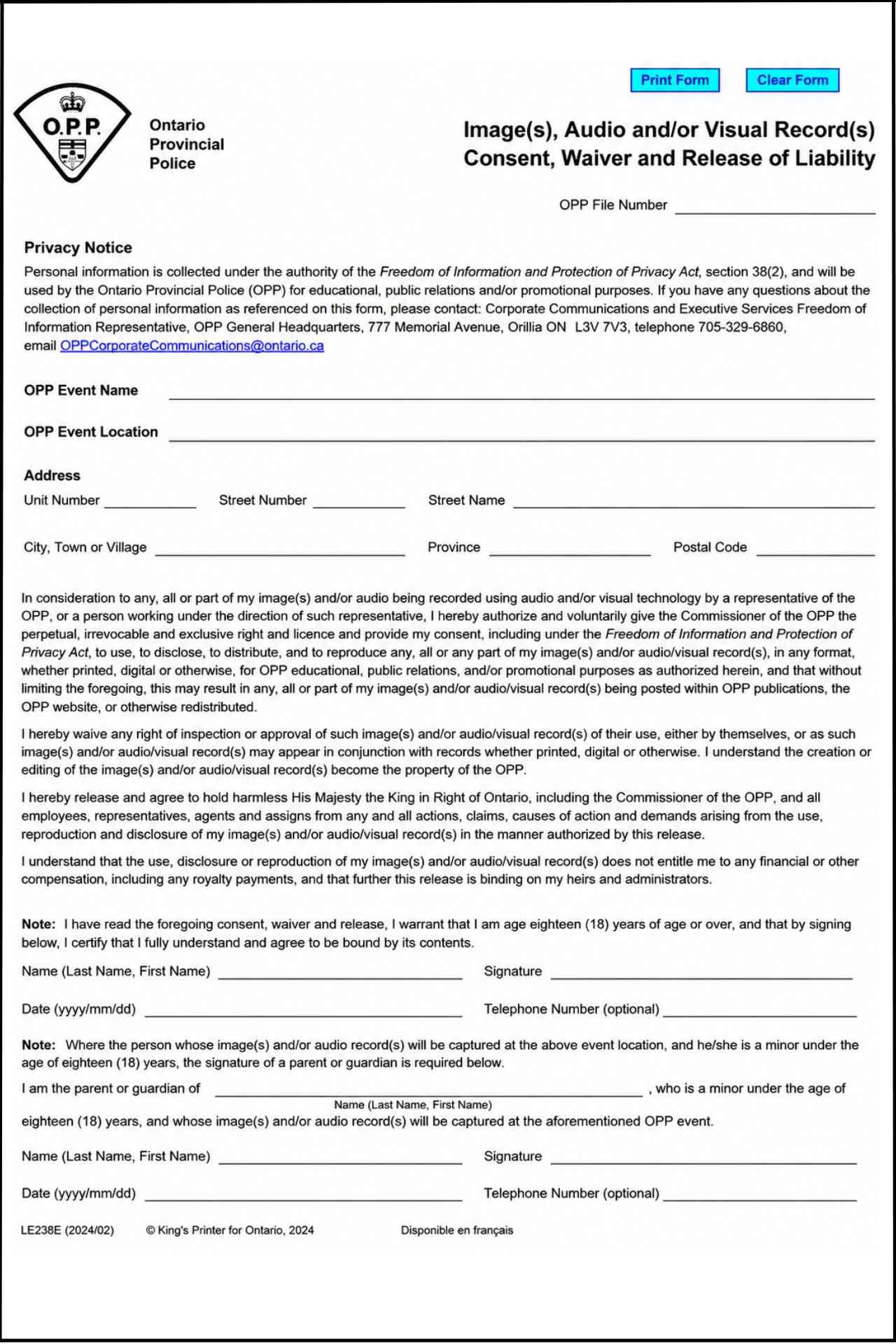
Another important distinction involves public institutions. Schools, municipalities, and provincial agencies frequently collect photographs for educational or administrative purposes. Their forms often contain additional statutory language that private businesses don’t require, including notices explaining the authority for collecting personal information and identifying a contact person for privacy questions.
When You’ll Need A Photo Release Form In Ontario
Many people assume photo releases are only necessary for professional models. In practice, they’re used in a much wider range of situations whenever someone’s identifiable image may be published or used commercially.
Common examples include:
- Commercial photography sessions
- Advertising campaigns
- Business websites
- Social media marketing
- Corporate brochures
- Product packaging
- Promotional videos
- Brand ambassador programs
A small business in Ottawa, for example, might hire a photographer to capture customer testimonials for its website. Even if every customer happily poses for the camera, obtaining a written release before publishing those images helps establish that consent extends beyond simply taking the photograph.
Educational institutions and municipalities have additional responsibilities. An Ontario university photographing students during orientation or a municipality documenting community events may need privacy notices that satisfy FIPPA or MFIPPA requirements because they collect personal information in the public sector.
Another situation that often gets overlooked involves editing photographs after they’re taken. Businesses frequently crop, resize, retouch, or combine images with advertising graphics. Where those changes affect rights protected under the Copyright Act, an express written waiver of moral rights should be included when appropriate. Generic online release forms often leave out this language entirely.
Not every photograph requires a release. Private family albums, purely personal use, or situations outside the scope of the verified legal framework may involve different legal considerations. Before relying on a release for unusual circumstances, confirm that the intended use matches the scope of the consent being requested.
What Invalidates A Photo Release Form In Ontario
Several recurring mistakes can undermine an otherwise well-prepared Photo Release Form. Most of them happen because organizations rely on broad, generic templates that don’t reflect Ontario’s privacy requirements.
Deceptive Or Unstated Purposes
Consent only extends to the purposes identified when the release was signed.
Suppose a London marketing company asks participants to sign a form stating photographs will appear in an employee newsletter. A year later, the same photographs become part of a national advertising campaign. That expanded use wasn’t disclosed when consent was obtained and may not satisfy PIPEDA’s valid consent requirements.
The safest approach is to identify every intended use before the person signs.
Parental Consent Omission
A release signed directly by a minor without the involvement of a parent or legal guardian may later become voidable.
This commonly affects:
- Youth sports photography
- Child modelling agencies
- School promotional photography
- Summer camps
- Children’s theatre productions
Obtaining the correct signature before publishing photographs is much easier than attempting to resolve consent issues after the images have already been distributed.
Missing “Notice Of Collection” For Public Bodies
Private businesses and Ontario public institutions don’t operate under identical rules.
An Ontario municipality, university, or school board using a generic commercial photo release may overlook the mandatory Notice of Collection required under FIPPA. Under the updated July 2026 framework, public bodies must combine this notice with a pre-collection Privacy Impact Assessment (PIA). The mandatory notice block must explicitly identify:
- The specific legal authority permitting the data collection.
- The explicit purpose for collecting and utilizing the photographs.
- Complete contact coordinates for a designated official who can address privacy complaints.
Because these statutory requirements don’t normally appear in commercial templates, downloading a generic form from the internet often creates compliance problems for public-sector organizations.
Summary of Applicable Laws
| Topic | Rule | Governing Statute |
|---|---|---|
| Who can sign | Subject if 18+; parent or legal guardian if the subject is a minor | Age of Majority and Accountability Act, R.S.O. 1990, c. A.7, s. 1 |
| Valid consent standard | Individual must reasonably understand the nature, purpose, and consequences of the consent | Personal Information Protection and Electronic Documents Act (PIPEDA), S.C. 2000, c. 5, s. 6.1 |
| Purpose limitation | Consent is limited to the purposes disclosed when the release is signed | PIPEDA, Schedule 1, Clause 4.3.2 |
| Moral rights waiver | Must be expressly stated in writing if the business intends to alter or modify the photograph | Copyright Act, R.S.C. 1985, c. C-42, s. 14.1(2) |
| Public sector notice requirement | Mandates a structural Notice of Collection and a pre-collection Privacy Impact Assessment (PIA) for public institutions handling personal data. | Freedom of Information and Protection of Privacy Act, R.S.O. 1990, c. F.31, s. 39(2) & Bill 97 (2026 Updates) |
Federal Vs Provincial Rules Behind Your Photo Release Form
One area that surprises many Ontario businesses is that the rules governing photo releases don’t come from a single provincial statute. Instead, the legal framework depends on who is collecting the image.
Private-sector businesses, including photographers, marketing agencies, retailers, and event organizers, are generally governed by the federal Personal Information Protection and Electronic Documents Act (PIPEDA). That means even a small photography studio operating only in Ontario must follow the federal consent standard when collecting and using photographs for commercial purposes.
Ontario differs from provinces such as Alberta, British Columbia, and Quebec because it hasn’t enacted a comprehensive private-sector privacy law that replaces PIPEDA. As a result, federal privacy requirements apply directly to most commercial photo releases used within the province.
Public-sector organizations operate differently. School boards, universities, municipalities, hospitals, and provincial ministries are generally subject to FIPPA or MFIPPA, which impose additional obligations beyond obtaining consent. For example, an Ontario college asking students to sign an image consent form Canada-style downloaded from the internet may still fail to comply if the document omits the required Notice of Collection.
A community recreation centre provides a good example. If the centre is privately owned, PIPEDA generally governs its photo release process. If it’s operated by a municipality, the organization must also satisfy the statutory notice requirements under municipal privacy legislation. Using the same generic form for both organizations can create compliance problems.
This distinction is one reason national templates often miss Ontario-specific requirements. Before using any release, confirm whether you’re acting as a private business or a public institution because the applicable privacy obligations aren’t identical.
Waiving Moral Rights In A Photo Release Form
Many people assume a photo release only deals with permission from the person appearing in the photograph. That’s only part of the picture.
If a business intends to crop, edit, combine, or otherwise modify an image, it should also consider the photographer’s rights under the Copyright Act. Section 14.1(2) provides that a waiver of moral rights must be expressly made in writing.
Imagine a Hamilton marketing agency hiring a professional photographer to create promotional images. Months later, the agency crops the photographs, adds branding, changes colours, and incorporates them into a national advertising campaign. If there isn’t an express written waiver covering those moral rights, editing the images may create copyright issues even though the person in the photograph signed a release.
This is one of the biggest weaknesses I see in free online forms. They often focus entirely on obtaining the subject’s consent while overlooking the photographer’s separate intellectual property rights.
A model release form Ontario businesses use should therefore be considered alongside any agreement dealing with ownership of the photographs. The two documents often work together but address different legal rights.
Not every situation requires a moral rights waiver. If photographs won’t be edited or the photographer has already addressed these issues in another written agreement, the analysis may differ. Review the intended use before deciding whether additional copyright language is appropriate.
Common Mistakes That Get Ontario Photo Release Forms Invalidated
Most disputes don’t happen because someone forgot to sign the document. They happen because the release didn’t accurately reflect how the photographs were actually used.
The most common mistakes include:
- Using photographs for purposes that weren’t disclosed when consent was obtained.
- Allowing a minor to sign without a parent or legal guardian.
- Editing photographs without an express written waiver of moral rights where one is required.
- Public institutions relying on generic commercial forms that omit the statutory Notice of Collection required by FIPPA or MFIPPA.
A Toronto charity offers a practical example. Volunteers signed releases allowing photographs for fundraising brochures, but the organization later licensed several images for commercial advertising with a corporate sponsor. Because that additional use wasn’t clearly identified when consent was obtained, questions arose about whether the original consent extended that far.
Another frequent issue involves schools and municipalities downloading commercial templates intended for private businesses. Those forms usually don’t include the statutory collection notices public institutions must provide, creating avoidable compliance issues before a single photograph is even published.
Businesses should also avoid vague wording such as:
- “Any future purpose.”
- “Unlimited promotional use.”
- “All media forever.”
Instead, describe the intended use as specifically as possible. Clear consent reduces misunderstandings and helps demonstrate that the individual understood the nature, purpose, and consequences of signing the release, consistent with PIPEDA’s consent standard.
Frequently Asked Questions
Is a photo release form legally binding in Ontario?
A properly prepared photo release can be effective when it clearly explains how the person’s image will be used and the individual understands the nature, purpose, and consequences of providing consent under PIPEDA, s. 6.1.
Can a minor sign their own photo release form in Ontario?
Generally, no. Under the verified legal framework, a parent or legal guardian should sign on behalf of a minor. A release signed directly by a minor may be voidable under the Age of Majority and Accountability Act.
Does a photo release form need to mention moral rights?
Yes, if the organization intends to alter, crop, edit, or modify the photograph. An express written waiver of moral rights may be required under Copyright Act, s. 14.1(2).
Can a business use my photograph for a different purpose later?
No. Consent under PIPEDA is tied to the purposes disclosed when the release was signed. Expanding the use beyond those stated purposes may fall outside the original consent.
Do Ontario schools and universities need a different photo release form?
Yes. Public institutions are subject to FIPPA or MFIPPA and generally need additional Notice of Collection language identifying the legal authority for collecting the images, the purpose of collection, and contact information for a responsible official.
What happens if someone uses my photo without a release?
Ontario doesn’t have a general private-sector Privacy Act creating a statutory tort for unauthorized use of a person’s likeness. Depending on the circumstances, claims may instead rely on common law causes of action such as appropriation of personality.