Is a Bill of Sale Necessary in Ontario? | Free Guide
Is Bill of Sale Required Ontario? This is one of the most common questions people ask when buying or selling something privately in Ontario.
The short answer: it depends on what you are selling.
In many cases, it is not legally required, but in some situations—especially vehicles—it becomes essential. In my experience helping Ontario clients with private sales, I have seen simple deals turn into expensive disputes because there was no proper proof of what was sold, when it changed hands, or what condition it was in.
First-time buyers and sellers are often surprised to learn that even when a Bill of Sale is not legally mandatory, it can still become one of the most important documents if problems come up later.
This article will help you:
- Understand when a Bill of Sale is required
- Avoid legal mistakes
- Use a simple, ready-to-use Ontario template
Last Updated: September 2026
Table of Contents
ToggleFree Bill of Sale Ontario Template
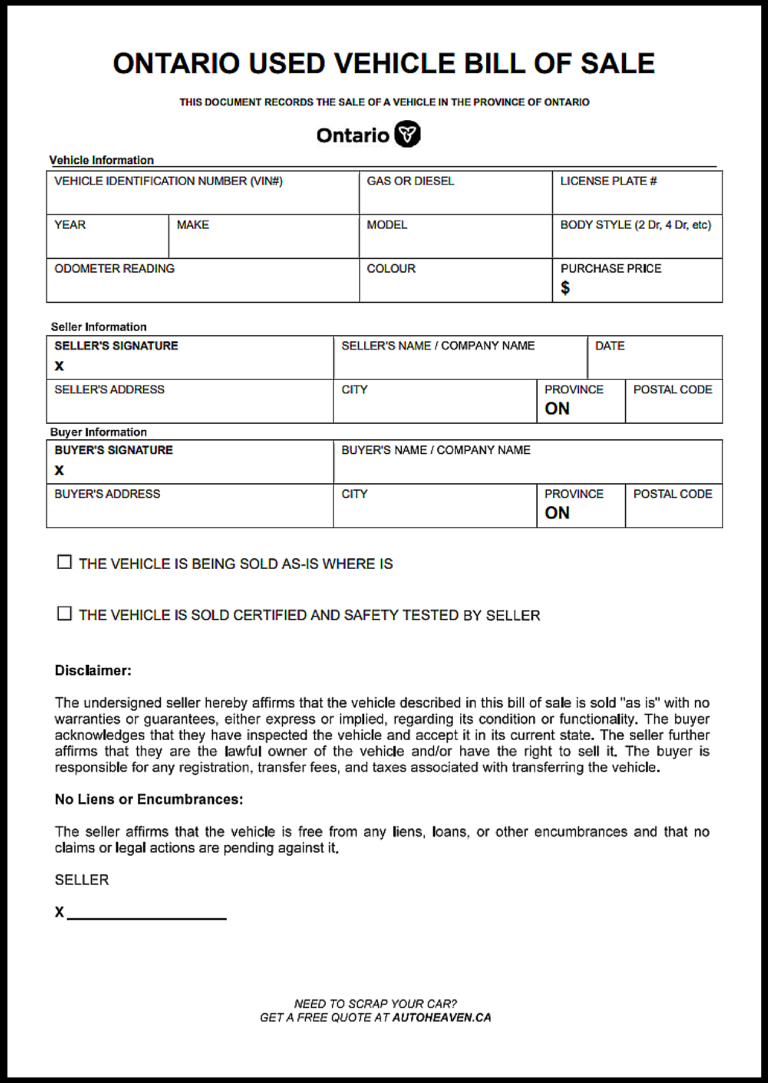
You can use the template below for most private sales in Ontario. It works for vehicles, bikes, electronics, furniture, and more.
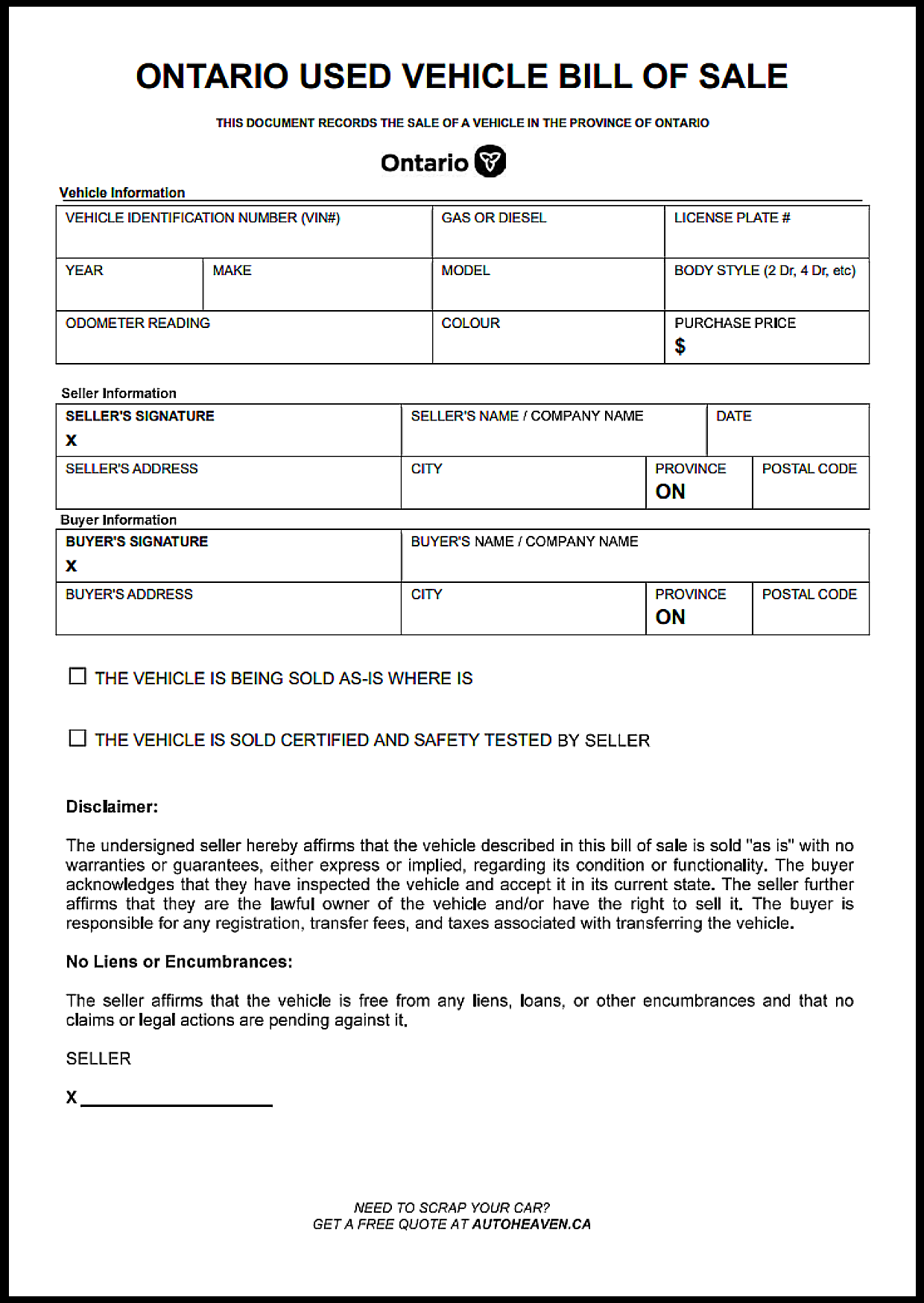
Tip: Always keep a signed copy for both buyer and seller.
Ontario Bill of Sale Legal Rules You Should Know
| Topic / Issue | Ontario Legal Rule | Governing Statute |
|---|---|---|
| Governing legislation | Private sales of goods in Ontario can be governed by the Sale of Goods Act and general contract law, depending on the transaction and the property involved. | Sale of Goods Act, R.S.O. 1990, c. S.1 |
| Vehicle-related transactions | Vehicle transfers and dealer-led sales are regulated separately from ordinary personal property sales. | Highway Traffic Act, R.S.O. 1990, c. H.8; Motor Vehicle Dealers Act, 2002, S.O. 2002, c. 30, Sched. B |
| Financing terms | Federal interest rules may apply to certain financing or interest terms, depending on the transaction. | Interest Act, R.S.C., 1985, c. I-15 |
| Who can sign | The seller or an authorized person acting for the seller should sign the bill of sale, and the buyer should also sign and date it where the transaction requires a signed bill of sale. | General contract principles; Ontario vehicle registration rules |
| Witness requirement | A witness is not generally required for an ordinary private bill of sale, although a particular transaction or document may have additional requirements. | General Ontario law |
| Notarization | Notarization is not generally required for an ordinary private bill of sale or the standard Ontario used-vehicle registration process. | Ontario registration requirements |
| Age and legal capacity | Contractual capacity can depend on the circumstances, including the age of the person and the nature of the transaction. This article does not treat age alone as determining whether every private sale is enforceable. | Ontario contract law |
| Vehicle transfer deadline | The buyer must register their name as the new owner within six days of purchasing the vehicle. | Highway Traffic Act, s. 11 |
| Vehicle Identification Number (VIN) | An Ontario bill of sale for a used or new vehicle must include the vehicle identification number (VIN). | Ontario vehicle-registration requirements |
| Used Vehicle Information Package (UVIP) | For applicable private sales of used vehicles in Ontario, the seller is legally required to provide the buyer with a Used Vehicle Information Package (UVIP). | Highway Traffic Act, s. 11.1 |
| “As-Is” disclosure | The Sale of Goods Act contains implied conditions about quality or fitness in specified circumstances. Whether those conditions apply to a private sale depends on the transaction and the parties’ circumstances. | Sale of Goods Act, s. 15 |
| Filing requirements for general property | An ordinary private sale of personal property generally does not require the bill of sale itself to be filed with the government, although separate registration may be relevant for security interests. | Ontario law |
| Vehicle registration requirement | For a used-vehicle registration, the buyer must bring the required documents to ServiceOntario, including the UVIP and bill of sale. | Ontario vehicle-registration requirements |
| Secured interest registration | If a seller or other creditor takes a security interest in personal property, PPSA registration may be used to perfect that security interest, depending on the transaction. | Personal Property Security Act |
| Unclear property description | A clear description of the property helps identify what was sold and reduces the risk of disputes about the subject of the transaction. | Ontario contract and sale-of-goods law |
| Seller without legal right to sell | A seller’s lack of title or authority to sell can create serious legal problems, including issues concerning the buyer’s title and the seller’s obligations under the Sale of Goods Act. | Sale of Goods Act |
| Missing UVIP in vehicle sales | For an applicable private used-vehicle sale, the seller must provide the buyer with the required UVIP as part of the Ontario vehicle-transfer process. | Highway Traffic Act, s. 11.1 |
| Ontario-specific difference | Ontario’s UVIP includes a dedicated Bill of Sale section that can be used to record the vehicle sale. | Ontario vehicle-registration framework |
| Ontario tax assessment rule | For most privately purchased used vehicles in Ontario, the buyer pays 13% RST when registering the vehicle, generally based on the purchase price or the vehicle’s wholesale value, whichever is greater. Additional appraisal rules apply to vehicles that are 20 years old or older. | Retail Sales Tax Act, R.S.O. 1990, c. R.31 |
Vehicle sales are different from ordinary private sales in Ontario. When you sell a used vehicle privately, the seller must provide the buyer with the UVIP and a signed bill of sale. The buyer then uses those documents, along with the other required registration documents, when registering the vehicle at ServiceOntario.
An “as-is” clause can help record what the parties agreed about the item’s condition, but it should not be treated as a complete legal shield. Ontario’s Sale of Goods Act contains implied conditions about quality or fitness in specified circumstances, so the effect of an as-is term depends on the transaction and the wording used.
The six-day vehicle registration deadline is also important. The buyer must register their name as the new owner within six days of purchasing the vehicle.
For many privately purchased used vehicles, Ontario calculates RST using the purchase price or the vehicle’s wholesale value, whichever is greater. If the vehicle is 20 years old or older, Ontario’s appraisal rules may apply.
Before signing, check the buyer and seller information, item description, purchase price and date. For a vehicle sale, also check the VIN and make sure the bill of sale is consistent with the UVIP and vehicle permit.
Is a Bill of Sale Legally Required in Ontario?
Under Ontario law, a Bill of Sale is:
- Not always legally required as a separate document
- Strongly recommended for many private sales
- Part of the required documentation for applicable vehicle-registration transactions
Legal Requirement vs Practical Need
There is an important difference:
- Legal requirement → Ontario law requires particular documentation for certain transactions, especially vehicle registration
- Practical necessity → A written bill of sale creates a useful record of the transaction and agreed terms
For ordinary private sales of personal property, Ontario law does not generally require a separate written bill of sale, although specific transactions—especially vehicle sales—have additional documentation requirements.
Whether a bill of sale is required depends on the type of transaction and asset involved. To understand its role in documentation, refer to the complete guide and related forms like the car bill of sale.
When a Bill of Sale Is REQUIRED
In Ontario, a Bill of Sale becomes essential in certain situations. For vehicle sales, including cars and trucks, Ontario’s registration process requires a bill of sale containing the required information. The buyer must also provide documents such as the Used Vehicle Information Package (UVIP), the ownership permit and a Safety Standards Certificate if applicable.
For trailer and motorcycle sales, the documentation requirements depend on the type of vehicle and transaction. For applicable used-vehicle sales, Ontario requires the buyer to complete the registration process with the required vehicle documents, including the UVIP and proof of purchase.
A detailed bill of sale can also be useful for business asset transfers because it creates a clear record of the property, purchase price and transaction date. If the transaction involves financing or a security interest, additional legal and registration requirements may apply.
When a Bill of Sale Is NOT Legally Required
You usually don’t need a separate written bill of sale for:
- Small personal sales of ordinary items
- Gifts between family or friends
- Informal exchanges
But here’s the reality:
Even if a separate bill of sale is not legally required, you may still want one. A written record can make it much easier to establish what was sold, for how much and on what date.
Why You Should Always Use a Bill of Sale
In many private sale situations, using a Bill of Sale is a practical way to keep a clear record of the transaction.
- Key Benefits: Creates a written record of the property, purchase price, date and agreed terms. It can also provide documentary evidence if a dispute later arises. In Ontario, the Small Claims Court currently handles claims of up to $50,000, effective October 1, 2025.
Real-Life Example
A buyer purchases a used laptop and later claims it was faulty.
Without a Bill of Sale:
- There may be no written record of the agreed condition
- The parties may disagree about the price, date or terms
- The dispute can become harder to resolve
With a Bill of Sale:
- Both parties have written evidence of the transaction
- The document can show the agreed price and terms
- Any condition or “as-is” wording can be reviewed as part of the agreement
For deeper clarity, you can compare this requirement with ownership rules in the ownership vs bill of sale guide. It may also help to review legal requirements in Ontario.
What Makes a Bill of Sale Valid in Ontario?
A Bill of Sale does not need to be complicated. It should clearly identify the parties, the property and the main terms of the transaction.
Essential Information
- Buyer and seller full names
- Addresses
- Item description (clear and specific)
- Sale price
- Date of sale
Signatures
- Both parties should sign
- This confirms the parties’ agreement to the recorded terms
“As-Is” Clause
This can be useful when the parties want to document the condition of the item at the time of sale.
It can state that:
- Buyer accepts the item in the condition described in the agreement
- The parties have agreed on the terms concerning the item’s condition
An “as-is” clause can record the parties’ agreement, but it should not be described as automatically eliminating every statutory or contractual obligation of the seller.
Special Rule for Vehicles
A Bill of Sale alone is NOT enough for vehicles.
You must also provide:
- Used Vehicle Information Package (UVIP)
- Vehicle ownership permit
- Safety certificate (if applicable)
The buyer must provide the documents required for the particular vehicle and transaction before ServiceOntario can complete the registration. Ontario’s current registration guidance lists the UVIP, proof of purchase, insurance, the original vehicle permit with the completed transfer portion and other applicable documents.
Common Mistakes People Make
For Ontario vehicle sales, check the VIN, purchase price, buyer and seller information, sale date and signatures before completing the transaction. Keep the original bill of sale and make sure it is consistent with the UVIP and vehicle permit.
Pro tip: Always double-check before signing.
What Happens If You Don’t Use a Bill of Sale?
Skipping a Bill of Sale can create practical problems:
- No written bill of sale documenting the transaction
- Higher risk of disputes
- Difficulty proving the agreed terms
- Problems establishing the purchase price or other transaction details
In simple words:
A written bill of sale gives both parties a clear record of what was sold, the agreed price and the date of the transaction.
Bill of Sale vs Receipt
| Feature | Bill of Sale | Receipt |
| Transaction record | Detailed record of the transaction |
Usually a more limited record, depending on what it contains
|
| Item details | Can contain detailed information |
May contain only basic information
|
| Signatures | Can be signed by the parties |
May or may not be signed
|
| Used in disputes | Can provide evidence of the agreed terms |
Can provide evidence of payment or purchase, depending on its contents
|
For higher-value or more complex transactions, a detailed bill of sale can provide more information than a basic receipt.
How to Fill Out a Bill of Sale?
Follow these simple steps:
Step 1: Add buyer and seller details
Step 2: Describe the item clearly
Step 3: Mention price and payment method
Step 4: Add terms (like “as-is”)
Step 5: Sign and keep copies
Frequently Asked Questions
Is a Bill of Sale mandatory for cars in Ontario?
For a used-vehicle registration, Ontario requires the buyer to provide a bill of sale containing the required information. The bill of sale can be completed using the dedicated Bill of Sale section at the bottom of the UVIP. The buyer must also provide the other documents required for registration.
Can I write my own Bill of Sale?
Yes. For a vehicle transaction, Ontario’s guidance allows the bill of sale to be handwritten. It should contain the required information and be signed and dated by both buyer and seller.
Does a Bill of Sale need to be notarized in Ontario?
No, notarization is not generally required for an ordinary private bill of sale or the standard Ontario used-vehicle registration process.
Who keeps the original copy?
Both the buyer and seller should keep signed copies of the Bill of Sale. This helps both parties have proof of the transaction.
Is a handwritten Bill of Sale valid?
For a vehicle transaction, Ontario’s guidance expressly allows the bill of sale to be handwritten, provided it contains the required information and is properly signed and dated.