Ontario Commercial Lease Agreement Template – Printable & Editable
Ontario Commercial Lease Agreement is a legal contract used when renting a space for business purposes like shops, offices, or warehouses. If you are planning to open a store in Toronto or rent an office in Mississauga, this agreement protects both the landlord and the tenant.
A written lease is very important. I’ve seen many Ontario business owners run into expensive disputes because key lease terms were never properly written down or reviewed before signing. When someone is renting commercial space for the first time, it’s easy to overlook clauses about maintenance costs, personal guarantees, or rent increases that can create serious legal and financial problems later.
It clearly explains rent, responsibilities, and rules. Without it, disputes can happen easily. In this article, you will get a free template plus simple, step-by-step help to understand and use it properly.
Last Updated: September 2026
What Is an Ontario Commercial Lease Agreement?
An Ontario commercial lease agreement is a contract between a landlord and a business tenant for renting commercial property.
This includes:
- Retail shops
- Office spaces
- Warehouses
- Industrial units
Commercial vs Residential Lease
Under Ontario law, commercial leases are not fully governed by the Residential Tenancies Act (RTA) , which you can review on the official Ontario government website. That means:
- Fewer protections for tenants
- More freedom to negotiate terms
- Rules depend mostly on the contract itself
People who use this agreement:
- Business owners
- Startups
- Property owners
- Investors
In simple words: commercial leases are flexible, but you must read every clause carefully.
Ontario Commercial Lease Laws Most Business Owners Miss
| Topic / Issue | Ontario Legal Rule | Governing Statute |
|---|---|---|
| Governing Legislation | Commercial landlord-tenant relationships are governed in part by Ontario’s Commercial Tenancies Act, together with the lease, common law and other applicable legislation. | Commercial Tenancies Act, R.S.O. 1990, c. L.7 |
| Short Form Lease Language | Ontario’s Short Forms of Leases Act gives specified short-form lease covenants their statutory effect when the lease meets the Act’s requirements. | Short Forms of Leases Act, R.S.O. 1990, c. S.11 |
| Competition & Exclusivity Clauses | Some exclusivity or restrictive covenant provisions may raise competition-law issues depending on their wording, purpose and market effects. | Competition Act, R.S.C., 1985, c. C-34 |
| Who Can Legally Sign | Individuals who are 18 or older are generally presumed capable of entering into contracts, while a corporation should sign through a person with proper authority to bind the corporation. | Substitute Decisions Act, 1992; applicable corporate law |
| Witness Requirements | A witness is not universally required for every commercial lease, but additional execution formalities can apply when a lease is executed as a deed. | Conveyancing and Law of Property Act |
| Notarization Requirements | A commercial lease does not generally need to be notarized simply because it may be registered. The Land Titles Act provides different ways of filing a notice of lease and supporting documents. | Land Titles Act, R.S.O. 1990, c. L.5 |
| Age & Legal Capacity | A person who is 18 or older is presumed to be capable of entering into a contract, subject to the applicable rules concerning capacity. | Substitute Decisions Act, 1992, s. 2 |
| Rent Default Deadline | Under section 18(1) of Ontario’s Commercial Tenancies Act, unless the parties agree otherwise, a statutory right of re-entry arises when rent remains unpaid for fifteen days after the day on which it was due. The lease and the Act should be reviewed before any re-entry or forfeiture action is taken. | Commercial Tenancies Act, R.S.O. 1990, c. L.7, s. 18(1) |
| Legal Action Time Limit | The basic limitation period for many civil claims in Ontario is two years from discovery, but exceptions and other limitation rules may apply to particular commercial lease claims. | Limitations Act, 2002, s. 4 |
| Required Short Form Wording | If the parties want to rely on the statutory short-form covenant system, the lease should be drafted so that it satisfies the requirements of the Short Forms of Leases Act. | Short Forms of Leases Act, R.S.O. 1990, c. S.11 |
| Exclusivity Clause Justification | Exclusivity clauses should be drafted carefully because their legal effect can depend on the wording, commercial context and applicable competition law. | Competition Act, R.S.C., 1985, c. C-34 |
| Filing Requirements | A commercial lease does not generally need to be filed with the government simply to create contractual obligations between the parties, although registration or notice on title may be important in some cases. | Applicable Ontario land and commercial tenancy law |
| Registration on Title | For registered land, a lessee or other interested person may apply to register notice of the lease. Registration can affect priority against later interests, so the need for registration should be assessed for the particular lease. | Land Titles Act, R.S.O. 1990, c. L.5, s. 111 |
| Lease Invalidity — Oral Long-Term Lease | Ontario’s Statute of Frauds imposes writing and execution requirements for leases and interests in land, subject to statutory exceptions. A commercial lease should therefore be properly documented and executed rather than relying on a long-term oral arrangement. | Statute of Frauds, R.S.O. 1990, c. S.19 |
| Lease Invalidity — 21-Year Rule | The Planning Act contains restrictions on certain leases or agreements granting use of part of a lot or land for periods of 21 years or more, subject to detailed statutory exceptions. Long-term commercial and ground leases should be reviewed for Planning Act compliance before signing. | Planning Act, R.S.O. 1990, c. P.13 |
| Lease Invalidity — Lack of Capacity | A lease signed by a person who lacks contractual capacity may raise enforceability issues, so the authority and capacity of the person signing should be confirmed. | Substitute Decisions Act, 1992; applicable contract law |
| Ontario’s 21-Year Lease Trap | The Planning Act contains an exception for certain leases of part of a building or structure, but the availability of the exception depends on the facts and the statutory requirements. Long-term leases should be reviewed carefully rather than assumed to be exempt. | Planning Act, R.S.O. 1990, c. P.13 |
| Ontario’s 16th-Day Re-entry Rule | Ontario’s Commercial Tenancies Act provides a statutory right of re-entry when rent remains unpaid for fifteen days after it was due, unless otherwise agreed. The lease and applicable law should be reviewed before re-entry or lock changes. | Commercial Tenancies Act, R.S.O. 1990, c. L.7, s. 18 |
| Ontario’s Unique Short Forms System | Ontario has a dedicated Short Forms of Leases Act that gives specified traditional lease wording its statutory effect when the Act’s requirements are met. | Short Forms of Leases Act, R.S.O. 1990, c. S.11 |
Long-term commercial leases need special care in Ontario because the Planning Act contains restrictions on certain interests in land for periods of 21 years or more, along with important statutory exceptions. This issue is particularly important for ground leases and arrangements involving part of a lot. Before agreeing to a long renewal structure, check whether Planning Act consent or an exception applies.
Another important rule is the statutory right of re-entry under section 18(1) of Ontario’s Commercial Tenancies Act. Unless the parties have agreed otherwise, the statutory right arises when rent remains unpaid for fifteen days after the day on which it was due. Ontario’s commercial-property guidance states that a landlord may change the locks and end the tenancy on the 16th day after the rent was due, subject to the lease and applicable rules. The lease should be reviewed carefully before the landlord takes steps to re-enter or terminate the tenancy.
The written lease requirement also matters because Ontario’s Statute of Frauds contains formal requirements for certain leases and interests in land, subject to statutory exceptions. A long-term commercial arrangement should therefore be documented carefully rather than left to verbal promises. Clear wording can also prevent later disputes about rent, renewal rights, repairs, assignment and termination.
The free Ontario Commercial Lease Agreement template can help you organize the main business terms, but complex leases should be reviewed carefully before signing, particularly where the term, renewal rights, guarantees, assignment, repairs or default provisions are significant.
When Do You Need a Commercial Lease in Ontario?
You need this agreement anytime you rent a space for business use.
Common situations:
- Opening a café, salon, or retail shop
- Renting an office for your company
- Expanding your business to a new location
- Leasing a warehouse or storage unit
- Renting part of a commercial building
Real example:
A small bakery rents a shop in a plaza. The lease defines rent, allowed use (only bakery), and who pays maintenance. Without this, confusion can lead to legal issues.
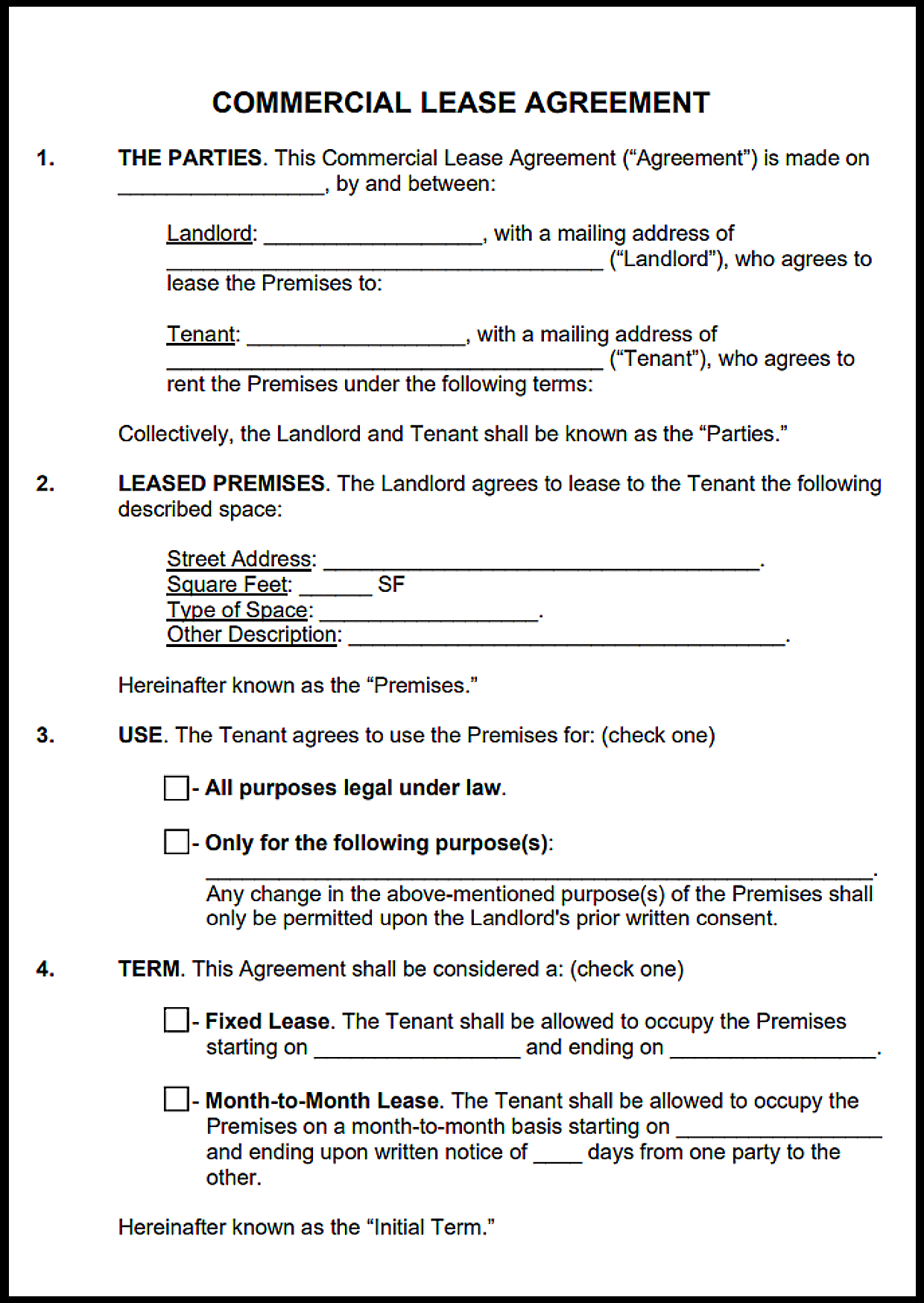
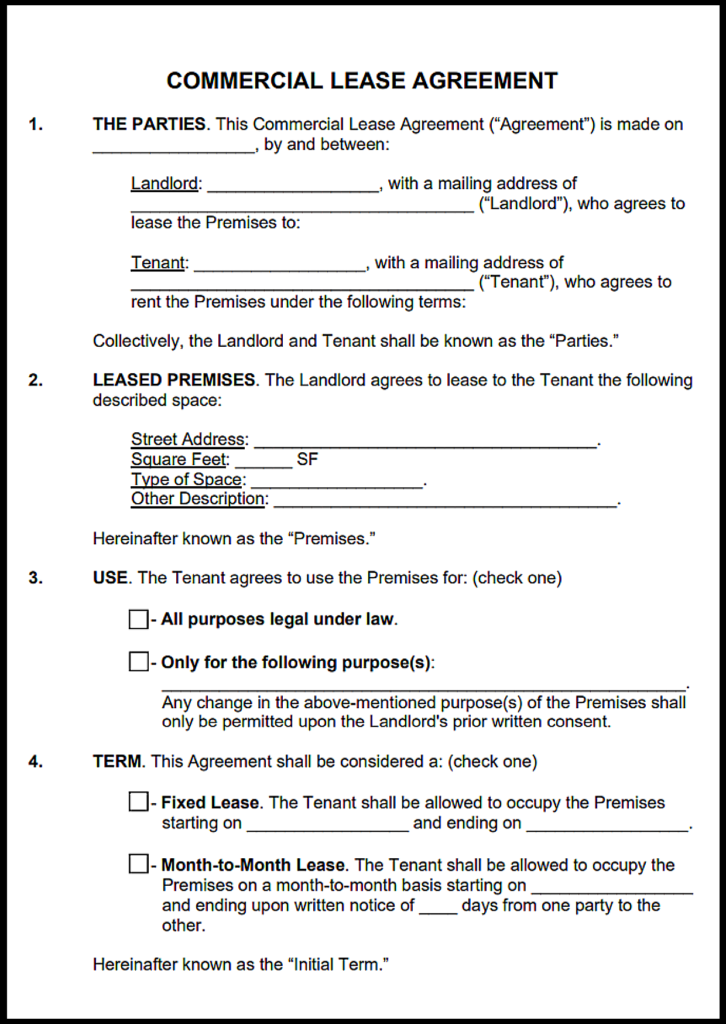
Free Ontario Commercial Lease Agreement Template
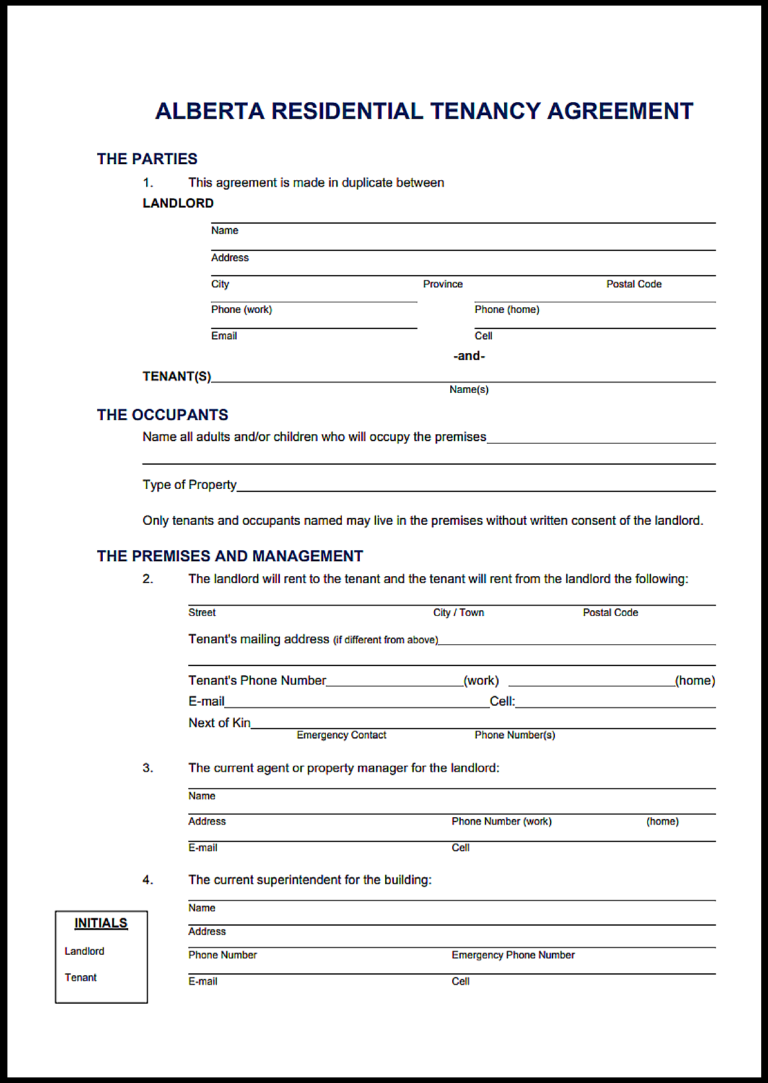
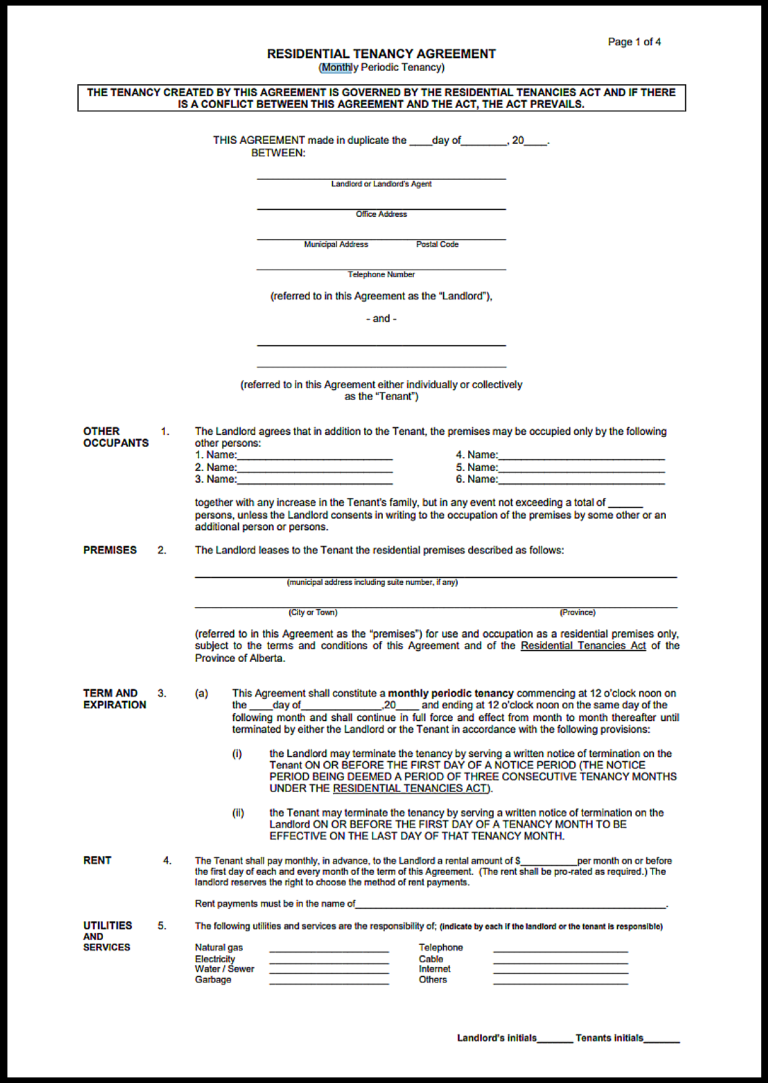
Use this simple template to create your agreement. Fill in the blanks based on your situation.
Ontario Commercial Lease Agreement (image)
This template is a basic starting point. For complex leases, always review carefully or consult a professional.
Key Clauses Every Commercial Lease Must Include
Lease Term & Renewal Options
- Fixed term (e.g., 3 or 5 years)
- Option to renew
- Clear renewal conditions
Tip: Always review renewal rights carefully to avoid losing your business location.
Rent, Additional Costs & Increases
In most commercial leases, rent has two parts:
- Base rent (fixed monthly amount)
- Additional rent (TMI) → Taxes, Maintenance, Insurance
Also check:
- Rent increase clauses
- Annual escalation percentage
Many tenants forget TMI costs and face higher expenses later.
Permitted Use Clause
This defines what business activities are allowed.
Example:
- “Retail bakery only”
- “Office use only”
If you want to expand later, this clause can restrict you.
Maintenance & Repair Responsibilities
Clearly divide who handles:
- Repairs
- Cleaning
- Structural maintenance
Disputes often happen here if not clearly written.
Assignment & Subleasing
This clause answers:
- Can you transfer the lease?
- Can you sublet to another business?
Important if your business grows or closes.
Default & Termination Rules
This explains:
- What happens if rent is not paid
- Penalties
- Eviction process
Commercial tenants do not receive the same statutory framework as residential tenants under the Residential Tenancies Act. The lease and Ontario commercial-tenancy rules therefore need to be reviewed carefully before a landlord or tenant acts on a default.
For business properties, this commercial lease agreement template differs from the residential lease format but still requires compliance with Ontario lease laws. You should also understand how to draft a lease agreement properly and review lease agreement fundamentals. Supporting documents like a rent receipt may still apply.
Is a Commercial Lease Legally Valid in Ontario?
Yes. A commercial lease can be legally enforceable when the parties have properly agreed to its terms and the applicable legal requirements have been satisfied.
A written lease is strongly recommended because it clearly records the parties’ agreement.
A verbal agreement may have legal effect in some circumstances, but relying on an oral arrangement can create serious proof and enforceability problems, particularly where land interests are involved.
Best practice: Always use a written lease.
Unlike residential leases:
- No standard government commercial lease form is required
- Commercial tenancies are generally not governed by the RTA
- The lease, Commercial Tenancies Act and other applicable law govern the relationship
Ontario-Specific Rules You Should Know
Here are key facts many people miss:
- Commercial leases are generally governed by the negotiated lease, the Commercial Tenancies Act and other applicable law
- Commercial rent is generally governed by the lease rather than residential rent-control rules
- Permitted-use clauses should match the business the tenant intends to operate
- Municipal zoning and other approvals can affect whether the proposed business use is permitted
Example: Before signing a lease for a restaurant, confirm that the proposed use is permitted for the property and that the required municipal approvals can be obtained.
How to Fill Out the Commercial Lease Template (Step-by-Step)
Follow these simple steps:
Step 1: Enter Correct Legal Names
- Use registered business name
- Include full legal names
Step 2: Clearly Describe Property
- Full address
- Type of space
Step 3: Define Rent Structure
- Base rent
- Additional costs (TMI)
Step 4: Add Permitted Use Carefully
- Be specific
- Think about future expansion
Step 5: Review Termination Clauses
- Exit options
- Penalties
Step 6: Sign and Keep Copies
- Both parties should sign
- Keep a copy for records
Common Mistakes to Avoid
Many tenants and landlords make these errors:
- Not defining additional rent (TMI)
- Ignoring permitted use restrictions
- No exit clause
- Not checking zoning laws
- Signing without negotiation
Tip: Always read the lease slowly before signing.
Commercial Lease vs Residential Lease
| Feature | Commercial Lease |
Residential Lease
|
| Main statutory framework | Commercial Tenancies Act, lease terms and other applicable law |
Residential Tenancies Act
|
| Standard government lease form | No standard commercial lease form |
Standard lease requirements apply to most RTA-covered residential tenancies
|
| Rent regulation | Commercial rent is generally governed by the lease rather than residential rent-control rules |
Residential rent-control rules may apply depending on the unit and circumstances
|
| Negotiation | Lease terms are generally negotiated between the parties |
Statutory tenant protections limit some lease terms
|
| Dispute framework | Depends on the lease, Commercial Tenancies Act and applicable court process |
Residential disputes are generally handled through the Landlord and Tenant Board
|
Risks & Disputes in Commercial Leasing
Commercial lease disputes often turn on the exact wording of the lease. Before signing, pay particular attention to rent and additional rent, repair obligations, permitted use, assignment and subleasing, renewal options, default provisions, and early termination rights.
If a dispute develops, the lease should be reviewed alongside the Commercial Tenancies Act and other applicable Ontario law. A clause that looks simple can have significant consequences when the business is dependent on the premises.
FAQs
Is a commercial lease legally required in Ontario?
Ontario does not require every commercial tenancy to use a standard government lease form. However, a written lease is strongly recommended because it clearly defines the rights and responsibilities of the landlord and tenant. Ontario’s Statute of Frauds also contains formal requirements for certain leases and interests in land, subject to statutory exceptions.
Can rent be increased anytime?
Commercial rent is generally governed by the lease rather than residential rent-control rules. A landlord should follow the rent-increase provisions contained in the commercial lease and any applicable law. The parties should therefore review the rent and additional-rent clauses before making or accepting an increase.
Can I break a commercial lease early?
The answer depends on the lease and the circumstances. A tenant may have an early-termination right if the lease provides one, or the parties may agree to end the tenancy early. Otherwise, ending a fixed-term commercial lease early can expose a tenant to contractual consequences.
Who pays property taxes in commercial leases?
In many commercial leases, tenants pay some or all property taxes as additional rent or through a TMI arrangement. However, this depends on the lease agreement. The lease should clearly state which taxes, maintenance expenses and insurance costs are payable by the tenant.
Do I need a lawyer for a commercial lease?
Hiring a lawyer is not mandatory for every commercial lease, but legal review can be especially helpful for complex or high-value leases. A lawyer can review terms involving renewal rights, personal guarantees, assignment, repairs, default, insurance and termination before you sign.