Ontario Vehicle Bill of Sale Form | Free Template
Ontario Vehicle Bill of Sale is one of the most important documents in a private car sale. It proves the deal happened, protects both sides, and helps complete the ownership transfer smoothly.
If you are buying or selling a used car in Ontario, this guide will walk you through everything in simple steps — including a free template you can use right away.
A vehicle bill of sale is a simple document that shows a car was sold from one person to another. It includes details about the buyer, seller, vehicle, and price.
In Ontario, it is especially important in private sales (when you buy directly from someone, not a dealership). I’ve seen private vehicle sales in Ontario turn into stressful disputes because the parties relied on text messages or handwritten notes that left out key details like the VIN, sale date, or ‘as-is’ condition. In my experience, a properly completed bill of sale can save both buyers and sellers from registration delays, payment disagreements, and ownership headaches later on.
Last Updated: September 2026
Table of Contents
ToggleFree Ontario Vehicle Bill of Sale Template
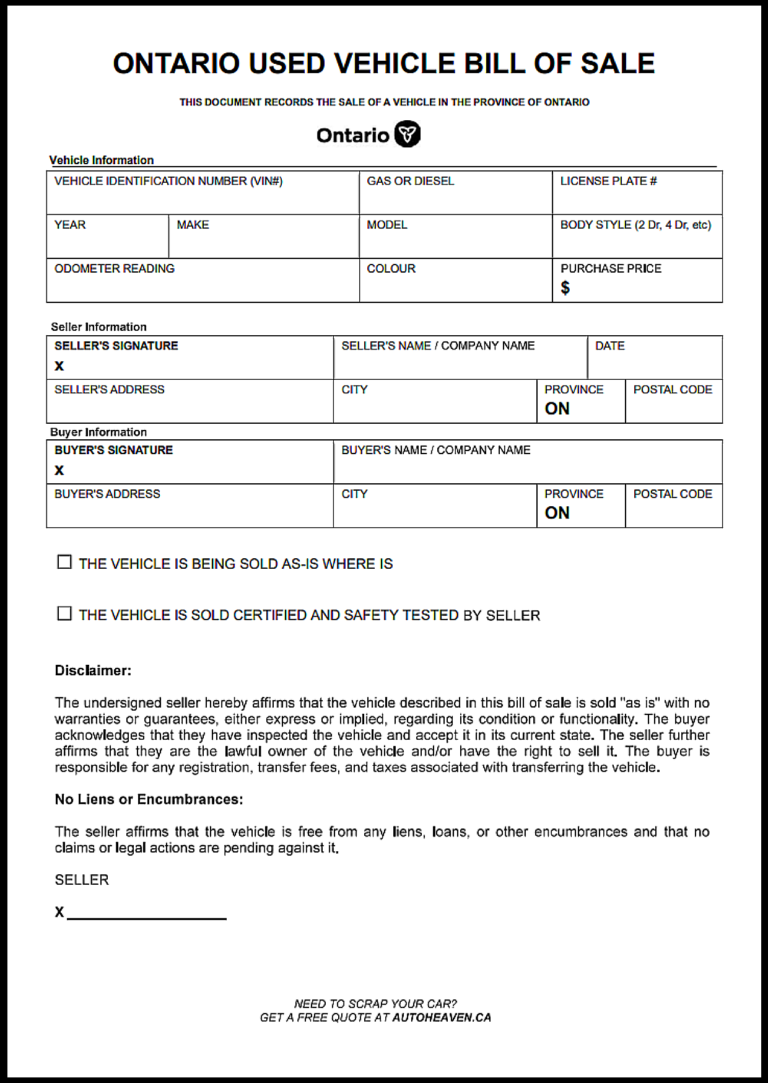
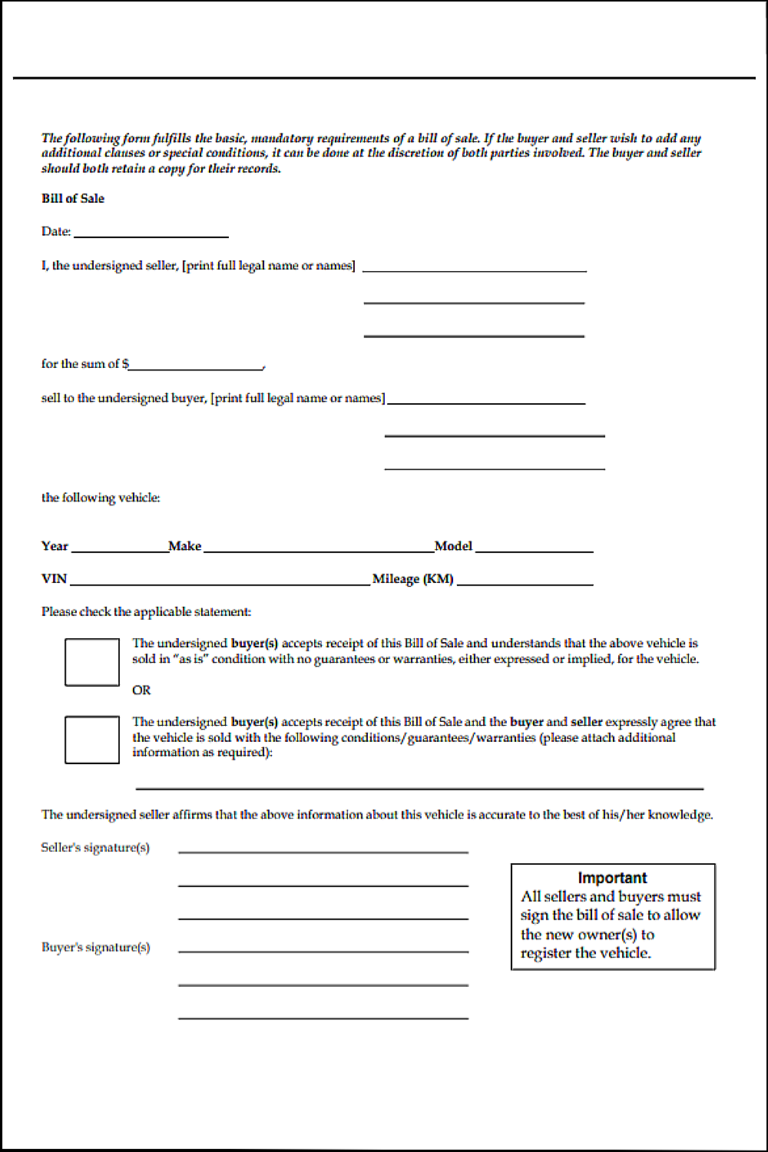
Below is a clean, ready-to-use template you can copy and use:
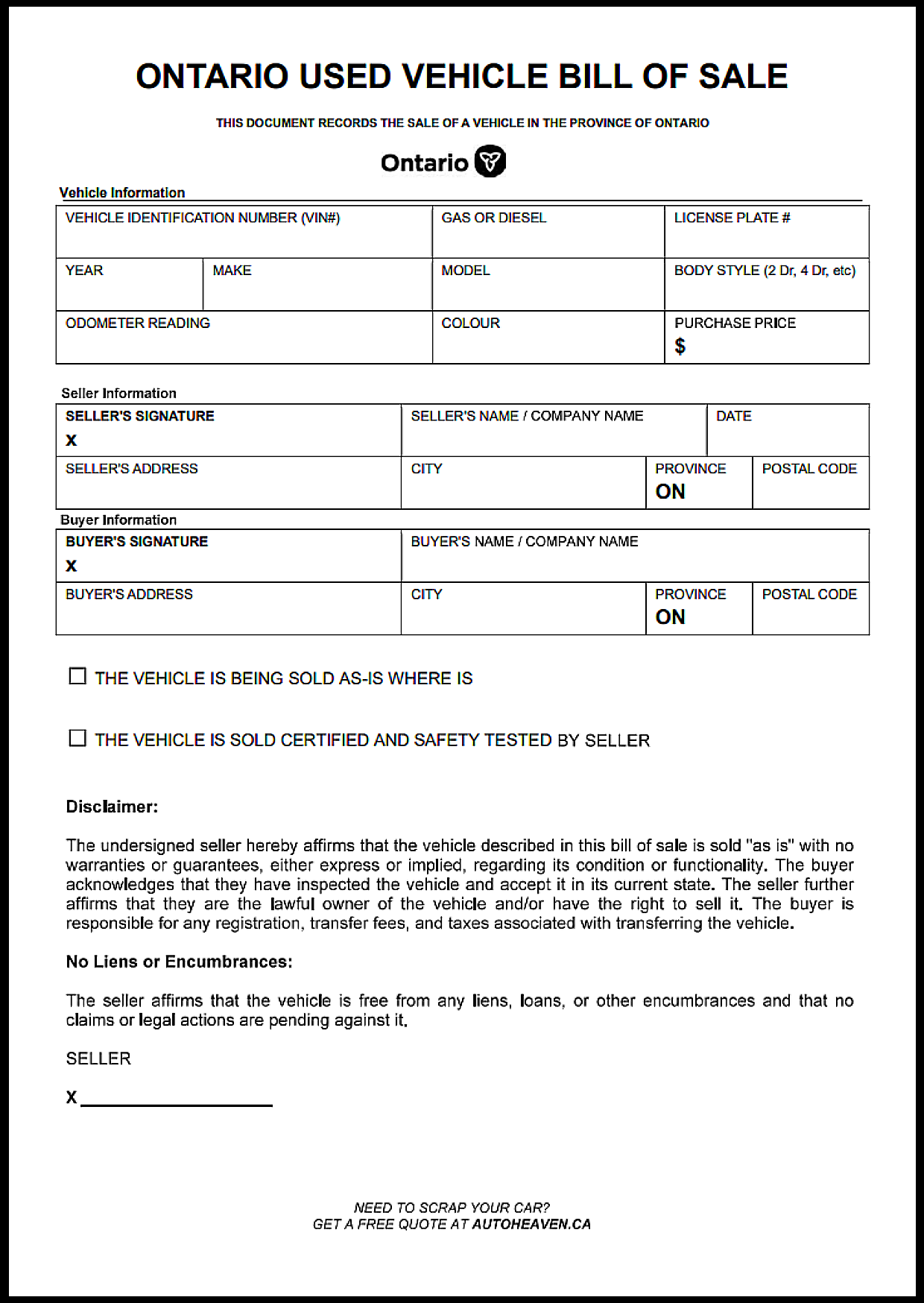
Tip: Always keep a signed copy for both buyer and seller. You may need it later for legal or registration purposes.
Ontario Vehicle Bill of Sale Laws and Registration Rules
| Topic / Issue | Ontario Legal Rule | Governing Statute |
|---|---|---|
| Governing legislation | Ontario vehicle sales and registration are governed primarily by provincial laws, including the Highway Traffic Act and related regulations, while the Sale of Goods Act can also apply to the contract of sale. | Highway Traffic Act, R.S.O. 1990, c. H.8; Sale of Goods Act, R.S.O. 1990, c. S.1 |
| Who can sign | The Sale of Goods Act addresses contractual capacity, while the Highway Traffic Act requires the seller to complete and sign the transfer application on the vehicle portion of the permit when transferring the vehicle. | Sale of Goods Act, R.S.O. 1990, c. S.1, s. 3; Highway Traffic Act, R.S.O. 1990, c. H.8, s. 11(1) |
| Witness requirement | Ontario does not generally require a witness for an ordinary private vehicle bill of sale. | N/A |
| Notarization | A normal private vehicle sale does not generally require notarization. For a qualifying family gift, the required sworn statement must be completed and signed before a Commissioner of Oaths or Commissioner for Taking Affidavits. | Retail Sales Tax Act, R.R.O. 1990, Reg. 1012 |
| Age and legal capacity | Ontario’s age of majority is 18. Contractual capacity for a vehicle purchase is governed by the general law of contract rather than a special minimum-age rule in the Highway Traffic Act. | Age of Majority and Accountability Act, R.S.O. 1990, c. A.7; Sale of Goods Act, s. 3 |
| Registration deadline | The purchaser must apply for a new vehicle permit within 6 days after becoming the owner of the vehicle. | Highway Traffic Act, R.S.O. 1990, c. H.8, s. 11(2) |
| Required vehicle details | Ontario’s official guidance says a bill of sale should include the vehicle identification number (VIN), make, year and power source, body type, colour and model if available, purchase price, seller name, address and signature, buyer name and address, and the sale or purchase date. | Ontario Ministry of Transportation guidance |
| “As Is” wording | If the parties agree that the vehicle is being sold in its current condition, the bill of sale can clearly state the agreed condition, including an appropriate “as-is” term where applicable. | Contract terms and applicable law |
| UVIP requirement | The seller is legally required to provide the buyer with a valid Used Vehicle Information Package (UVIP) when selling a used motor vehicle. | Highway Traffic Act, s. 11.1(1) |
| Registration filing requirement | When registering a used vehicle, the buyer generally needs proof of purchase such as a bill of sale, the original vehicle permit with the transfer portion completed, the UVIP where required, proof of insurance, and a Safety Standards Certificate where required. | Ontario Ministry of Transportation guidance |
| Incorrect VIN | The VIN on the vehicle should match the VIN on the permit and other transaction documents. Ontario law also provides consequences where false vehicle information or a knowingly false VIN is submitted in documents required under the Highway Traffic Act. | Highway Traffic Act |
| Undervaluation of vehicle | If the purchase price is below the applicable Canadian Red Book value, Ontario may calculate RST using the applicable fair-market-value rules. A qualifying appraisal may support a lower taxable value in the circumstances permitted by Ontario’s rules. | Ontario RST rules |
| Ontario plate rules | Ontario licence plates stay with the owner rather than the vehicle, so the seller generally removes and keeps the plates. | Ontario Ministry of Transportation guidance |
| Ontario UVIP difference | Ontario requires the seller to provide a UVIP during applicable private used-vehicle sales. | Highway Traffic Act, s. 11.1 |
| Recent updates | Ontario’s Electronic Commerce Act generally recognizes electronic signatures and electronic documents, subject to the Act’s requirements and exceptions. | Electronic Commerce Act, 2000 |
Ontario’s official guidance requires a seller to provide the buyer with a valid Used Vehicle Information Package in an applicable private used-vehicle sale. The buyer also has 6 days after becoming the owner to apply for a new vehicle permit. Keep the UVIP, signed transfer paperwork and proof of purchase together so the registration process is easier to complete.
Check the VIN against the vehicle and the ownership permit before signing anything. Ontario also has specific RST valuation rules for used vehicles. If the purchase price is below the applicable Canadian Red Book value, the buyer may need an appraisal to support a lower taxable value.
To avoid registration problems and costly mistakes, use the free Ontario Vehicle Bill of Sale template below and fill it out carefully.
What Is an Ontario Vehicle Bill of Sale?
In simple terms, a vehicle bill of sale is proof that a car was sold.
For an Ontario private sale, the bill of sale is the written record of the transaction and can be used as proof of purchase when the buyer registers the vehicle. Ontario’s official guidance also specifies information that must be included on a bill of sale for a vehicle transaction.
For an Ontario private sale, the bill of sale records the transaction between the seller and buyer. It identifies the vehicle and records important terms such as the purchase price and sale date.
Is It Legally Required in Ontario?
A bill of sale is not always a separate mandatory document in every circumstance, but it is an important part of the vehicle registration process and is specifically accepted as proof of purchase.
It is important because:
- It supports ownership transfer
- It helps establish the purchase price for registration and tax purposes
- It acts as written evidence of the transaction
Without proper proof of purchase, things can become complicated, especially during registration or disputes. Ontario’s registration guidance specifically lists a bill of sale or other proof of purchase among the documents used to register a used vehicle.
Important Ontario Rules You Must Know
When selling or buying a vehicle in Ontario, there are a few key rules you cannot ignore.
Used Vehicle Information Package (UVIP)
In applicable private sales, the seller must provide a UVIP. This document contains important vehicle history and lien information.
The buyer needs the UVIP when registering a used vehicle purchased from a private seller, subject to the applicable exemptions.
Ownership Transfer Process
After buying the vehicle, the buyer has only 6 days to register it.
You can confirm the official registration process through Ontario Ministry of Transportation.
To complete this process, these documents are usually needed:
- Bill of sale or other proof of purchase
- UVIP, where applicable
- Original ownership permit with the completed transfer portion
- Safety Standards Certificate, if required
- Proof of insurance
Safety Certificate
A Safety Standards Certificate confirms that the vehicle met Ontario’s minimum safety standards on the date it was issued. It is not required for every type of vehicle transfer or every vehicle. For applicable used-vehicle transfers, a certificate may be required to register the vehicle and obtain plates.
This document is widely used when transferring ownership of a vehicle in Ontario and acts as a key record for both buyer and seller. For a complete overview of how this fits into the legal process, refer to the complete bill of sale guide, along with more specific formats like the car bill of sale template.
Key Elements Every Bill of Sale Must Include
A proper bill of sale should not miss any important detail. Even a small mistake can cause problems later.
The most important elements are:
- Full names and contact details of both parties
- Complete vehicle information, especially the VIN
- Correct sale price and date
- Vehicle information such as make, year, power source, body type, colour and model where applicable
- Signatures of the buyer and seller
Ontario’s official guidance specifically lists the VIN, make, year and power source, body type, colour and model if available, purchase price, seller information and signature, buyer information, and sale date.
Among all these, the VIN is especially important. Check it against the vehicle and ownership permit before completing the transaction.
In many cases, this form is supported by variations such as the motorcycle sale document or the trailer transfer agreement, depending on the type of vehicle involved. Understanding how to write a bill of sale in Ontario can also help ensure accuracy.
How to Fill It (Simple Example)
Let’s understand with a quick real-life situation.
Suppose Raj is selling his car to Mohit. They sit together and fill the bill of sale.
First, they write their full names and addresses. Then they carefully enter vehicle details, including the VIN and mileage.
After that, they mention the exact price (for example, $7,500). Finally, both sign the document and keep copies.
This gives both parties a clear written record of what was agreed and makes it easier to check the registration paperwork later.
Common Mistakes to Avoid
A few avoidable errors can create registration or tax problems in Ontario, especially when the VIN, UVIP, purchase price, or transfer paperwork is incomplete.
For example, some sellers write a lower price to save tax. Others forget to include the VIN or do not provide the UVIP.
Here are some common errors to watch out for:
- Missing or incorrect VIN
- Not providing the UVIP when required
- Underreporting the sale price
- Not signing the document
- Relying only on a verbal agreement
Avoiding these mistakes can save you time, money, and stress.
Bill of Sale vs Ownership Permit
Many people confuse these two documents, but they serve different purposes.
| Bill of Sale |
Ownership Permit
|
| Written evidence of the sale and proof of purchase |
Ontario government record showing the registered owner
|
| Created by the buyer and seller |
Issued by the Ontario government
|
| Shows details such as price and date |
Used as part of the vehicle registration and transfer process
|
The buyer generally needs both the seller’s transfer paperwork and proof of purchase to complete the registration process.