Living Will vs Power of Attorney Alberta Guide
Living Will vs Power of Attorney Alberta is one of the most common questions in estate planning. Many people think both documents are the same, but under Alberta law, they are completely different and serve separate purposes.
Both documents help protect your decisions if you cannot speak for yourself due to illness, injury, or loss of mental capacity. One focuses on your healthcare choices, while the other manages your financial and legal matters.
This article explains everything in simple English so you can clearly understand the difference and choose what you need.
In Alberta, planning for the future is not just about writing a will. You also need to prepare for situations where you are alive but unable to make decisions. This is where a Living Will (Personal Directive) and Power of Attorney become important.
Under Alberta law, these documents allow you to choose trusted people to act on your behalf. I’ve seen Alberta families assume one document covers everything, only to face delays and disagreements later because no one had proper authority to handle medical or financial decisions. In stressful situations, even close family members can run into legal problems if these documents are missing or prepared incorrectly.
Last Updated: August 2026
Alberta Living Will and Power of Attorney Legal Differences
| Topic / Issue | Alberta Legal Rule | Governing Statute |
|---|---|---|
| Governing Legislation | Alberta uses the Personal Directives Act for Personal Directives and the Powers of Attorney Act for powers of attorney. A Personal Directive addresses personal matters, while an Enduring Power of Attorney gives authority over financial decisions. | Personal Directives Act, RSA 2000, c P-6 and Powers of Attorney Act, RSA 2000, c P-20 |
| Federal Jurisdiction | The Personal Directive and Enduring Power of Attorney requirements discussed in this article are governed primarily by Alberta law. | Personal Directives Act and Powers of Attorney Act |
| Jurisdiction | Both documents are governed primarily by Alberta provincial law. | Personal Directives Act and Powers of Attorney Act |
| Recent Amendments | Administrative updates affecting capacity assessment processes should be checked against Alberta’s current legislation and official legislative history. | Adult Guardianship and Trusteeship Act |
| Who Can Sign | The person making a Personal Directive is commonly referred to as the “Maker,” while the person granting a power of attorney is the “Donor.” | PDA s. 3; PAA s. 2 |
| Witness Requirements | A Personal Directive must be signed and dated in front of a witness, who must sign in the Maker’s presence. Powers of attorney are subject to their own execution requirements under Alberta law. | PDA s. 5; PAA s. 2(4) |
| Witness Disqualification | For a Personal Directive, the witness cannot be the appointed agent, the agent’s spouse or adult interdependent partner, the Maker’s spouse or adult interdependent partner, or certain other disqualified persons. | PDA s. 5(4); PAA s. 2(5) |
| Notarization | A Personal Directive does not need to be notarized or commissioned. An Enduring Power of Attorney has its own execution requirements. | N/A |
| Age Requirement | The Maker or Donor must be at least 18 years old. | PDA s. 3(1); PAA s. 2(b) |
| Mental Capacity Requirement | The person making the document must have the capacity required by Alberta law and understand the nature and effect of making the document. | PDA s. 3(1); PAA s. 2(a) |
| Timing Requirement | Both documents should be made while the person has the capacity required to make them. An Enduring Power of Attorney can be drafted to take effect immediately, on a specified date or event, or when the donor loses capacity. | PDA s. 3; PAA s. 2 |
| Enduring Clause Requirement | An Enduring Power of Attorney must meet Alberta’s statutory requirements for an enduring power of attorney, including the required statement concerning incapacity. | Powers of Attorney Act, s. 7(b) |
| Personal Directive Requirement | A Personal Directive can appoint one or more agents, provide instructions without appointing an agent, or do both. | Personal Directives Act, s. 7 |
| Personal Directive Registry | Alberta offers voluntary registration for Personal Directives. The Registry helps authorized healthcare providers determine whether a Personal Directive exists and how to contact the agent(s), if any. | Personal Directives Act |
| Power of Attorney Registration | There is no Alberta central registry comparable to the Personal Directives Registry for Enduring Powers of Attorney. | Powers of Attorney Act |
| Real Estate Filing Requirement | If a power of attorney is used for a land-title transaction, the applicable Land Titles registration requirements must be followed. | Powers of Attorney Act |
| Invalid Due to Improper Witnessing | The Personal Directive and power of attorney must satisfy their applicable execution requirements, including the rules governing who may act as a witness. | PDA s. 5(4); PAA s. 2(5) |
| Invalid Due to Lack of Capacity | The Maker or Donor must have the capacity required by Alberta law and understand the nature and effect of making the document. | PDA s. 3(1); PAA s. 2 |
| Invalid Due to Missing Enduring Clause | A power of attorney that does not meet Alberta’s requirements for an enduring power of attorney may not continue to operate after the donor loses capacity. | PAA s. 7 |
| Alberta Two-Document System | Alberta uses a Personal Directive for personal matters and an Enduring Power of Attorney for financial authority, so these documents address different areas of decision-making. | Personal Directives Act and Powers of Attorney Act |
| Alberta Registry Difference | Alberta’s Personal Directives Registry helps authorized healthcare providers determine whether a Personal Directive exists and how to contact the agent(s), if any. | Personal Directives Act |
The important Alberta distinction is between personal and financial authority. A Personal Directive addresses personal matters, while an Enduring Power of Attorney gives authority over financial matters. Because the documents serve different purposes, they should not be treated as interchangeable.
An Enduring Power of Attorney must meet Alberta’s requirements for enduring status. The document should clearly establish how and when the Attorney’s authority is intended to operate, particularly if authority is to continue or begin in connection with incapacity.
The witness requirements should be followed carefully. The people who are disqualified from witnessing a Personal Directive should not sign as witnesses, and the applicable execution requirements for a power of attorney should also be followed.
Download the free Alberta Living Will and Power of Attorney template below to help organize your planning, but the completed documents should be checked against Alberta’s current legal requirements.
Understanding the Key Difference
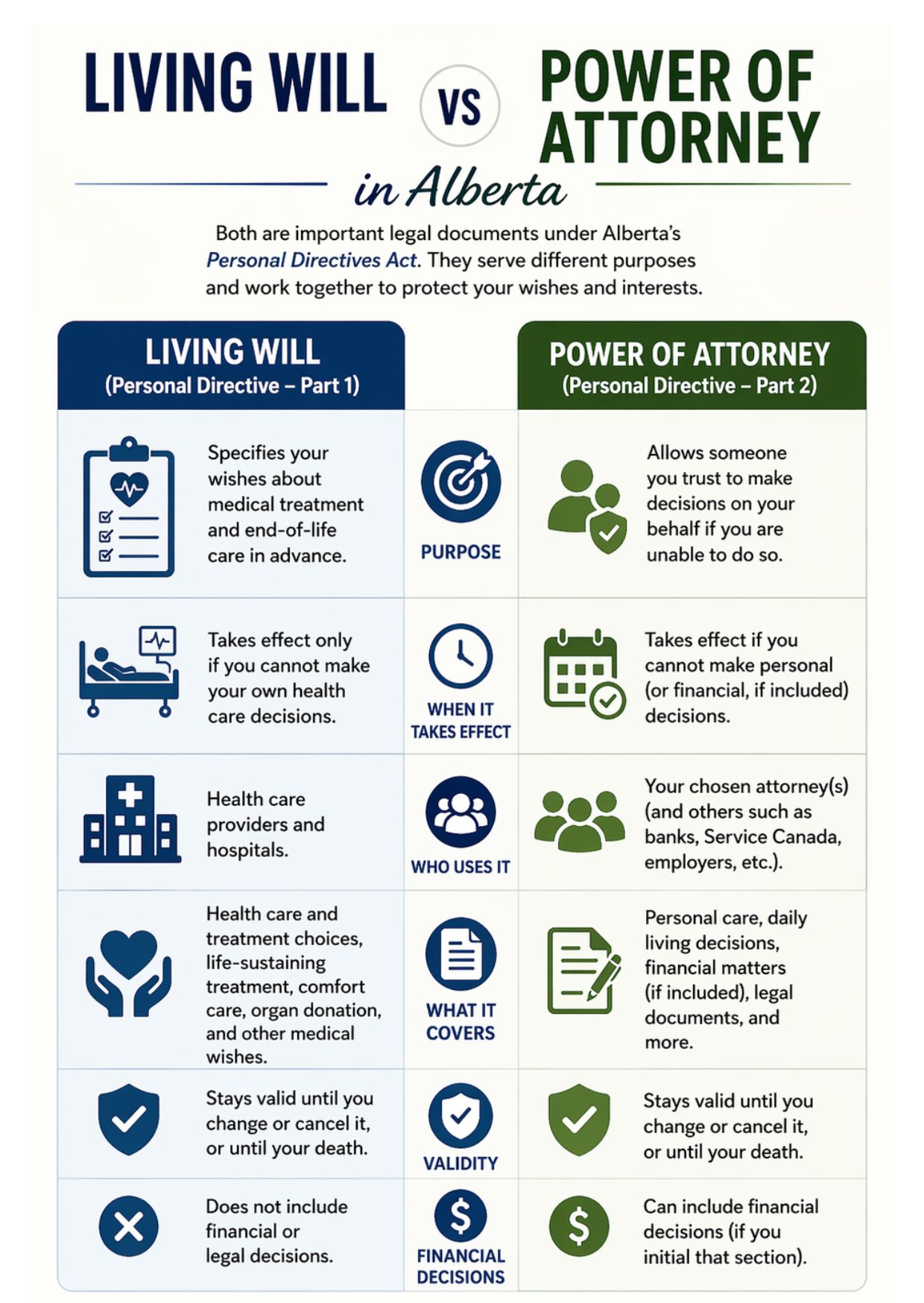
The main difference is the type of authority each document addresses. In Alberta, a Personal Directive deals with personal matters, while an Enduring Power of Attorney gives authority over financial matters.
They address different areas of authority. A Personal Directive does not replace an Enduring Power of Attorney for financial matters, while an Enduring Power of Attorney does not replace a Personal Directive for personal matters.
Because they address different areas of authority, many people include both documents as part of broader advance planning.
What is a Living Will in Alberta? (Personal Directive)
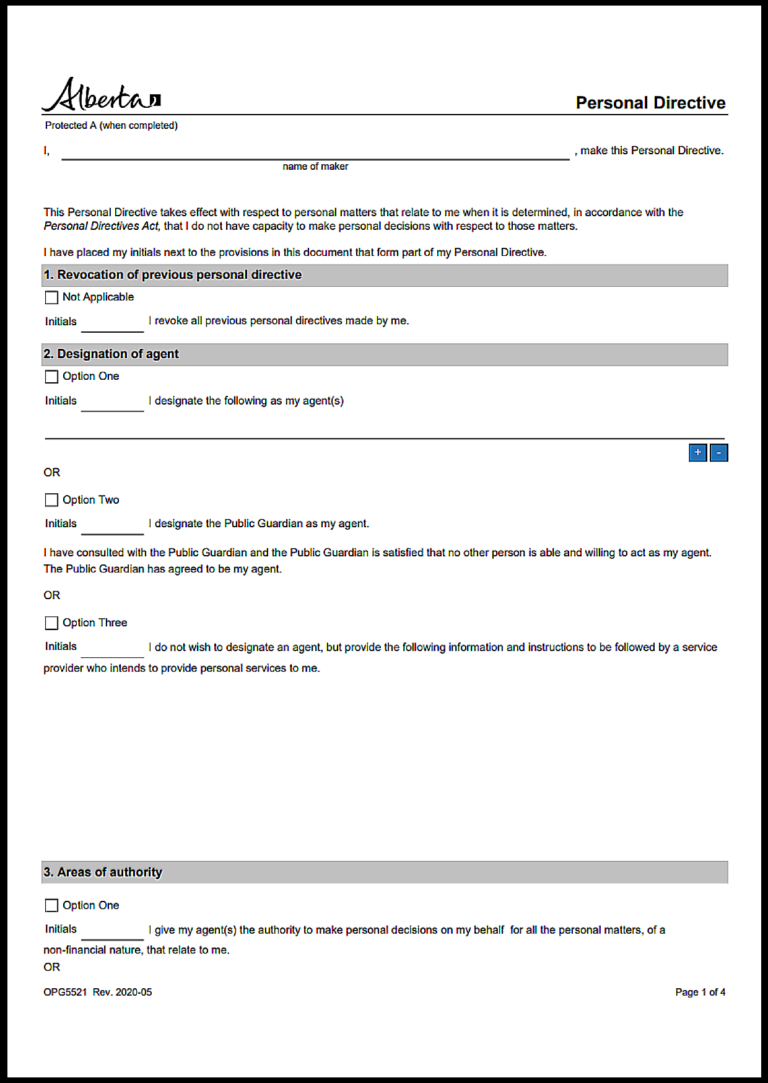
In Alberta, the formal legal document is a Personal Directive. It can record instructions about personal matters and can appoint an agent to make personal decisions when the Maker lacks capacity.
What It Covers
This document addresses personal matters, including healthcare and personal care. It can contain instructions about treatment and other personal decisions.
Some common areas it covers include:
- Medical treatment decisions
- End-of-life care
- Life support preferences
- Daily care instructions
Who Makes Decisions
You can appoint one or more agents. Once the Personal Directive is enacted, an agent can make decisions within the authority granted by the directive and must follow any clear instructions it contains.
If you do not appoint an agent, the Personal Directive can still provide instructions to service providers. The effect of those instructions depends on the applicable decision and Alberta law.
When It Starts
A Personal Directive is enacted when the Maker has been declared incapable of making the relevant personal decision. An agent does not have legal authority until the directive has been enacted.
Real-Life Example
If you are unable to make a personal decision, your Personal Directive may provide instructions and, if it has appointed an agent, the agent may make decisions within the authority granted once the directive is enacted.
Understanding the difference between these documents is important for proper estate planning. Both play different roles within the Alberta will framework.
What is a Power of Attorney in Alberta?
An Enduring Power of Attorney is a legal document that gives another person authority to make financial decisions on your behalf.
What It Covers
An Enduring Power of Attorney gives authority over financial matters specified in the document, such as:
- Banking and accounts
- Paying bills
- Property management
- Investments
Types of POA
Alberta distinguishes between ordinary powers of attorney and Enduring Powers of Attorney, with the enduring form designed to continue or take effect in relation to incapacity.
An Enduring Power of Attorney can continue if you lose capacity, depending on how the document is drafted.
A non-enduring power of attorney does not have the same statutory ability to continue through the donor’s incapacity as an Enduring Power of Attorney.
When It Starts
An Enduring Power of Attorney can come into effect when it is signed, on a specific date or event, or when the donor loses capacity, depending on the terms of the document.
Real-Life Example
If the Enduring Power of Attorney grants the relevant authority, your Attorney can manage financial matters such as paying bills, dealing with accounts and managing property.
Side-by-Side Comparison (Living Will vs POA)
| Feature | Living Will (Personal Directive) |
Power of Attorney
|
| Purpose | Personal and healthcare decisions |
Financial decisions
|
| Decision Maker | Agent | Attorney |
| Activation | When the Personal Directive is enacted after incapacity is established |
As specified in the Enduring Power of Attorney, including immediately, on a date/event, or on incapacity
|
| Covers Money | No | Yes |
| Covers Healthcare | Yes | No |
Do You Need Both Documents in Alberta?
Many Albertans choose to have both documents because they address different areas of decision-making. They can work together to address both personal and financial decision-making needs.
A Personal Directive addresses personal matters, while an Enduring Power of Attorney addresses financial authority. Having only one document may leave the other area of decision-making unaddressed.
Without appropriate planning, family members may face uncertainty about who has authority to make a particular decision. In some circumstances, another legal process may be required.
Having both documents can make it clearer who has authority over personal and financial matters and can help communicate your wishes.
A living will focuses on healthcare preferences, while a power of attorney handles decision-making authority. You may also consider a personal directive for broader coverage.
Alberta Legal Rules You Must Follow
Each document must satisfy the Alberta legal requirements that apply to its execution and intended use.
For Living Will (Personal Directive)
The Personal Directive must be in writing, dated, signed in accordance with Alberta’s requirements, and witnessed.
For Power of Attorney
The document must satisfy Alberta’s execution requirements. If it is intended to be an Enduring Power of Attorney, it must meet the statutory requirements concerning incapacity.
Who Can Be a Witness
For a Personal Directive, the witness must meet Alberta’s eligibility requirements and cannot be a disqualified person such as the appointed agent or certain spouses or partners.
Common Mistakes to Avoid
A common planning mistake is treating a Personal Directive and an Enduring Power of Attorney as interchangeable. They address different areas of authority, so each document should be prepared for its intended purpose.
Choose someone who is trustworthy, responsible and willing to take on the authority given by the document.
Clear instructions can make it easier for an agent or service provider to understand the wishes and authority expressed in the document.
Other common mistakes include:
- Not updating documents after major life changes
- Not informing family members about the documents
- Keeping documents in a place where no one can find them
When Should You Create These Documents?
These documents should be prepared while you have the capacity required to make them. Waiting until capacity is in question can make planning more difficult.
You should consider creating them:
- Before serious illness or aging
- When buying property or managing finances
- After marriage or having children
Making the documents while you have capacity allows you to record your wishes and decide who, if anyone, should have authority to act on your behalf.
Risks of Not Having These Documents
Without appropriate planning, family members may face uncertainty about who has authority to make personal or financial decisions. The applicable process depends on the type of decision involved.
In some circumstances, another legal process, including a court or trusteeship process, may be required when no appropriate authority has been put in place.
Without advance instructions or an appropriate decision-maker, the person making the decision may not have the same understanding of your wishes that you would have had yourself.
How to Choose the Right Person (Agent or Attorney)
Choose someone who understands your wishes and can handle the authority you are giving them. The role can involve significant personal or financial responsibility, depending on the document.
Qualities to Look For
Look for someone trustworthy, responsible and willing to take on the role. They should also understand your wishes and be able to carry out the authority given by the document.
Who You Can Choose
You can choose:
- Your spouse
- An adult child
- A close friend
- A professional (in some cases)
Make sure the person understands your wishes and is willing to take on the role.
FAQs
Is a Living Will the same as a Personal Directive in Alberta?
No, but they are closely related. In Alberta, the formal legal document is a Personal Directive. The term “Living Will” is commonly used to describe written healthcare wishes, but it is not the statutory name of the Alberta document. A Personal Directive can contain instructions and can also appoint an agent.
Can one person be both my agent and attorney?
Yes, the same individual can be appointed in both documents if the person is eligible and willing to act. The roles remain legally separate, so the person’s authority depends on the terms of each document.
Do I need a lawyer to create these documents?
A lawyer is not required in every situation. Alberta provides government information and forms for Personal Directives, while there is no regulated form for an Enduring Power of Attorney. Legal advice can be particularly useful where the arrangement or financial situation is complex.
What happens if I don’t have these documents?
If you do not have appropriate documents in place, the applicable legal process depends on the type of decision involved. In some financial situations, a family member or friend may need to apply to court for trusteeship, while personal decisions are governed by Alberta’s substitute decision-making rules.