Living Will vs Power of Attorney British Columbia (Free Guide)
Tip: In most estate planning situations, individuals prepare all three sections together so there is no confusion later.
Critical British Columbia Rules That Separate Living Wills From Power of Attorney
| Topic / Issue | British Columbia Legal Rule | Governing Statute |
|---|---|---|
| Governing Law for Living Will Equivalent | In British Columbia, the legal equivalent of a Living Will is an Advance Directive governed under Part 2.1 of the Health Care (Consent) and Care Facility (Admission) Act. Representation Agreements are governed separately. | Health Care (Consent) and Care Facility (Admission) Act, R.S.B.C. 1996, c. 181; Representation Agreement Act, R.S.B.C. 1996, c. 405 |
| Governing Law for Enduring POA | Financial Powers of Attorney are governed separately under BC’s Power of Attorney Act. | Power of Attorney Act, R.S.B.C. 1996, c. 370 |
| Jurisdiction Type | Both documents are governed entirely under provincial British Columbia law. | Health Care (Consent) and Care Facility (Admission) Act; Power of Attorney Act |
| Electronic Signing & Remote Witnessing | BC permanently modernized these planning documents to allow electronic formats and remote witnessing rules. | Wills, Estates and Succession Amendment Act, 2020; Power of Attorney Regulation, B.C. Reg. 20/2011; Representation Agreement Regulation, B.C. Reg. 67/2020 |
| Who Can Sign an Advance Directive | The capable adult must sign. If physically unable, another adult may sign in the adult’s presence and by express direction. | Health Care (Consent) and Care Facility (Admission) Act, s. 19.5(1) |
| Who Can Sign an Enduring POA | The capable adult and the named attorney must sign the document. | Power of Attorney Act, s. 16; s. 17(1) |
| Witness Rules for Advance Directive | Two witnesses are normally required, but only one witness is needed if that witness is a practicing BC lawyer or BC notary public. | Health Care (Consent) and Care Facility (Admission) Act, s. 19.5(1)-(2) |
| Witness Rules for Enduring POA | Two witnesses are normally required, but one practicing BC lawyer or BC notary public can act as the single witness. | Power of Attorney Act, s. 16(1)-(6) |
| Disqualified Witnesses for Advance Directive | The named health representative, their spouse, anyone under 19, and compensated care providers cannot witness the document. | Health Care (Consent) and Care Facility (Admission) Act, s. 19.5(2) |
| Disqualified Witnesses for POA | The named attorney, their spouse, child, parent, employee, agent, or anyone under 19 cannot witness the document. | Power of Attorney Act, s. 16(1)-(6) |
| Notarization Rules | Neither document requires notarization to be legally valid. | Health Care (Consent) and Care Facility (Admission) Act, s. 19.5; Power of Attorney Act, s. 16 |
| Real Estate Exception | Enduring POAs involving land transactions must comply with Land Title certification requirements. | Land Title Act, s. 51 |
| Age Requirement | The adult must be at least 19 years old for both documents in British Columbia. | Health Care (Consent) and Care Facility (Admission) Act, s. 19.1; Power of Attorney Act, s. 11 |
| Capacity Requirement for Advance Directive | The adult must understand the consequences of giving or refusing healthcare consent directly in the document. | Health Care (Consent) and Care Facility (Admission) Act, s. 19.2 |
| Capacity Requirement for POA | The adult must understand the nature and extent of their property and that the attorney gains financial authority. | Power of Attorney Act, s. 12 |
| Expiration Rules | Neither document has a statutory expiry date and remains valid until revoked or otherwise terminated under law. | Health Care (Consent) and Care Facility (Admission) Act, s. 19.6; Power of Attorney Act, s. 29 |
| Mandatory Advance Directive Statement | The document must state that healthcare providers cannot provide treatment refused in the directive and no substitute decision-maker can override those instructions. | Health Care (Consent) and Care Facility (Admission) Act, s. 19.2(2)(a)-(b) |
| Mandatory Enduring POA Clause | The document must clearly state that the attorney’s authority continues despite later mental incapacity. | Power of Attorney Act, s. 14(1) |
| Filing Requirements | Neither document requires mandatory government filing to become legally active. | Health Care (Consent) and Care Facility (Admission) Act; Power of Attorney Act |
| Land Title Filing Requirement | An Enduring POA must be filed with the LTSA if used for selling, mortgaging, or transferring real estate. | Land Title Act |
| Invalid Combined Documents | A financial POA cannot authorize healthcare decisions, and healthcare directives cannot authorize financial control. Combining them improperly can invalidate healthcare instructions. | Power of Attorney Act, s. 11; Health Care (Consent) and Care Facility (Admission) Act, s. 19.15 |
| Attorney Signature Requirement | An attorney’s authority is not legally usable until the attorney signs the required section properly. | Power of Attorney Act, s. 17(1) |
| Caregiver Witness Problem | Paid caregivers, private nurses, or care staff acting as witnesses can invalidate Advance Directives. | Health Care (Consent) and Care Facility (Admission) Act, s. 19.5(2)(a) |
| Direct-to-Doctor Effect | A BC Advance Directive operates directly between the adult and healthcare providers without requiring family approval or substitute decision-makers for covered instructions. | Health Care (Consent) and Care Facility (Admission) Act, Part 2.1 |
| BC Age Difference | British Columbia requires adults to be at least 19, which is higher than several other Canadian provinces. | Health Care (Consent) and Care Facility (Admission) Act, s. 19.1; Power of Attorney Act, s. 11 |
One of the biggest misunderstandings in British Columbia is assuming a Power of Attorney automatically covers healthcare decisions. It does not. BC law completely separates financial authority from medical decision-making, which means an Enduring Power of Attorney cannot legally authorize treatment decisions or end-of-life instructions. I’ve seen families discover this only after hospitals refused to follow financial POA paperwork during emergencies because the person never completed an Advance Directive or Representation Agreement properly.
Another major issue is execution mistakes. Many people never realize the attorney must actually sign the Enduring Power of Attorney before it becomes legally usable. Others accidentally ask paid caregivers or care home staff to witness healthcare documents, which can invalidate the execution entirely under BC law. The strict age requirement also surprises families because British Columbia requires adults to be at least 19, unlike provinces where incapacity planning starts earlier.
Understanding the difference between a living will and a power of attorney is an important part of creating a complete estate plan. To see how these documents fit into broader personal planning, you can review the British Columbia living will template alongside the British Columbia power of attorney template, as each serves a distinct legal purpose.
Living Will vs Power of Attorney – Key Difference
Here is a clear comparison to help you understand quickly:
| Feature | Living Will (Advance Directive) |
Power of Attorney (POA)
|
| Purpose | Gives medical instructions |
Appoints decision-maker
|
| Control | You decide in advance |
Someone else decides for you
|
| Type of Decisions | Healthcare only |
Financial or medical
|
| When It Works | When you cannot communicate |
Based on conditions set
|
| Legal Authority | Doctors must follow instructions |
Attorney has legal authority
|
Living Will (Advance Directive in BC)
A living will is a written document where you clearly state your medical wishes.
Under British Columbia law, it is called an Advance Directive.
You do not need to appoint someone if your instructions are clear. Doctors will follow your written wishes when you cannot speak.
Power of Attorney (POA)
A power of attorney is a legal document where you appoint someone you trust.
This person (called an attorney or representative) makes decisions on your behalf.
There are two main types in British Columbia:
- Financial (Enduring Power of Attorney)
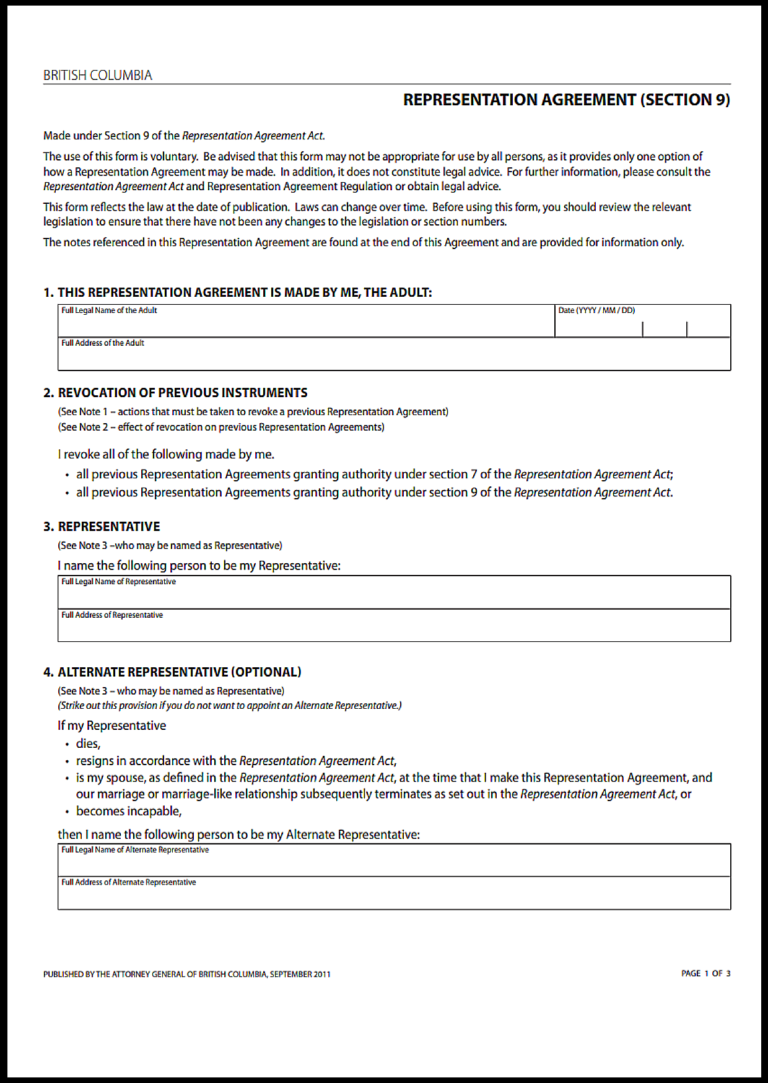
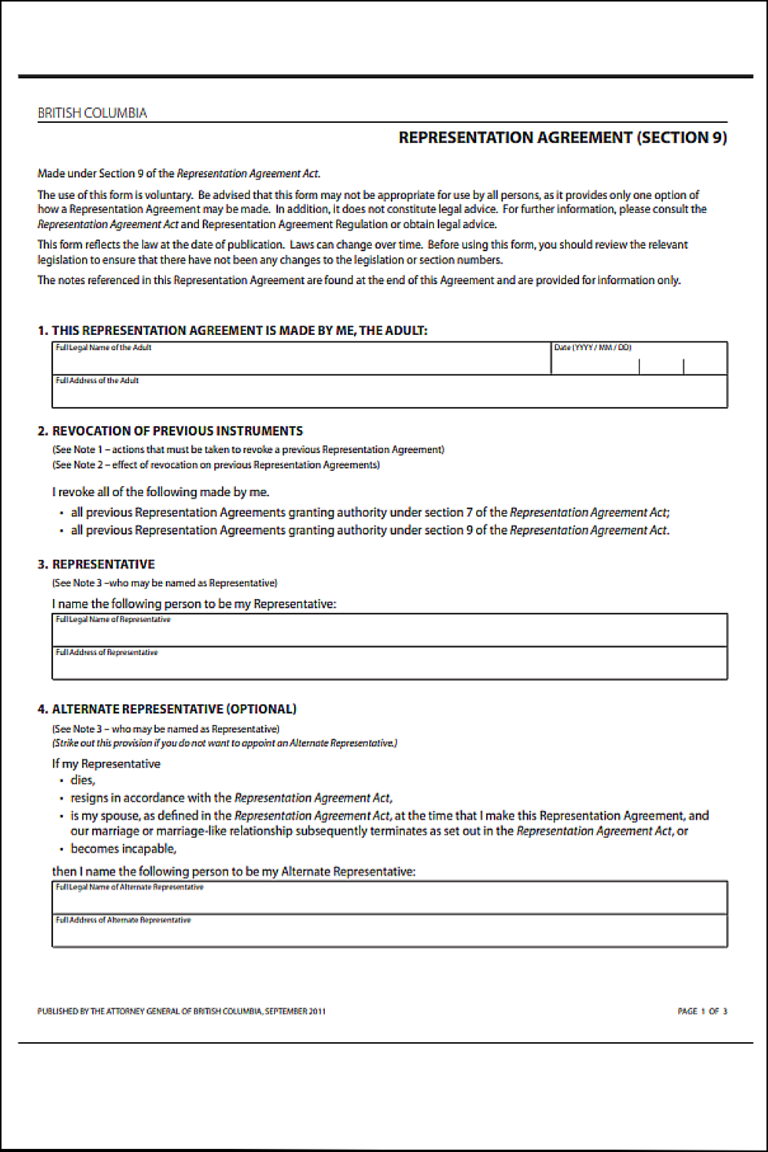
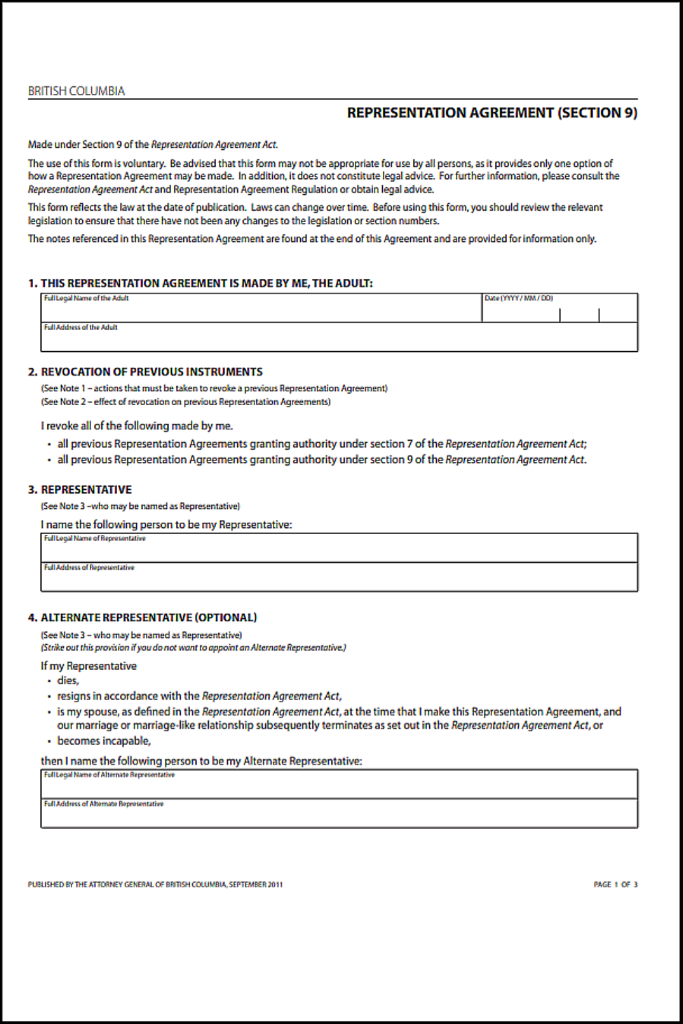
- Medical (Representation Agreement)
While a living will focuses on healthcare preferences, a power of attorney allows another person to make financial or legal decisions on your behalf. Depending on your needs, you may also benefit from preparing a medical power of attorney document or a financial power of attorney template to address specific decision-making responsibilities.
What Is a Living Will in British Columbia?
In British Columbia, a living will is legally known as an Advance Directive.
Under provincial healthcare consent laws, it allows you to give direct instructions to doctors about your treatment.
This document is used only when you are not capable of making decisions.
When You Need a Living Will
You should consider it if:
- You have a serious illness
- You are going for major surgery
- You are planning for old age
In real life, many families face stress because they do not know what their loved one wanted. A living will removes that confusion.
What Decisions It Covers
A living will can include:
- Life support (machines to keep you alive)
- Tube feeding
- Do Not Resuscitate (DNR) instructions
- Pain relief and comfort care
The key is clarity. Doctors follow clear instructions, not guesses.
Many individuals who create incapacity planning documents also prepare inheritance-related forms at the same time. For a more complete legal strategy, consider reviewing the British Columbia last will and testament template and the British Columbia will template guide to ensure both healthcare and estate wishes are properly documented.
What Is Power of Attorney in British Columbia?
A power of attorney allows someone you trust to manage your affairs.
Under British Columbia law, there are two important types.
Enduring Power of Attorney (Financial)
This type continues even if you lose mental capacity.
It covers:
- Banking
- Paying bills
- Managing property
- Handling investments
In most estate planning situations, this is essential to avoid financial problems during incapacity.
Representation Agreement (Medical POA in BC)
This is the BC version of a medical power of attorney.
It allows someone to:
- Make healthcare decisions
- Decide on personal care (living arrangements, support)
It is commonly used along with a living will.
When Should You Use Each Document? (Real-Life Scenarios)
Scenario 1 – Medical Emergency
If you are unconscious in a hospital:
- A living will gives direct instructions
- A representative steps in if something is unclear
This ensures fast and correct decisions.
Scenario 2 – Financial Management
If you cannot manage your finances:
- Your attorney pays bills
- Manages bank accounts
- Handles property
Without this, your family may need court approval.
Scenario 3 – Long-Term Incapacity
In cases like dementia:
- Living will guides medical care
- POA manages finances
- Representation agreement handles personal care
All three work together.
Can You Have Both in British Columbia?
Yes, and it is strongly recommended.
They serve different roles:
- Living will = instructions
- POA = decision-maker
Using both gives complete protection.
In practice, most well-prepared individuals have:
- Advance Directive
- Representation Agreement
- Enduring Power of Attorney
Legal Rules in British Columbia You Must Follow
Under British Columbia law, these documents must meet certain legal standards.
| Requirement | Rule in BC |
| Age |
Must be 19 or older
|
| Capacity |
Must understand what you are signing
|
| Witnessing |
Usually requires witnesses
|
| Clarity |
Instructions must be clear
|
| Validity |
Takes effect based on document terms
|
Laws That Apply
These documents are governed by:
- Representation Agreement Act
- Power of Attorney Act
- Health Care Consent rules
British Columbia residents can also review the official BC Government incapacity planning guide for additional information about advance directives, representation agreements, and powers of attorney.
How to Fill Out These Documents (Step-by-Step)
For Living Will
- Write clear medical instructions
- Avoid vague terms like “no extreme care”
- Be specific about treatments
Good example:
“I do not want life support if there is no chance of recovery.”
For Power of Attorney
- Choose a trusted person
- Clearly define their powers
- Set when it becomes active
You can choose:
- Immediate effect
- Only after incapacity
Common Mistakes to Avoid
Many problems happen because of simple errors.
Avoid these:
- Mixing up living will and POA
- Choosing someone unreliable
- Not updating documents after life changes
- Writing unclear instructions
- Not following BC legal format
In real cases, unclear documents can lead to family disputes or court involvement.
Risks of Not Having Either Document
If you do not prepare these documents, your family may face serious issues:
- Delays in medical decisions
- Disagreements among family members
- Court applications for decision authority
- Financial problems and unpaid bills
In British Columbia, this process can be stressful and time-consuming.
Living Will vs Representation Agreement vs POA (BC Specific)
This is where most confusion happens.
Advance Directive vs Representation Agreement
- Advance Directive = written instructions
- Representation Agreement = person making decisions
Both are used for healthcare but serve different roles.
Representation Agreement vs POA
- Representation Agreement = medical and personal care
- Power of Attorney = financial decisions
They do not overlap.
FAQs
Is a living will legally binding in BC?
Yes. Under British Columbia law, an Advance Directive is legally binding if it is clear and valid.
Is representation agreement the same as medical POA?
Yes, in British Columbia, a Representation Agreement works like a medical power of attorney.
Can family override a living will?
No. If the document is valid and clear, doctors must follow it.
When does POA take effect?
It depends on what you choose:
- Immediately
- Or only after incapacity
Do I need a lawyer in British Columbia?
Not always. You can create these documents yourself. However, for complex situations, legal advice is strongly recommended.