Free Prenuptial Agreement Ontario | Legal Template & Guide
Ontario Prenuptial Agreement is a legal document that helps couples decide how money, property, and debts will be handled before they get married. It may sound like something only rich people need, but in real life, it’s useful for many couples who want clarity and fewer conflicts later.
In Ontario, this agreement is legally recognized if done properly under family law rules. It mainly focuses on financial matters—like assets, debts, and support—not emotional or parenting issues. Think of it as a practical plan, not a sign of mistrust.
A prenuptial agreement (also called a marriage contract in Ontario) is a written agreement made before marriage. It sets clear rules about finances during the marriage and in case of separation.
Many couples in Ontario choose a prenup to:
- Protect property they already own
- Keep debts separate
- Avoid confusion or disputes later
- Plan financial responsibilities clearly
Under Ontario law, these agreements are enforceable if they meet certain legal requirements. That means courts will usually respect your agreement if it is fair and properly prepared.
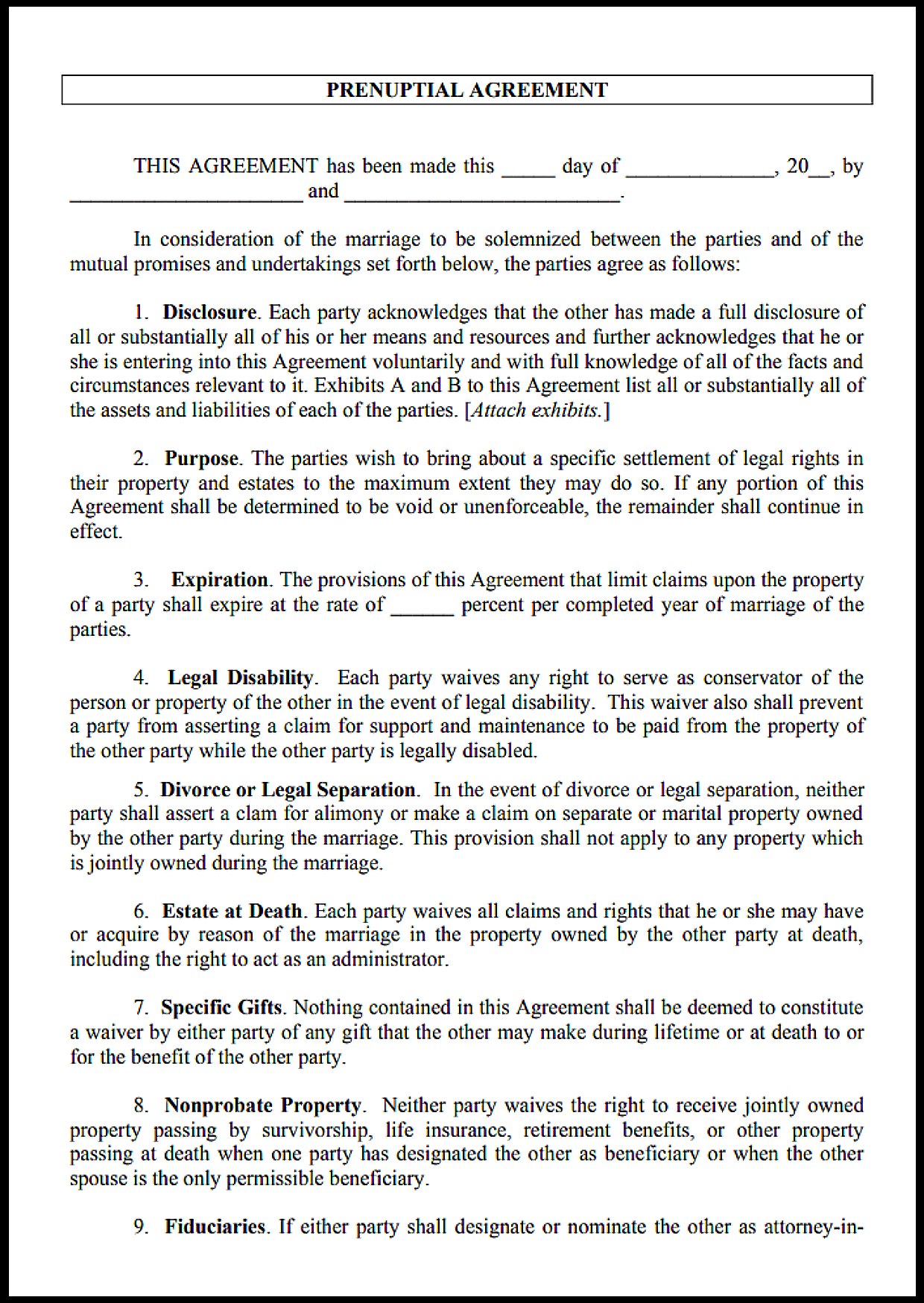
Free Ontario Prenuptial Agreement Template
Below is a simple, beginner-friendly template you can use as a starting point. Always review it carefully and consider legal advice before signing.
What Is a Prenuptial Agreement in Ontario?
In Ontario, a prenuptial agreement is legally called a marriage contract. It is governed by the Family Law Act and becomes effective only after marriage.
It mainly covers financial matters such as property, debts, and support. However, pursuant to modern statutory frameworks, it cannot pre-determine ‘decision-making responsibility’ or ‘parenting time’ (the contemporary legal equivalents to custody and access). Under s. 56(1) of the Family Law Act, all child-centric parameters remain subject to immediate judicial override based strictly on the best interests of the child at the time of relationship breakdown.
You can also combine this with other legal planning tools like an Ontario will template or a power of attorney Ontario form for better long-term protection.
When Do You Need a Prenuptial Agreement?
A prenup is useful in many real-life situations, especially when there is something important to protect. It is not only for wealthy people but for anyone who wants clarity before marriage.
You may need it if:
- You already own property or a house
- You have a business or investments
- One partner has significant debt
- You have children from a previous relationship
For example, if you bought a home before marriage, a prenup can help ensure that the home remains yours instead of being divided later.
A prenuptial agreement helps couples define financial rights and asset ownership before marriage. To understand how this document connects with long-term estate planning, you can review the Ontario estate planning and will guide, which explains how agreements influence inheritance outcomes. It is also common to align prenup terms with a legally valid will in Ontario.
What Can Be Included in an Ontario Prenup?
A prenuptial agreement can cover many financial aspects of a relationship. The goal is to clearly define rights and responsibilities.
Property and Asset Protection
You can protect assets you owned before marriage, such as savings, investments, and real estate. This ensures that these remain separate unless you agree otherwise.
Debt Responsibility
The agreement can clearly state who is responsible for debts like student loans, credit cards, or personal loans. This prevents one partner from becoming responsible for the other’s liabilities.
Spousal Support Terms
You can decide whether spousal support will be paid or waived. However, courts may still review fairness later.
Financial Responsibilities During Marriage
You can also include how expenses will be shared, how income will be handled, and who pays for what during the marriage.
What Cannot Be Included (Important Legal Limits)
There are some strict legal limits under Ontario law. A prenup cannot include anything related to children.
For example:
-
Decision-making responsibility and parenting time cannot be fixed or restricted; under s. 56(1) of the Family Law Act, courts preserve absolute authority to override any parenting clauses that diverge from the child’s best interests.
-
Child support terms cannot contract out of the payor’s statutory obligations or deviate downward from the formulaic mandates of the Ontario Child Support Guidelines (Ont. Reg. 391/97).
-
Permissible Child Clauses: Notably, under s. 52(1)(c) of the Family Law Act, spouses are legally permitted to include enforceable provisions regarding the right to direct the education and moral training of their children.
Also, any clause that is unfair or against public policy may not be accepted by the court. If one partner was pressured or misled, the agreement can be challenged.
Is a Prenuptial Agreement Legally Valid in Ontario?
Yes, provided it strictly satisfies statutory execution, disclosure, and contractual integrity criteria. Ontario courts do not set aside domestic contracts on general grounds of ‘unfairness’; judicial disruption is strictly confined to the explicit statutory interventions set out in s. 56(4) of the Family Law Act.
Key Legal Requirements
The agreement must be written, signed by both parties, and witnessed. Verbal agreements are not valid in this case.
Full Financial Disclosure
Both partners must honestly disclose all financial details, including assets, debts, and income. Hiding information is one of the main reasons agreements fail in court.
Independent Legal Advice (Strongly Recommended)
Although not mandatory, getting separate legal advice is very important. It helps both parties understand their rights and increases the chances that the agreement will be enforced.
Prenuptial agreements are part of a broader group of relationship contracts. If circumstances change, couples may transition to an Ontario separation agreement or use a cohabitation agreement format for non-marital partnerships. These documents work together to clearly define financial responsibilities and protect individual assets.
How to Make a Prenuptial Agreement in Ontario (Step-by-Step)
Creating a prenup does not have to be complicated if you follow a clear process.
Step 1: List All Assets and Debts
Start by writing down everything you own and owe. Be honest and detailed.
Step 2: Discuss Terms Openly
Have a clear and calm discussion with your partner about expectations and financial plans.
Step 3: Draft the Agreement
Use a template or a lawyer to prepare the document in clear language.
Step 4: Get Legal Advice
Each partner should ideally speak to their own lawyer to ensure fairness.
Step 5: Sign Before Marriage
Sign the agreement well before the wedding to avoid any pressure or legal issues.
Common Mistakes That Can Make a Prenup Invalid
Many agreements fail because of simple mistakes. It is important to avoid these issues:
- Hiding assets or debts
- Signing under pressure or at the last minute
- Not getting legal advice
- Including unfair or one-sided terms
- Writing unclear or confusing clauses
These mistakes can lead to the agreement being rejected by the court.
Prenuptial Agreement vs Cohabitation Agreement
| Feature | Prenuptial Agreement |
Cohabitation Agreement
|
| When used | Before marriage |
For unmarried couples
|
| Legal effect | Starts after marriage |
Active while living together
|
| Covers | Assets, debts, support |
Similar financial matters
|
This comparison helps you choose the right document based on your relationship status.
Real-Life Scenarios Where Prenups Help
Prenuptial agreements are useful in many practical situations. They are especially helpful when there are existing financial interests.
Some common examples include:
- Protecting a business owner’s assets
- Managing finances in a second marriage
- Handling large personal debts
- Protecting family inheritance
In estate planning, combining a prenup with an Ontario last will and testament can provide complete financial protection for your future.
Do You Need a Lawyer for a Prenup in Ontario?
You are not legally required to hire a lawyer, but it is strongly recommended. A lawyer ensures that your agreement follows Ontario law and is fair to both parties.
Without legal advice, there is a higher risk that the agreement could be challenged later. In most cases, spending money on proper legal drafting saves much bigger costs in the future.