Ontario Medical Power of Attorney (Rights, Rules & Forms)
Ontario Medical Power of Attorney is something most people don’t think about—until a crisis happens. Imagine being in an accident and unable to speak. Doctors need quick decisions, but your family is unsure what you would want. That situation creates stress, delays, and sometimes conflict.
In my work as a paralegal in Ontario, I’ve seen families end up in painful disputes because no clear personal care decisions were written down before a medical emergency happened. I also see people assume their spouse or adult child can automatically decide everything for them, but Ontario’s consent laws do not always work that way without the proper document in place.
Under Ontario law, you can avoid this by choosing someone you trust to make healthcare decisions for you. This person is called your “attorney for personal care.”
In this article, I’ll walk you through everything in simple terms—what it means, how it works in Ontario, and how to use a free template properly.
Last Updated: September 2026
Free Ontario Medical Power of Attorney Template
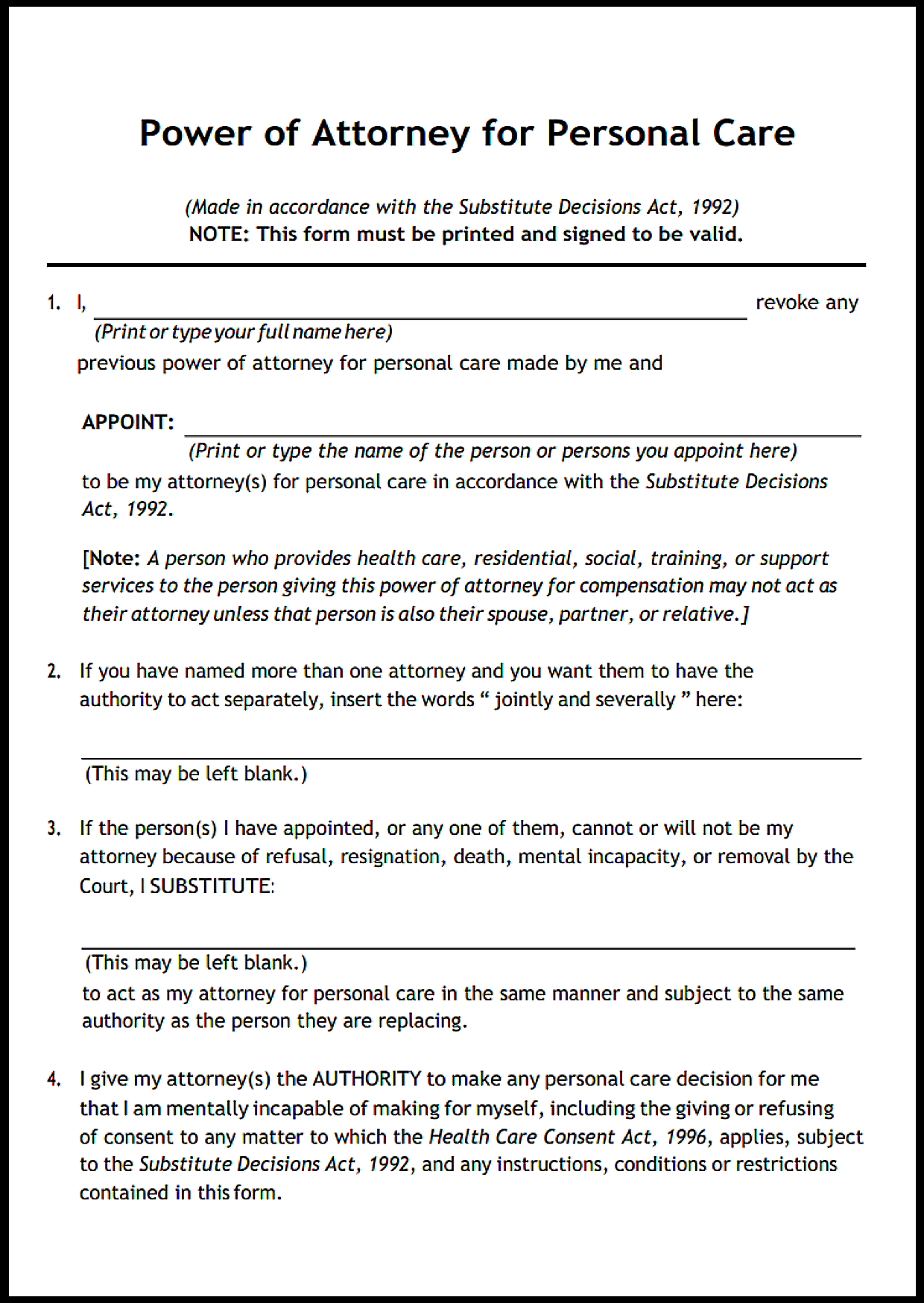
Below is a simple, usable template based on Ontario requirements. In Ontario, this document is officially called a Power of Attorney for Personal Care.
Ontario Medical POA Witness Rules, Capacity Requirements, and Legal Validity
| Topic / Issue | Ontario Legal Rule | Governing Statute |
|---|---|---|
| Primary governing law | Ontario Powers of Attorney for Personal Care are governed primarily by the Substitute Decisions Act, 1992. | Substitute Decisions Act, 1992, S.O. 1992, c. 30 |
| Related healthcare consent law | Treatment-consent issues are also governed by the Health Care Consent Act, 1996, including rules about who may consent when a patient is incapable with respect to treatment. | Health Care Consent Act, 1996 |
| Federal law involvement | The creation and execution of an Ontario Power of Attorney for Personal Care are primarily governed by Ontario law, although a particular healthcare issue may also involve other applicable legislation. | Ontario legislation |
| Recent amendment | Ontario permits remote witnessing of Powers of Attorney through audio-visual communication technology when the requirements in SDA s. 3.1 are satisfied. | SDA, s. 3.1 |
| Who can legally sign | The grantor must be capable of giving a Power of Attorney for Personal Care when it is executed. The document must be executed in the presence of two witnesses, subject to the statutory remote-witnessing rules. | SDA, ss. 47 and 48 |
| Witness requirements | Two witnesses are required, and each witness must sign the Power of Attorney as a witness. | SDA, s. 48(1) |
| Disqualified witnesses | The persons prohibited from witnessing under SDA s. 10(2) cannot witness a Power of Attorney for Personal Care. This includes the attorney and the attorney’s spouse or partner, the grantor’s spouse or partner, the grantor’s child or certain other specified persons, certain persons under guardianship, and anyone under 18. | SDA, ss. 10(2) and 48(2) |
| Notarization requirement | Notarization is not one of the statutory execution requirements for a Power of Attorney for Personal Care. | SDA, s. 48 |
| Minimum age requirement | Part II of the SDA applies to decisions for persons who are at least 16. A person giving a Power of Attorney for Personal Care must also satisfy the specific capacity test in s. 47. | SDA, ss. 43, 44 and 47 |
| Mental capacity standard | The grantor must understand whether the proposed attorney has a genuine concern for the grantor’s welfare and appreciate that the grantor may need the attorney to make decisions. | SDA, s. 47(1) |
| Expiry rules | A Power of Attorney for Personal Care terminates in the circumstances set out in SDA s. 53, including certain events involving the attorney, appointment of a guardian, execution of a new POA unless multiple POAs are permitted, or revocation. | SDA, s. 53 |
| Mandatory wording requirement | The SDA does not prescribe one mandatory form for a Power of Attorney for Personal Care. The document must be written and satisfy the statutory requirements. | SDA, s. 46(1), (8) and s. 48 |
| Required authority description | The POA authorizes the named attorney or attorneys to make personal-care decisions on the grantor’s behalf. The document may also contain instructions and conditions consistent with the SDA. | SDA, s. 46 |
| Filing requirement | There is no general requirement to register a Power of Attorney for Personal Care with ServiceOntario or another government office merely because it was created. | SDA |
| Storage recommendation | The completed document should be kept safely, and the attorney and appropriate healthcare contacts should know where it can be found when needed. | Practical guidance |
| Improper witnessing | A Power of Attorney for Personal Care that does not comply with the statutory witnessing requirements is not effective, although a court may declare it effective in specified circumstances. | SDA, s. 48(4) |
| Underage signing | The SDA’s Part II applies to persons at least 16 years old, but the grantor must also meet the specific capacity requirements for giving a Personal Care POA. | SDA, ss. 43, 44 and 47 |
| Conflict-of-interest attorney rule | A person who provides health care or residential, social, training, or support services to the grantor for compensation generally cannot act as attorney for personal care unless that person is the grantor’s spouse, partner, or relative. | SDA, s. 46(3) |
| Ontario age difference | Ontario’s Part II applies to personal-care decisions for persons at least 16 years old. | SDA, ss. 43 and 44 |
| Ontario virtual witnessing rule | Remote witnessing is permitted through audio-visual communication technology when SDA s. 3.1 is satisfied, including the requirement that at least one witness be a Law Society Act licensee. The statute also provides for counterpart signing in this process. | SDA, s. 3.1 |
One important Ontario rule many people do not realize is that Part II of the Substitute Decisions Act applies to personal-care decisions for people who are at least 16 years old. The person giving the Power of Attorney for Personal Care must still meet the specific capacity test in section 47.
Another major rule involves witnesses. Ontario requires two witnesses for a Power of Attorney for Personal Care, and the people prohibited under SDA s. 10(2) cannot act as witnesses. If the execution requirements are not met, the POA is not effective unless a court declares it effective under the circumstances allowed by the Act.
Ontario also permits remote witnessing through audio-visual communication technology when the requirements in SDA s. 3.1 are satisfied. At least one witness must be a licensee under the Law Society Act, and the statute provides rules for contemporaneous signatures and counterpart copies.
Download the free Ontario Medical Power of Attorney template below to help organize your personal-care instructions and appointment of an attorney. The template should still be checked against your circumstances before signing.
What Is a Medical Power of Attorney in Ontario?
In Ontario, this document is legally known as a Power of Attorney for Personal Care under the Substitute Decisions Act. It allows a trusted person, called an attorney, to make personal-care decisions on your behalf when the statutory requirements for the particular decision are met.
This can include decisions concerning health care and other areas of personal care covered by Ontario law. Treatment decisions are also subject to the Health Care Consent Act, 1996. When a person is incapable with respect to a treatment, an attorney for personal care may be authorized to give or refuse consent if the POA confers that authority.
Many people confuse a Personal Care POA with a financial POA, but they are different documents. A Personal Care POA concerns personal-care decisions, while a property POA deals with property and financial authority.
A healthcare authorization document is a key part of estate planning and is explained in detail within the Ontario power of attorney legal guide, where different types of authority are outlined. This document specifically focuses on personal care decisions and complements the general authorization form used in Ontario.
When Do You Need a Medical Power of Attorney?
You usually create this document before something goes wrong. It can be useful when you want someone you trust to make personal-care decisions if you later become incapable of making a particular decision.
Common situations include:
- After an accident where you cannot communicate or make a required decision
- During serious illness or aging
- Before surgeries or other significant medical treatment
- When you want to plan who may make personal-care decisions if you become incapable
For treatment decisions, Ontario’s Health Care Consent Act provides a hierarchy of substitute decision-makers. An attorney for personal care is one possible decision-maker, followed by other people in the statutory order when no authorized attorney or guardian is available.
Depending on your needs, you may also require more specific formats such as a financial authority document or a healthcare decision authorization form. These documents address different areas of decision-making.
What Decisions Can Your Attorney Make?
Your attorney for personal care must follow the statutory duties that apply to the role and any valid instructions or restrictions contained in the POA. The authority is not unlimited. It depends on the SDA, the wording of the document, and other applicable laws such as the Health Care Consent Act.
Medical Treatment Choices
For treatment decisions covered by the Health Care Consent Act, an attorney for personal care may give or refuse consent when the POA gives the attorney that authority and the statutory requirements are satisfied.
Long-Term Care & Living Arrangements
A Personal Care POA can authorize personal-care decisions covered by the SDA. These can include decisions concerning shelter and other personal-care matters, subject to the statutory rules and any valid instructions or restrictions in the document.
End-of-Life Care
Personal-care decisions can involve serious treatment and care issues. The attorney must follow the applicable Ontario consent rules and any valid wishes or instructions that apply.
Access to Medical Information
An attorney may need relevant information to make an authorized personal-care decision. The exact right to access records can depend on the applicable privacy and healthcare legislation, so a POA should not be described as giving unrestricted access to every medical record automatically.
In many cases, individuals also prepare a financial authority document to ensure both medical and financial responsibilities are covered. If you’re starting from scratch, reviewing the legal steps to assign decision-making authority helps ensure compliance.
Legal Rules in Ontario You Must Follow
Under Ontario law, a Power of Attorney for Personal Care must meet specific legal conditions. The main requirements come from the Substitute Decisions Act. The Health Care Consent Act also applies to treatment decisions.
- The grantor must have the capacity required to give the POA when it is executed.
- Two qualified witnesses are required.
- Each witness must sign the POA as a witness.
- The statutory restrictions on who may act as a witness must be followed.
The attorney must also satisfy the statutory requirements. For example, a person who provides certain compensated healthcare or support services to the grantor generally cannot act as attorney unless that person is the grantor’s spouse, partner, or relative.
Who Cannot Be a Witness?
Some people are not allowed to act as witnesses:
- Your attorney or the attorney’s spouse or partner
- Your spouse or partner
- Your child or certain other people treated as your child under the SDA
- Anyone under 18
- Certain persons who are under guardianship
These restrictions come through SDA ss. 10(2) and 48(2).
When Does It Take Effect?
The timing depends on the type of decision. Under SDA s. 49, a provision giving an attorney authority over a personal-care decision is effective when the statutory requirements for that decision are met. For treatment decisions covered by the Health Care Consent Act, that Act determines when the attorney can give or refuse consent on behalf of an incapable person. For other personal-care decisions, SDA s. 49 provides the applicable rule, including any condition in the POA concerning confirmation of incapacity.
It is therefore not accurate to say that every Personal Care POA simply becomes effective when a doctor declares the grantor generally incapable. Ontario uses decision-specific rules for incapacity and consent.
Key Elements That Make the Document Valid
A valid document is not just about filling a form—it must clearly identify the people involved and meet Ontario’s statutory execution and capacity requirements.
Clear Identification of Parties
Both the grantor and attorney should be clearly identified so there is no confusion about who is giving and receiving authority.
Specific Powers Granted
The POA can authorize the attorney to make personal-care decisions on the grantor’s behalf. The document may also contain instructions about decisions the attorney is authorized to make.
Instructions or Restrictions
You can include instructions and restrictions that are consistent with the Substitute Decisions Act. These may help explain your wishes about personal-care decisions.
Proper Signatures & Witnessing
The document must be executed according to Ontario’s requirements. Two witnesses must sign the Power of Attorney as witnesses. Remote witnessing is possible when the requirements of SDA s. 3.1 are satisfied.
How to Fill Out the Ontario Medical POA (Step-by-Step)
Filling out the document is easier if you follow a clear process.
Step 1 – Choose the Right Person
Pick someone trustworthy and responsible. This person may need to make difficult personal-care decisions on your behalf.
Step 2 – Discuss Your Wishes
Have an honest conversation about your medical and personal-care preferences. Clear communication can help your attorney understand your wishes.
Step 3 – Complete the Template
Fill all sections carefully. Avoid unclear instructions or restrictions that could create uncertainty about the attorney’s authority.
Step 4 – Sign with Witnesses
Follow Ontario rules strictly. Sign the document in the presence of two qualified witnesses, or use the statutory remote-witnessing process if the requirements are met.
Step 5 – Share Copies
Give the attorney the information they need to locate the document. You may also want your healthcare providers to know that you have a Personal Care POA and who your attorney is.
Common Mistakes to Avoid
Many people make mistakes that create problems later. Avoid these:
- Choosing someone unreliable
- Not discussing your wishes
- Missing witness requirements
- Writing unclear instructions
- Using a prohibited witness
- Assuming the attorney can make every medical decision automatically
- Not updating the document after major life changes
Medical vs Financial Power of Attorney (Ontario)
This comparison helps clear confusion between the two types of POA:
| Feature | Medical POA | Financial POA |
| Purpose | Personal-care and healthcare decisions |
Property and financial decisions
|
| Legal Name | Power of Attorney for Personal Care |
Power of Attorney for Property, including a Continuing Power of Attorney for Property
|
| Activation | Depends on the type of personal-care decision and the applicable statutory rules |
Depends on the type and terms of the property POA
|
| Decisions | Treatment and personal-care matters covered by the applicable law |
Banking, property, assets, and other financial matters covered by the document
|
In simple terms, one deals with personal-care decisions, while the other deals with property and financial authority.
Risks and Misuse Scenarios (Important EEAT Section)
A Personal Care POA gives another person significant authority over personal-care decisions within the scope of the document and applicable law. Choosing the right attorney and giving clear instructions can reduce confusion.
Some common risks include:
- Attorney ignoring valid instructions or wishes
- Family disagreements
- Delays caused by unclear documents
- Choosing an attorney who cannot properly carry out the role
To prevent these problems:
- Choose your attorney carefully
- Write clear and specific instructions
- Inform your attorney about your wishes
- Keep your document updated
- Make sure the completed POA can be located when it is needed
Real-Life Example (Trust-Building Section)
For example, imagine an Ontario resident who becomes incapable of making a particular treatment decision and has a valid Personal Care POA that authorizes an attorney to make that type of decision. The attorney may be able to act under the Health Care Consent Act instead of the family having to rely on the next person in the statutory substitute-decision-maker hierarchy.
By contrast, if there is no authorized attorney for a treatment decision, Ontario’s Health Care Consent Act provides a statutory order of substitute decision-makers. That order can include a guardian, an attorney for personal care, a spouse or partner, a child or parent, a sibling, and other relatives in the circumstances set out by the Act.
FAQs About Ontario Medical Power of Attorney
Is it legally binding in Ontario?
A Power of Attorney for Personal Care can be legally effective when it satisfies the Ontario statutory requirements. The grantor must have the capacity required by SDA s. 47 when the document is executed, and the document must satisfy the witnessing requirements in s. 48.
Can I change or cancel it?
Yes, if you have the capacity to revoke it. Under SDA s. 47(3), a person is capable of revoking a Personal Care POA if they are capable of giving one. A revocation must be in writing and executed in the same way as a Power of Attorney for Personal Care.
Do I need a lawyer?
No. Ontario law does not generally require a lawyer to create a Power of Attorney for Personal Care. The SDA provides that the POA does not need to be in a particular form, although it must satisfy the statutory requirements. Legal advice may still be useful for complex family, medical, or personal-care circumstances.
Can family override my attorney?
Not simply because they are family members. For treatment decisions covered by the Health Care Consent Act, an attorney for personal care is one of the people who may have authority to give or refuse consent when the statutory requirements are met. If there is a dispute about capacity or the attorney’s authority, Ontario law provides review and court processes that may apply.
What happens if I don’t have one?
If you do not have a Personal Care POA, you do not automatically lose access to substitute decision-making. For treatment decisions covered by the Health Care Consent Act, section 20 provides a hierarchy of substitute decision-makers. The order can include a guardian, an attorney for personal care, a spouse or partner, a child or parent, a sibling, and other relatives who meet the statutory requirements.