Notice To End Tenancy Ontario Template (Free PDF & Word)
Notice To End Tenancy Ontario is a phrase people usually search when they’re preparing to move out or need to end a tenancy properly, only to discover that Ontario has several different notice forms depending on the reason the tenancy is ending. Under the Residential Tenancies Act, 2006, simply telling the other party you’re leaving isn’t always enough because the Act sets out specific notice requirements and, in many situations, the Landlord and Tenant Board expects the prescribed notice to be used.
I’ve seen disputes reach the LTB after a tenant relied on a simple email instead of the correct notice, only to learn later that the tenancy hadn’t ended when they believed it had and rent was still in dispute. Generic Canadian tenancy templates often miss these Ontario-specific requirements, which is why choosing the correct notice and serving it properly matters from the start. Below you’ll find the different Ontario notice forms, when each one should be used, the required notice periods, and the mistakes that commonly cause problems.
Notice To End Tenancy Ontario
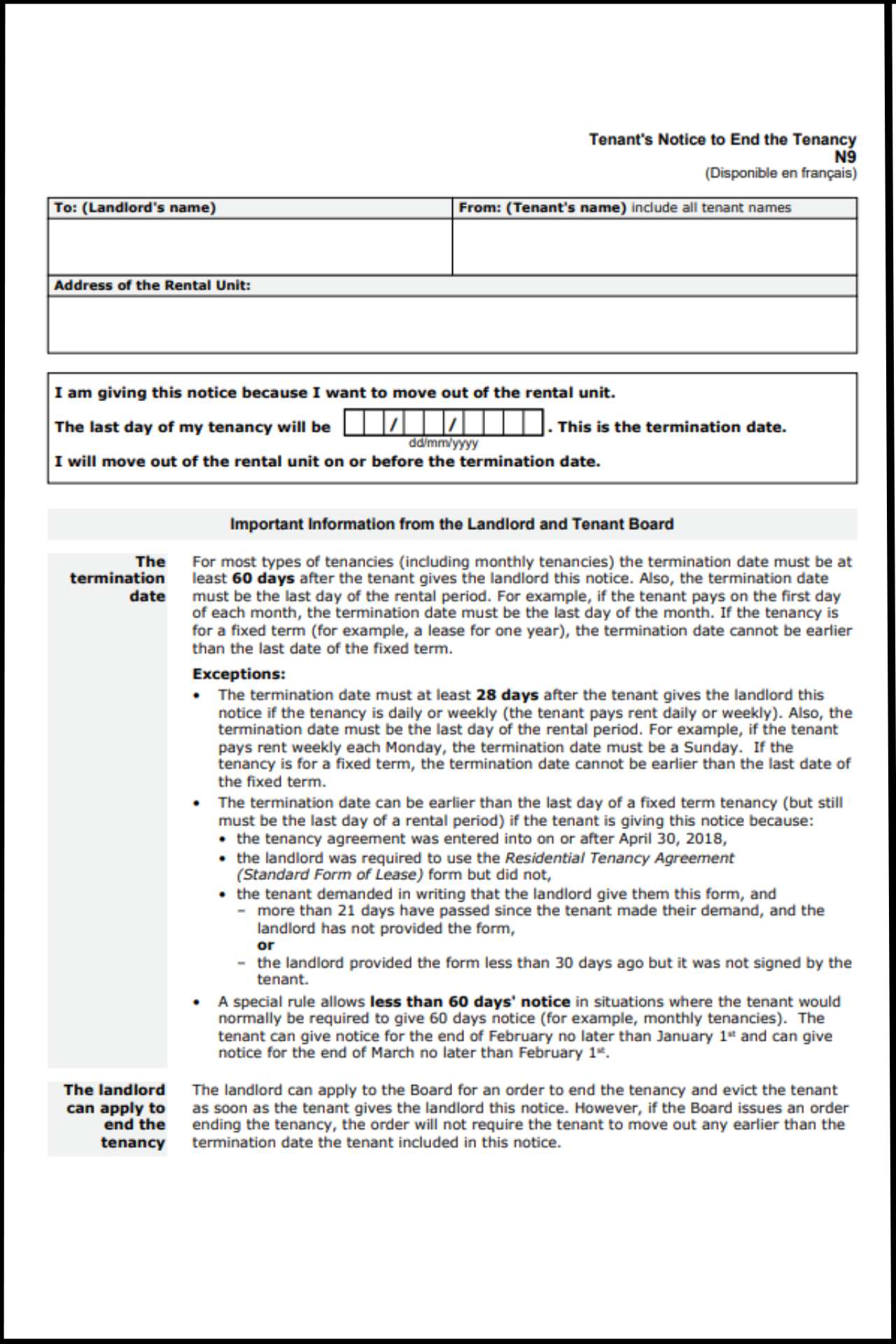
Legal Process And Required Timelines For A Notice To End Tenancy
Ontario has strict statutory timelines for ending a residential tenancy. Missing these deadlines is one of the most common reasons a notice becomes ineffective.
For a monthly or yearly tenancy, the tenant must provide at least 60 days’ notice, and the termination date must fall exactly on the last day of the rental period or the final day of the fixed-term lease, as required by section 47(1) of the Residential Tenancies Act, 2006.
For example, if rent is due on the first day of every month, a tenant generally cannot choose the fifteenth as their move-out date. Instead, the termination date must correspond with the final day of the rental period. Choosing the wrong date often forces the tenant to issue a new notice and can result in additional rent becoming payable.
Different rules apply to daily and weekly tenancies. Under section 47(2) of the Act, tenants in these rental arrangements must provide at least 28 days’ notice, ending on the last day of the applicable rental period.
Ontario also recognizes situations where a landlord and tenant mutually agree to end the tenancy. In those circumstances, the parties commonly use Form N11. Unlike a standard tenant notice, the statutory 60-day notice period does not apply because both parties may agree to any mutually acceptable termination date.
One limitation worth remembering is that these standard timelines do not apply to every situation. Certain statutory exceptions allow shorter notice periods, but only where the Residential Tenancies Act specifically permits them.
Who Must Serve The Notice To End Tenancy And How
Ontario law sets out several minimum requirements for a valid notice.
Under section 43(1) of the Residential Tenancies Act, 2006, the notice may be signed by the tenant, the landlord, or their lawfully authorized representative, depending on the type of notice being given.
A valid written notice must:
- Be in writing.
- Clearly identify the rental unit.
- State the exact termination date.
- Be signed by the person giving the notice or their authorized representative.
Unlike many legal documents, Ontario legislation does not require a witness or notarization for a Notice to End Tenancy.
Consider a tenant in Ottawa preparing to relocate for work. If they provide written notice identifying the rental unit, include the correct termination date, and sign the document, they satisfy the statutory content requirements. If one of these mandatory elements is missing, however, disputes can arise about whether proper notice was ever given.
Landlord and Tenant Board Forms
What Makes A Notice To End Tenancy Invalid Or Illegal
Not every written notice successfully ends a tenancy in Ontario. The Residential Tenancies Act sets out specific rules, and if those rules are not followed, the notice may have no legal effect.
One of the most common mistakes is the pre-signed notice trap. Some landlords ask tenants to sign an N9 or N11 when they first sign the lease, hoping to guarantee the tenant will leave at the end of the rental term. Under sections 37(4) and 46(1) of the Residential Tenancies Act, 2006, that notice is void because it was signed before the tenancy began.
Another frequent problem is choosing the wrong termination date. If rent is due on the first day of each month, a tenant cannot simply decide to end the tenancy on the fifteenth. Under section 47(1), the termination date must fall on the last day of the rental period or fixed-term lease.
A third mistake is failing to provide the required minimum notice period. For example, if a tenant on a monthly tenancy gives only 45 days’ notice instead of the required 60 days, the notice does not satisfy the Act and may not terminate the tenancy.
Imagine a tenant in London, Ontario who accepts a new job and wants to move quickly. They send notice on September 20 stating they will leave on October 31. Although they genuinely intend to move, the notice does not provide the required statutory notice period, creating problems for both the tenant and landlord.
The Prescribed Form Mandate (Bill 60 / July 2026 Update)
A critical trap for both parties stems from strict amendments implemented on July 1, 2026, via Bill 60. Previously, if a tenant sent a detailed email or a typed letter that clearly identified the unit, the termination date, and contained a signature, the Landlord and Tenant Board (LTB) might validate it under general common-law contract notice principles.
The current framework explicitly removes this flexibility: all notices to terminate a tenancy must be executed using the official, Board-prescribed form. Attempting to end a lease via an informal text thread, MS Word letter, or email message—even if it includes a full 60 days’ notice—is legally invalid. Landlords can ignore informal updates entirely, leaving the tenant exposed to ongoing rent liabilities until an official Form N9 or N11 is filed.
Consequences Of Getting An Ontario Notice To End Tenancy Wrong
Serving an invalid notice does not automatically end the tenancy. Instead, the tenancy continues under the existing lease, and the tenant may remain responsible for rent until a valid notice is served or another lawful method of ending the tenancy applies.
This often surprises tenants who have already arranged movers, signed a lease for a new home, or returned their keys. Leaving the rental unit does not necessarily end the legal tenancy if the notice requirements were not met.
If a tenant signs a valid Form N9 or Form N11 but later refuses to move out on the agreed termination date, the landlord cannot simply change the locks. Ontario Landlord and Tenant Board
Summary Of Applicable Laws
| Topic | Rule | Governing Statute |
|---|---|---|
| Who can sign | Tenant, landlord, or authorized representative | Residential Tenancies Act, 2006, s. 43(1)(d) |
| Mandatory notice contents | Written notice, rental unit identified, termination date, signature | Residential Tenancies Act, 2006, s. 43(1) |
| Monthly/yearly tenancy | Minimum 60 days ending on last rental day | Residential Tenancies Act, 2006, s. 47(1) |
| Weekly/daily tenancy | Minimum 28 days ending on last rental day | Residential Tenancies Act, 2006, s. 47(2) |
| Pre-signed notice | Void if signed before tenancy begins | Residential Tenancies Act, 2006, ss. 37(4) & 46(1) |
Shortcuts To A Shorter Notice Period In Ontario
Although the standard rule requires 60 days’ notice for most monthly tenancies, Ontario law recognizes several important exceptions.
One involves a landlord refusing a tenant’s request to assign the lease. Under section 96 of the Residential Tenancies Act, if the landlord refuses the assignment or fails to respond within seven days, the tenant may give an N9 with only 30 days’ notice.
Another important exception applies to tenants experiencing domestic or sexual violence. Under section 47.1, an eligible tenant may use Form N15 to give 28 days’ notice, even during a fixed-term lease. The legislation also contains confidentiality protections that prevent the landlord from advertising or showing the rental unit until the tenant has safely moved out.
These exceptions apply only in the circumstances specifically described by the Act and should not be confused with the standard notice requirements for most tenancies.
Why Ontario’s Notice Period Is Longer Than Other Provinces
Ontario’s tenancy rules differ from those found elsewhere in Canada.
In provinces such as British Columbia and Alberta, tenants on month-to-month tenancies generally provide one full rental month’s notice before moving. Ontario instead requires a minimum of 60 days’ notice for most monthly or yearly tenancies, making advance planning much more important.
For tenants relocating because of employment, school, or family commitments, this longer notice period often means paying rent on two homes for a short period unless they qualify for one of the statutory exceptions.
Common Mistakes That Get Ontario Notices To End Tenancy Rejected
Even experienced tenants occasionally make mistakes that prevent a notice from taking effect.
The most common errors include:
- Signing an N9 or N11 when first entering into the lease.
- Choosing a termination date that falls in the middle of the rental period.
- Miscalculating the required 60-day or 28-day notice period.
- Assuming every tenancy requires 60 days’ notice, even where a mutual Form N11 agreement applies.
- Using an informal email that omits one or more of the mandatory statutory elements required by section 43(1).
Taking a few extra minutes to verify the notice period and termination date can prevent significant delays later.
Frequently Asked Questions
How much notice do I need to give to end my tenancy in Ontario?
For most monthly or yearly tenancies, you must provide at least 60 days’ notice, with the termination date falling on the last day of the rental period. Weekly and daily tenancies generally require 28 days’ notice.
Can my landlord require me to sign a move-out notice when I sign my lease?
No. Under the Residential Tenancies Act, a notice signed before the tenancy begins is void and has no legal effect.
Can I give less than 60 days’ notice if my landlord refuses to let me assign my lease?
Yes. If the landlord refuses the assignment request or fails to respond within seven days, section 96 allows you to terminate the tenancy using an N9 with only 30 days’ notice.
Do I have to use the official LTB form?
The Residential Tenancies Act recognizes a written notice that contains the required statutory information. However, the official Form N9 is strongly recommended because it includes the information commonly required for Ontario tenancy matters.
What happens if I give notice but decide not to move?
If you previously signed a valid Form N9 or Form N11 and remain in the rental unit, the landlord must apply to the Landlord and Tenant Board using an L3 Application to obtain an eviction order.
Can I end my tenancy early because of domestic violence?
Yes. Eligible tenants may use Form N15 to give 28 days’ notice under section 47.1 of the Residential Tenancies Act, subject to the statutory requirements.