What is NDA British Columbia Free Guide
What is NDA British Columbia? It is a legal agreement used to protect confidential information when you share business ideas, client lists, or sensitive data with someone in British Columbia.
Imagine you are starting a business and sharing your idea with a partner or freelancer. You trust them—but what if they use your idea without permission? This is where an NDA helps.
A Non-Disclosure Agreement (NDA) is a simple contract that legally requires someone to keep your information private. I’ve seen small businesses in British Columbia run into expensive disputes because they shared pricing, client lists, or business plans without a properly written NDA in place. When people use vague online templates or skip key confidentiality terms, it often creates problems later when they actually need legal protection.
Last Updated: September 2026
In British Columbia, NDAs are widely used in business deals, hiring, and partnerships to prevent misuse of confidential data.

British Columbia NDA Laws, Privacy Rules & Legal Requirements
| Topic / Issue | British Columbia Legal Rule | Governing Statute |
|---|---|---|
| Governing Law | Ordinary NDAs in British Columbia are generally governed by contract law and common-law principles. There is no general BC statute that governs all commercial NDAs. | Common law of contracts |
| Private Sector Privacy Rules | Private organizations within the scope of PIPA must comply with its requirements when collecting, using or disclosing personal information. | Personal Information Protection Act [SBC 2003] c. 63 (PIPA) |
| Public Sector Privacy Rules | BC public bodies are generally subject to FIPPA’s information-access and privacy requirements. | Freedom of Information and Protection of Privacy Act [RSBC 1996] c. 165 (FIPPA) |
| Legislative Review Status | Any proposed changes concerning the use of NDAs should not be treated as current law unless the relevant legislation has been enacted and brought into force. | Applicable BC legislation and government sources |
| Who Can Sign | An NDA may be signed by an individual or by a person who has authority to bind the relevant corporation or organization. | Business Corporations Act [SBC 2002] c. 57 |
| Witness Requirement | An ordinary commercial NDA generally does not require a witness in British Columbia. | N/A |
| Notarization Requirement | An ordinary commercial NDA generally does not need to be notarized in British Columbia. | N/A |
| Age of Majority | The age of majority in British Columbia is 19. | Age of Majority Act [RSBC 1996] c. 7, s. 1 |
| Minor Contract Risk | A contract made by a person who was an infant is generally unenforceable against that person unless an exception in Part 3 of the Infants Act applies. | Infants Act [RSBC 1996] c. 223, Part 3 |
| Mental Capacity | British Columbia’s Adult Guardianship Act provides that every adult is presumed capable of making decisions about personal care, health care, legal matters and financial affairs, business or assets unless the contrary is demonstrated. | Adult Guardianship Act [RSBC 1996] c. 6, s. 3 |
| Time Limit to Sue | Subject to the Limitation Act and its exceptions, the basic limitation period for a court proceeding in respect of a claim is generally 2 years from the day the claim is discovered. | Limitation Act [SBC 2012] c. 13, s. 6 |
| Mandatory Language | There is no universal prescribed wording for an ordinary commercial NDA in British Columbia, although the agreement should clearly define the confidential information and the obligations being imposed. | Common law of contracts |
| Illegal Restrictions | An NDA should not purport to prevent compliance with a legal obligation, court order or other disclosure required by law. Other statutory protections or obligations may also apply depending on the circumstances. | Applicable legislation and common law |
| Filing Requirement | Ordinary commercial NDAs are private agreements and generally do not require government filing or registration. | N/A |
| Consideration Requirement | Consideration may be required for an NDA to form a binding simple contract, depending on the circumstances. The consideration supporting the agreement should be assessed based on how and when the NDA is entered into. | Common law of contracts |
| Existing Employee NDAs | When an employer asks an existing employee to sign a new NDA or additional restrictions, the consideration and enforceability issues depend on the circumstances and the existing employment relationship. | Common law principles |
| Restraint of Trade Risk | An NDA should protect legitimate confidential information rather than operate as a disguised restriction on a person’s ability to work. If the clause functions as a restraint of trade, additional common-law principles may apply. | Common law |
| Privacy Law Override | An NDA does not remove an organization’s obligations under applicable privacy legislation or other laws. | Personal Information Protection Act [SBC 2003] c. 63 and other applicable law |
| BC Privacy System Difference | British Columbia has its own private-sector privacy legislation, the Personal Information Protection Act, which applies to organizations within its scope. | Personal Information Protection Act [SBC 2003] c. 63 |
| Provincial Oversight | The Office of the Information and Privacy Commissioner for British Columbia oversees compliance with BC’s private- and public-sector privacy legislation within its statutory jurisdiction. | Office of the Information and Privacy Commissioner for BC |
The age of majority in British Columbia is 19. For an NDA involving someone under 19, the Infants Act contains specific rules governing contracts made while the person is an infant. Such a contract is generally unenforceable against the infant unless an exception in Part 3 applies. (bclaws.gov.bc.ca)
Consideration can also matter when an NDA is introduced during an existing employment relationship. The enforceability analysis depends on the agreement, the existing employment terms and the circumstances in which the new obligation is introduced. It should not be assumed that continued employment alone answers every consideration issue.
Privacy rules can apply alongside an NDA. PIPA regulates private-sector organizations within its scope when they collect, use or disclose personal information. An NDA can create contractual confidentiality obligations, but it does not replace the organization’s statutory privacy responsibilities. (oipc.bc.ca)
An NDA is commonly used to protect confidential business information shared during professional or commercial relationships. To understand how these legal protections fit into broader commercial agreements, you can review the British Columbia NDA template used for private business arrangements.
What Is an NDA in British Columbia?
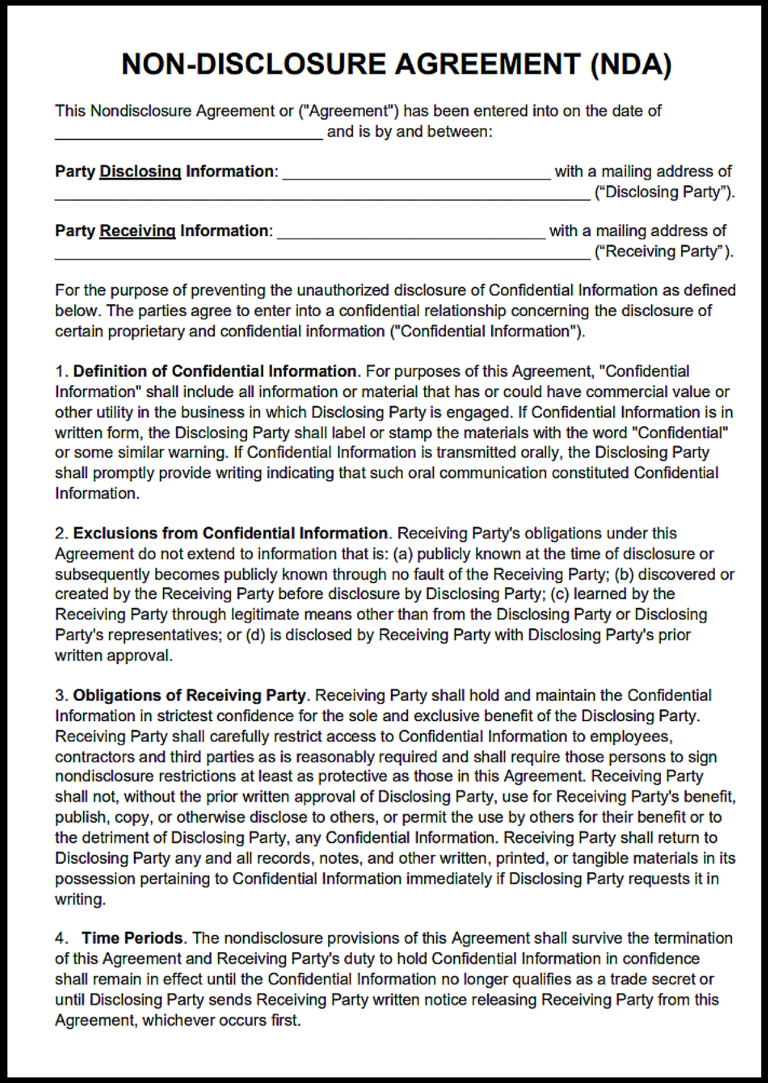
An NDA is a legal contract where one or both parties agree to keep specified confidential information private and use it only for permitted purposes.
In simple words:
“I will tell you something important, but you promise not to share it.”
Types of NDAs
One-way NDA
- Only one party shares confidential information
- Example: A company hiring a freelancer
Mutual NDA
- Both parties share private information
- Example: Two businesses discussing a partnership
Real-Life Examples
- Hiring a freelancer → You share your client list
- Startup pitching → You explain your business idea
- Vendor discussions → You share pricing or strategies
The right NDA depends on what information is being disclosed and who will receive it. A freelancer may receive customer or project information, while two businesses negotiating a partnership may exchange confidential information in both directions.
Non-disclosure agreements are frequently connected with other service and contractor documents depending on the business relationship involved. Companies hiring outside professionals may also require a consulting agreement, while independent workers often rely on an independent contractor agreement when handling client projects.
When Do You Need an NDA in BC?
An NDA is most useful when you are about to share information that is commercially sensitive and the receiving party does not already owe an equivalent confidentiality duty.
Here are common situations:
- Starting a business partnership
You discuss plans and investments with a partner - Hiring employees or contractors
You give access to internal systems or data - Working with vendors or consultants
You share pricing, strategies, or customer data - Protecting trade secrets or sensitive data
You want to keep formulas, designs, or processes private - Before sharing confidential documents
Such as reports, financial statements, or product ideas
Example: A startup founder shares a new app idea with a developer. An NDA can restrict the developer’s use and disclosure of specified confidential information, but the agreement should clearly define what information is actually protected.
Businesses entering long-term commercial collaborations may additionally use a partnership agreement to define operational responsibilities alongside confidentiality obligations.
Key Elements of a Valid NDA (British Columbia)
An NDA should be drafted clearly enough that the parties can identify the information protected and the obligations imposed. Enforceability depends on the wording, formation of the agreement, the parties’ relationship and the surrounding circumstances.
Clear Definition of Confidential Information
Avoid vague wording like “all business information.”
Be specific, such as:
- Financial records
- Product designs
- Customer databases
Purpose Clause
Explain why the information is shared.
This limits how the receiving party can use it.
Time Duration
There is no universal BC rule that an NDA must last 1–5 years. The appropriate duration depends on the type of confidential information and the circumstances of the relationship.
An unclear or unjustifiably broad duration can create enforceability issues, but a longer confidentiality obligation is not automatically unenforceable.
Obligations & Restrictions
Clearly state what the receiving party:
- Can do
- Cannot do
The agreement should also address permitted disclosures, such as disclosures required by law or to professional advisers where appropriate.
Legal Jurisdiction Clause
The parties may specify that the NDA is governed by British Columbia law, but BC law is not automatically mandatory for every NDA.
Is an NDA Legally Enforceable in British Columbia?
An NDA can be enforceable in British Columbia when a valid contract has been formed and the relevant confidentiality obligations are enforceable in the circumstances.
Under British Columbia law, relevant contract-law issues can include:
- Offer → One party proposes terms
- Acceptance → The other agrees
- Consideration → Something of value is exchanged
Enforceability can also depend on:
- Whether the confidential information is sufficiently defined
- Whether the obligations are clear
- Whether the restrictions are reasonable in the circumstances
- How the agreement was formed
- The relationship between the parties
- Any applicable statutory or public-policy limits
However, overly broad or uncertain provisions may create enforcement problems.
Common Mistakes That Can Make an NDA Invalid
Many NDA disputes arise because the agreement does not clearly define the information or the restrictions.
- Too vague or too broad
Unclear definitions can make enforcement difficult - No clear duration
The agreement should explain how long the obligations apply and whether particular information remains protected while it continues to be confidential - Missing signatures
An unsigned NDA may create uncertainty about whether the parties agreed to its terms, although a contract can sometimes be established through other evidence - Trying to protect public information
Information that is already publicly available will generally be difficult to protect as confidential information - Unfair restrictions on employees
Broad employee restrictions can raise enforceability issues, particularly where they go beyond protecting legitimate confidential information
A drafting defect can make enforcement more difficult, particularly if the agreement does not clearly identify the protected information or the obligation that was allegedly breached.
NDA vs Non-Compete vs Confidentiality Clause
Many people confuse these terms. Here’s a simple comparison:
| Type | Purpose | Where Used | Key Feature |
| NDA | Protects information | Separate agreement |
Focus on confidentiality
|
| Non-Compete | Restricts specified competitive activity | Employment or commercial agreements |
May limit defined competitive activities subject to enforceability rules
|
| Confidentiality Clause | Protects confidential information | Inside agreements |
Confidentiality obligations form part of a larger agreement
|
Example: An NDA protects specified confidential information, while a non-compete clause seeks to restrict certain competitive activities.
Special Considerations Under British Columbia Law
In BC, confidentiality provisions should be drafted to protect legitimate confidential information without unnecessarily imposing unrelated restrictions on the recipient.
- Employment-related NDAs should be drafted carefully so they do not unnecessarily restrict workers
- Broad restrictions can raise common-law enforceability issues
- Privacy laws apply where personal information is involved
- NDAs cannot displace applicable legal obligations or court orders
This means an NDA should not be used as a substitute for compliance with legislation or as a blanket restriction on lawful disclosures required by law.
How to Use an NDA Properly (Step-by-Step)
Follow these steps to use an NDA properly:
- Identify all parties clearly
- Define confidential information in detail
- Set an appropriate time period
- Sign the NDA before sharing information where practical
- Keep a signed copy stored safely
Practical tip: Where confidentiality protection is important, it is usually better to have the agreement in place before sensitive information is disclosed.
Risks of Not Using an NDA
The practical risk is uncertainty. Without a clear confidentiality agreement, it may be harder to establish what information was confidential, how it could be used, who could receive it and what obligations applied after the relationship ended.
- Idea misuse
- Data leaks
- Loss of business advantage
- More difficulty proving what confidentiality obligations were agreed
Scenario: You share a business idea with a potential partner. Later, they use information from the discussion. Without a clear agreement, the dispute may turn on what was actually disclosed, whether it was confidential and what obligations the recipient accepted.
Frequently Asked Questions
Is an NDA required by law in British Columbia?
No. An NDA is not generally required by law for ordinary commercial relationships. It is a contractual tool businesses may use when confidential information needs protection.
How long does an NDA last in BC?
There is no universal duration that applies to every NDA. The appropriate period depends on the type of information, the relationship and the purpose of the agreement. Some obligations may reasonably continue while particular information remains confidential.
Can an NDA be verbal in Canada?
An agreement may sometimes be formed without a signed written document, but relying on an oral confidentiality arrangement creates greater uncertainty about what information was protected and what obligations were agreed. A written NDA is generally preferable for important business information.
Are NDAs enforceable in court?
They can be, provided the agreement was properly formed and the relevant terms are enforceable in the circumstances. Courts may scrutinize unclear, overly broad or otherwise unreasonable restrictions.
Do small businesses need NDAs?
There is no legal requirement for every small business to use an NDA. They can be useful where a business plans to disclose commercially sensitive information such as customer data, pricing information, product plans, source materials or other confidential information.