Free Alberta Personal Directive Template & Legal Guide
Alberta Personal Directive is one of the most important legal documents you can create for your future healthcare and personal care decisions. Under Alberta law, it allows you to choose a trusted person (called an agent) who will make decisions for you if you lose mental capacity.
In simple words, it protects your wishes when you cannot speak for yourself due to illness, injury, or conditions like dementia. Without it, your family may struggle or even go to court to make decisions.
I’ve seen Alberta families face delays and disagreements because no Personal Directive was in place when a loved one suddenly lost mental capacity after a stroke or serious illness. In many cases, people assume their spouse or adult children can automatically make healthcare decisions, but Alberta law does not always work that way without the proper document.
This article explains everything in simple English, including a free template, legal rules, and mistakes you must avoid.
Last Updated: August 2026
Table of Contents
ToggleFree Alberta Personal Directive Template
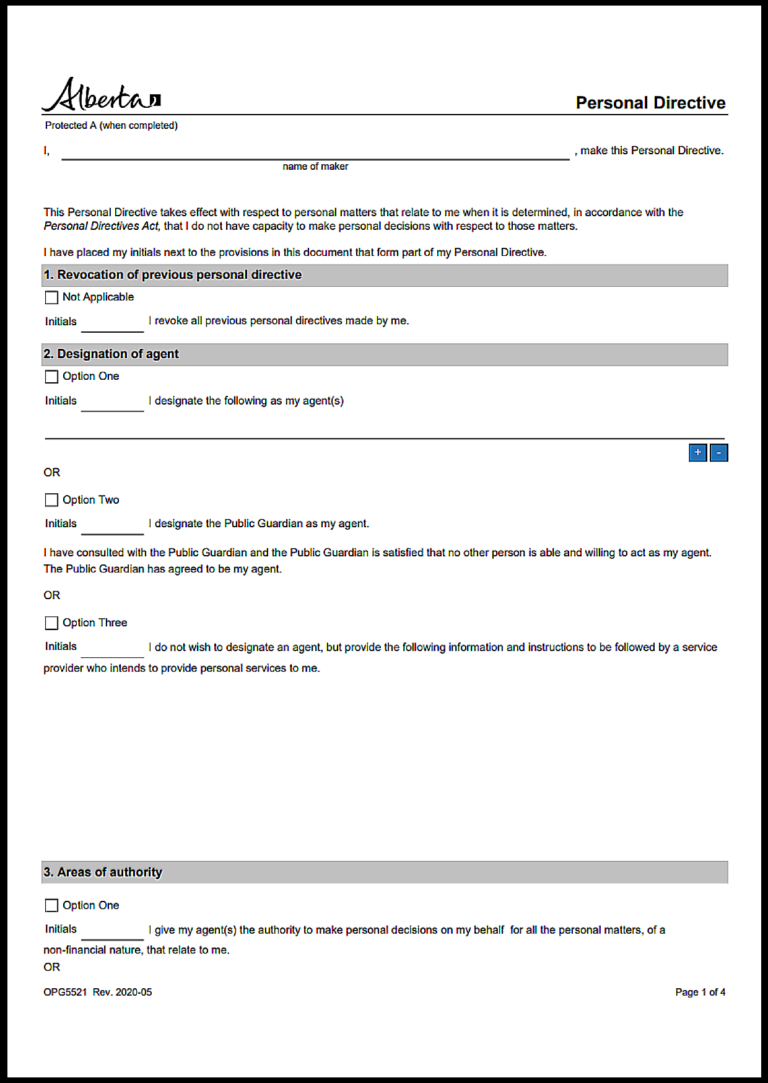
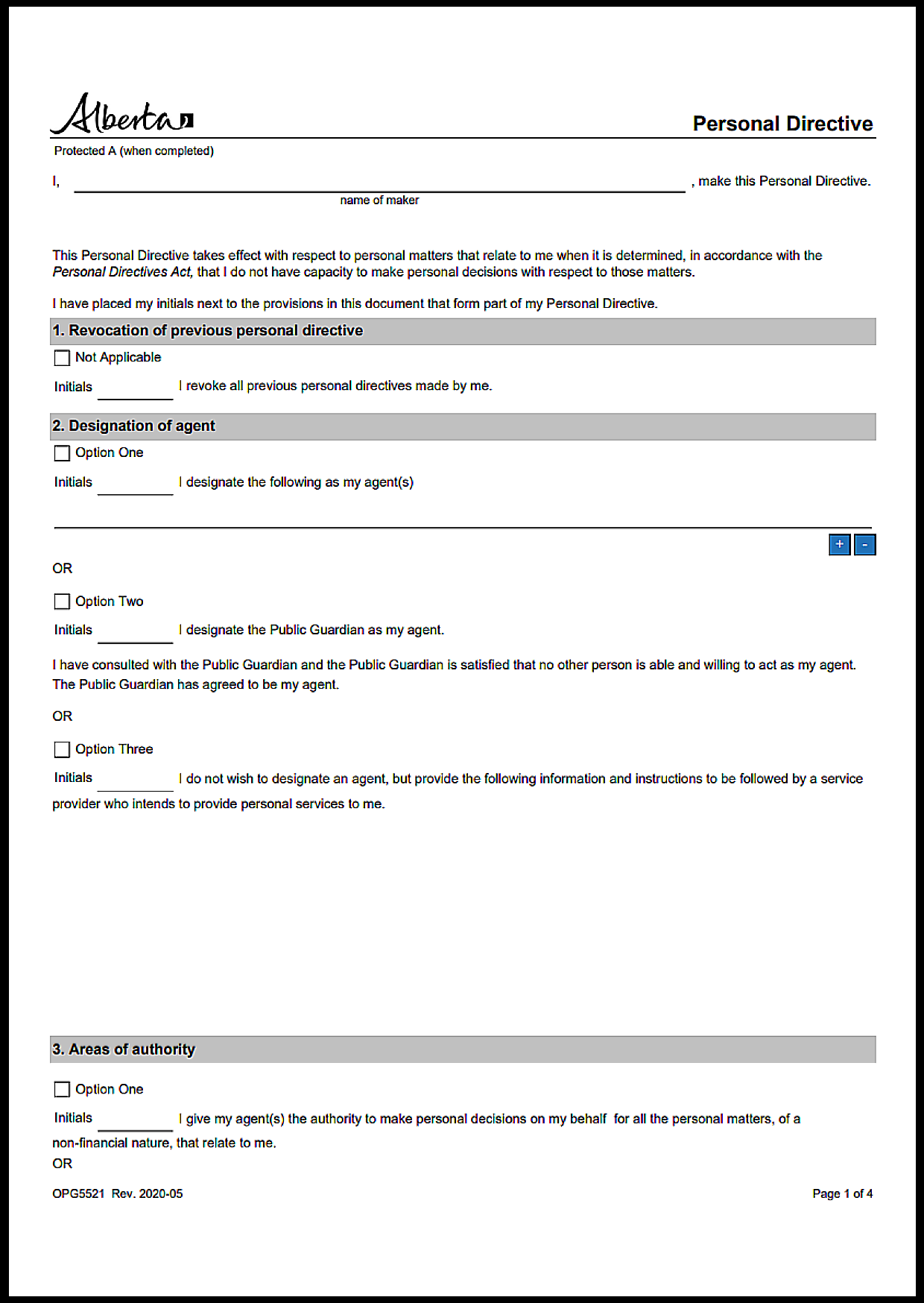
Below is a simple, beginner-friendly template you can copy and customize based on your needs.
Alberta Personal Directive Legal Rules and Witness Requirements
| Topic / Issue | Alberta Legal Rule | Governing Statute |
|---|---|---|
| Governing Legislation | Alberta Personal Directives are governed by Alberta’s Personal Directives Act. | Personal Directives Act, RSA 2000, c P-6 |
| Governance | Personal Directives in Alberta are governed primarily by Alberta provincial law. | Personal Directives Act |
| Recent Amendments | Administrative procedures and forms under the Personal Directives Regulation were updated in 2019 through Alta Reg 176/2019. | Personal Directives Regulation, Alta Reg 176/2019 |
| Who Can Sign | The Maker is the person who makes the Personal Directive and signs it in accordance with Alberta’s legal requirements. | Personal Directives Act, s. 5(1) |
| Witness Requirements | A Personal Directive must be signed by the Maker and a witness in accordance with Alberta’s witnessing requirements. | Personal Directives Act, s. 5(1) |
| Disqualified Witnesses | The witness must be over 18 and cannot be the Maker’s spouse or interdependent partner, the agent, or the agent’s spouse or interdependent partner. | Personal Directives Act, s. 5(2) |
| Notarization | A Personal Directive does not need to be notarized or commissioned. | N/A |
| Age Requirement | The Maker must be at least 18 years old. | Personal Directives Act, s. 3(1) |
| Mental Capacity Requirement | The Maker must understand the nature and effect of the Personal Directive when making it. | Personal Directives Act, s. 3(1) |
| Time Limits | A Personal Directive does not have to expire on a fixed date, but it can cease to have effect through revocation, the Maker’s death, regained capacity, or a court determination. | Personal Directives Act, s. 12 |
| Mandatory Language | Alberta does not require a special “magic phrase” or mandatory wording for a Personal Directive. | Personal Directives Act |
| Writing Requirement | The Personal Directive must be in writing. | Personal Directives Act, s. 7(1) |
| Date Requirement | The Personal Directive must be dated. | Personal Directives Act, s. 7(1) |
| Signature Requirement | The Personal Directive must be signed in accordance with Alberta’s statutory signing requirements. | Personal Directives Act, s. 7(1) |
| Agent or Instruction Requirement | A Personal Directive can name an agent or include instructions about personal matters, depending on how the Maker chooses to structure it. | Personal Directives Act |
| Registry Availability | Alberta offers a voluntary Personal Directives Registry through the Office of the Public Guardian and Trustee (OPGT). | Office of the Public Guardian and Trustee (OPGT) |
| Registry Purpose | Registration is optional and helps healthcare providers find out whether you have a Personal Directive and how to contact your agent or agents. The registry does not keep a copy of the directive. | Personal Directives Act |
| Invalid Due to Improper Witnessing | The agent and other disqualified people cannot act as witnesses, so the Personal Directive should be signed only in accordance with Alberta’s witnessing requirements. | Personal Directives Act, s. 5(2)(a) |
| Invalid Due to Lack of Capacity | The Maker must understand the nature and effect of the Personal Directive when making it. | Personal Directives Act, s. 3(1) |
| Invalid if Not in Writing | A Personal Directive must be in writing; oral instructions alone do not satisfy the formal requirements for a Personal Directive. | Personal Directives Act |
| Alberta Single Witness Rule | Alberta requires a witness for a Personal Directive, and the witness must meet Alberta’s statutory requirements. | Personal Directives Act |
| Alberta Terminology Difference | Alberta uses the term “Agent” for the person named to make personal decisions on behalf of the Maker. | Personal Directives Act |
| Scope of Authority | A Personal Directive deals with personal, non-financial matters such as healthcare and living arrangements. Financial authority is addressed separately through an Enduring Power of Attorney. | Personal Directives Act |
Alberta requires a Personal Directive to be witnessed, and the witness must meet the province’s eligibility rules. The directive does not need to be notarized or commissioned, and Alberta does not require a special “magic phrase.” You can name an agent, include instructions, or use both approaches.
A Personal Directive deals with personal, non-financial matters. Financial authority is addressed separately through an Enduring Power of Attorney. Keeping those two documents separate is important because an agent under a Personal Directive does not receive general authority over banking, property, or other financial matters simply because they are named as an agent.
The witness rules matter at the time the document is signed. An agent and other disqualified people cannot act as witnesses, so the Personal Directive should be executed using an eligible witness.
The free Alberta Personal Directive template below can help you organize your wishes, but the completed document should be checked against Alberta’s current legal requirements.
What Is a Personal Directive in Alberta?
A Personal Directive is a legal document under Alberta’s Personal Directives Act. It lets you set out instructions about personal matters and, if you choose, appoint an agent to make personal decisions for you when you lack capacity.
It covers both:
- Healthcare decisions (treatment, surgery, life support)
- Personal care decisions (living arrangements, daily care)
A Personal Directive comes into effect when you are found to lack capacity to make personal decisions. Until then, you continue to make your own personal decisions.
Simple example:
For example, if an accident or illness leaves you unable to make a particular personal decision, an agent named in an enacted Personal Directive can make decisions within the authority given by the directive.
Why You Should Have a Personal Directive
A Personal Directive serves a different purpose from a will. A will deals with your estate after death, while a Personal Directive deals with personal decisions while you are alive and lack capacity.
Without a directive, the available decision-making process depends on the type of personal decision involved.
- Disagreements between relatives
- Delays in medical decisions
- Court processes for guardianship
With a directive, you get:
- Clear decision-maker authority
- Your medical wishes respected
- Less emotional stress for loved ones
Real-life scenario:
If you name an agent and your Personal Directive has been enacted for the relevant matter, the agent can make decisions within the authority granted by the directive.
A personal directive allows someone to make personal and healthcare decisions for you. It works alongside your estate planning documents.
Who Can Be an Agent (Decision Maker)?
Eligibility Rules
Under Alberta law, your agent must:
- Be at least 18 when the Personal Directive takes effect
- Have the capacity to make personal decisions
- Be someone you trust
Who You Should Choose
Choosing the right agent is very important. Good options include:
- Your spouse or partner
- An adult child
- A close and responsible friend
Who You Should Avoid
Avoid choosing someone who:
- Is unreliable or hard to contact
- May create conflict in the family
- Does not understand your values
A wrong choice can create more problems than having no directive at all.
It is commonly paired with a living will or an advance care directive for full medical planning.
What Decisions Can an Agent Make?
Once the Personal Directive is enacted, your agent can make decisions within the areas of authority and instructions set out in the directive. These may include:
- Healthcare treatments and medications
- Approving or refusing surgeries
- Choosing long-term care facilities
- Daily personal care decisions
- End-of-life care (based on your wishes)
Your agent must follow clear instructions in the Personal Directive. If the directive does not contain clear instructions, Alberta’s rules provide how the agent is to make the decision.
When Does a Personal Directive Become Active?
A Personal Directive does not start immediately. It comes into effect when you are found to lack capacity to make personal decisions.
The Personal Directive is enacted through Alberta’s capacity-assessment process. The requirements depend on whether the Maker designated someone to determine capacity.
Until that point, you continue to make your own decisions.
Legal Requirements in Alberta (Must Follow)
For a Personal Directive to satisfy Alberta’s formal requirements, it must be written, dated, signed and witnessed as required by Alberta law.
- Must be in writing
- Must be signed by you
- Must have at least one witness
Who Cannot Be a Witness
The following people cannot act as witnesses:
- Your agent
- Your agent’s spouse or interdependent partner
- Your spouse or interdependent partner
If these rules are not followed, your directive may not be legally valid.
Common Mistakes to Avoid
Many people make simple mistakes that can cause serious problems later.
- Not updating the document after marriage, divorce, or major life changes
- Choosing the wrong agent
- Writing unclear or vague instructions
- Not telling family members about the directive
- Losing the original document
Quick tip: Always keep copies with your agent, family members, and your doctor.
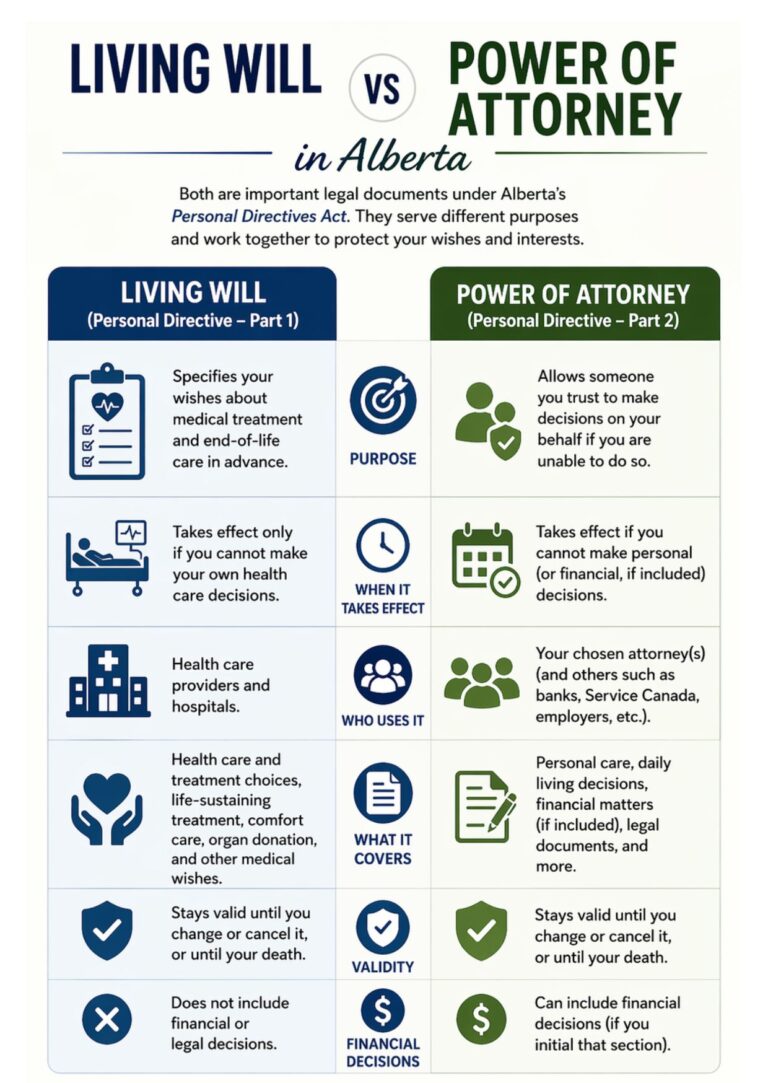
Personal Directive vs Living Will vs Power of Attorney
| Feature | Personal Directive | Living Will |
Power of Attorney
|
| Covers healthcare | ✔ | ✔ | ✘ |
| Covers personal care | ✔ | ✘ | ✘ |
| Covers finances | ✘ | ✘ | ✔ |
| Legal in Alberta | ✔ | Not formal term | ✔ |
This table helps clear a common confusion. A Personal Directive is for healthcare and personal care, while financial decisions are handled by a Power of Attorney.
How to Create a Personal Directive (Step-by-Step)
Step 1 – Think About Your Wishes
Decide what kind of medical care you want or do not want. Think about life support, pain relief, and long-term care.
Step 2 – Choose Your Agent
Pick someone responsible and trustworthy who understands your values.
Step 3 – Fill the Template
Use the template above and write clear instructions. Avoid confusing language.
Step 4 – Sign with Witness
Make sure you sign it in front of a valid witness as required by law.
Step 5 – Share Copies
Give copies to your agent, family, and healthcare provider.
You can also explore related documents like /alberta-medical-power-of-attorney/ and /estate-planning-documents/ to complete your plan.
What Happens If You Don’t Have One?
If you do not have a Personal Directive, the available decision-making process depends on the type of personal decision involved. A healthcare provider may select a nearest relative for certain decisions, while a family member or friend may need to use the guardianship process for broader personal decisions.
This can lead to:
- Delays in urgent medical decisions
- Extra legal costs
- Stress and conflict among family members
- Loss of control over your care
In real situations, families may face uncertainty because no one has been specifically chosen in advance to make broader personal decisions.
Can You Change or Cancel It?
Yes, you can change or revoke your Personal Directive while you have the capacity to do so.
To update it:
- Create a new directive
- Clearly cancel the old one
Important tip: Always inform your agent and family after making changes to avoid confusion.
Frequently Asked Questions (FAQs)
Is a Personal Directive legally binding in Alberta?
Yes. A Personal Directive is legally recognized in Alberta when it satisfies the applicable legal requirements. Clear instructions must be followed within the scope of the directive and applicable law.
Do I need a lawyer to make a Personal Directive?
No, you do not need a lawyer. You can create one using a simple template like the one above. However, in complex family or medical situations, legal advice can help avoid future problems.
Can I have more than one agent?
Yes, you can appoint more than one agent and can also name alternate agents. The directive should clearly state their roles and areas of authority.
What is the difference between agent and guardian?
An agent is someone you choose in advance through a Personal Directive. A guardian is appointed by the court through the guardianship process when that form of decision-making authority is required. Choosing your own agent lets you identify who should make personal decisions within the authority you give them.
Where should I keep my Personal Directive?
Keep the original in a safe place and give copies to your agent, close family members, and your healthcare provider. Easy access is very important in emergencies.