How to Write Bill of Sale Manitoba? (Step by Step Guide)
How to Write Bill of Sale Manitoba is something many buyers and sellers search for when handling private sales in Manitoba. Whether you are selling a used vehicle, trailer, electronics, furniture, or farm equipment, a properly written bill of sale helps protect both parties and creates a clear record of the transaction.
In Manitoba, rules for a bill of sale depend on what is being sold. General personal property sales are usually simple, but vehicle sales involve extra requirements through Manitoba Public Insurance (MPI). A written bill of sale can help prevent disputes, confirm ownership transfer, support tax records, and show the agreed purchase terms if problems happen later.
This guide explains Manitoba bill of sale rules, vehicle transfer requirements, VIN and lien disclosure rules, “As-Is” wording, and the most common mistakes people make during private sales.

How to Properly Write a Manitoba Bill of Sale for Vehicles, Boats & Private Sales
| Topic / Issue | Manitoba Legal Rule | Governing Statute |
|---|---|---|
| Contract formation rules | Written transfers of personal property are governed under Manitoba sale contract law. | The Sale of Goods Act, R.S.M. 1987, c. S10 |
| Vehicle transfer data requirements | Manitoba requires specific ownership and registration details for vehicle transfers. | The Drivers and Vehicles Act, C.C.S.M. c. D104 |
| Federal vessel ownership compliance | Boat bills of sale must satisfy federal proof-of-ownership standards. | Canada Shipping Act, 2001, S.C. 2001, c. 26; Small Vessel Regulations (SOR/2010-91) |
| Required transfer wording | The document should contain clear present-tense wording showing the seller transfers ownership. | The Sale of Goods Act, R.S.M. 1987, c. S10, s. 3 |
| Witness requirements | Witnesses are generally optional for ordinary Manitoba private sales. | No statutory requirement — governed by common law principles |
| Price requirement | A valid sale contract requires a clearly stated money price in Canadian dollars. | The Sale of Goods Act, R.S.M. 1987, c. S10, s. 3 & 10 |
| Signature requirements | Both buyer and seller should sign the document for registration purposes. | The Drivers and Vehicles Act, C.C.S.M. c. D104; MPI Standards |
| Electronic signature acceptance | Digital signatures may be accepted if the document remains fully legible and unaltered. | The Electronic Statutes and Regulations Act, C.C.S.M. c. E55 |
| Buyer and seller identification | Full legal names and physical addresses should match identification and registration records. | MPI and Transport Canada processing standards |
| Vehicle information requirements | Vehicle bills of sale should contain year, make, model, odometer reading, and full VIN. | The Drivers and Vehicles Act, C.C.S.M. c. D104 |
| Boat information requirements | Boat bills of sale should contain HIN and Pleasure Craft Licence information where applicable. | Canada Shipping Act, 2001; Small Vessel Regulations |
| Motor information requirements | Boat motor packages should identify engine make, model, horsepower, and serial number. | Transport Canada processing standards |
| “As-Is” wording requirements | Exclusion wording should clearly waive implied conditions under Section 16 of the Sale of Goods Act. | The Sale of Goods Act, R.S.M. 1987, c. S10, s. 16 |
| Date and execution requirements | Bills of sale should contain the full execution date and signatures of all parties. | MPI and Transport Canada processing standards |
| TOD companion requirement | Sellers completing documentation needed when transferring a trailer in Manitoba should prepare both the signed TOD and a properly itemized bill of sale before meeting the buyer. | The Drivers and Vehicles Act, C.C.S.M. c. D104 |
| Boat and trailer itemization | Boat, trailer, and motor package values should be separated clearly for registration and tax purposes. | Manitoba Public Insurance tax processing procedures |
| Missing co-owner signatures | A co-owner cannot legally transfer full ownership alone. | The Sale of Goods Act, R.S.M. 1987, c. S10, s. 23(1) |
| Post-signature alterations | Handwritten changes added after signing may invalidate the document. | Manitoba common law contract principles |
| Vague asset descriptions | Property must be described clearly enough to identify the exact asset being sold. | The Sale of Goods Act, R.S.M. 1987, c. S10, s. 21 |
| Manitoba trailer tax valuation review | MPI may apply standardized valuation methods if package pricing is not itemized properly. | Manitoba Public Insurance valuation procedures |
One of the most important Manitoba drafting rules is that a bill of sale must clearly identify the exact property being sold. A vague description like “used trailer” or “fishing boat package” may not provide enough certainty to complete registration or prove ownership later. Manitoba also treats vehicle and trailer sales much more strictly than ordinary private property sales because MPI requires precise VIN matching, signatures, pricing details, and the signed Transfer of Ownership Document before registration can happen.
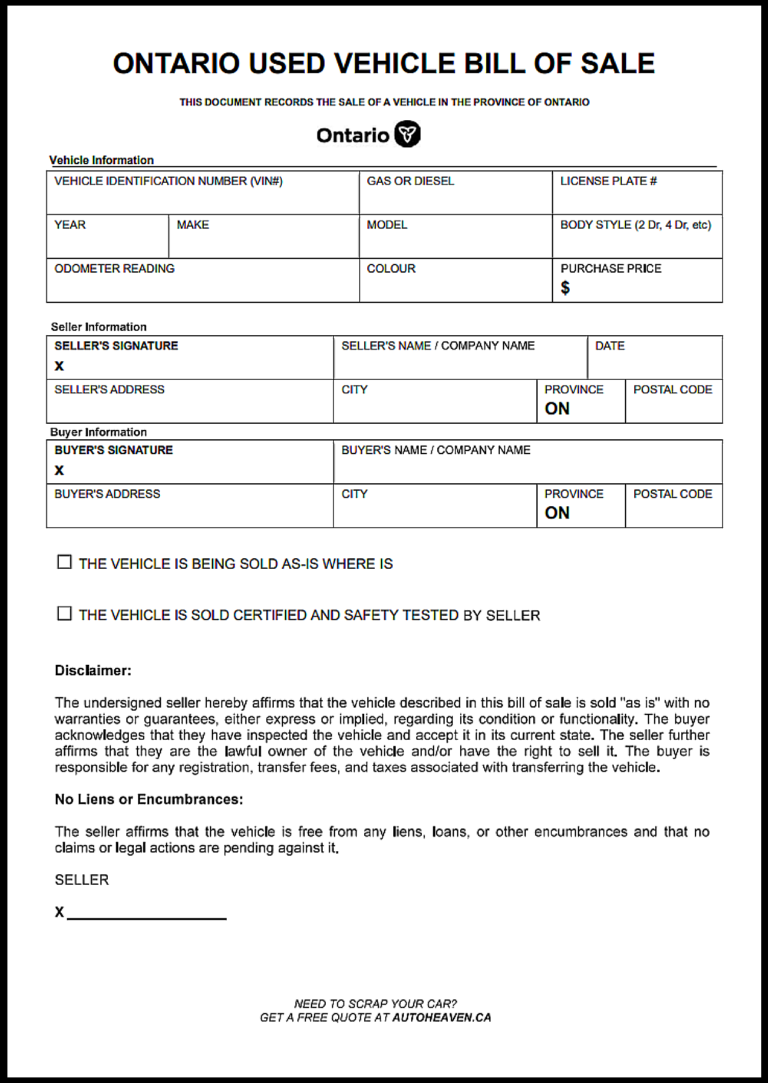
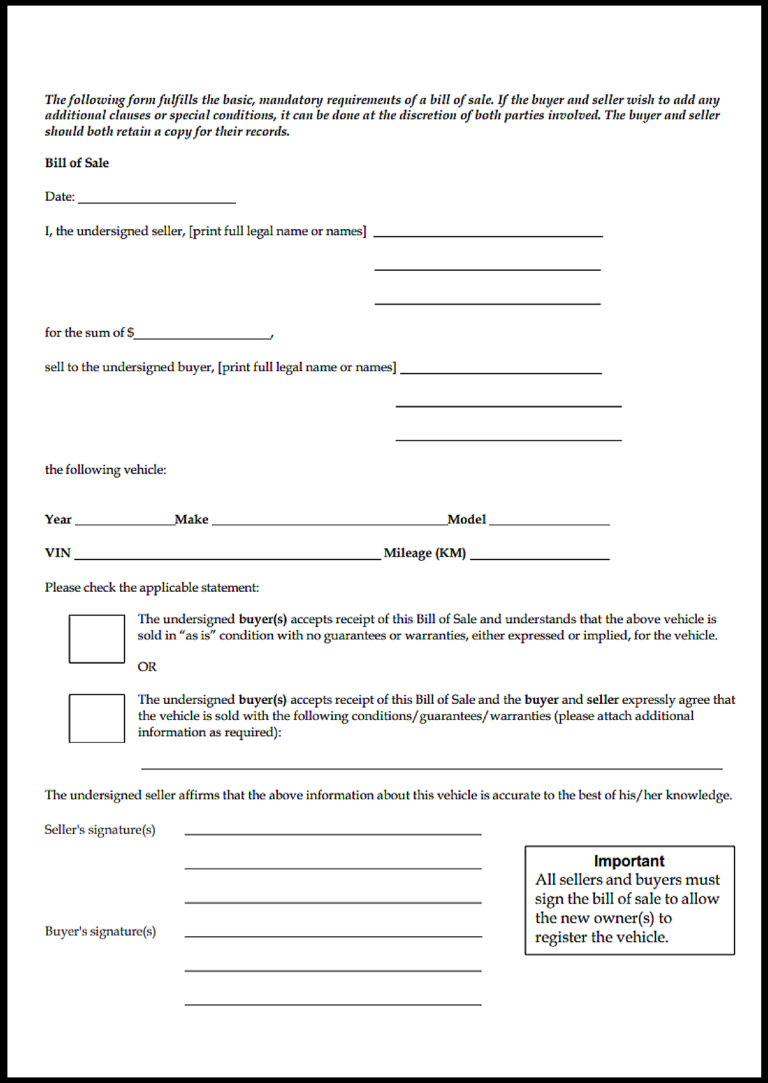
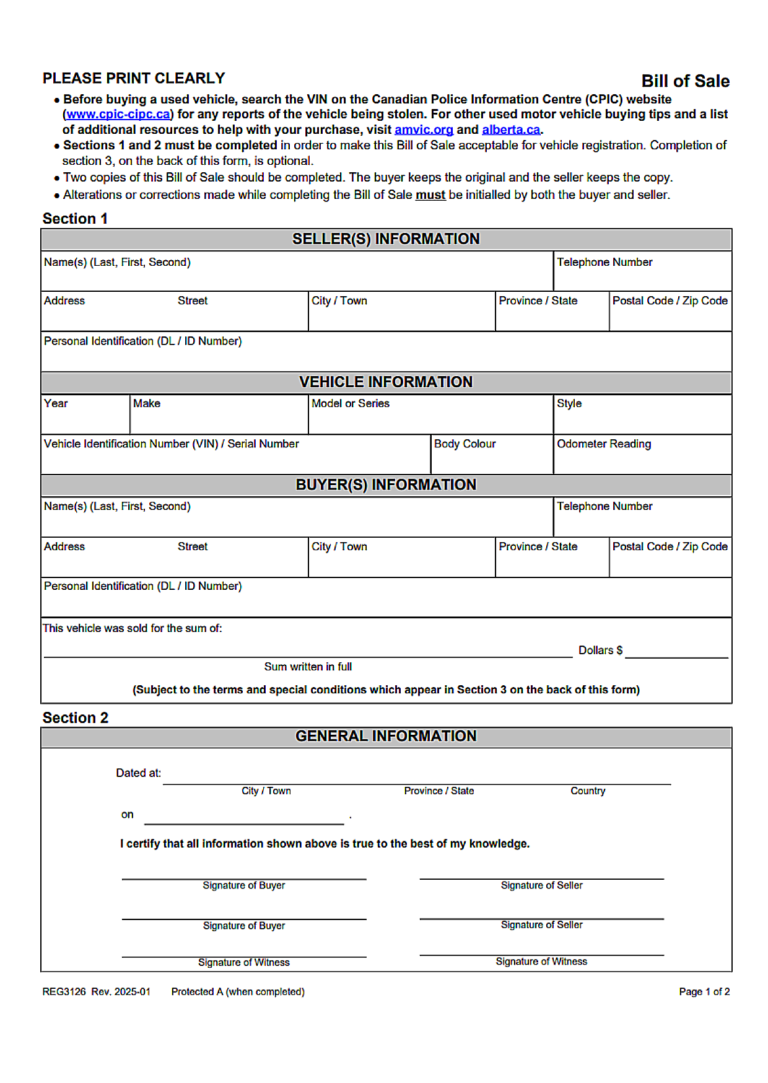
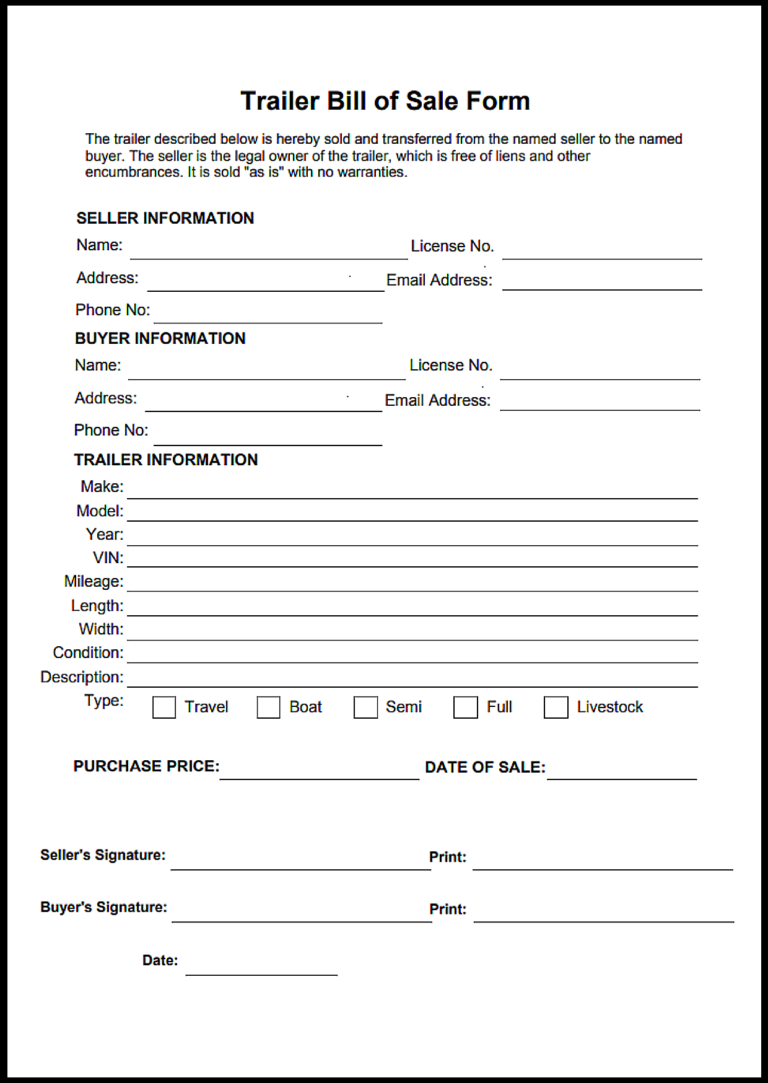
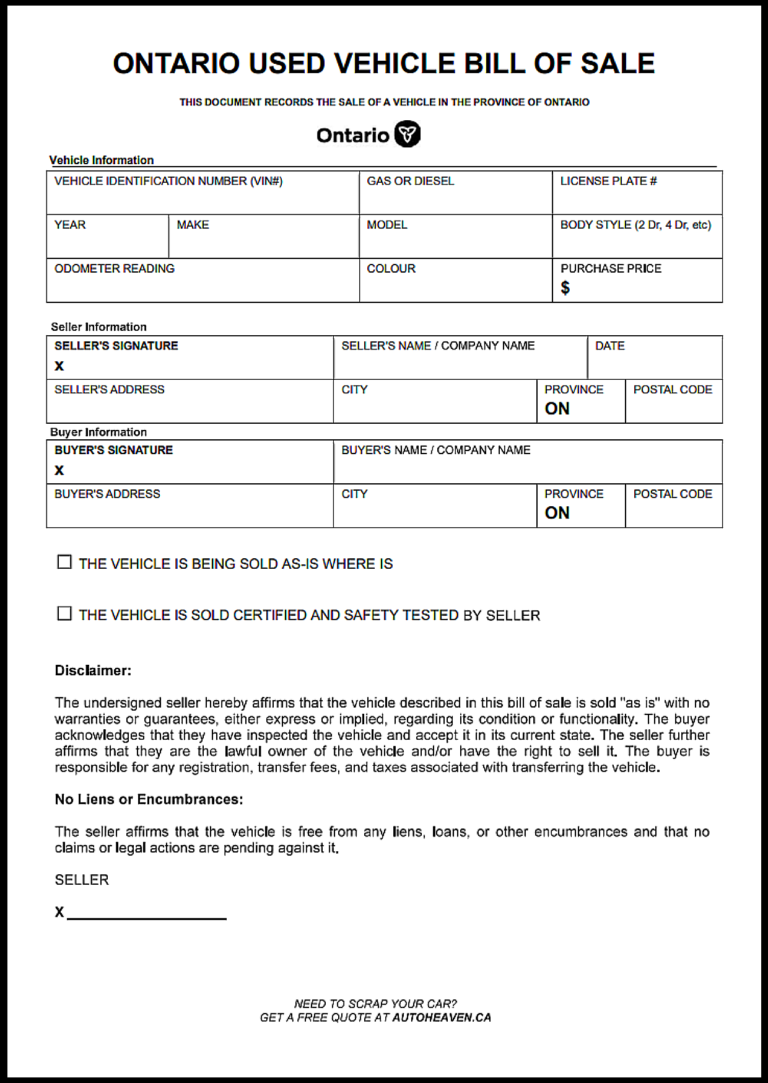
The pricing rules matter in real life because Manitoba considers the written purchase price a core part of the contract itself. If the amount is missing, altered after signing, or appears artificially low, MPI may reject the document or trigger additional tax review procedures. Buyers and sellers also commonly run into problems when co-owners fail to sign or handwritten corrections are added after execution. Even small drafting mistakes can delay registration, create fraud concerns, or weaken legal ownership evidence later. Download the free Manitoba Bill of Sale template below to help write your document correctly the first time.
Is a Bill of Sale Legally Required in Manitoba?
Private Sales of Personal Property
Many buyers and sellers first wonder whether a bill of sale is legally required for private transactions in Manitoba before preparing their paperwork. People often buy and sell used furniture, electronics, tools, appliances, or small equipment through online marketplaces or local sales without formal paperwork.
Still, creating a bill of sale is strongly recommended. A written agreement gives both parties proof of what was sold, when the sale happened, and how much money changed hands. If disagreements happen later, the bill of sale can help prove ownership and the terms of the transaction.
Under Manitoba law, a bill of sale acts as evidence that the buyer and seller agreed to the sale.
Vehicle Sales Have Extra Requirements
Vehicle sales in Manitoba are different from ordinary private sales because additional registration rules apply.
When selling a vehicle, buyers normally need:
- A properly completed bill of sale
- The Transfer of Ownership Document (TOD)
- Registration through Manitoba Public Insurance (MPI)
The bill of sale alone is usually not enough to complete a vehicle ownership transfer. MPI may refuse registration if required information is missing.
The TOD is not a separate form; it is the detachable right-hand portion of the official Manitoba vehicle registration certificate. It acts as the primary legal instrument to verify and transfer ownership from the registered owner to the buyer.
What Information Must Be Included in a Manitoba Bill of Sale?
Buyer and Seller Legal Names
The bill of sale should include the full legal names of both the buyer and seller. Nicknames should be avoided because they can create confusion later.
For example, using “Michael Thompson” instead of “Mike Thompson” is safer for legal and registration purposes. Names should match government-issued identification whenever possible.
This is especially important for vehicle sales because MPI may compare the information against registration records.
Sale Date and Purchase Price
The exact sale date matters more than many people realize.
The date helps determine:
- When ownership changed
- When insurance responsibility ended
- When taxes became payable
- Which party was responsible if damage occurred
The purchase price should also be written accurately. Manitoba may assess Retail Sales Tax based on fair market value if the listed price appears unrealistic.
Writing a false price to reduce taxes can create legal and tax problems later.
Full Description of the Item
The item being sold should be described clearly enough to identify it without confusion.
Common examples include:
| Item Type |
Details to Include
|
| Furniture |
Brand, material, colour, dimensions
|
| Electronics |
Model number, serial number, accessories
|
| Farm equipment |
Year, make, model, serial number
|
| Trailers |
VIN, trailer size, condition
|
| Vehicles |
Year, make, model, VIN, mileage
|
A vague description like “used machine” or “old furniture” may not provide enough protection if disputes happen later.
VIN or Serial Number Requirements
Vehicles sold in Manitoba should include the full 17-character Vehicle Identification Number (VIN). MPI generally requires the VIN before processing registration and ownership transfer.
Trailers, ORVs, snowmobiles, and farm equipment may also have serial numbers that should be listed on the bill of sale.
Missing VINs or serial numbers are one of the biggest causes of registration delays and ownership disputes.
Signatures of Both Parties
The buyer and seller should both sign the bill of sale.
Signatures help prove:
- The parties agreed to the transaction
- Ownership changed voluntarily
- The terms were accepted
Witnesses are usually optional in Manitoba private sales. However, witnesses can help if the transaction involves expensive property or if disputes later arise.
“As-Is” Clause Protection
Under Manitoba’s Sale of Goods Act, certain warranties may apply automatically unless they are properly excluded.
For example, the law generally assumes:
- The seller has the legal right to sell the item
- The buyer will receive peaceful ownership
- The item matches its description
Because of this, many private sellers include “As-Is” wording.
An “As-Is” clause tells the buyer that the property is being accepted in its current condition without guarantees or warranties, except where the law still requires disclosure.
Different transactions may require more specialized transfer paperwork depending on the type of asset being sold. Vehicle purchases often involve a vehicle ownership transfer form, while private automobile sales commonly use a car bill of sale template for registration and legal recordkeeping.
How to Write a Vehicle Bill of Sale in Manitoba
Information MPI Requires
Vehicle bills of sale in Manitoba should contain:
- Vehicle year
- Make and model
- Full VIN
- Purchase price
- Date of sale
- Buyer and seller names
- Signatures
Even one missing detail can delay registration through MPI or an Autopac agent.
The Transfer of Ownership Document (TOD)
Many people mistakenly believe a bill of sale automatically transfers vehicle ownership.
In Manitoba, a bill of sale alone cannot complete a transfer. The seller must also physically provide the Transfer of Ownership Document (TOD), which constitutes the right-hand section of the seller’s current registration certificate. The seller must fill out, sign, and date the TOD, then hand it to the buyer as a companion piece to the bill of sale. Without a physically signed TOD, an Autopac agent will reject the registration application entirely.
Without the TOD, the buyer may not be able to register the vehicle properly.
Odometer Accuracy Rules
Odometer fraud is illegal under Canadian law.
Sellers should never:
- Roll back mileage
- Guess inaccurate mileage
- Misrepresent the vehicle’s true distance travelled
Incorrect mileage information can lead to lawsuits, criminal investigations, and financial penalties.
If the seller does not know the actual mileage, that should be clearly stated.
Vehicle Liens and Outstanding Loans
Before paying for a used vehicle, buyers should check for liens.
A lien means a lender or creditor may still have a legal claim against the vehicle because of unpaid financing.
If the debt is not cleared, the vehicle could potentially be repossessed even after the buyer pays the seller.
Buyers can search the Personal Property Registry (PPR) to check for registered liens.
Under Manitoba law, sellers are expected to disclose known liens or encumbrances affecting the property.
Retail Sales Tax (RST) on Vehicle Purchases
Retail Sales Tax (RST) usually applies to vehicle purchases in Manitoba unless a specific exemption exists.
MPI may calculate tax using:
- The declared purchase price
- The vehicle’s fair market value
If the listed price appears too low, tax may still be charged based on market value.
When parties want additional protection during private sales, they may also choose to use an as-is bill of sale agreement. Buyers comparing ownership paperwork may also benefit from reviewing the difference between a bill of sale and ownership documents in Manitoba before completing the transfer process.
How “As-Is” Sales Work in Manitoba
What “As-Is” Actually Means
An “As-Is” sale means the buyer contractually agrees to accept the asset in its present operational state, invoking Section 56 of The Sale of Goods Act to exclude default statutory warranties of quality or fitness. It is critical to note that while “As-Is” disclaimers are completely valid in private, peer-to-peer sales, they are strictly illegal and legally void when buying from a licensed commercial dealership. Commercial vehicle and equipment dealers are banned from stripping away consumer protections due to strict provisions within The Consumer Protection Act (C.C.S.M. c. C200).
For example, an “As-Is” clause does not protect a seller who:
- Sells stolen property
- Hides a lien
- Lies about major damage
- Provides fake ownership information
The clause mainly protects sellers from complaints about ordinary wear, defects, or condition issues the buyer could reasonably inspect before purchase.
Situations Where Sellers Still Have Legal Duties
Even in an “As-Is” sale, sellers still have responsibilities under Manitoba law.
They must avoid:
- Selling stolen property
- Hiding financing or liens
- Making false statements
- Misrepresenting the item’s condition
- Providing fake VIN or serial numbers
Courts may set aside transactions involving fraud or unfair conduct.
Example of Proper “As-Is” Wording
Many Manitoba private sales use wording similar to this:
“The buyer accepts the goods in ‘as is’ condition with no guarantees or warranties, express or implied.”
This helps reduce confusion and future disputes.
Common Mistakes That Cause Problems Later
Leaving Out the VIN or Serial Number
Missing VINs or serial numbers can create serious issues later.
Problems may include:
- Registration delays
- Ownership disputes
- Difficulty proving identity of the property
- Fraud concerns
Always verify the VIN directly from the vehicle before signing documents.
Using Incorrect Buyer or Seller Names
Incorrect names can create legal confusion during registration or future disputes.
This may cause:
- MPI processing delays
- Insurance issues
- Contract disputes
- Ownership challenges
Full legal names are always the safest option.
Forgetting Lien Disclosure
Undisclosed liens are one of the biggest financial risks in private vehicle sales.
If a lender still has a legal interest in the property, the buyer may risk repossession even after completing payment.
Buyers should consider checking the Personal Property Registry before purchasing expensive assets.
Writing the Wrong Sale Price
Some people intentionally understate the purchase price to reduce taxes.
This can create:
- Tax reassessments
- Fraud concerns
- Insurance valuation disputes
- Legal problems during resale
The safest approach is to record the true sale amount.
Relying Only on Verbal Agreements
Verbal agreements are difficult to prove if disagreements happen later.
A written bill of sale helps show:
- What was sold
- Who purchased it
- The agreed price
- The date of transfer
- Special sale conditions
Even simple private sales benefit from written records.
Should a Manitoba Bill of Sale Be Notarized?
When Notarization Is Usually Not Required
Most private sales in Manitoba do not require notarization.
This usually includes:
- Used vehicle sales
- Electronics
- Furniture
- Farm tools
- Small trailers
A properly signed bill of sale is normally enough for standard private transactions.
Situations Where Notarization Can Help
Notarization may still be useful in some situations, including:
- High-value equipment sales
- Cross-province transactions
- Commercial asset transfers
- Dispute prevention
- Estate-related transfers
A notarized document may provide stronger proof if ownership is challenged later.
Selling to Buyers in Other Provinces
Some provinces may request notarized documents before allowing registration of imported vehicles or equipment.
If the buyer lives outside Manitoba, both parties should confirm the destination province’s requirements before finalizing the sale.
What Happens After the Bill of Sale Is Signed?
Steps for Buyers
After signing the bill of sale, buyers should:
- Keep signed copies
- Register vehicles with MPI
- Pay applicable taxes
- Verify lien status if necessary
- Update insurance coverage
Keeping both digital and paper copies is a smart idea.
Steps for Sellers
Sellers should also protect themselves after the sale.
Important steps include:
- Keeping transaction records
- Removing insurance coverage if needed
- Providing honest disclosures
- Confirming payment cleared
- Retaining signed documents
Good records can help resolve disputes months or even years later.
Keeping Records for Tax and Legal Purposes
Bills of sale may later be needed for:
- Tax records
- Capital gains reporting
- Business expense documentation
- Insurance claims
- Ownership disputes
Under Canadian tax rules, records should generally be stored for several years.
Frequently Asked Questions
Can I handwrite a Bill of Sale in Manitoba?
Yes. Manitoba law generally allows handwritten bills of sale as long as the information is clear and complete.
Does a Bill of Sale need witnesses?
No. Witnesses are usually optional for standard private sales in Manitoba.
Can I sell a vehicle without a TOD?
In many cases, no. MPI normally requires the Transfer of Ownership Document in addition to the bill of sale.
Is a Bill of Sale enough proof of ownership?
It helps prove ownership, but vehicles usually also require registration records through MPI.
What if the vehicle still has a loan?
The seller should disclose the lien, and buyers should check the Personal Property Registry before paying.
Can a Bill of Sale be canceled after signing?
Possibly. Courts may cancel agreements involving fraud, stolen property, misrepresentation, or unconscionable conduct.