Manitoba Car Bill of Sale Form – Free PDF Printable
A Manitoba Car Bill of Sale is one of the most important documents in a private vehicle transaction, but many buyers and sellers are surprised to learn that it isn’t the only paperwork needed to complete the transfer. Under Manitoba’s vehicle registration framework, a signed Bill of Sale works alongside the Transfer of Ownership Document and other required records when ownership changes hands.
I’ve seen situations where a purchaser arrived at an MPI service centre with a properly signed Bill of Sale only to discover that the seller had not completed the Transfer of Ownership Document, bringing the registration process to a standstill until the paperwork could be corrected. That’s a common problem because many generic Canadian templates focus on the sale itself and overlook Manitoba’s registration requirements.
This page explains what information belongs in a Manitoba Car Bill of Sale, when it should be used, and how it fits into the vehicle ownership transfer process.
Free Manitoba Car Bill of Sale Template
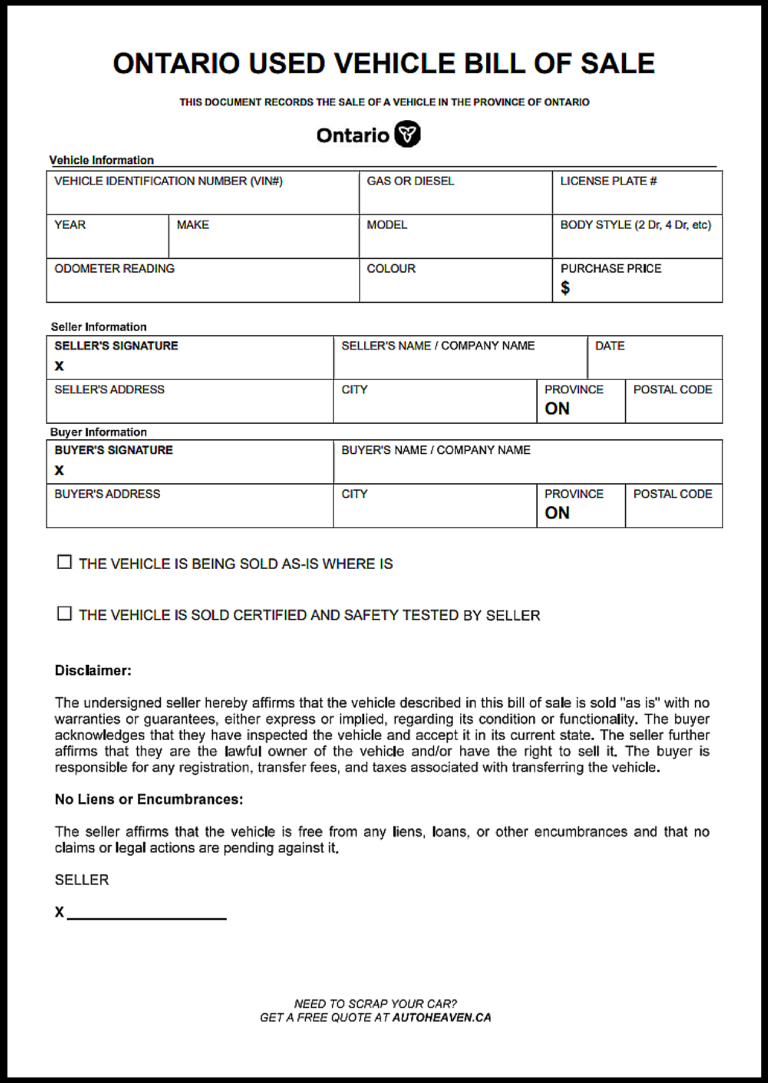
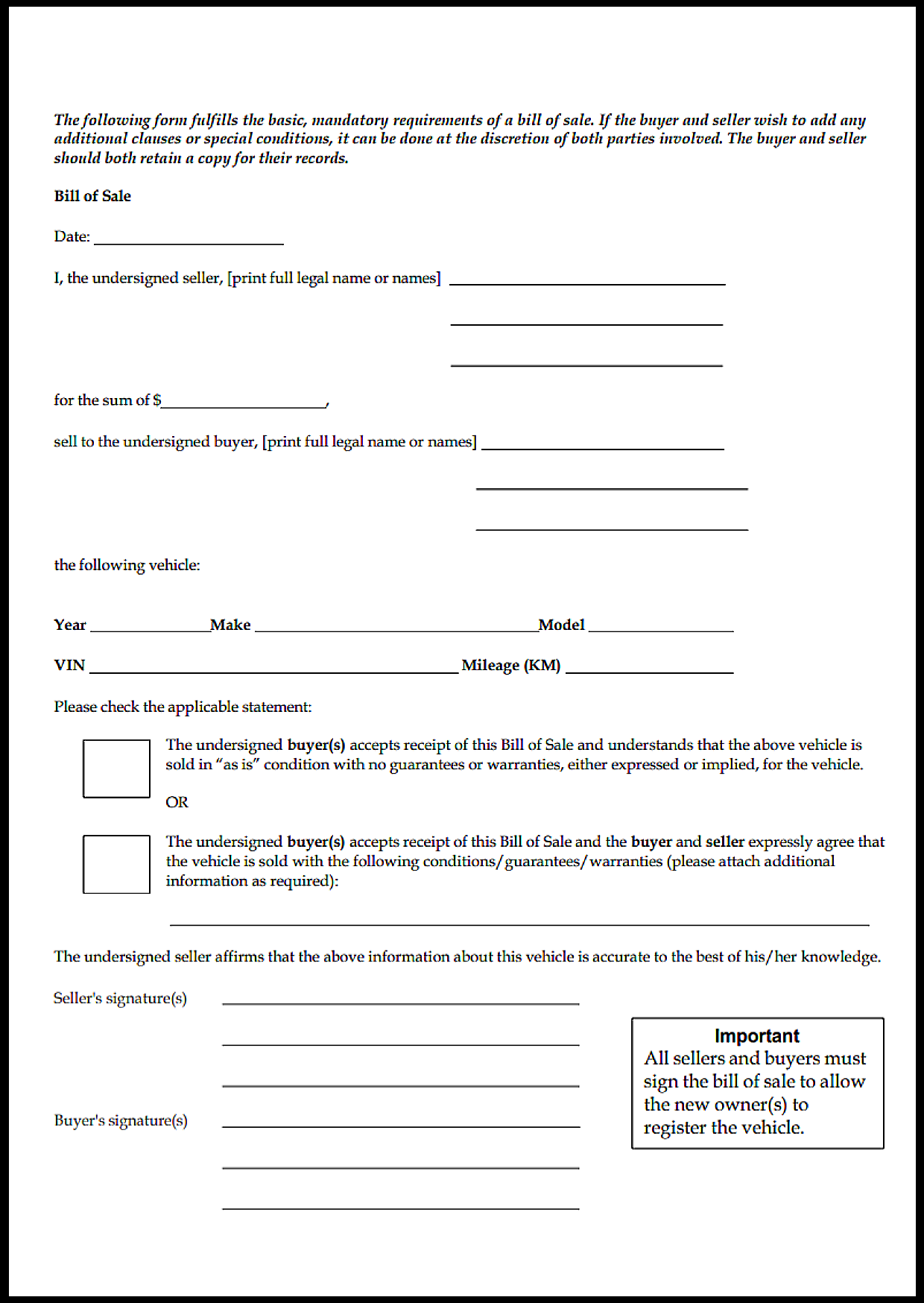
You can copy, download, or customize the following template for a private vehicle sale in Manitoba. It includes the information commonly requested by MPI and follows standard Manitoba private sale practices.
What Is a Manitoba Car Bill of Sale?
A Manitoba Car Bill of Sale is a legal sales record showing that ownership of a vehicle was transferred from one person to another. It explains who sold the vehicle, who bought it, how much was paid, and which vehicle was involved in the transaction.
The Bill of Sale is different from a registration card or ownership certificate. The registration card proves the vehicle is registered with MPI, while the Bill of Sale proves the private sale agreement itself.
Under Manitoba law, the Bill of Sale alone is not enough to register the vehicle. Buyers also need the Transfer of Ownership Document (TOD), which is the detachable section found on the seller’s current registration card.
People commonly use this document in situations such as:
- Private used car sales
- Family vehicle transfers
- Buying a vehicle from an individual seller
- Ownership recordkeeping
- Tax and payment documentation
Without a proper Bill of Sale, MPI may refuse registration until the missing information is corrected.
Car sales are often connected with other transportation-related legal documents depending on the type of asset involved. Buyers handling broader vehicle transfers may also use a vehicle ownership transfer form, while motorcycle purchases commonly involve a motorcycle bill of sale template.
When a Car Bill of Sale Is Legally Important in Manitoba
A Bill of Sale becomes legally important as soon as the vehicle changes ownership. Even though it is a private contract, it plays a major role during registration, taxation, and future disputes.
Under Manitoba law, buyers must present the original Bill of Sale to an Autopac agent or MPI Service Centre before registering the vehicle.
The document also helps prove:
- The agreed purchase price
- The date ownership changed
- The condition of the vehicle at sale
- The odometer reading
- Which parties were involved
For example, if a seller receives parking tickets weeks after the sale, the Bill of Sale can help prove the vehicle was already transferred. Likewise, if a buyer later claims the vehicle was misrepresented, the signed agreement may help clarify what was disclosed during the sale.
Situations Where Buyers Need It
Buyers commonly need the document for:
- Registering the vehicle with MPI
- Paying Retail Sales Tax (RST)
- Proving the purchase price
- Transferring licence plates
- Showing proof of ownership
Buyers should keep a signed copy permanently because disputes sometimes appear years later.
Situations Where Sellers Need It
Sellers often use the document to:
- Show the vehicle was legally sold
- Protect themselves from future fines or claims
- Record the exact transfer date
- Confirm the sale amount received
Keeping copies of payment records together with the Bill of Sale is also a smart practice.
Before registering the automobile, buyers may also benefit from reviewing the difference between ownership records and a bill of sale in Manitoba to avoid confusion during the transfer process.
Required Information for a Valid Manitoba Car Bill of Sale
Manitoba does not require one official government form for private vehicle sales. However, MPI expects certain information before accepting the document during registration.
Missing details can delay registration or create confusion about ownership.
Buyer and Seller Information
The document should include:
- Full legal names
- Residential addresses
- Contact details
- Signatures from all parties
If there are multiple registered owners, every legal owner must sign the Bill of Sale.
Vehicle Identification Details
Accurate vehicle information is extremely important.
The Bill of Sale should contain:
| Required Detail | Why It Matters |
| Year | Identifies the vehicle generation |
| Make | Confirms manufacturer |
| Model | Identifies the exact vehicle |
| Full 17-digit VIN |
Legally identifies the vehicle
|
| Colour |
Helps verify the vehicle
|
| Body style |
Supports registration accuracy
|
Even one incorrect VIN digit can create registration problems or make the document invalid.
Odometer Disclosure
The seller should accurately record the odometer reading at the time of sale.
Providing false mileage information may violate both provincial and federal law. Odometer fraud is treated seriously because buyers rely on mileage when judging a vehicle’s value and condition.
If the odometer is inaccurate or has been replaced, sellers should clearly explain this in writing.
Purchase Price and Payment Terms
The Bill of Sale should clearly show:
- Exact purchase price
- Deposit amount
- Payment method
- Trade-in information if applicable
Under Manitoba’s Retail Sales Tax rules, MPI may assess tax using fair market value if the listed sale price appears unusually low.
Vehicle Condition and Status Disclosure
Sellers should honestly disclose the vehicle’s status.
Common status categories include:
- Rebuilt
- Salvage
- Irreparable
- Previously damaged vehicles
Failing to disclose major vehicle history problems may lead to disputes or fraud allegations later.
The “As Is” Clause in Manitoba Private Vehicle Sales
Under Manitoba’s Sale of Goods Act, certain warranties may automatically apply during a vehicle sale unless they are properly excluded.
For example, there is usually an implied condition that the seller has the legal right to sell the vehicle and that the goods are reasonably fit for normal use.
An “As Is” clause helps reduce disputes by explaining that the buyer accepts the vehicle in its present condition.
However, an “As Is” clause does not protect a seller who lies about the vehicle, hides damage, or commits fraud.
Example of an “As Is” Statement
The following wording is commonly used in Manitoba private vehicle sales:
“The vehicle is sold in ‘as is’ condition with no guarantees or warranties, either expressed or implied.”
Risks of Selling a Vehicle Without an “As Is” Clause
Without proper wording, sellers may face:
- Unexpected repair complaints
- Arguments about hidden defects
- Misunderstandings about warranties
- Legal disputes after the sale
This is especially common in older used vehicle sales where mechanical problems appear shortly after purchase.
Transfer of Ownership Rules in Manitoba
Vehicle ownership changes officially when the required documents are signed and the vehicle is properly registered with MPI.
The Bill of Sale is only one part of the process. Buyers also need the TOD from the seller’s registration card.
What Is the TOD?
The Transfer of Ownership Document (TOD) is the detachable section attached to the seller’s vehicle registration.
MPI requires this document together with the Bill of Sale because it confirms the current registered owner and allows ownership transfer processing.
Without the TOD, the buyer may not be able to complete registration.
Who Must Sign the Documents?
The following people usually must sign:
- All registered vehicle owners
- All buyers
- Parents or guardians for minors under 18
Under Manitoba law, minors cannot register a vehicle without written parental or guardian consent.
Registration Timeline After Purchase
Buyers should register the vehicle as quickly as possible after purchase.
Manitoba generally allows a 7-day grace period for plate transfers from a previously owned vehicle. However, driving without proper registration or insurance can still create legal and financial risks.
It is best to complete registration immediately after the sale whenever possible.
Certificate of Inspection (COI) Requirements
A Certificate of Inspection (COI), sometimes called a safety inspection, confirms that a vehicle meets Manitoba’s required safety standards.
Most used vehicles require a valid COI before the buyer can register the vehicle with MPI.
The inspection must usually be completed at an approved inspection station.
How Long a COI Is Valid in Manitoba
In most situations, a Manitoba COI remains valid for one year from the inspection date.
Buyers should always check the inspection date carefully before relying on the document.
Common COI Mistakes Buyers Make
Many buyers make avoidable mistakes such as:
- Accepting expired inspections
- Assuming every used vehicle automatically qualifies for registration
- Failing to confirm repairs were completed
- Forgetting to request inspection paperwork
These mistakes can delay registration or create unexpected repair expenses.
Vehicle Liens and Unpaid Loan Risks
A Bill of Sale does not automatically remove liens attached to a vehicle.
Under Manitoba PPSA rules, a registered lien can remain attached even after the vehicle is sold to a new owner.
This means a lender may still have legal rights against the vehicle if the previous owner failed to pay their loan.
Why Buyers Should Check for Liens
Checking for liens helps buyers avoid:
- Vehicle repossession
- Hidden debt problems
- Financial disputes
- Unexpected lender claims
Many buyers wrongly assume ownership transfer automatically clears unpaid loans.
How Sellers Can Reduce Liability
Sellers can protect themselves by:
- Providing lien-free confirmation
- Paying off outstanding loans before sale
- Keeping proof of payment
- Using accurate documentation
Honest disclosures reduce the risk of future legal disputes.
Taxes and Registration Fees in Manitoba
Manitoba charges Retail Sales Tax (RST) when most vehicles are registered after a private sale.
Currently, the RST rate is 7%.
MPI collects the tax during registration on behalf of Manitoba’s Taxation Division.
How Fair Market Value Can Affect Taxes
If a vehicle is sold for a price far below normal market value, MPI may calculate tax using the vehicle’s estimated book value instead of the listed sale price.
This commonly happens when people try to use unrealistic “gift” pricing.
Buyers should always use honest sale amounts on the Bill of Sale.
Where Buyers Register the Vehicle
Vehicle registration is normally completed at:
- Autopac agent offices
- MPI Service Centres
Buyers should bring:
- Original Bill of Sale
- TOD document
- COI if required
- Identification
- Payment for taxes and fees
Common Mistakes in Manitoba Private Car Sales
Small mistakes often create major registration problems.
Common errors include:
- Missing VIN digits
- Unsigned documents
- Incorrect odometer readings
- Forgetting the TOD
- Using fake “gift” pricing
- Not checking for liens
- Missing seller information
- Accepting expired COIs
Both buyers and sellers should review every document carefully before signing.
Frequently Asked Questions
Is a Bill of Sale required in Manitoba?
Yes. In most private vehicle sales, MPI requires a Bill of Sale before the buyer can register the vehicle.
Can I handwrite a Manitoba Car Bill of Sale?
Yes. Handwritten Bills of Sale are generally accepted if the information is clear, complete, and signed by all required parties.
Does a Manitoba Car Bill of Sale need notarization?
No. Manitoba law does not normally require notarization for a standard private vehicle Bill of Sale.
What happens if the VIN is incorrect?
An incorrect VIN can delay registration or make the document invalid. Buyers and sellers should carefully verify all 17 VIN digits before signing.
Can I sell a car without a safety inspection?
Yes, but the buyer may not be able to register the vehicle until a valid Certificate of Inspection is provided if one is required.
How long should I keep the Bill of Sale?
Both buyers and sellers should keep copies permanently because ownership or payment disputes can appear years later.
Can a minor buy a car in Manitoba?
Minors may face registration restrictions. In Manitoba, buyers under 18 usually need written consent from parents or guardians before registering the vehicle.
What if the vehicle has an unpaid lien?
The lien may still remain attached to the vehicle after sale. Buyers should always check for liens before completing the purchase.