British Columbia Power of Attorney Form | Free & PDF Guide
A British Columbia Power of Attorney Form is often prepared when someone wants a trusted person to handle banking, property, and financial matters before a health issue or unexpected incapacity creates problems. In British Columbia, the Power of Attorney Act contains execution rules that are more technical than many people realise, particularly for enduring powers that are intended to remain effective after capacity is lost.
I’ve seen situations where a document looked complete on its face but was later questioned because the attorney never properly signed the required acceptance, leaving families scrambling to deal with accounts and property transactions. Similar issues surface when an enduring power of attorney is presented for land title purposes and the witnessing requirements cannot be verified, resulting in delays that occur at exactly the wrong time.
This article explains how a British Columbia power of attorney works, the signing requirements that matter, when an enduring power is appropriate, and the details people often miss when relying on a generic template.
Last Updated: September 2026
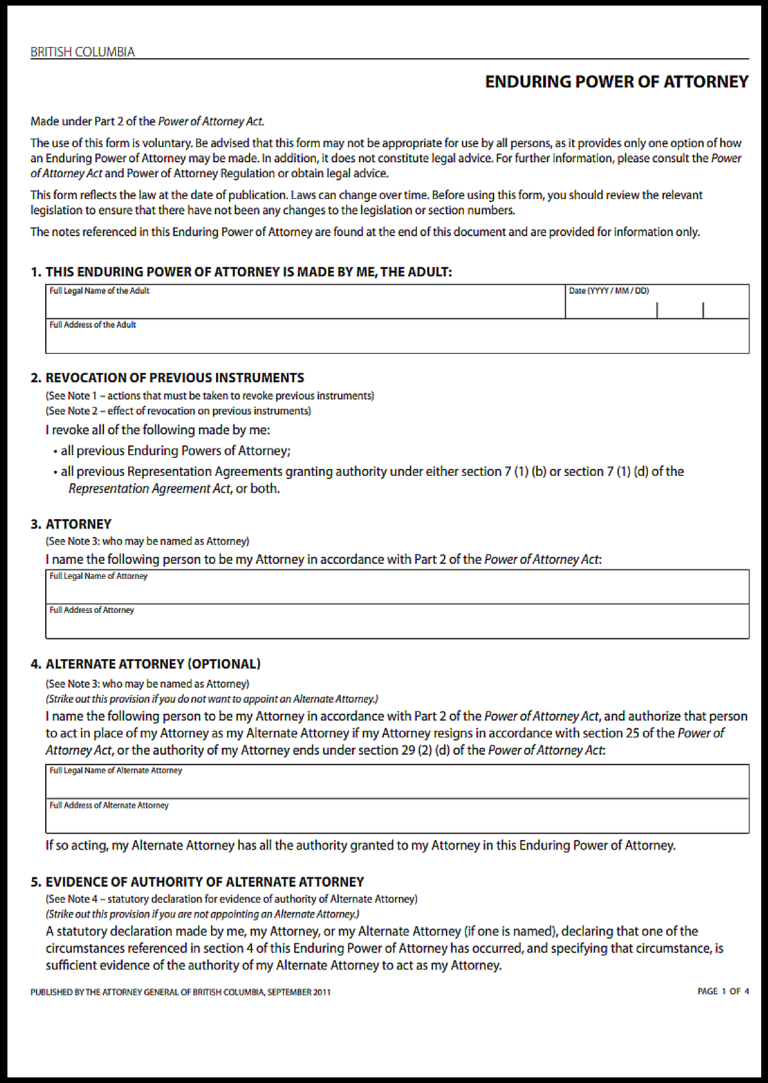
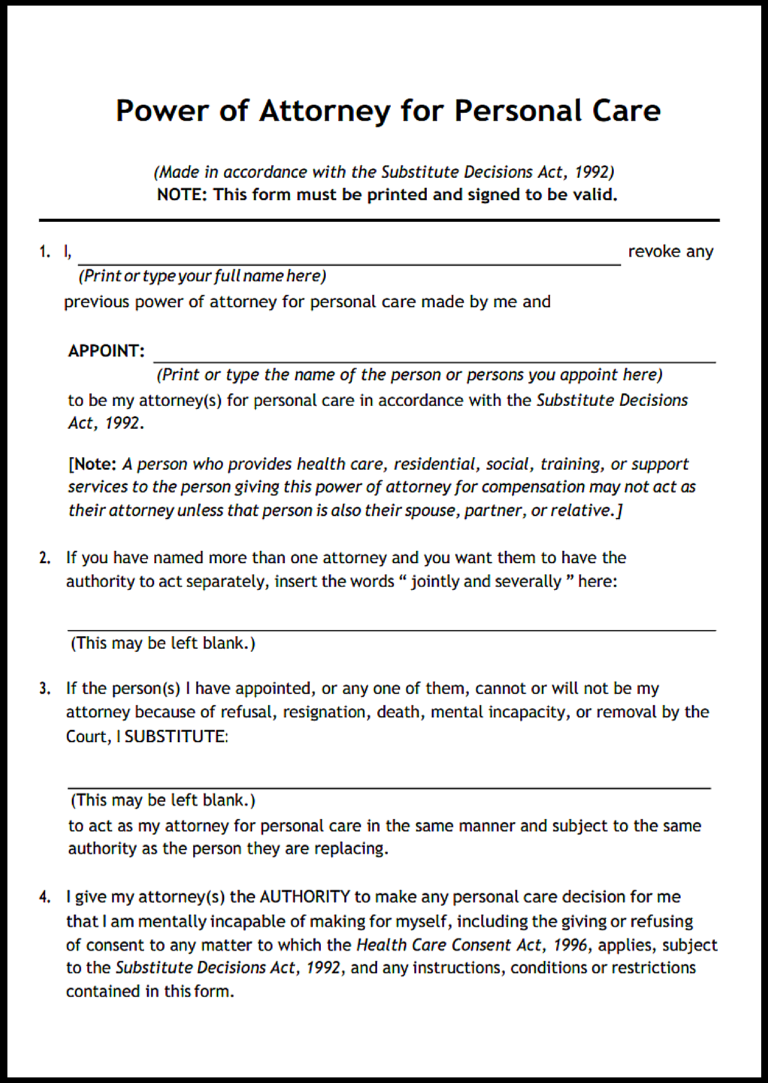
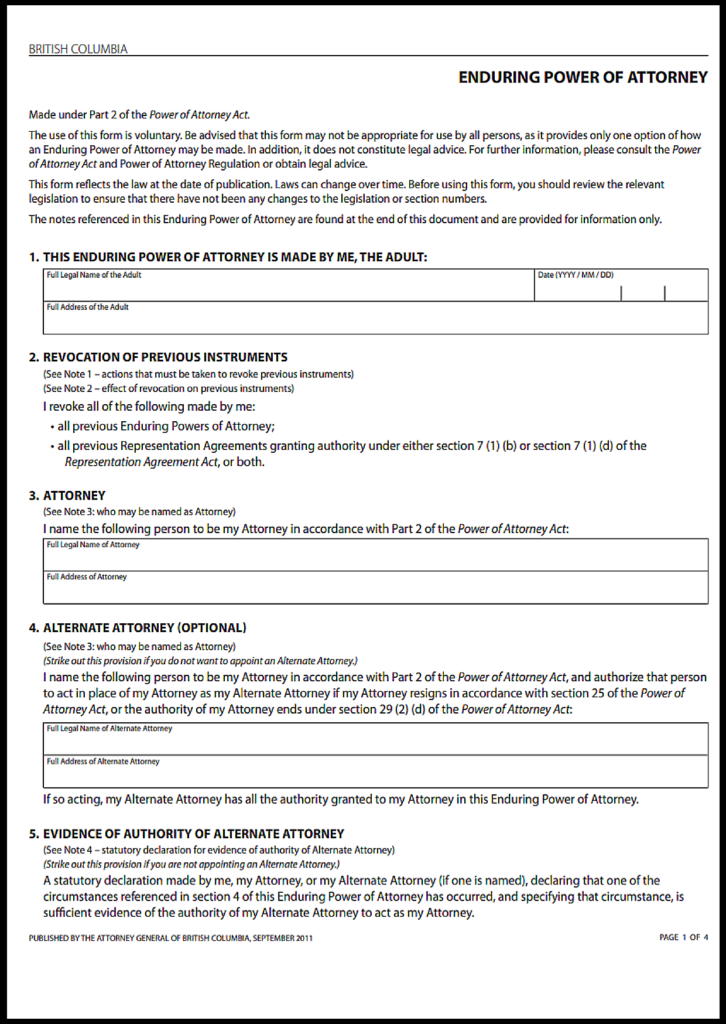
Free British Columbia Power of Attorney Template
Below is a simple, general-purpose British Columbia Power of Attorney Form you can use for basic financial authority.
Critical British Columbia Power of Attorney Form Rules Most People Miss
| Topic / Issue | British Columbia Legal Rule | Governing Statute |
|---|---|---|
| Governing Legislation | Powers of Attorney in British Columbia are governed entirely under provincial law. | Power of Attorney Act, RSBC 1996, c 370 |
| Federal Status | No federal statute governs the creation of a Power of Attorney in British Columbia. | Power of Attorney Act, RSBC 1996, c 370 |
| 2011 Legislative Overhaul | Major reforms effective September 1, 2011 created modern rules for Enduring Powers of Attorney, attorney duties, and capacity standards. | Power of Attorney Act, RSBC 1996, c 370 |
| Remote Visual Witnessing | Since January 1, 2023, remote visual witnessing involving a BC lawyer or BC notary public is permanently allowed under the regulation amendments. | Power of Attorney Regulation (B.C. Reg. 20/2011) |
| Who Can Legally Sign | The adult may sign personally, or another person may sign on the adult’s behalf if the adult is physically incapable and directly instructs the signing while present. Attorneys must also sign before acting. | Power of Attorney Act, RSBC 1996, c 370, s. 16(1), 16(2), 17(1) |
| Witness Requirements | Two witnesses are normally required, but only one witness is needed if that witness is a BC lawyer or BC notary public. | Power of Attorney Act, RSBC 1996, c 370, s. 16(1), 16(4) |
| Disqualified Witnesses | An attorney, their spouse, child, parent, or employee/agent generally cannot act as a witness. | Power of Attorney Act, RSBC 1996, c 370, s. 16(6) |
| Notarization Requirements | Notarization is not required for general validity, but real estate matters must comply with Land Title Act execution rules before a BC lawyer or BC notary. | Land Title Act, RSBC 1996, c 250, Part 5 & s. 51 |
| Affidavit of Execution Requirement | If two non-lawyer/non-notary witnesses are used for land matters, a Land Title Office-approved Affidavit of Execution must be sworn. | Land Title Act, RSBC 1996, c 250, Part 5 & s. 51 |
| Adult Capacity Rules | The adult must satisfy a statutory 6-part understanding test covering assets, obligations, attorney powers, risks of misuse, and revocation rights. | Power of Attorney Act, s. 12 |
| Attorney Age Requirement | Attorneys must be at least 19 years old unless acting as a financial institution or Public Guardian and Trustee. | Power of Attorney Act, s. 16(6.1); Age of Majority Act, RSBC 1996, c 7, s. 1 |
| Expiration Rules | A Power of Attorney remains valid until revoked or until the adult dies. | No statutory requirement — governed by common law principles |
| Mandatory Enduring Clause | An Enduring Power of Attorney must contain wording confirming authority continues after incapacity or only begins upon incapacity. | Power of Attorney Act, RSBC 1996, c 370, s. 14 |
| Standard Enduring Clause Wording | The Act provides standard wording confirming the attorney’s authority continues despite later incapability. | Power of Attorney Act, RSBC 1996, c 370, s. 14 |
| Filing Requirements | No government registration is required for ordinary financial use. | Power of Attorney Act, RSBC 1996, c 370 |
| Land Registration Requirement | A Power of Attorney used for land transactions must be registered with the LTSA. | Land Title Act, RSBC 1996, c 250, s. 51 |
| Invalid Without Attorney Signature | An attorney cannot legally act until they sign the document before witnesses. | Power of Attorney Act, RSBC 1996, c 370, s. 17(1) |
| Invalid Witness Problem | Using a prohibited witness can invalidate the execution of the document. | Power of Attorney Act, RSBC 1996, c 370, s. 16(6) |
| Healthcare Decisions Not Allowed | A BC Power of Attorney cannot authorize healthcare or personal care decisions. Those powers belong under a Representation Agreement. | Representation Agreement Act, RSBC 1996, c 405, s. 7; Power of Attorney Act, RSBC 1996, c 370, s. 9(2) |
| Unique BC Rule | British Columbia uniquely requires attorneys themselves to formally sign before gaining authority. | Power of Attorney Act, RSBC 1996, c 370, s. 17(1) |
One of the biggest surprises for many people in British Columbia is that a Power of Attorney is not fully usable until the attorney signs it too. In many provinces, only the adult’s signature matters, but BC has stricter execution rules. This catches families off guard during emergencies because banks or land title offices may reject the document entirely if the attorney never signed properly.
The witness rules are equally important. A witness who is related to the attorney can invalidate the execution, even if everyone believed the document was prepared correctly. Problems like this often surface only after someone loses mental capacity, when fixing mistakes becomes much harder and more expensive.
Another major rule unique to British Columbia is the complete separation between financial powers and healthcare decisions. A POA cannot authorize medical care decisions at all. Those instructions must be placed in a separate Representation Agreement.
These legal details matter because one missing signature or invalid witness can delay access to finances, property transactions, or urgent decision-making when families need help most. Download the free British Columbia Power of Attorney Form template to help create your document correctly from the start.
People preparing broader estate and inheritance records may also review the British Columbia will template or the estate planning laws guide for British Columbia when organizing long-term legal and financial arrangements.
Types of Power of Attorney in British Columbia
Understanding the different types is critical. Choosing the wrong one can make your document useless when you need it most.
General Power of Attorney
A General POA gives broad authority over your financial and legal matters.
Key point: It ends if you become mentally incapable.
Best used for:
- Temporary help
- Managing finances while traveling
- Short-term delegation
Enduring Power of Attorney (Most Important)
An Enduring POA continues even if you lose mental capacity.
Under British Columbia law, this is the most important type for long-term planning.
Common uses:
- Aging individuals planning ahead
- People with health concerns
- Anyone wanting full protection
Without an enduring clause, your POA becomes invalid if you lose capacity.
Limited (Specific) Power of Attorney
This type gives authority for a specific task or time period.
Examples:
- Selling a home
- Managing one bank account
- Signing documents for a single transaction
It ends once the task is completed.
Springing Power of Attorney
A Springing POA only becomes active when a specific condition is met.
Usually:
- When you are declared mentally incapable
Important note:
The triggering condition must be clearly defined, or the document may not work properly.
Power of Attorney vs Representation Agreement
Many people confuse these two documents.
| Feature | Power of Attorney |
Representation Agreement
|
| Purpose | Financial & legal decisions |
Health & personal care
|
| Covers money matters | Yes | No |
| Covers medical decisions | No | Yes |
| Used for incapacity planning | Yes | Yes |
In most estate planning situations, individuals should have both documents to be fully protected.
Different situations may require different legal authority forms depending on the responsibilities being assigned. Financial matters are often handled through a financial power of attorney template, while healthcare-related decisions may involve a medical power of attorney document for treatment and care instructions.
Real-Life Use Cases in British Columbia
A Power of Attorney is not just a legal document—it solves real-life problems.
Here are common situations:
- A young professional travels abroad for a year and needs someone to manage bills and banking
- An elderly parent plans ahead in case of dementia or illness
- A homeowner authorizes someone to sell property while they are unavailable
- A business owner assigns temporary financial control during absence
- Someone recovering from surgery needs short-term help managing finances
These everyday examples show why POA is essential for adults of all ages.
A power of attorney form allows an individual to give someone else legal authority to handle financial or personal matters on their behalf. To understand how these legal decision-making documents fit into broader planning arrangements, you can review the British Columbia power of attorney guide together with the guide on getting power of attorney in British Columbia.
Key Elements of a Valid Power of Attorney
To be legally valid in British Columbia, your POA must include certain elements.
Identification of Parties
You must clearly state:
- Your full legal name (the “adult”)
- The attorney’s full legal name
Errors here can cause rejection by banks or institutions.
Scope of Authority
Define what the attorney can do:
- General authority (broad control)
- Specific powers (limited tasks)
This may include:
- Banking
- Property management
- Paying bills
Enduring Clause (if applicable)
For an Enduring POA, specific wording must confirm that the authority continues after incapacity.
Without this clause, the document becomes invalid when it’s needed most.
Signatures and Witnessing
Under British Columbia law:
- The document must be signed while you are mentally capable
- It must be witnessed properly
Witness rules:
- Witness must be 19+
- Cannot be your attorney or their spouse
Improper witnessing can make the document legally invalid.
Effective Date
You must state when the POA becomes active:
- Immediately
- On a specific date
- Upon a condition (springing)
How to Create or Complete a Power of Attorney
Creating a POA is straightforward if you follow the right steps:
- Choose the correct type first
- Select a trustworthy attorney
- Clearly define their powers
- Sign the document with proper witnessing
- Store it safely and share copies with relevant people
Keep it simple, but accurate.
Legal Overview in British Columbia
Power of Attorney in BC is governed by the Power of Attorney Act.
Under British Columbia law:
- You must be mentally capable when signing
- Enduring POAs must include specific wording
- Financial institutions may request their own forms
- Attorneys must act in your best interest
While not legally required, many people choose to consult a lawyer or notary—especially for complex situations.
Common Mistakes to Avoid
Many POAs fail because of simple mistakes.
Avoid these:
- Choosing a General POA when you need an Enduring POA
- Not including an enduring clause
- Selecting someone unreliable or unprepared
- Forgetting to update the document after major life changes
- Improper witnessing
Even one of these errors can make your POA unusable.
Choosing the Right Power of Attorney
Use this quick guide to decide:
| Situation | Best Option |
| Long-term protection | Enduring POA |
| Short-term help | General POA |
| One specific task | Limited POA |
| Activation on incapacity | Springing POA |
| Health decisions needed |
Representation Agreement
|
FAQs About Power of Attorney in British Columbia
Do I need a lawyer to make a POA in BC?
No. You can create one yourself. However, legal advice is recommended for complex situations.
What happens if I don’t have a POA?
Your family may need to go to court to manage your finances, which can be slow and expensive.
Can I have more than one attorney?
Yes. You can appoint multiple attorneys to act jointly or separately.
When does a POA end?
It ends when you revoke it, pass away, or (for general POA) lose mental capacity.
Can a POA be revoked or changed?
Yes, as long as you are mentally capable.
Is a POA valid across Canada?
Generally yes, but some institutions may require additional verification.
What’s the difference between an enduring POA and a will?
A POA works while you are alive. A will only takes effect after death.