Ontario Divorce Agreement Template (Free PDF & Word)
An Ontario Divorce Agreement is often prepared after spouses have decided how they’ll deal with property, support, parenting arrangements, and other financial matters before moving forward with a divorce. In Ontario, these agreements are treated as domestic contracts, and the Family Law Act requires them to be in writing, signed, and witnessed, which is where many self-prepared or generic Canadian templates fall short.
It’s not unusual for an agreement that looked complete at the time of signing to be questioned later in the Ontario Superior Court of Justice because it wasn’t properly executed or important financial information wasn’t fully disclosed. Whether you’re trying to settle matters cooperatively or reduce the likelihood of future disputes, this page explains how an Ontario Divorce Agreement works, what it should include, and the provincial requirements that can affect its enforceability.
Ontario Divorce Agreement Free Template
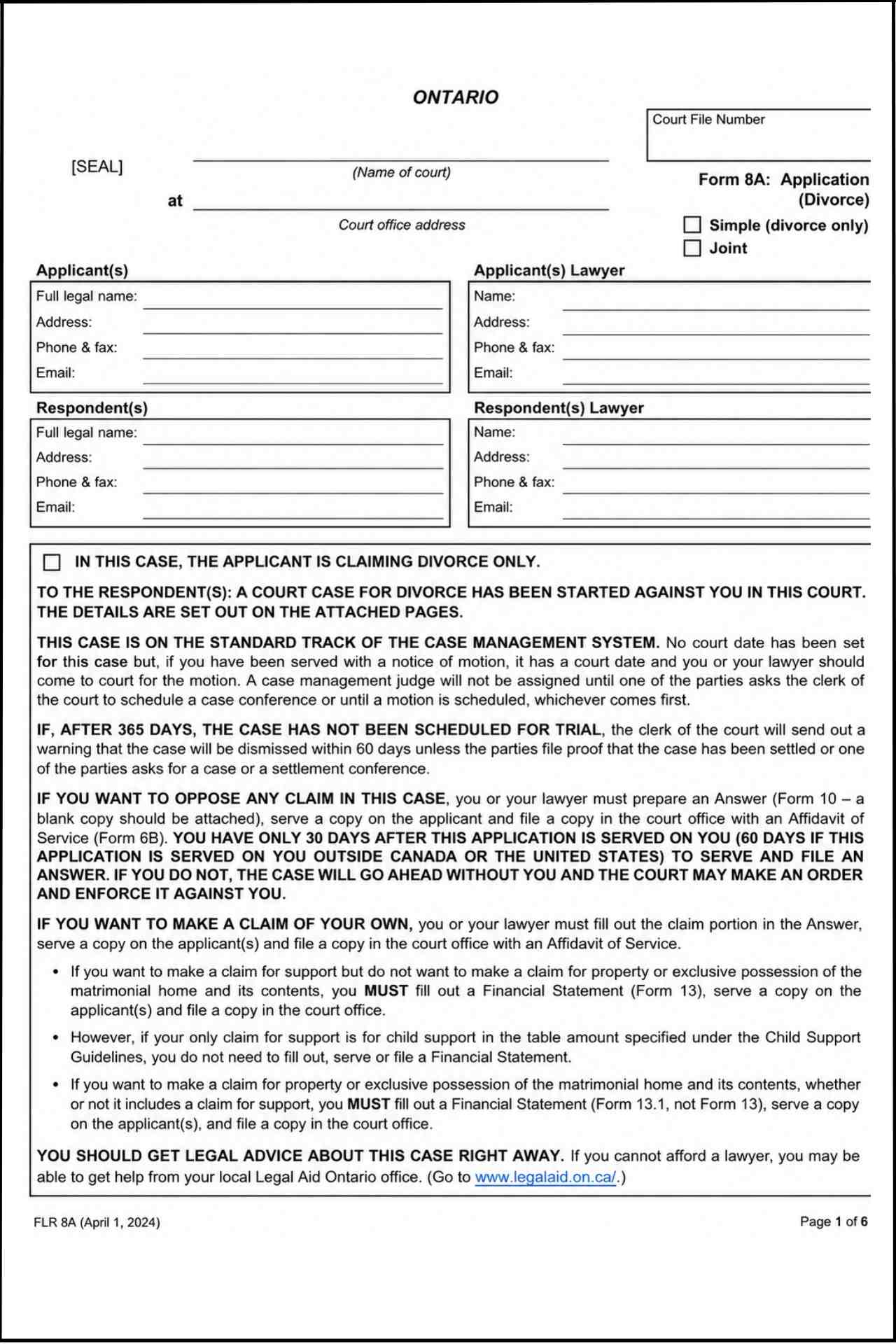
What Can an Ontario Divorce Agreement Cover?
An Ontario Divorce Agreement can address nearly every financial and parenting issue arising from the end of a marriage. Instead of resolving each issue separately, spouses can include all agreed terms in one comprehensive legal document.
The contents depend on each family’s circumstances. Couples without children may focus mainly on property and financial matters, while parents often devote considerable attention to parenting responsibilities and support obligations.
Parenting arrangements and decision-making responsibility
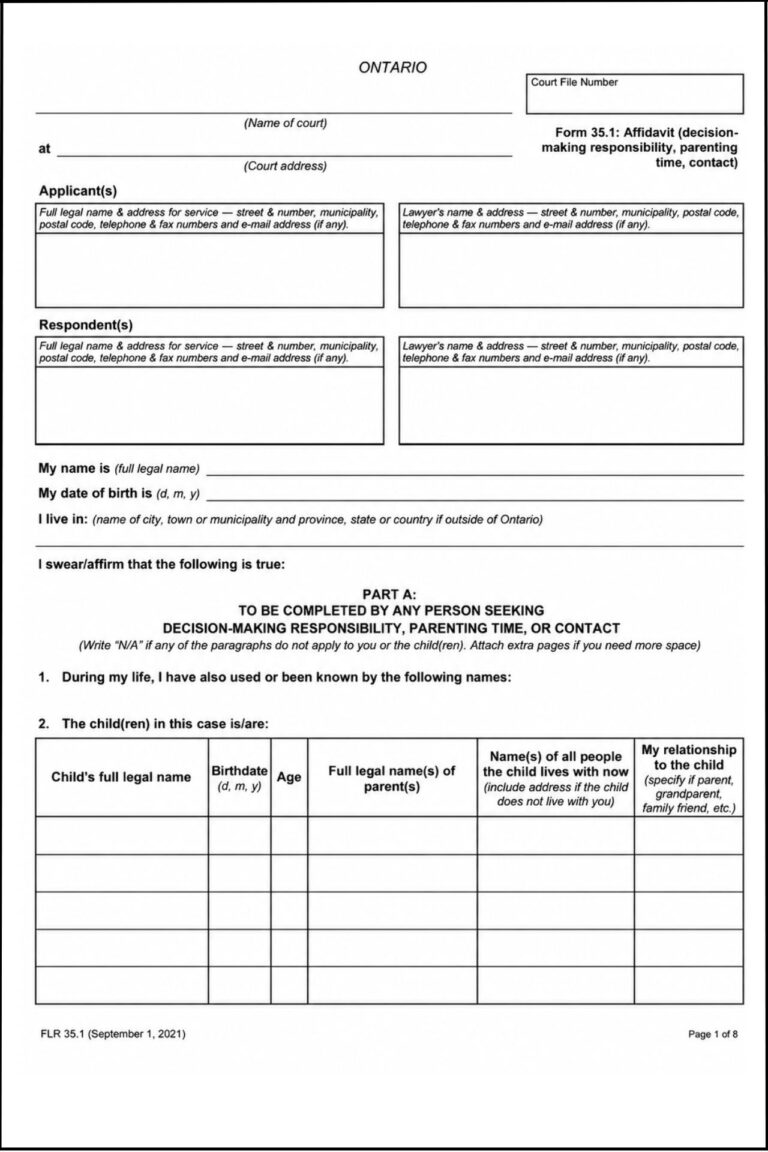
Following amendments to the Divorce Act and the Children’s Law Reform Act that came into effect on March 1, 2021, Ontario now uses the terms decision-making responsibility and parenting time instead of “custody” and “access.”
An Ontario Divorce Agreement should clearly identify who will make important decisions about the child’s education, healthcare, religion, and overall welfare. Parents may choose to share decision-making responsibilities or assign them to one parent, depending on their circumstances.
Using the correct legal terminology helps avoid unnecessary confusion if the agreement is later reviewed by the court.
Parenting time schedules
A detailed parenting schedule helps establish consistency for both parents and children after separation. Clearly defining parenting time reduces misunderstandings and makes future arrangements easier to follow.
Many Ontario Divorce Agreements include provisions covering:
- Weekly parenting schedules.
- Weekends.
- School holidays.
- Summer vacations.
- Birthdays.
- Transportation arrangements.
For example, parents in Hamilton may agree that the children live primarily with one parent during the school week while spending alternate weekends with the other parent.
Child support
Child support provisions explain how children’s financial needs will be met following separation. An Ontario Divorce Agreement commonly identifies payment amounts, payment dates, responsibility for special expenses, and circumstances that may require future adjustments.
If spouses agree to child support that differs from the Child Support Guidelines (O. Reg. 391/97), the agreement must satisfy the court that reasonable arrangements have been made for the child’s support. Otherwise, under section 11(1)(b) of the Divorce Act, a judge may refuse to grant the Divorce Order.
Spousal support
An Ontario Divorce Agreement may also establish whether one spouse will pay financial support to the other after separation.
The agreement usually explains:
- The amount payable.
- Payment frequency.
- When payments begin.
- Circumstances that may change or end support.
Each family’s financial situation is different, so these provisions should reflect the spouses’ individual circumstances.
Equalization of net family property
Ontario does not automatically divide every asset equally after separation. Instead, the province uses an equalization of net family property system.
Under this approach, each spouse calculates the increase in their net worth during the marriage. If one spouse accumulated significantly more wealth, they may owe an equalization payment to the other spouse rather than transferring ownership of individual assets.
Matrimonial home arrangements
The matrimonial home receives special treatment under Ontario family law. An Ontario Divorce Agreement often explains:
- Who will remain in the home.
- Whether the property will be sold.
- How sale proceeds will be divided.
- Responsibility for mortgage and household expenses until the sale.
Carefully drafting this section helps reduce future disputes over one of the family’s most valuable assets.
Division of assets
The agreement should clearly describe how significant assets will be divided between the spouses.
These assets often include:
- Bank accounts.
- Investments.
- Vehicles.
- Household furnishings.
- Business interests.
- Personal valuables.
Providing detailed descriptions helps prevent disagreements after the divorce has been finalized.
Division of debts
An Ontario Divorce Agreement should also allocate responsibility for existing financial obligations.
Common examples include:
- Credit cards.
- Personal loans.
- Lines of credit.
- Tax liabilities.
- Joint household debts.
Resolving debt issues at the same time as property matters creates a more complete financial settlement.
Pension and retirement benefits
Retirement savings may represent a significant part of the family’s financial resources. Where pensions, RRSPs, or similar investments are included in the settlement, the Ontario Divorce Agreement should clearly explain how those interests will be addressed.
Complex retirement arrangements may require additional professional advice depending on the spouses’ financial circumstances.
Future dispute resolution
Many Ontario Divorce Agreements include a clause explaining how future disagreements will be handled. Establishing a process for resolving disputes can help avoid unnecessary court proceedings if issues arise after the agreement has been signed.
Although Ontario law does not prescribe specific wording for these clauses, including one often encourages cooperation and provides a practical framework for resolving future disagreements.
Legal Requirements for a Valid Ontario Divorce Agreement
An Ontario Divorce Agreement must satisfy several legal requirements before it can be relied upon as a valid domestic contract. Meeting these requirements reduces the likelihood of future challenges and helps ensure the agreement remains enforceable.
Who can enter into the agreement
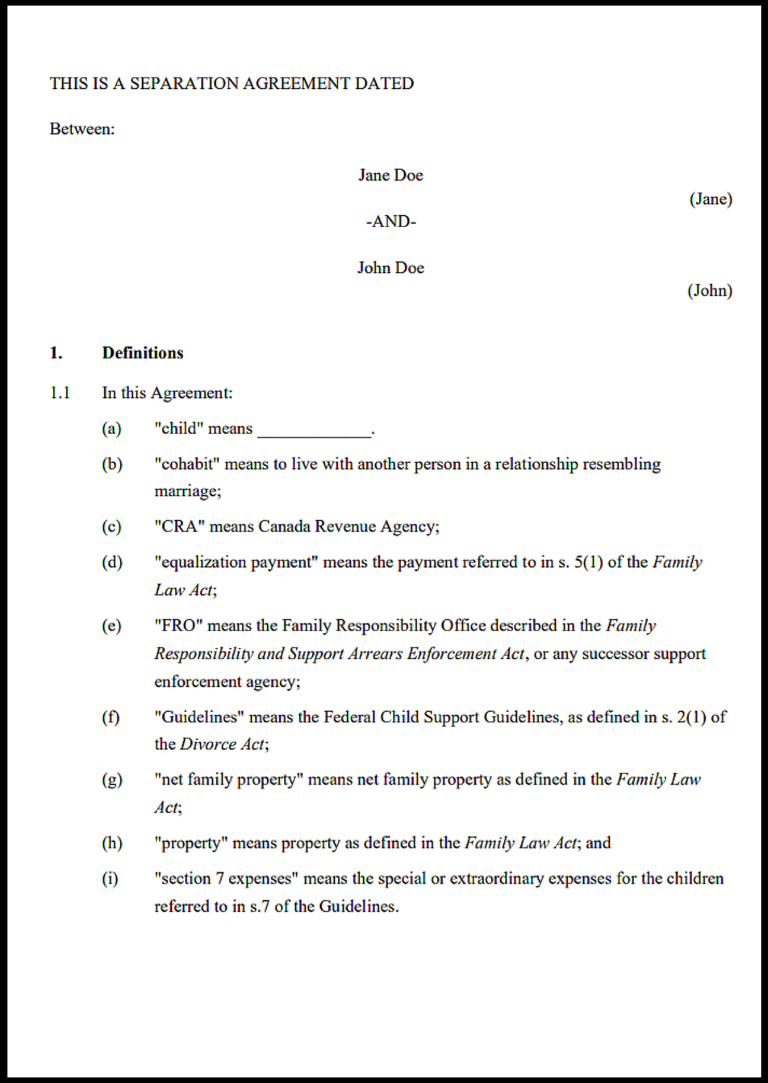
Under section 54 of the Family Law Act, spouses and former spouses who have cohabited and are living separate and apart may enter into an Ontario Divorce Agreement.
The agreement allows the parties to resolve financial and parenting issues privately before or during divorce proceedings.
Witness requirements
Ontario law requires a domestic contract to be in writing, signed by both spouses, and witnessed.
Under section 55(1) of the Family Law Act, each signature should normally be witnessed by an independent adult. Failing to satisfy these execution requirements may affect the agreement’s enforceability.
Independent legal advice
Although Ontario law does not require every spouse to obtain independent legal advice before signing an Ontario Divorce Agreement, doing so is strongly recommended.
Independent legal advice helps demonstrate that each spouse understood the agreement and signed voluntarily. If one spouse later argues they did not understand the agreement, the court may consider this under section 56(4)(b) of the Family Law Act.
Independent legal advice is especially valuable when:
- Significant assets are involved.
- One spouse owns a business.
- Parenting arrangements are complex.
- Large support obligations are being negotiated.
Financial disclosure obligations
Before signing the agreement, both spouses should exchange complete financial information.
This typically includes:
- Income details.
- Bank accounts.
- Investments.
- Real estate.
- Debts.
- Other significant financial obligations.
Incomplete disclosure remains one of the most common reasons an Ontario Divorce Agreement is challenged in court.
Legal capacity to sign
Each spouse must have the legal capacity to enter into the agreement.
Under section 55(2) of the Family Law Act, a minor may enter into a Separation Agreement with court approval before it becomes effective. Mental capacity continues to be governed by common law principles.
What Happens If One Spouse Does Not Follow the Agreement?
An Ontario Divorce Agreement is a legally binding contract once it has been properly signed and witnessed. If one spouse does not comply with its terms, the other spouse may ask the court to enforce the agreement.
Court enforcement
If a spouse fails to meet their obligations, the agreement may be filed with the Ontario Superior Court of Justice to obtain the enforceable effect of a court order.
Registering the agreement with the court
An Ontario Divorce Agreement does not have to be registered to be legally valid. However, filing it with the court can make enforcement easier, especially where support obligations are involved.
Enforcement through the Family Responsibility Office
After the agreement is filed with the court, eligible child support and spousal support provisions are automatically filed with the Family Responsibility Office (FRO). The FRO is responsible for collecting and enforcing support payments.
When a court may set aside the agreement
Under section 56(4) of the Family Law Act, a court may set aside all or part of an Ontario Divorce Agreement if:
- A spouse failed to disclose significant assets, debts, or liabilities.
- A spouse did not understand the nature or consequences of the agreement.
- The agreement was not properly signed and witnessed.
Do You Need a Lawyer for an Ontario Divorce Agreement?
You are not legally required to hire a lawyer to prepare an Ontario Divorce Agreement. However, obtaining legal advice before signing is strongly recommended, particularly when children, property, or support obligations are involved.
Situations where legal advice is strongly recommended
- Significant assets or investments.
- Parenting arrangements involving children.
- Child or spousal support issues.
- Business ownership.
- Complex financial matters.
Simple versus complex divorce agreements
If both spouses agree on every issue, preparing an Ontario Divorce Agreement is generally more straightforward. Where there are disagreements about parenting, property, or support, legal advice can help ensure the agreement reflects each party’s rights and obligations.
Why independent legal advice helps protect both parties
Independent legal advice helps show that each spouse understood the agreement before signing. If a spouse later argues they did not understand the agreement, the court may consider this under section 56(4)(b) of the Family Law Act.
Summary of Applicable Laws
| Topic | Rule | Governing Statute |
|---|---|---|
| Domestic contracts | Must be in writing, signed, and witnessed | Family Law Act, s.55 |
| Eligible parties | Spouses living separate and apart | Family Law Act, s.54 |
| Equalization claims | Six years after separation or two years after divorce | Family Law Act, s.7(3) |
| Parenting and child support | Child’s best interests prevail | Family Law Act, s.56(1) |
| Divorce proceedings | Divorce Orders | Divorce Act |
| Filing procedure | Court filing requirements | Family Law Rules, O. Reg. 114/99 |
Common Mistakes That Can Make an Ontario Divorce Agreement Invalid
Failing to provide full financial disclosure
A spouse who hides significant assets, debts, or liabilities risks having the agreement set aside by the court.
Using outdated parenting terminology
Current Ontario law uses the terms decision-making responsibility and parenting time instead of custody and access.
Not properly signing or witnessing the agreement
An Ontario Divorce Agreement must be in writing, signed by both spouses, and witnessed in accordance with section 55(1) of the Family Law Act.
Ignoring the child’s best interests
A court may refuse to enforce parenting or child support provisions that are not in the child’s best interests.
Skipping independent legal advice
Although not mandatory, independent legal advice helps reduce the likelihood of future legal challenges.
Ontario Divorce Agreement vs Divorce Order
Key differences
An Ontario Divorce Agreement settles issues such as property division, parenting arrangements, and support. A Divorce Order legally ends the marriage.
When each document is required
An Ontario Divorce Agreement is typically prepared before applying for divorce. A Divorce Order is required to legally dissolve the marriage.
How they work together
Many couples first complete an Ontario Divorce Agreement to resolve outstanding issues before applying for an uncontested Divorce Order.
Ontario Rules That Make Divorce Agreements Different from Other Provinces
Equalization of net family property
Ontario uses an equalization of net family property system rather than automatically dividing assets equally between spouses.
Special treatment of the matrimonial home
The matrimonial home has unique legal treatment under the Family Law Act, making it different from most other assets.
Property rights of common-law partners
Unlike some other Canadian provinces, Ontario does not give common-law partners the same statutory property division rights as married spouses under the Family Law Act.
Interaction between federal and provincial family laws
Ontario Divorce Agreements operate under both provincial and federal legislation. The Family Law Act governs domestic contracts and property matters, while the Divorce Act governs the legal divorce process and related parenting and support orders.
Frequently Asked Questions
Is an Ontario Divorce Agreement legally binding?
Yes. An Ontario Divorce Agreement becomes legally binding once it is properly prepared, signed, and witnessed in accordance with Ontario law.
Does an Ontario Divorce Agreement end a marriage?
No. An Ontario Divorce Agreement resolves issues arising from separation, but only a Divorce Order issued under the Divorce Act legally ends the marriage.
Can an Ontario Divorce Agreement be changed later?
Yes. Both spouses may agree to amend the agreement in writing. In certain circumstances, a court may also set aside or vary parts of the agreement where permitted by law.
Is independent legal advice mandatory?
No. Ontario law does not require independent legal advice, but obtaining it is strongly recommended because it helps show that both spouses understood the agreement before signing.
Can child support be different from the Child Support Guidelines?
Yes. If the agreed amount differs from the Child Support Guidelines, the court must be satisfied that reasonable arrangements have been made before granting a Divorce Order.
How do I file an Ontario Divorce Agreement with the court?
An Ontario Divorce Agreement may be filed with the Ontario Superior Court of Justice. Once filed, eligible child and spousal support provisions are automatically filed with the Family Responsibility Office for enforcement.