Free Bill of Sale Requirements Alberta Template Guide
Bill of Sale Requirements Alberta are often ignored, but they play a very important role in any buying or selling process. Whether you are selling a used car, electronics, or equipment, this document works as legal proof of the transaction.
In Alberta, a bill of sale helps both the buyer and seller stay protected. I have seen many Alberta buyers run into ownership and payment disputes simply because the bill of sale was missing important details or signatures. When people come to me after a problem starts, it is usually much harder and more expensive to prove what was actually agreed upon.
It clearly shows who owns the item and what terms were agreed upon. Without it, disputes can become difficult to handle.
Last Updated: August 2026
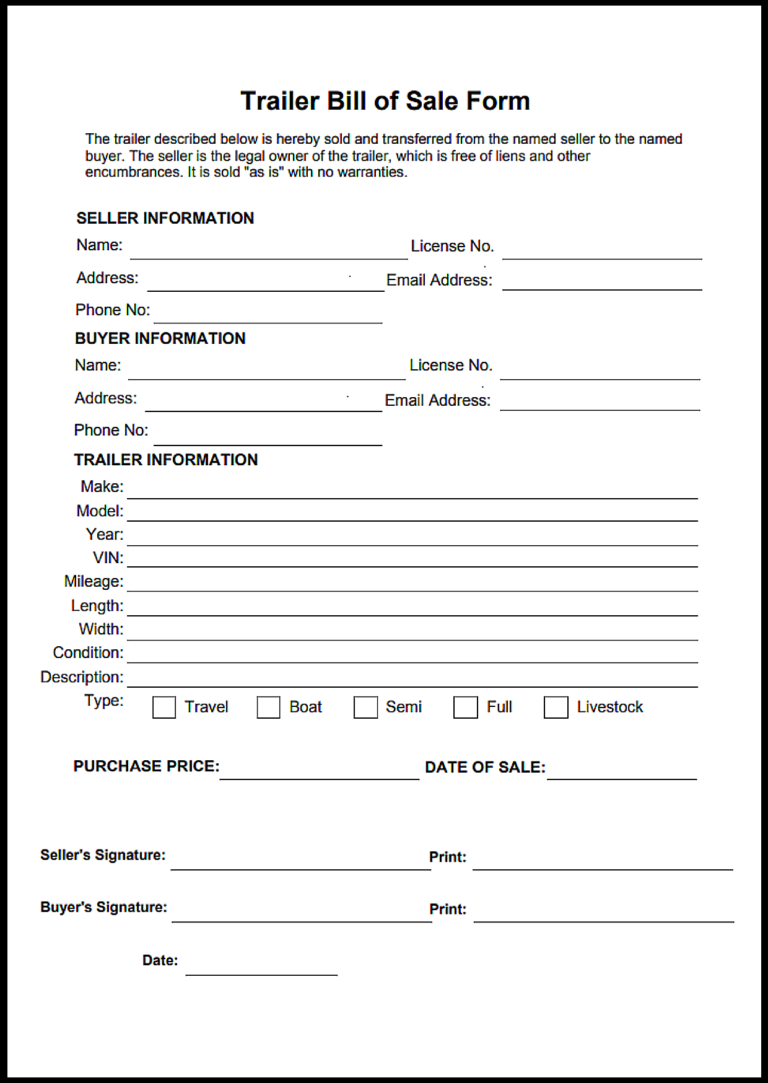
Free Bill of Sale Requirements Alberta Template
Alberta Bill of Sale Legal Rules You Should Not Ignore
| Topic / Issue | Alberta Legal Rule | Governing Statute |
|---|---|---|
| Main law for bills of sale | Alberta bills of sale are mainly governed by provincial sale and contract laws. | Sale of Goods Act, RSA 2000, c S-2 |
| Consumer protection for dealer vehicle sales | Automotive business sales must follow Alberta consumer protection and disclosure rules. | Consumer Protection Act, RSA 2000, c C-26.3 |
| Security interest registration | Financing interests connected to a bill of sale are governed through Alberta’s PPSA system. | Personal Property Security Act (PPSA), RSA 2000, c P-7 |
| Federal marine vessel rule | Registered marine vessels may also fall under federal shipping laws. | Canada Shipping Act, 2001 |
| Jurisdiction | Most Alberta bill of sale transactions are governed provincially. | Alberta provincial jurisdiction |
| Recent amendments | Alberta updated vehicle sales disclosure requirements in 2018. | Consumer Protection Act updates |
| Who can sign | The seller must sign, and the buyer should sign to acknowledge terms and warranties. | Alberta vehicle registration guidelines |
| Witness requirement | Witnesses are not legally required for standard private sales. | Common law principles |
| Witness for PPR affidavit | A witness is required if an Affidavit of Execution is used for Personal Property Registry registration. | Alberta PPR registration requirements |
| Notarization | Notarization is generally not required unless connected to certain PPSA registrations. | Common law principles |
| Age and legal capacity | Parties must generally be at least 18 years old and legally competent to contract. | Age of Majority Act, s. 1 |
| Vehicle registration deadline | Buyers using an existing licence plate must register the vehicle within 14 days. | Operator Licensing and Vehicle Control Regulation, s. 86 |
| Mandatory dealer disclosure | Licensed dealers must disclose VIN, vehicle details, total cost, and known damage history. | Automotive Business Regulation, s. 31.1 |
| Private contract status | Most bills of sale remain private contracts between buyer and seller. | Alberta contract law principles |
| Registry requirement for vehicles | Vehicle bills of sale must be presented to an Alberta registry agent during ownership transfer. | Traffic Safety Act framework |
| Financing protection | Sellers financing buyers should register their interest with Alberta’s Personal Property Registry. | Personal Property Security Act (PPSA) |
| Missing VIN problem | Vehicle bills of sale without a valid 17-digit VIN may not work for ownership transfer. | Traffic Safety Act |
| Illegal property sales | Bills of sale involving illegal property are automatically void. | Common law principles |
| Wrong property description | If the property description is fundamentally incorrect, the contract may be voided. | Sale of Goods Act, s. 15 |
| Alberta tax difference | Alberta bills of sale generally do not include Provincial Sales Tax calculations. | Alberta provincial tax framework |
| Government standard template | Registry Agents may reject incomplete vehicle bills of sale that do not match Alberta’s recommended template structure. | Service Alberta administrative policy |
One important Alberta rule many people miss is the strict VIN requirement for vehicle bills of sale. If the VIN is missing, incomplete, or incorrect, registry offices may refuse to transfer ownership. Even one wrong digit can create registration delays and legal confusion later.
Another major point is Alberta’s dealer disclosure rules. Licensed automotive businesses must disclose important details like previous damage and vehicle history. This protects buyers from hidden problems and makes dealer transactions more transparent.
The Personal Property Registry (PPR) rules are also important in financed sales. If a seller allows installment payments but does not properly register their interest, they may lose legal protection if disputes happen later.
These rules matter in real life because a poorly prepared bill of sale can cause ownership disputes, rejected registrations, financial loss, or even court problems. Alberta also follows a stricter registry review process compared to many provinces, which is why accurate paperwork matters more than people expect.
Download the free Alberta Bill of Sale template to create a properly documented and legally safer transaction.
What Are Bill of Sale Requirements in Alberta?
Under Alberta law, there is no single rule that applies to every bill of sale. The requirements mainly depend on what type of item you are buying or selling. For example, vehicle sales have stricter rules compared to general goods.
However, in most private sale situations, certain details are expected so the document can be used as legal proof. A bill of sale becomes very important when you need to prove ownership, register a vehicle, or deal with insurance or tax matters.
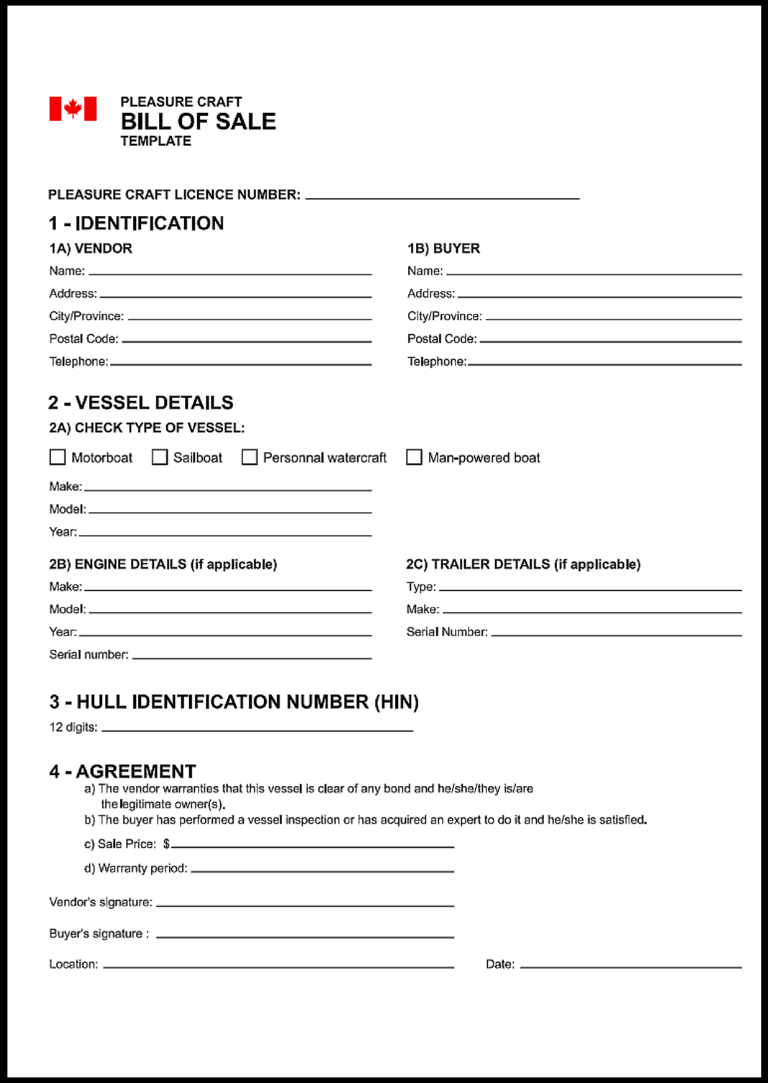
Understanding legal requirements is essential when using the Alberta bill of sale template. Whether you’re drafting a vehicle sale document or a boat bill of sale, each must include key details to be valid.
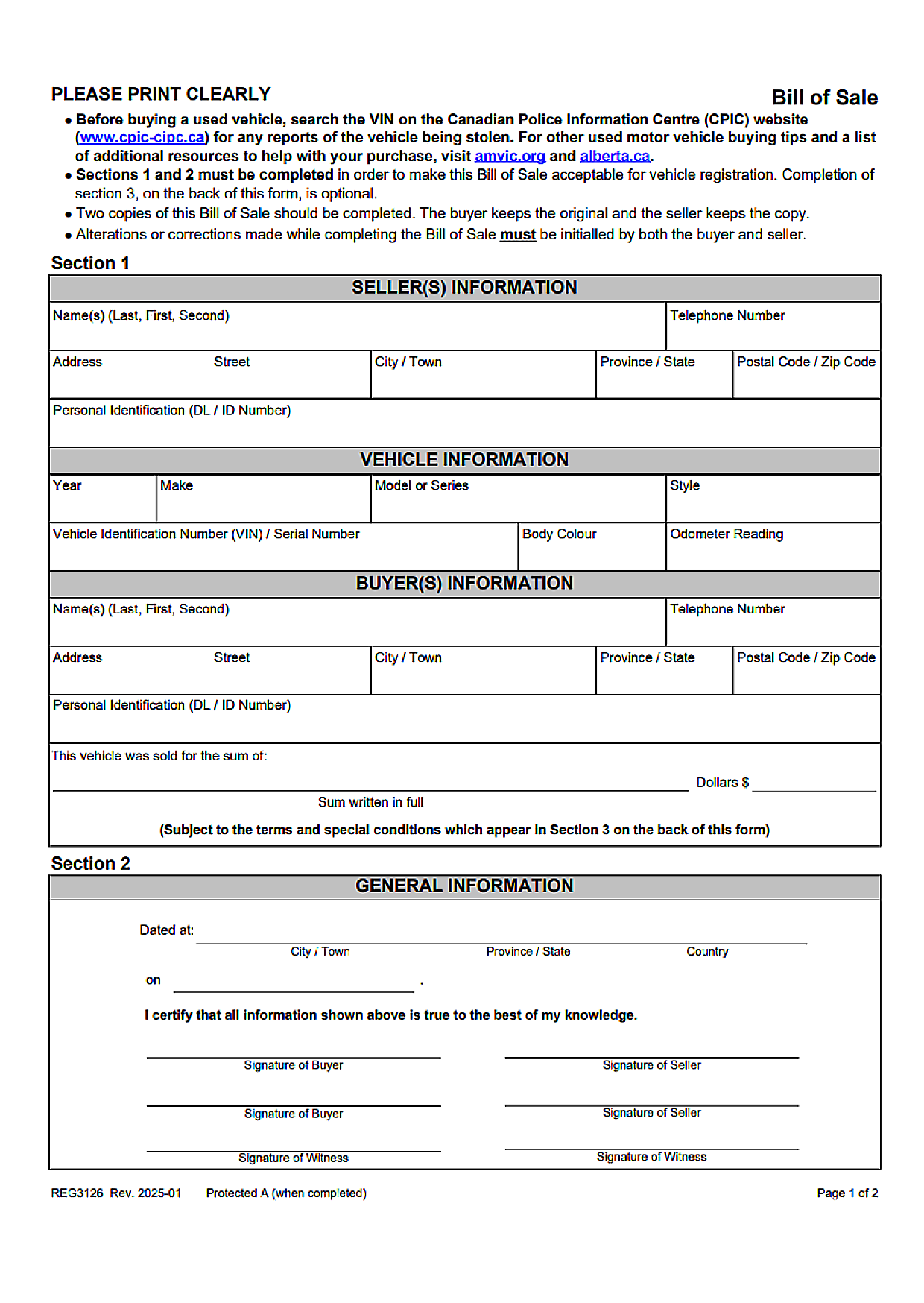
Mandatory Information You Must Include
A valid Alberta bill of sale must include specific details. These are not complicated, but missing them can cause problems later.
Buyer and Seller Details
The document must clearly identify both parties. This usually includes full legal names and addresses. Contact details are not mandatory but are recommended because they help in case any issue arises after the sale.
Description of the Item
The item description should be clear and detailed. You should include make, model, year, and any identifying number such as a serial number or VIN. Avoid vague descriptions because they can lead to confusion or disputes.
Sale Price and Payment Details
You must clearly mention the exact amount paid and the payment method used. If the payment is not completed, it should be clearly written whether it is partial or in installments.
Date of Sale
The date is very important because it shows when ownership was transferred. It is also used for tax and registration purposes, especially for vehicles.
Signatures
Both buyer and seller must sign the bill of sale. This confirms that both parties agree to the terms. A witness is not required under Alberta law, but having one adds extra protection.
Special Requirements for Vehicle Bills of Sale
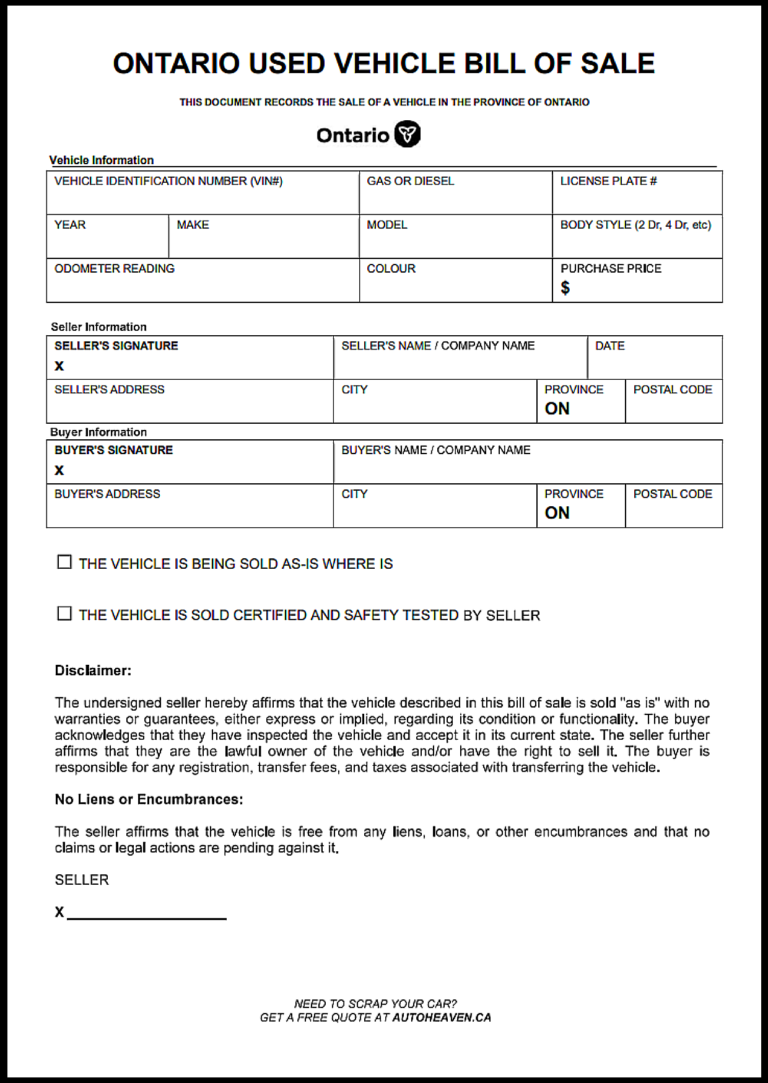
Vehicle sales in Alberta require more accurate details compared to regular items. This is because the document is used for registration at a registry office.
Vehicle Identification Number (VIN)
The VIN is mandatory for all vehicle transactions. It helps identify the exact vehicle and is required during registration.
Odometer Reading
The mileage at the time of sale should be written clearly. This protects both parties and prevents fraud-related disputes.
“As-Is” Condition Clause
Most private vehicle sales are done on an “as-is” basis. This means the seller is not responsible for future repairs. However, sellers are still expected to be honest about known issues.
Registration Requirement
The buyer must submit the bill of sale when registering the vehicle. If details are missing or incorrect, registration can be rejected.
If you are preparing your own document, refer to the step-by-step writing guide. You may also want to confirm whether the document is required in your case.
Important vehicle requirements at a glance:
| Requirement | Why It Matters |
| VIN |
Identifies the vehicle
|
| Odometer |
Shows condition and usage
|
| Sale Price | Acts as the primary financial record |
| Signatures |
Confirms legal agreement
|
Is a Bill of Sale Legally Required in Alberta?
A bill of sale is not always legally required for every transaction. However, in many situations, it becomes practically necessary.
It is strongly required for vehicle sales and highly recommended for high-value items or business transactions. In case of disputes, it acts as legal evidence in court.
In simple terms, even if it is not mandatory, you should always use one to stay safe.
How to Write a Valid Bill of Sale (Step-by-Step)
Writing a bill of sale is simple if you follow a clear structure. Start by adding the details of both buyer and seller. Then include a proper description of the item being sold.
After that, mention the sale price and payment method. Clearly state the condition of the item, especially if it is sold “as-is.” Finally, include the date and signatures of both parties.
Quick steps:
- Add buyer and seller details
- Write full item description
- Mention price and payment method
- Include condition of item
- Add date and signatures
Keeping the language simple and clear is always the best approach.
Common Mistakes That Can Make It Invalid
Many people make small mistakes that later cause big problems. Missing information or unclear wording can make the bill of sale weak as legal proof.
Common issues include missing signatures, incomplete item details, or not including a VIN for vehicles. Verbal agreements that are not written down can also create disputes.
Avoid these mistakes:
- Missing signatures
- Wrong or incomplete details
- No VIN in vehicle sale
- Vague descriptions
- Relying only on verbal agreement
These errors can lead to registration rejection or legal disputes.
Real-Life Example (Why It Matters)
Consider a situation where someone buys a used car without a proper bill of sale. Everything seems fine at first, but later the seller claims that full payment was not received.
Since there is no written proof, the buyer struggles to prove ownership or payment. This can lead to legal trouble and financial loss.
A simple bill of sale could have avoided the entire issue.
Tax and Financial Implications in Alberta
Tax rules in Alberta can vary depending on the type of sale. In most private sales, GST is not charged. For private vehicle sales, buyers do not pay sales tax during registration, only the registry fee.
The bill of sale also helps determine the fair market value of the item, which is important for insurance and financial records.
|
Transaction Type
|
Tax Impact |
| Private goods sale | Usually no GST |
| Vehicle purchase |
Tax may apply at registration
|
| Insurance claim |
Value proof required
|
When You Should Definitely Use a Bill of Sale
Even if it is not legally required, there are situations where using a bill of sale is highly recommended.
It should always be used when buying or selling a car, expensive electronics, or machinery. It is also important in any private party transaction where money is involved.
Best use cases:
- Car buying or selling
- Expensive item transactions
- Equipment transfers
- Private sales
Even for smaller deals, having written proof adds safety.